September 8, 2026
How Much Should a House Cleaning Cost in 2026
How Much Should a House Cleaning Cost. Learn how much a house cleaning should cost in 2026, with real pricing ranges by home size, service type, and tips

Monday, May 4, 2026
Boost your cleaning business with our 8 free cleaning schedule checklist templates. Download daily, weekly, monthly, and commercial lists to standardize jobs.
.png)
You’ve trained the crew, loaded the vans, and filled the calendar. Then two houses on the same route get two different versions of your service.
One tech catches switch plates, edges, and buildup around fixtures. Another handles the obvious surfaces and leaves. One client rebooks on the spot. The next asks why the baseboards were missed again. Owners often blame hiring first. In the field, the bigger problem is usually scope control.
A weak cleaning schedule checklist creates that problem. It tells a cleaner what room to enter, but not what level of service was sold, how long the task should take, which extras were approved, or what finished work should look like. Once the business starts growing, that gap hits margins fast. Clients already see cleaning as recurring work that takes time and planning, and the American Cleaning Institute’s guide to building a household cleaning schedule reflects how structured those expectations already are. They are not buying vague effort. They are buying a defined result.
A strategic cleaning schedule checklist proves its value by doing more than guiding the crew. It sets the service scope your office can quote, gives sales a clear way to explain price differences, and creates a record of what was promised before the job starts. When that checklist is tied to estimating and follow-up, it stops being a clipboard document and starts working as an operating system.
That connection matters. A checklist can feed directly into line items, service tiers, and add-on options inside your estimating process, which makes it easier to justify pricing without long back-and-forth calls. It also gives you a clean handoff from sales to operations. If you are tightening that process, this guide on scheduling software for cleaning businesses pairs well with the checklist systems below.
The 8 templates in this article are built to help cleaning business owners standardize service, train faster, sell optional work with less friction, and protect profit as volume increases.
The daily checklist is where most cleaning companies either build discipline or create chaos.
For recurring residential work, this template should be tight, repeatable, and impossible to misread. Room-by-room is often the most effective approach: kitchen, bathrooms, bedrooms, living areas, floors, and touchpoints. Each line item should describe an action, not a vague intention. “Sanitize sink and faucet” works. “Clean bathroom” doesn’t.
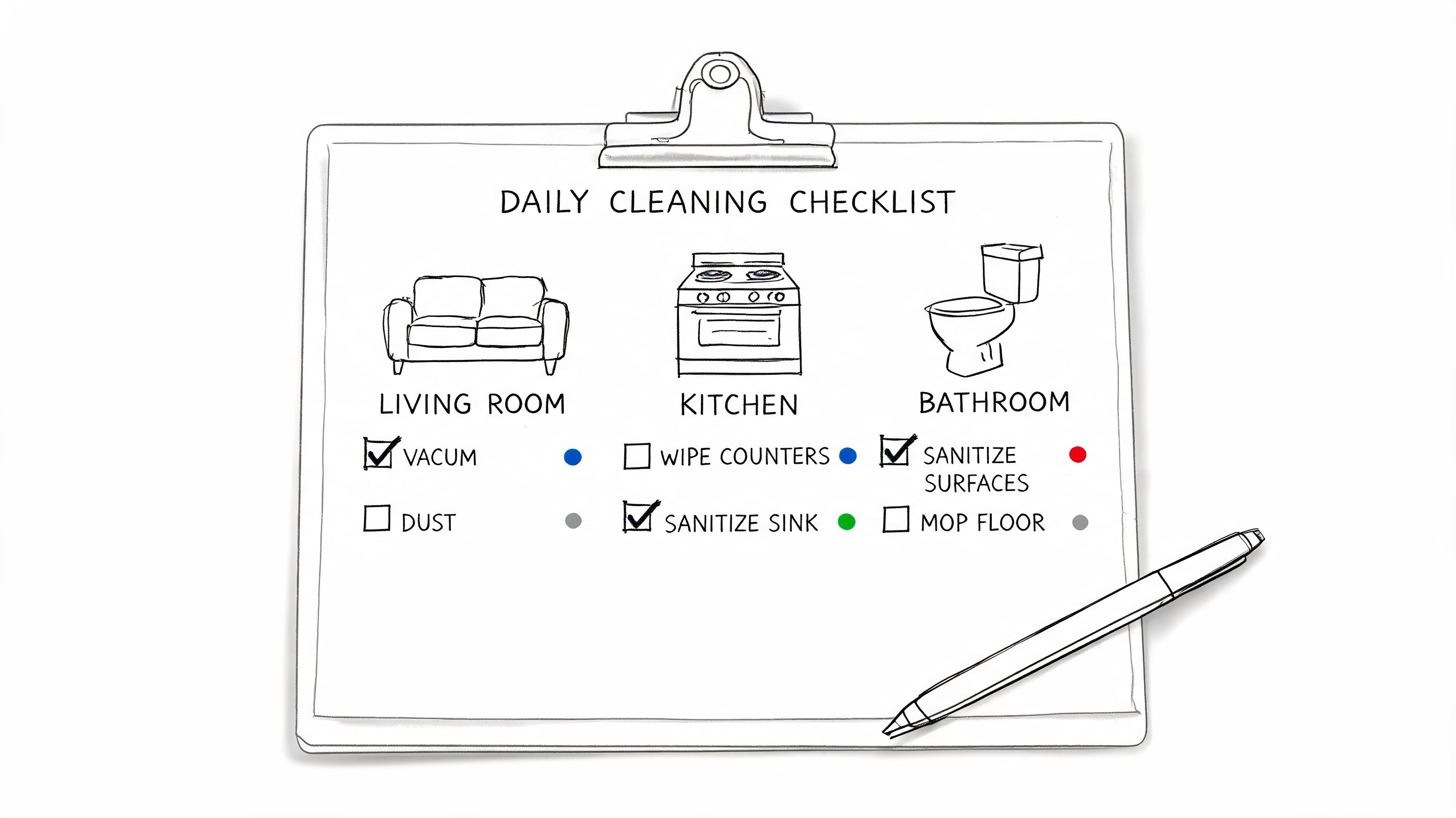
Most homeowners already think in structured routines, and cleaning systems commonly break work into daily, weekly, monthly, and seasonal blocks, with many people separating morning and evening tasks to spread effort more evenly, as described in this overview of structured cleaning schedule printables. That matters for your business because your clients aren’t buying “cleaning” in the abstract. They’re comparing your promise to the routine they’d run themselves.
Use three service levels. Basic. Standard. Premium. If your team carries one universal list, they’ll either over-clean low-margin jobs or under-deliver on premium ones.
Practical rule: If a cleaner can’t tell in five seconds whether a task is included, the checklist is too loose.
Tie the checklist to your service definitions and your cleaning scheduling software workflow. That way the daily list matches the estimate, the route, and the invoice. If you use Estimatty, build area definitions into the estimate logic so the crew’s checklist reflects what the client purchased, not what someone in the office assumed.
A weekly cleaning schedule checklist solves a problem the daily version can’t. It tells your business when things happen.
Without that schedule, teams bunch up detail work on the wrong days, skip less visible tasks, and lose margin on recurring clients because every visit turns into a mini deep clean. Weekly structure fixes that. It assigns recurring jobs, spreads heavier work across the calendar, and makes capacity visible before you accept another booking.
The broader cleaning market is projected to expand by USD 41.66 billion at a CAGR of 6.1% from 2025 to 2030, according to this cleaning services market forecast from Technavio. Growth attracts competitors. Operators who schedule by memory get sloppy first.
A good weekly template doesn’t cram every possible task into every day. It distributes labor with intent. Bathrooms and kitchen-heavy jobs may cluster early in the week. Larger recurring homes may land on the same route days to reduce windshield time. Detail tasks can fill slower slots instead of disrupting your best production windows.
Try a layout like this:
What fails is overcommitting your calendar and pretending crews can absorb surprises. They can’t. Every missed arrival window damages trust twice. Once with the client, once with the team that now has to rush.
Use the weekly plan with your best cleaning business software stack so the office only sends estimates your actual capacity can support. A weekly checklist isn’t just for operations. It protects sales from promising work you can’t deliver cleanly.
A client walks through after a standard recurring clean and says, "Can you also wipe the baseboards and get the fan blades next time?" If that work is not separated on paper, your team usually does one of two bad things. They either squeeze it in and give away labor, or they say no awkwardly and make the service feel inconsistent.
A monthly deep-cleaning checklist fixes that. It draws a hard service boundary between maintenance cleaning and detail work that takes longer, requires different pacing, and deserves different pricing. Baseboards, vents, ceiling fans, behind toilets, grout attention, reachable trim, and appliance detailing belong on their own checklist with their own production targets.
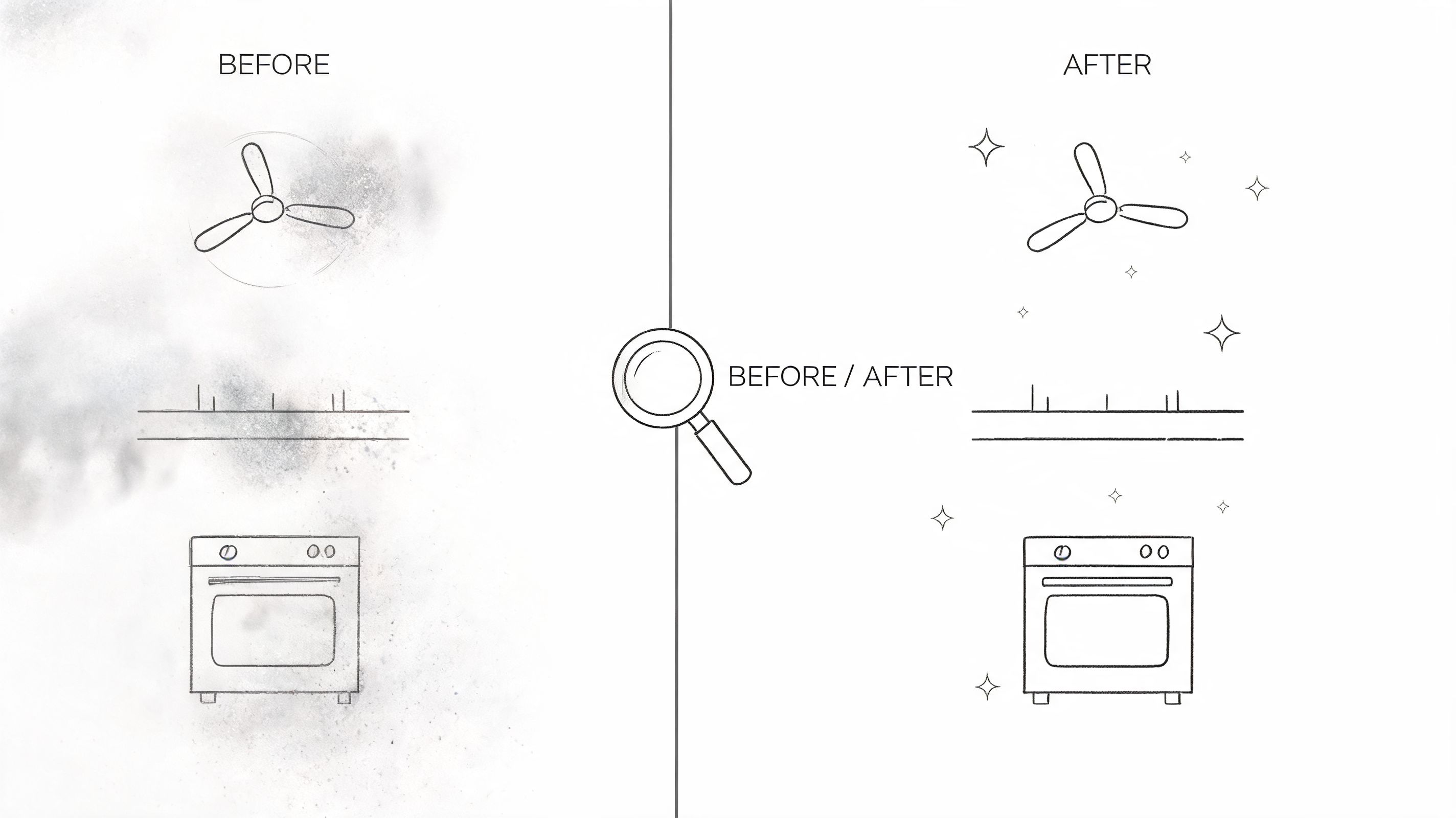
You do not need a generic printable sheet here. You need an operational document that sales, office staff, and field crews all interpret the same way. That is where margin gets protected. The checklist defines what is included, estimation rules define how it is priced, and your sales process turns that scope into a clean upgrade instead of a last-minute favor.
Monthly deep cleaning should cover the tasks clients notice immediately but that would drag down a normal recurring appointment if crews tried to do them every visit.
The trade-off is simple. The more detail you include, the more exact your production standards need to be. If "appliance detailing" means one thing to the estimator and another to the crew, the job goes long and the client still may not get what they expected.
Monthly work should feel visibly different from standard maintenance the moment the client walks in.
That visible difference supports the price. It also gives your team a clearer upsell path. A defined monthly checklist can be attached to quoting rules inside AI estimating software for cleaning businesses, so room count, task intensity, and add-ons are priced consistently before the crew arrives.
Use a separate pricing profile and connect it to your deep cleaning price list structure. Estimatty can then handle estimates in a way that reflects the extra labor, the room count, and the scope differences. That also makes upsells easier because the add-on isn’t improvised by a receptionist. It’s already defined in the checklist.
Seasonal checklists are where smart operators stop waiting for clients to ask.
Most cleaning businesses know spring matters. Fewer turn that demand into a repeatable system. A seasonal cleaning schedule checklist lets you package what changes across the year and present it before the client starts shopping around. Window tracks, post-holiday reset work, patio transitions, mud-season entry cleanup, and indoor detail work all belong here.
The house cleaning app market is projected to reach USD 500 million in 2025 with a 15% CAGR, and to-do task list functionality is the dominating segment in most apps, according to this house cleaning app market report. That tells me clients and teams both expect scheduled, trackable, mobile-friendly task lists now. Seasonal work shouldn’t live in sticky notes or office memory.
Present it as preventive and timely, not optional fluff. Clients respond better when the checklist is tied to what their home is dealing with right now.
Examples that work in the field:
They wait for a client complaint or a casual mention. By then, someone else may already have the job.
Plug your seasonal logic into AI estimate software for cleaning businesses so the estimate flow recommends timely add-ons based on current conditions and service history. That turns your checklist into a sales prompt. It also keeps your team from improvising seasonal offers inconsistently across calls and web leads.
Residential habits don’t transfer cleanly into commercial work. That’s where many expansion attempts stall.
A commercial cleaning schedule checklist has to account for access rules, tenant expectations, restocking, shift timing, security, traffic patterns, and inspection. An office suite, retail store, clinic waiting area, and warehouse all need different language on the checklist because “clean” means different things in each environment.
The strongest commercial operators rely on usage patterns and digital tracking, not memory. The same Technavio-backed market analysis notes that more profitable cleaning operations use data-driven approaches to identify patterns and optimize schedules, while software tools automate collection and pattern identification in ways manual tracking can’t match. That’s a major operational difference between a company that grows into commercial and one that takes on commercial jobs.
Break the checklist into zones and responsibilities. Don’t hand crews one long list with mixed priorities.
In commercial work, documentation matters almost as much as execution.
Clients often have multiple decision-makers, and complaints can travel through property managers, office admins, or franchise supervisors. A checklist that includes inspection and sign-off reduces disputes because it records what your crew completed.
If you’re moving into this segment, align the checklist with your office cleaning business setup process. Also create separate commercial estimate rules in Estimatty so your pricing reflects service windows, floor type, access complexity, and recurring frequency. Commercial jobs don’t stay profitable when they’re estimated like houses.
This is the checklist that keeps a good client from leaving over something small.
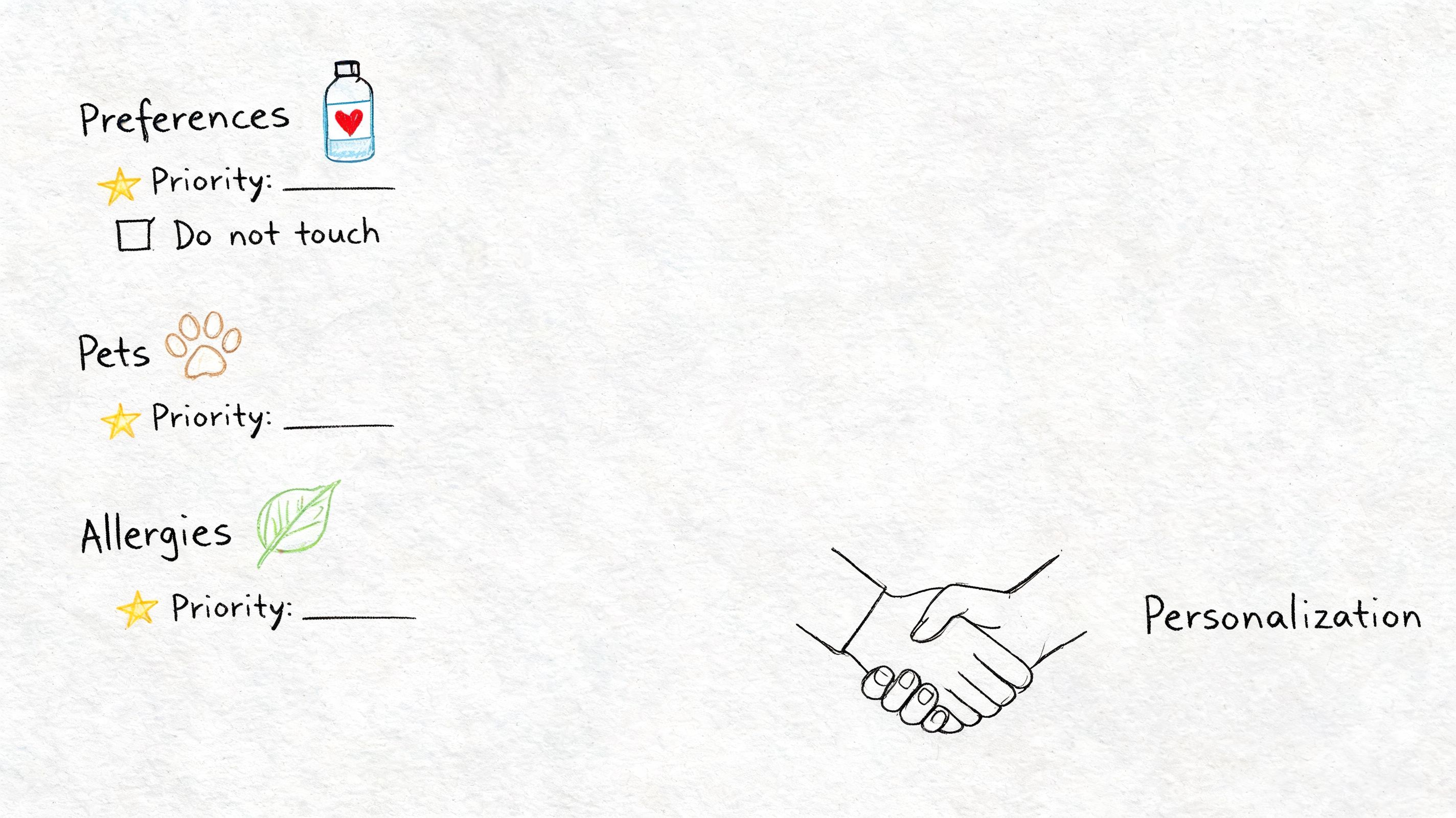
Some clients care most about kitchen sanitation. Others hate streaks on stainless steel, need fragrance-free products, or want pet hair addressed first. A standardized checklist creates consistency, but a client-customized cleaning schedule checklist is what creates loyalty. It tells the client, “We didn’t just assign a crew. We paid attention.”
A lot of public checklist content still leans heavily toward homeowner DIY routines and generic weekly task lists, while leaving a gap around customization for professional service businesses, as noted in this discussion of the home-cleaning checklist content gap. That gap is real. Professional cleaners deal with service scope, client preferences, property variables, and estimate accuracy at the same time.
Keep the customization structured. If you let it turn into a freeform note field, your crews will miss things.
Use a first-visit profile that records:
Too much customization slows production if you don’t separate preferences from actual scope. Not every preference deserves a new line item. Some belong in crew notes, not in the checklist core.
The winning approach is a standard base checklist plus a short client-specific overlay. Store those preferences where your office and field team can both see them. If Estimatty handles the estimate, add key requests to the estimate record so the client hears those needs acknowledged early, not after the first cleaning.
Most owners think quality control starts with training. It doesn’t. It ends with inspection.
A post-service quality assurance checklist catches the misses that turn into refunds, re-cleans, and tense text messages. It should be completed before the client walkthrough or before the crew closes out the job. If your team marks work complete without that final pass, you’re trusting memory at the exact moment people are trying to leave fast.
Quality assurance should focus on outcomes the client can verify, not internal jargon.
A lot of cleaning businesses mention apps casually but don’t define how digital tools connect checklists, lead handling, and real-time notifications, which is part of the gap described in this article on home cleaning schedules for busy homes. On the ground, that missing connection matters. A QA checklist isn’t just a service document. It’s proof that the delivered work matched the estimated scope.
Checklists protect good cleaners from bad assumptions. They also protect owners from “we thought that was included.”
If you use Estimatty, make QA completion part of job closeout. That way the estimate, scope, and final verification sit in one chain of evidence. For premium clients, add photos and digital sign-off. Not every job needs that level of documentation, but the clients who do need it usually reveal themselves early.
A weak onboarding checklist costs you twice. First in mistakes. Then in turnover.
New hires don’t fail because they can’t mop or dust. They fail because nobody translated your company standard into a repeatable training path. Once you’ve hired through your usual channels or a recruiting platform like PipehireHRM for cleaning employee hiring, the onboarding checklist becomes your operating manual in action.
Show the training asset early:
The checklist should cover cleaning technique, chemical handling, client etiquette, lockup rules, tool care, time expectations, and issue escalation. It should also show how your estimates connect to execution. If the office sells one scope and the cleaner performs another, the root problem is usually onboarding.
A useful training checklist has stages, not one giant signoff page.
Your crew also needs to understand how estimates are created. When the office uses Estimatty, teach staff what details affect the estimate and what doesn’t. That reduces scope drift. It also helps cleaners flag upsell opportunities properly instead of making promises in the field.
For documentation language and process structure, it can help to compare your internal form against a general employee onboarding checklist. Then tailor it to cleaning realities. Access codes, breakables, pets, client communication, and property-specific standards all need a place.
| Template | Implementation complexity | Resource requirements | Expected outcomes | Ideal use cases | Key advantages |
|---|---|---|---|---|---|
| Daily Cleaning Checklist Template | Low, simple room-by-room checklist, easy to implement | Minimal, basic forms or digital checklist, short staff training | Consistent service delivery, accurate time estimates, fewer missed tasks | Recurring residential cleanings, solo cleaners, standard contracts | Standardization, fast adoption, improves billing accuracy |
| Weekly Cleaning Schedule Template | Medium, requires rotation logic and coordination | Moderate, scheduling tools, staff coordination, inventory tracking | Balanced workload, improved team efficiency, reduced burnout | Multi-location operations, franchises, mixed recurring and deep services | Even task distribution, better capacity planning |
| Monthly Deep Cleaning Checklist Template | Medium–High, detailed tasks, documentation and sign-off | High, skilled staff, longer appointment windows, specialty supplies | Revenue from upsells, premium service differentiation, marketing assets | Upselling existing clients, seasonal deep cleans, premium packages | Higher margins, visible before/after proof, client retention |
| Seasonal Cleaning Checklist Template | Medium, seasonal planning and marketing coordination | Moderate, seasonal equipment, marketing effort, flexible scheduling | Targeted seasonal revenue, timely service delivery, demand smoothing | Spring/fall campaigns, outdoor maintenance, holiday prep | Captures seasonal demand, enables bundled promotions |
| Commercial Property Cleaning Checklist Template | High, compliance, multi-shift and security coordination | High, commercial equipment, certifications, insurance, larger teams | Stable contracts, larger job sizes, predictable recurring revenue | Offices, retail spaces, warehouses, facility management | Higher margins, scalable contracts, diversified income |
| Client-Customized Cleaning Checklist Template | Medium–High, requires intake, personalization and updates | Moderate, consultation time, documentation system, tailored training | Increased client satisfaction, higher retention, ability to charge premiums | High‑end residential clients, pet/allergy accommodations, bespoke services | Strong differentiation, reduced complaints, loyalty building |
| Post-Service Quality Assurance Checklist Template | Medium, inspection workflows and documentation required | Moderate, time for final walkthrough, photo/timestamp tools, training | Fewer disputes, improved quality control, documented proof of work | Premium services, franchise QA, dispute-prone accounts | Reputation protection, accountability, reduced callbacks |
| Team Training and Onboarding Checklist Template | Medium, structured training tracks and sign-off processes | Moderate–High, trainer time, training modules, certification tracking | Consistent performance, fewer safety incidents, faster ramp-up | Growing teams, franchises, new hire onboarding | Ensures quality at scale, legal protection, faster productivity |
A cleaning schedule checklist isn’t admin work. It’s the operating system behind consistent delivery.
When owners treat checklists like printable paperwork, they get uneven results. Crews fill them out loosely, the office keeps separate notes, and clients hear one promise while the field team works from another. That disconnect creates the usual headaches: underpriced jobs, missed tasks, unnecessary callbacks, and upsells that never happen because nobody defined the trigger points.
The better approach is simple. Build each checklist around service scope first, then connect it to the estimate, the schedule, and the closeout. Daily templates protect recurring quality. Weekly templates protect capacity. Monthly and seasonal templates create revenue without inventing new offers every week. Customized client templates protect retention. QA and onboarding templates protect your reputation.
That’s also how you justify pricing. Clients don’t buy line items in isolation. They buy confidence that your company knows what’s included, when it happens, and how it’s verified. A detailed checklist gives your team a repeatable standard and gives your client a clearer reason to say yes. It turns “we clean homes” into a defined service product.
This is also where sales gets easier. If your checklist already defines standard clean, deep clean, seasonal extras, and client-specific adjustments, your estimate process stops depending on memory. Estimatty is one option that fits naturally here because it’s built to help cleaning businesses standardize estimates, capture job details, and present add-ons in a consistent way. That’s useful when you want your office, your website, and your phone coverage to speak the same operational language.
Use the templates above as working documents, not static forms. Review them when complaints repeat. Update them when a premium package expands. Tighten them when a crew keeps missing the same finish detail. And if you’re reworking your operations more broadly, it can help to borrow process discipline from other industries with something like a website redesign checklist, then adapt that same review mindset to service delivery.
The businesses that scale cleanly don’t just clean better. They define better, estimate better, and inspect better. The checklist is where all three start.
If you want your cleaning schedule checklist to do more than sit in a binder, take a look at Estimatty. It can help you turn defined service checklists into consistent estimates, cleaner handoffs, and more structured upsell opportunities without relying on voicemail, memory, or manual back-and-forth.