September 8, 2026
How Much Should a House Cleaning Cost in 2026
How Much Should a House Cleaning Cost. Learn how much a house cleaning should cost in 2026, with real pricing ranges by home size, service type, and tips

Tuesday, May 5, 2026
Build a profitable cleaning service price list. Our 2026 guide covers pricing models, sample rates, add-ons, and how to automate estimates with AI.
.png)
A lot of cleaning businesses lose jobs before they ever get a chance to clean the first bathroom.
It usually happens in the gap between inquiry and response. A prospect calls after work, fills out a form late at night, or sends a text asking for pricing on a home that doesn’t fit neatly into your old sheet. If your process depends on memory, callbacks, and rough math, you’re already slower than the company that answers with a clear estimate right away.
That’s why a cleaning service price list can’t just be a PDF or a note in your phone. It has to work like a system. It has to help you sell, protect your margin, handle weird jobs, and keep your team consistent. If it doesn’t do those things, it’s not a business tool. It’s a liability.
A weak price list creates two problems at the same time. It confuses the customer, and it puts pressure on you.
The customer wants a fast answer that feels fair. You want to avoid underpricing a filthy first clean, overpricing an easy recurring job, or giving one price on the phone and another after you see the home. When your pricing lives in your head, every inquiry becomes a judgment call. That doesn’t scale.
Most owners think of pricing as an operations task. It’s really a sales task.
If someone asks for an estimate at 9 PM and you tell them you’ll get back to them tomorrow, you’ve added friction. Another company may answer first with a clear estimate, explain the add-ons, and move the lead toward booking before you’ve even opened your laptop. That’s why your price list has to function as a response system, not just a reference sheet.
Practical rule: If a customer has to wait for basic pricing on a standard job, your process is working against your sales.
A static list also creates inconsistency. You price one home by bedroom count, another by square footage, and another by what “feels right.” Customers notice when pricing sounds improvised. Team members notice too, and then everyone starts making exceptions.
The strongest pricing systems do four jobs well:
That’s the difference between “our standard clean starts at…” and a working sales asset that closes jobs.
If you want to see what happens when instant estimating becomes part of the sales process, this case study on company sales doubling after instant estimates shows why speed matters so much in service businesses.
The owner who wins more profitable work usually isn’t the cheapest. It’s the one who answers clearly, quickly, and consistently.
A profitable cleaning business starts with three cost buckets: labor, supplies, and overhead. Get those wrong, and every quote that looks good on paper can lose money in the field.

Owners usually underestimate labor first. They use hourly wage and forget payroll taxes, paid travel, training time, callbacks, and the slower pace of a new hire. A cleaner paid $22 an hour can easily cost far more once those pieces are included.
Start with cost per productive hour, not cost per clocked hour. Productive hour means time spent cleaning on paying jobs. If a two-person team is on the clock for 8 hours but only cleans for 6.5, your pricing has to absorb the gap.
Use simple math:
Add those together and you have your floor. Profit gets added after that, not mixed in with guesswork.
A lot of small operators miss overhead because the charges are scattered across cards, subscriptions, and renewal notices. If you need a clean way to sort those hidden expenses, this guide to calculating overhead costs for service businesses does the job well.
Here is the practical test I use. If a standard clean brings in $180 and your true cost to deliver it is $145, you do not have a pricing problem alone. You have a system problem. One reschedule, one extra bathroom, or one callback wipes out the job's margin. That is why static price sheets fail. They rarely account for the conditions that change job cost.
Both matter.
Local research helps you see what customers are already trained to expect, but copying another company's menu is how owners inherit someone else's mistakes. You do not know their labor efficiency, retention rate, average home condition, or how often they discount to close.
Study competitors for structure first, price second. Look at how they separate recurring cleans from first-time cleans, what they exclude from base service, and how they charge for extras like pet hair, inside oven cleaning, or heavy buildup. That tells you how the market frames value and where margin is being protected.
For that side of local research, I like using tactics similar to optimizing SEO with competitor insights, because competitor analysis also shows how other cleaners package services, attract better-fit leads, and justify higher rates.
Then build your own pricing rules around your numbers.
If your average labor-loaded cost is high because you run insured teams, background checks, and tight scheduling, your prices should reflect that. If you serve larger homes with frequent deep-clean resets, your quoting system should increase automatically based on size, condition, and add-ons. That is the shift that matters. You are no longer publishing a static list and hoping it fits. You are building a pricing engine that uses your costs and your market position to produce accurate estimates fast.
That is how a price list turns into a system you can trust.
A homeowner fills out your quote form at 9:30 p.m. They want a price now, not a call tomorrow. If your pricing model cannot turn a few inputs into a quote you trust, the price list is not doing its job.

The right model does two things at once. It gives the customer a price they can understand, and it gives you a quote you can produce fast without giving away margin. That is why pricing model choice is really a systems decision, not just a math decision.
| Model | Best use | What works | What breaks |
|---|---|---|---|
| Hourly | Unpredictable jobs, partial cleans, unknown conditions | Easy to explain internally | Customers worry about time dragging |
| Flat-rate | Standard residential cleaning with clear scope | Simple for customers, easier to sell | Bad estimating hurts margin |
| Per-room | Homes with varied room counts and easy room categories | Easy to build menu logic | Large rooms and tiny rooms may price unfairly |
| Per-square-foot | Homes where size strongly affects labor | Consistent and scalable | Needs accurate intake data |
Hourly pricing protects you when the scope is fuzzy. It works for severe buildup, partial-service requests, and jobs where the customer cannot give reliable details.
It is also the hardest model to sell online.
Homeowners hear "$50 per hour per cleaner" and start worrying about how long the visit will take, whether two cleaners are faster or just more expensive, and what happens if the house is worse than expected. You may still need hourly pricing as a fallback rule, but it is a weak front-end sales model for routine residential work.
Flat-rate pricing is easier to close because the customer knows the number before the job starts. That certainty matters.
The problem is not the model. The problem is vague scope. If your flat rate covers "a 2 bed, 2 bath home" without adjusting for first-time condition, pet hair, extra bathrooms, or add-ons, you are effectively underpricing hard jobs and overpricing easy ones. Owners call that simple pricing. In practice, it is blunt pricing.
Per-room pricing works well when you want a menu customers can understand quickly. It also fits quote forms nicely because people usually know how many bedrooms and bathrooms they have.
The weakness is labor mismatch. One powder room is not equal to a primary bathroom with double vanity, shower glass, and heavy use. Kitchens are even worse. If you use per-room pricing, build category rules into it or you will end up with fair prices on paper and uneven margins in the field.
Per-square-foot pricing is strong because it scales well and translates cleanly into an automated quote flow. If larger homes generally take more labor in your business, square footage gives you a reliable base number to work from.
It still needs guardrails. Square footage alone misses condition, occupancy, pets, and service frequency. A 2,400 square foot home on weekly service is a different job from a 2,400 square foot first-time reset. The model works best when square footage sets the base and the rest of your rules handle the exceptions.
If you want examples of how owners structure those rate decisions by service type, this guide on how much to charge for cleaning services is a useful reference.
Customers buy clarity faster than they buy complexity.
The winning setup is often a primary model, usually flat-rate or per-square-foot, with clear exception rules layered on top. That is how static pricing becomes a pricing system. You stop forcing every job into one formula and start building quote logic that can handle real-world variation without manual back-and-forth.
Once the model is chosen, the job is to make your pricing easy to buy from. That means fewer vague options and more structure.
A strong cleaning service price list should answer three questions fast. What’s included, what changes the price, and what can the customer add without calling back for clarification?
The market already supports clear tiers. According to Service Agent’s 2026 residential cleaning pricing guide, standard cleaning for typical 2 to 3 bedroom homes ranges from $120 to $280 per visit, deep cleaning costs $200 to $600+ per visit, and move-in or move-out cleaning runs $250 to $700 per job. The same source lists professional company hourly rates at $45 to $75 per cleaner, per-room ranges such as $30 to $50 for standard bedrooms, $40 to $75 for bathrooms, and $70 to $100 for kitchens, plus square-foot pricing from $0.10 to $0.25 depending on service type.
That gives you a market-backed frame for service tiers.
A practical setup looks like this:
| Package | Best for | Pricing approach |
|---|---|---|
| Standard Refresh | Maintained homes on recurring service | Flat-rate or square footage base |
| Deep Clean Transformation | First-time cleans or homes with buildup | Premium over standard service |
| Move-In or Move-Out Ready | Empty or nearly empty homes with detailed scope | Separate package with stricter scope notes |
Don’t start with every exception. Start with your most common job.
For many residential companies, that’s recurring standard cleaning. Build a clean base price for a “normal” home in your target market, then define what that includes. Typical line items are kitchens, bathrooms, dusting, floors, trash, and exterior appliance wipe-downs. The customer should know what they’re getting without needing a follow-up explanation.
Then layer your higher-labor services on top. Deep cleaning should not be a vague promise of “more detail.” It should be a different package with different labor assumptions and a different price structure. The same goes for move-out work.
If you want examples of how companies separate standard and higher-detail work, this deep cleaning price list guide for cleaning businesses shows the type of structure that keeps scope tight.
Add-ons work best when they’re optional, specific, and easy to say yes to.
The same 2026 pricing source lists add-ons such as window cleaning at $3 to $8 per window, oven cleaning at $25 to $50, and refrigerator cleaning at $20 to $40. Those are useful because customers understand them immediately.
A clean add-on menu might include:
Recurring service should be easier to deliver than one-time service, but don’t slash rates blindly.
Use recurring pricing to reward consistency and reduce future labor strain. Weekly, biweekly, and monthly service can each have their own internal labor assumptions, but the customer-facing message should stay simple. Maintained homes cost less to service than neglected homes. That’s fair, easy to explain, and easy to defend.
Owner mindset: The purpose of a price list isn’t to cover every possible home on one page. It’s to make common jobs easy to buy and uncommon jobs easy to estimate.
Your final list should feel like a menu with guardrails, not a spreadsheet dumped on a customer.
Most pricing problems don’t come from the main rate. They come from the exceptions nobody wrote down.
A professional business needs written rules for small jobs, far-away jobs, and homes that are in much rougher condition than the customer described. Without those rules, you’ll keep making emotional decisions in the moment. Emotional pricing is where margins disappear.

You don’t need a legal document. You need clear policies your team can explain in one sentence.
Three rules matter most:
These rules protect both sides. The customer knows what changes the estimate. Your team knows when to apply an adjustment.
Owners sometimes avoid written policies because they don’t want to seem difficult. It does the opposite. Clear policies make you easier to work with.
If you don’t have a minimum, you’ll accept tiny jobs that look easy and then realize the whole block of time was barely worth sending a team. If you don’t have a condition clause, you’ll either absorb the extra labor or call the customer from the driveway and create tension. If you don’t have a travel rule, distant jobs slowly eat your week.
A simple condition note can say the estimate assumes average buildup and may be revised if the home requires extra labor beyond normal maintenance or standard first-time cleaning. That’s fair. It’s also professional.
As your rule set grows, the pricing decisions become accounting decisions too. Discounts, travel policies, labor efficiency, and package design all affect margin in ways that aren’t obvious when you’re busy. If you want help tightening the numbers behind your service menu, working with Hire CPAs can help owners understand where profit is leaking and how pricing policy affects the books.
The customer doesn’t get upset because you have rules. The customer gets upset when the rules appear halfway through the job.
Recurring discounts belong in this same category. Offer them because repeat service is operationally easier, not because prospects push for them. A discount should reflect lower effort and better scheduling, not panic during the sales call.
It’s 8:47 p.m. A lead fills out your form for a 2,300 square foot home, wants a deep clean before guests arrive, and asks for the oven, fridge, and interior windows. If your process depends on someone reviewing that tomorrow morning, you did not lose on price yet. You lost on speed.
Manual quoting works until inquiry volume rises or requests get messy. Then the cracks show. Two office staff quote the same job differently. A field manager gives a number from memory. A late-night lead goes cold before anyone replies. A static cleaning service price list gives a starting point, but it cannot calculate the full job in real time.
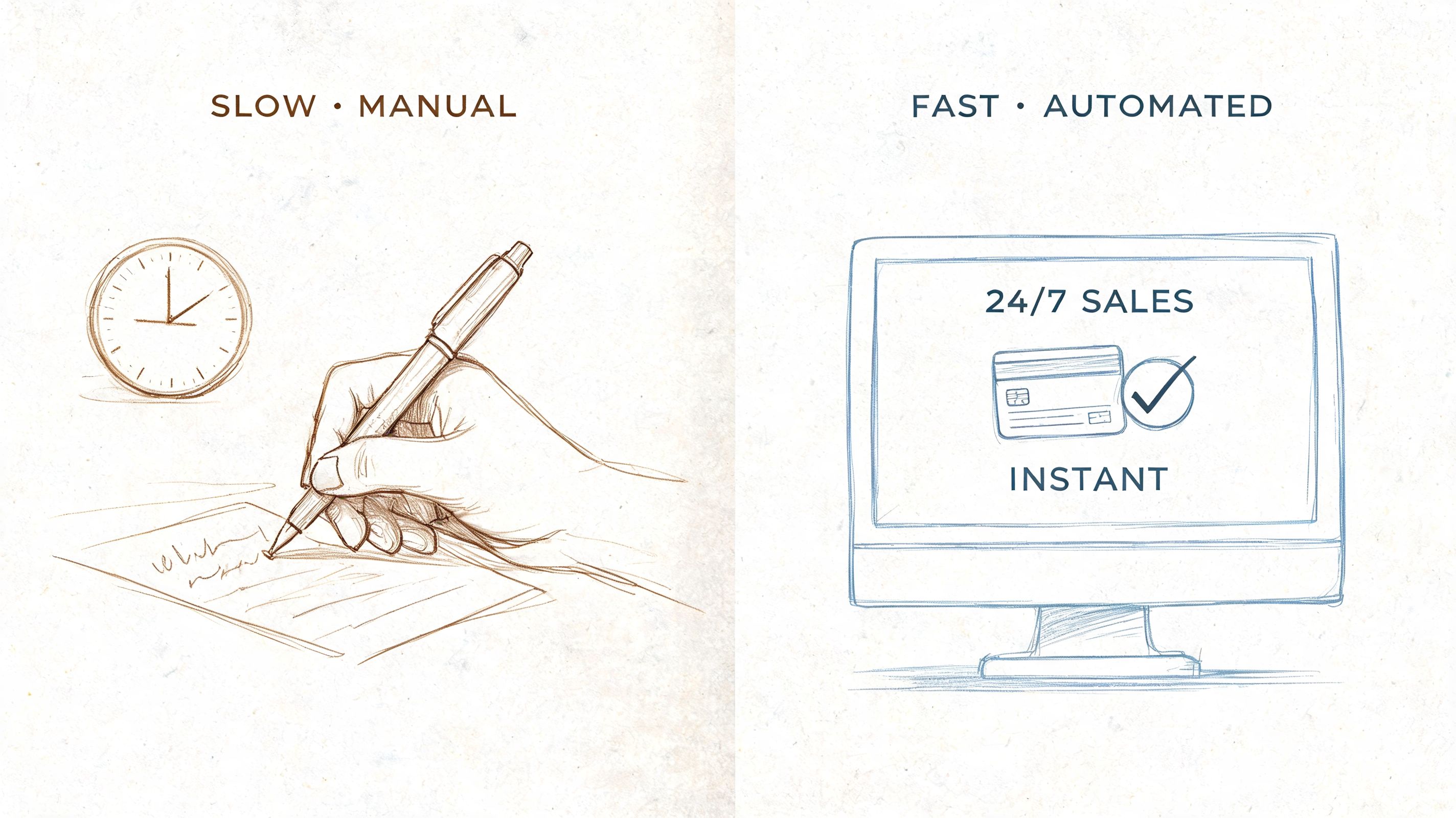
Many cleaning businesses get stuck here. They build a polished menu, then discover that actual leads rarely fit neat price boxes.
One customer wants same-day service. Another has a home with an unusual layout. Another wants add-ons stacked onto a first-time clean. Another asks for recurring service after a heavy reset visit. If your answer is, “Let me review it and call you back,” you add friction right when the buyer is ready.
According to Housecall Pro’s pricing discussion, static price lists struggle with variables such as square footage, urgency, and add-ons during live inquiries. That article also shows why a simple menu often breaks down. Standard residential pricing may be quoted by square foot, flat rate, or frequency discount, and add-ons like oven cleaning can shift the total again. The problem is not a lack of prices. The problem is having no system that applies them consistently on the spot.
The fix is to convert your pricing logic into rules a system can run without you.
That system should answer a lead in seconds:
This is the shift that matters. Your price list stops being a document your team reads and starts being a pricing engine your business uses.
That is where tools such as AI estimates software for cleaning businesses earn their keep. Once your rules are configured, leads can get an estimate based on your actual service logic instead of whoever happens to be available to answer the phone.
Here’s a useful example of how owners are thinking about price competition and response speed:
An automated price list sells while you sleep. It collects job details, applies your rules, presents add-ons, and sends a quote while the customer is still paying attention.
That changes more than convenience. It improves consistency across office staff, reduces underquoting, and gives you cleaner data on what people ask for most. You start seeing patterns. Which zip codes need travel fees. Which add-ons convert. Which job types need tighter minimums.
Human judgment still matters. Bad-condition homes, vague move-out requests, and unusual properties still need review. But those become the exceptions instead of the whole workflow. That is how you stop treating quoting like admin work and start using it as a sales system that runs 24/7.
Don’t roll out a new cleaning service price list just because the math looks neat on paper. Test it against real jobs first.
The fastest way to do that is to run old inquiries through your new system. Use past standard cleans, deep cleans, recurring homes, and ugly one-offs. If the estimate looks wrong, don’t force it. Fix the rule that caused it.
Before going live, review these points:
Don’t change every customer-facing price at once if you’re unsure. Start with new leads and compare how the estimates feel against actual labor and customer reactions.
This also helps you prepare communication for existing clients. Keep it simple. Explain that you’ve updated pricing to reflect service scope, operating costs, and a more consistent estimating process. Customers don’t need a long justification. They need clarity.
Review pricing on a schedule, not only when cash gets tight.
That habit matters because costs shift, your team changes, and your best-fit customer may change too. The businesses that keep pricing healthy treat it like a living system.
For ongoing ideas, keep an eye on the practical articles published on estimatty.com/blog and get.pipehirehrm.com/blog. One helps with estimating systems. The other is useful when pricing and staffing decisions start affecting each other.
If your current process still depends on callbacks, spreadsheets, or gut-feel math, it’s worth looking at Estimatty. It gives cleaning businesses a way to turn their pricing rules into instant estimates delivered through web and voice, so leads can get answers even when the office is closed.