September 29, 2026
Commercial and Residential Cleaning in 2026
Compare commercial and residential cleaning markets in 2026. Explore pricing, staffing, compliance, and how AI estimators streamline operations.

Sunday, February 15, 2026
Stop guessing how much to charge for cleaning services. Our guide breaks down pricing models and rates to help you create profitable estimates that win jobs.
.jpg)
Figuring out how much to charge for cleaning services can feel like trying to hit a moving target in the dark. Price too high, and you scare off potential customers. Price too low, and you're essentially volunteering your time, working hard for next to nothing. You might hear that a typical 1,500 sq ft home costs between $100 to $200 to clean, but that simple number glosses over the strategy you need to build a truly profitable business.
Let's be blunt: setting your prices is the most critical decision you'll make for your cleaning business. It's the foundation of everything. Get it right, and you're on your way to building a scalable, profitable company. Get it wrong, and you'll be stuck in a cycle of just scraping by. This isn't about pulling a number out of a hat; it’s about a deep understanding of your costs, your market, and the real value you bring to every client.
The cleaning industry is booming, which makes a smart pricing strategy non-negotiable. The global market for contract cleaning is projected to explode, jumping from around USD 397.50 billion in 2025 to a massive USD 685.51 billion by 2034. North America is a huge piece of that pie, holding a 35% revenue share as people focus more than ever on health and hygiene.
For residential cleaners here in the US, you’ll typically see rates between $0.10 to $0.25 per square foot. But here’s a pro tip: businesses that ditch the guesswork and use data-driven estimators can see their conversion rates jump by as much as 30%. That's real money you could be leaving on the table. You can dig into the market trends over on Precedence Research.
When you get down to it, pricing for cleaning services really comes down to two main approaches: charging by the hour or providing a flat-rate fee. Each has its own rhythm and can seriously affect your profit, your workflow, and how customers see you.
Choosing between them really depends on your business goals, the specific services you're offering, and the type of clients you want to attract.
To help you decide, here’s a quick breakdown of how these two models stack up against each other.
.tbl-scroll{contain:inline-size;overflow-x:auto;-webkit-overflow-scrolling:touch}.tbl-scroll table{min-width:600px;width:100%;border-collapse:collapse;margin-bottom:20px}.tbl-scroll th{border:1px solid #ddd;padding:8px;text-align:left;background-color:#f2f2f2;white-space:nowrap}.tbl-scroll td{border:1px solid #ddd;padding:8px;text-align:left}Pricing ModelBest ForProsConsHourly RateUnpredictable jobs, first-time deep cleans, specialized tasks.Simple to calculate, ensures you are paid for all time spent.Can scare off budget-conscious clients; doesn't reward efficiency.Flat-Rate FeeRecurring standard cleans, move-in/out cleans, commercial contracts.Attracts clients with price certainty; rewards fast, efficient work.Risk of underbidding if you misjudge the time needed.
Ultimately, many seasoned pros use a hybrid approach—maybe an hourly rate for the initial deep clean, followed by a flat rate for ongoing maintenance.
Your price tag does more than just cover your cleaning supplies and payroll. It's a powerful statement about your brand. A well-thought-out price signals professionalism and quality. It tells potential customers that you're a serious business owner who knows your worth and stands behind the results you deliver.
A thoughtful pricing structure is your best sales tool. It filters for serious clients who respect professional service and are willing to pay for quality, rather than attracting bargain hunters who can drain your resources.
In the end, learning how much to charge is about finding that perfect balance where your clients feel they're getting fantastic value and you're earning a healthy profit. Once you master the core models and the psychology behind them, you're ready to build a pricing foundation that can support real, sustainable growth. For a closer look at the actual numbers, check out our detailed guide on house cleaning prices. This knowledge is what turns a simple estimate into a signed, sealed, and delivered long-term client.
Before you can throw a price out there, you need to know your numbers. Cold. I’ve seen too many cleaning businesses fold because they guessed at their pricing instead of building it on the rock-solid foundation of their actual costs. True profitability starts with knowing the real, all-in cost of every single job.
New owners often make the classic mistake of just adding up their obvious expenses, like payroll and a few bottles of cleaner. But your break-even rate—the absolute bare minimum you have to charge just to keep the lights on—is so much more than that. Getting a handle on a detailed breakdown of costs and pricing plans is the first step toward building a business that actually makes money.
Let’s start with the easy stuff. Direct costs are the expenses you can point to and say, "That was for the Smith job." They're the most straightforward to calculate, but you have to be disciplined about tracking them.
These two are your biggest variable costs; they climb right alongside the number of jobs you book.
Now for the costs that can really sink you if you ignore them. Overhead, or indirect costs, are the expenses that keep your business running, whether you're cleaning one small office or a hundred homes this month.
These are the silent partners in your business:
Here's a pro tip: Add up your total monthly overhead and divide it by the total number of hours your team can realistically work and bill for in a month. This gives you an hourly overhead rate that you must build into every single hour you charge.
This is the foundation for any pricing model you choose, whether you end up going with hourly or flat-rate pricing.
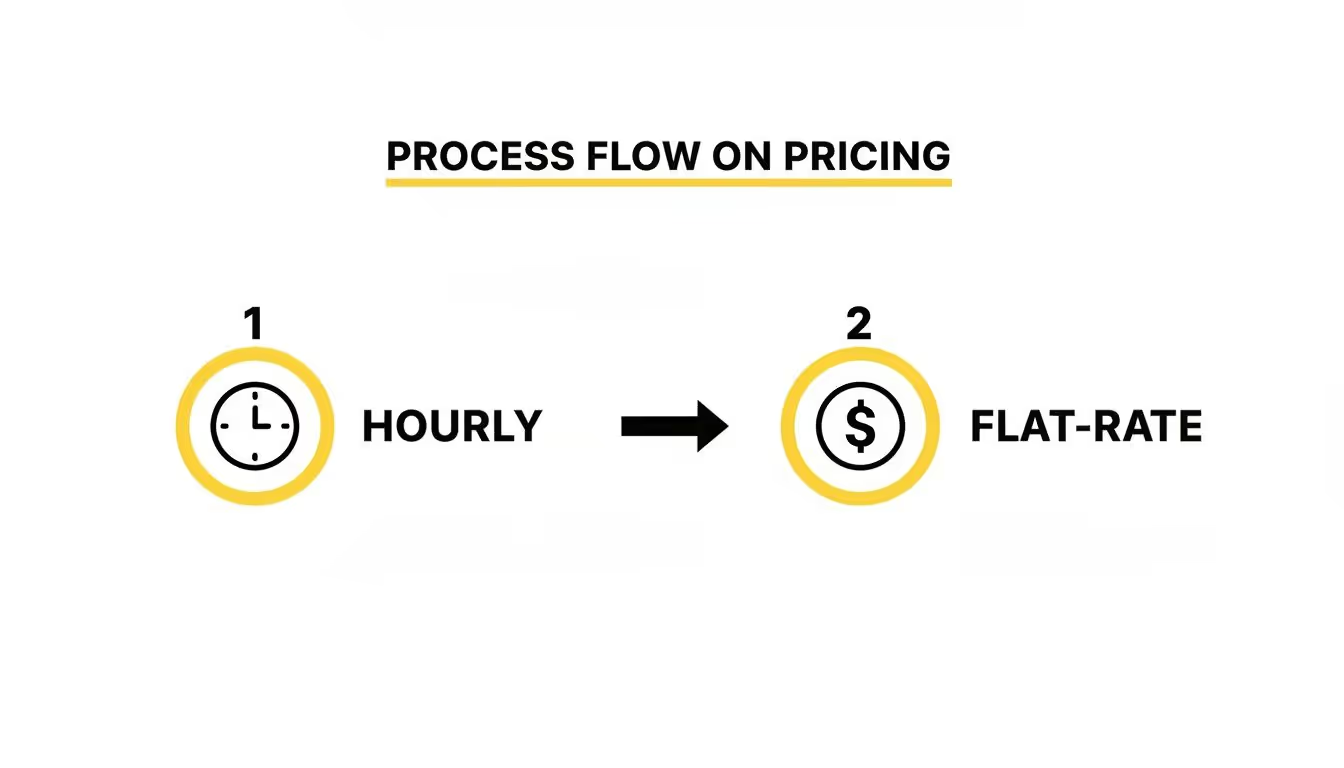
As you can see, no matter which path you take, it all starts with a deep dive into your costs.
Okay, let's connect the dots. Once you have a firm grip on all your expenses, you can find that magic break-even number.
Let's run a quick, simplified example. Say your fully-loaded direct labor cost is $20/hour and your hourly overhead rate comes out to $10/hour. Just like that, your total cost to have a cleaner on a job is $30 per hour.
This is your floor. Your absolute zero.
If you charge a penny less than $30 per hour, you are literally paying to work for your client. This number is your starting line, not the price you present in an estimate. The final step is adding your profit margin on top so you can actually invest back into the business and grow. This is why knowing how to calculate your costs precisely is essential to creating accurate estimates.
Once you've nailed down your costs, the next step is to set prices that are smart—prices that not only keep the lights on but also pull in the kind of clients you actually want. This is where you pivot from figuring out what you need to earn to deciding what you should earn. It’s all about understanding the market without just copying the company down the street.
Your goal is to position your business as the go-to, reliable choice, not just the cheapest one. That means digging into industry benchmarks and then tweaking them to fit your unique services and your local area.
Knowing the going rates provides a much-needed reality check. For residential cleaning, you'll generally see hourly rates land somewhere between $25 and $50 per hour. This spectrum covers everyone from a solo cleaner just starting out to established companies with a full team and higher overhead.
Commercial cleaning is a different beast. Pricing there is often done by the square foot, typically from $0.08 to $0.15 per square foot for a standard office gig. Of course, specialized jobs like cleaning a medical clinic will fetch a higher price, and for good reason—they come with stricter requirements and need specific supplies.
Pricing for cleaning services isn't just pulling a number out of thin air—it's backed by some serious data. North America is poised to take 37.52% of the global market share in 2025, a market valued at a whopping $169.45 billion. For businesses with multiple locations, standardizing commercial contracts can lock in 35% margins when automated. These figures are crucial as the global market is projected to swell to $859.20 billion by 2034.
Think of these numbers as your starting point, not the final word. Several key factors will nudge your pricing toward the lower or higher end of these ranges.
No two cleaning businesses are the same, and your prices should reflect what makes you special. What you ultimately charge will be a careful mix of industry norms and your own unique situation.
Here are the main variables you need to weigh:
For a clearer picture, our house cleaning cost calculator is a great tool to see how these factors come together to shape a final estimate.
Let’s be clear: checking out the competition isn't about starting a price war. It's about strategic intelligence. You're trying to understand the local market so you can find your perfect niche within it.
Start by making a list of 5-7 direct competitors in your service area. Look for companies that are similar in size and seem to be targeting the same customers you are.
Once you have your list, it's time to do some digging:
To get a better handle on different models, exploring various businesses' pricing plans can give you great ideas for setting up your own competitive rates. Seeing how others package their services can inspire a strategy that makes you stand out.
With this knowledge in hand, you can set your rates with confidence, knowing they reflect your true value, attract your ideal clients, and lay the foundation for a profitable, long-lasting business.
To give you a clearer starting point, here are some typical price ranges for common residential and commercial cleaning jobs. Remember, these are industry averages—your final pricing should be adjusted based on your specific costs, location, and market.
.tbl-scroll{contain:inline-size;overflow-x:auto;-webkit-overflow-scrolling:touch}.tbl-scroll table{min-width:600px;width:100%;border-collapse:collapse;margin-bottom:20px}.tbl-scroll th{border:1px solid #ddd;padding:8px;text-align:left;background-color:#f2f2f2;white-space:nowrap}.tbl-scroll td{border:1px solid #ddd;padding:8px;text-align:left}Service TypeAverage Hourly RateAverage Flat Rate (Per Job)Average Per Square Foot RateResidential Standard Clean$30 - $55$120 - $250N/AResidential Deep Clean$45 - $70$250 - $450+N/AMove-In/Move-Out Clean$50 - $80$300 - $600+N/ACommercial Office Clean$35 - $60Varies widely$0.08 - $0.15Post-Construction Clean$50 - $90Varies widely$0.10 - $0.50
Use this table as a guide to see where you might fit in. After you've done your local competitor research, you'll have a much better sense of how to price your services to be both competitive and profitable.
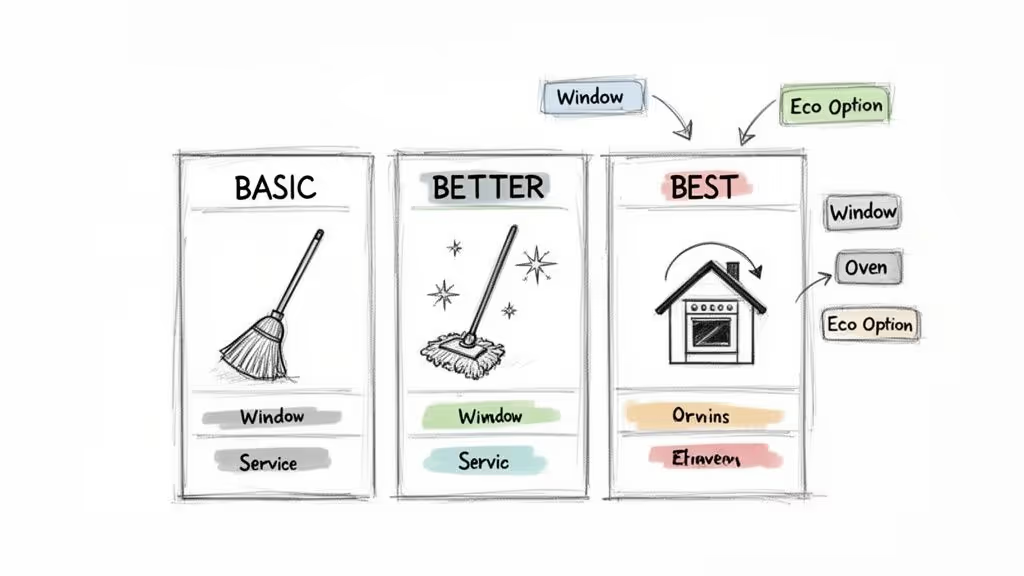
If you're only offering a single, take-it-or-leave-it price, you're leaving money on the table. It’s a classic rookie mistake. The most successful cleaning companies I’ve seen don't just sell a service; they present a complete solution.
The secret is creating tiered service packages. It’s a simple "Good, Better, Best" strategy that guides customers toward the option that fits them perfectly, all while naturally bumping up your average revenue per job. This little shift in approach makes it easy for clients to choose, turning a clunky sales negotiation into a smooth, simple decision.
You instantly go from being just another cleaner with a price tag to a trusted expert who understands their needs.
Structuring your services this way is just smart psychology. It appeals to different kinds of buyers without you having to change your sales pitch. Some people just want the basics covered, while others are looking for a top-to-bottom transformation. You can be the solution for all of them.
With a tiered system, you subtly change the customer's mindset. Instead of asking, "Should I hire them?" they start asking themselves, "Which package is right for me?" That small shift is incredibly powerful.
Once you have your core packages dialed in, the real magic happens with add-ons. These are high-value, optional services that customers are often more than happy to pay extra for. The best part? They require minimal extra setup but can seriously boost your profit on every single job.
Smartly priced add-ons can increase the total value of a cleaning job by 15-30%. You're no longer just cleaning a house; you're providing a complete home care solution. The upsell feels like a helpful suggestion, not a pushy sales tactic.
Some of the most popular and profitable add-ons I've seen work time and time again include:
Don't sleep on that last one. The demand for green cleaning is exploding. With the market projected to hit $850.2 billion by 2035, specializing in eco-friendly options is a massive differentiator. In fact, green cleaning is on track to become a $109.7 billion industry on its own by 2026, which easily justifies a 15-25% price bump for these specialized services.
Modern tools, like AI-powered estimators, can even suggest these valuable add-ons automatically during the estimate process. We've seen this increase the average job value by up to 25% while ensuring your pricing stays consistent every time.
Combining tiered packages with strategic add-ons is a proven formula for maximizing how much you charge. It elevates your brand, makes customers happier, and builds a more profitable, resilient business. To see how all these pieces fit together in a real-world estimate, check out our guide on creating the perfect cleaning estimate template.
Let's be honest. In a world where customers expect answers now, speed is everything.
If you’re still doing the old routine—playing phone tag, driving out for walkthroughs, and then spending your evening crunching numbers—you aren't just wasting time. You're actively losing jobs to the competitor who can deliver a professional estimate in seconds.
The hard truth is that the first company to get a clear, accurate estimate in front of a potential client usually wins. Every hour they wait for your numbers is an hour they can spend finding someone else. This delay is a massive revenue leak, and most cleaning business owners don't even see it happening.
Relying on "gut-feel" estimates is one of the fastest ways to kill your profit margins. It's inconsistent, it looks unprofessional, and it’s impossible to scale. One day you might underbid a huge job and end up working for next to nothing; the next, you overbid a simple one and scare away a perfect long-term client.
This inconsistency creates chaos. Your prices end up depending on who answers the phone, how busy you are, or even your mood that day. This makes training new staff a nightmare and forecasting revenue a total shot in the dark. Without a standardized system, your business is built on guesswork, not strategy.
Your pricing should be a direct reflection of your true costs and desired profit, not a number you pull out of thin air. Inconsistent estimates scream a lack of professionalism and can destroy a customer's trust before you've even picked up a sponge.
This is where automation becomes a total game-changer. It strips the emotion and guesswork out of the process, replacing it with data-driven precision.
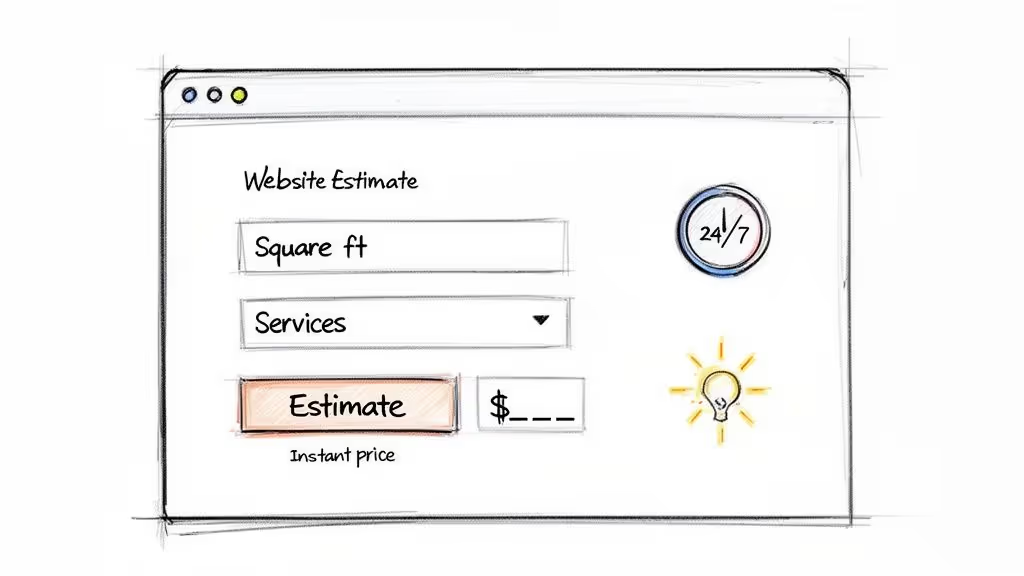
Picture this: a potential client lands on your website at 10 PM on a Sunday. Instead of filling out a "contact us" form and waiting for you to call back Monday, they find an intelligent estimator tool.
In less than a minute, they enter their details—square footage, number of bedrooms and bathrooms, and any special add-ons—and boom. A professional, accurate estimate is sent right to their phone and email.
This is exactly what a tool like Estimatty does. An AI-powered estimator on your website works for you 24/7, engaging potential customers the second they show interest. It becomes your best salesperson—one that never sleeps, capturing crucial info and turning website browsers into genuine, qualified leads.
Here's how this technology fundamentally changes the game:
By automating this critical step, you stop guessing and start scaling. You can see how one business owner completely changed his workflow in this Estimatty case study.
An automated system does more than just spit out numbers; it tightens up your entire sales process. The moment an estimate is generated, your team can get an instant notification. This lets you make a quick, personal follow-up call to a lead who is already warm and knows exactly what to expect on price.
This kind of efficiency is what makes scaling possible. As you grow, you need systems that can handle more leads without piling on more admin work. Finding great cleaning employees is hard enough (though tools like Pipehire can help). Once you have them, you want them focused on billable cleaning hours, not bogged down in paperwork. You can learn more about hiring on pipehirehrm.com.
Automating your estimates lets you scale your operations without scaling your stress. It’s how you ensure that as your business grows, your professionalism and your profits grow right along with it.
Even with the best plan, you're going to run into some tricky pricing situations. It’s just part of the game. I’ve seen them all, so let's walk through some of the most common questions that pop up and give you some straight, actionable answers.
Putting a static price list on your website feels transparent, but honestly, it can be a double-edged sword. A "Starting At" price might get you some clicks, but I've seen it backfire more often than not. It can scare away clients with bigger or more complex homes who just assume you won't work with them, or it can anchor your value way too low before you've even had a conversation.
A much savvier move is to use an interactive estimator tool. This gives potential customers that instant estimate they crave, but it does it on your terms. It grabs the essential details—like the home's size and the specific services they need—to spit out a personalized, accurate estimate. This is a game-changer because it engages visitors right away, captures their info for your follow-up, and provides a custom price that converts way better than a generic list ever will.
You need to sit down and review your entire pricing structure at least once a year. No exceptions. It’s also absolutely critical to take another look anytime your major costs jump. This could be anything from your favorite cleaning solution going up in price, gas prices getting crazy, or a local minimum wage hike that bumps up your labor costs.
Never be afraid to adjust your rates to protect your profit margins. When you do have to raise prices on your regulars, it all comes down to communication.
Trust me, your loyal customers will almost always be more receptive to a small, well-explained annual increase than a huge, out-of-the-blue price hike after you've held the same rate for years.
Giving out one-off discounts is a slippery slope that can quickly devalue your work and torpedo your profits. Instead of caving every time someone asks, build smart incentives into your pricing model that reward the exact behavior you want to see.
For instance, you could offer a 10-15% discount for clients who commit to weekly service versus a one-time clean. This rewards loyalty and helps you build that all-important base of recurring revenue. If a new lead is really pushing for a lower price, stand your ground with confidence. Politely walk them through the immense value packed into your estimate—your professional insurance, top-tier supplies, and the skill of your trained staff. Holding firm on your price is a great way to filter for clients who are looking for quality, not just the rock-bottom cheapest option.
Responding to discount requests isn't about just saying no. It's about shifting the conversation back to the value you deliver. A client obsessed with getting the lowest price is rarely going to be a great long-term partner for a quality-focused business.
You can find some fantastic resources on managing your team and how they contribute to your costs over at the PipehireHRM blog. It's great material for reinforcing the value your people bring to every single job.
An initial clean should always cost more than your regular maintenance clean. It's a completely different animal. That first visit takes way more time, elbow grease, and product to get a home up to your professional standard.
Be upfront and label this service as an "Initial Deep Clean," then charge for it accordingly. You’ve got two solid ways to do this:
This approach sets clear expectations right from the start and makes sure you’re paid properly for the heavy lifting that makes all future maintenance cleans smoother and more efficient. It’s a vital step in building a profitable relationship with a new client. As you keep refining your pricing, you can find more great ideas by checking out articles on the Estimatty blog.
Stop guessing and start growing. Estimatty gives your cleaning business a 24/7 salesperson on your website, delivering instant, accurate estimates that turn more visitors into booked jobs. Get started with Estimatty today!