October 25, 2026
Pressure Cleaning Prices in 2026: Rates by Job and Size
Compare pressure cleaning prices for homes and commercial jobs in 2026, with size bands, per-square-foot rates and sample estimates you can use.
Friday, June 12, 2026
Boost your cleaning business! Implement a strong cleaning quality assurance program to cut callbacks, increase profits, and earn stellar reviews. Your 2026
The callback usually comes at the worst time. Your crew already left. The client is annoyed. Your phone rings with the same message every cleaning owner knows too well: something was missed, expectations weren't met, and now you're paying twice for the same job.
Most owners treat that as a staff problem. Sometimes it is. More often, it's a system problem. Cleaning quality assurance is what separates a business that constantly recleans from one that delivers consistent service, protects margins, and earns better reviews without firefighting all week.
The painful part of a callback isn't just the extra labor. It's the chain reaction. You interrupt the day, reshuffle routes, calm down a customer, and hope the team doesn't make the same mistake at the next site. One vague scope can create problems for days.
I've seen owners blame the cleaner when the underlying issue started earlier. The client thought inside appliances were included. The team thought they weren't. The office promised one level of detail. The field delivered another. That isn't a quality miss. That's a management miss.
Modern research backs that up. Structured systems for employee management and communication are directly linked to higher service quality and better overall performance, which shows that quality assurance has moved beyond basic inspection into core operations, as noted in modern cleaning quality management research.
A strong QA system changes the day-to-day rhythm of the business. Supervisors stop guessing. Cleaners know what “done” means. Clients hear the same answer from sales, operations, and the crew.
A business without QA relies on memory and good intentions. A business with QA relies on standards.
That doesn't mean turning your company into a bureaucracy. It means building a practical operating system: documented procedures, training, audits, and corrective action that keeps service steady across crews, sites, and shifts.
When a customer does raise an issue, the conversation changes. Instead of arguing over opinions, you review the documented scope, the checklist, the inspection notes, and the response. That's how you reduce friction with unhappy accounts and handle service recovery professionally. If complaint handling is a weak point, this guide on dealing with difficult customers in a cleaning business is worth a read.
A lot of cleaning companies say they care about quality. Fewer can show how their quality system works. The difference comes down to six pillars that support the entire operation.
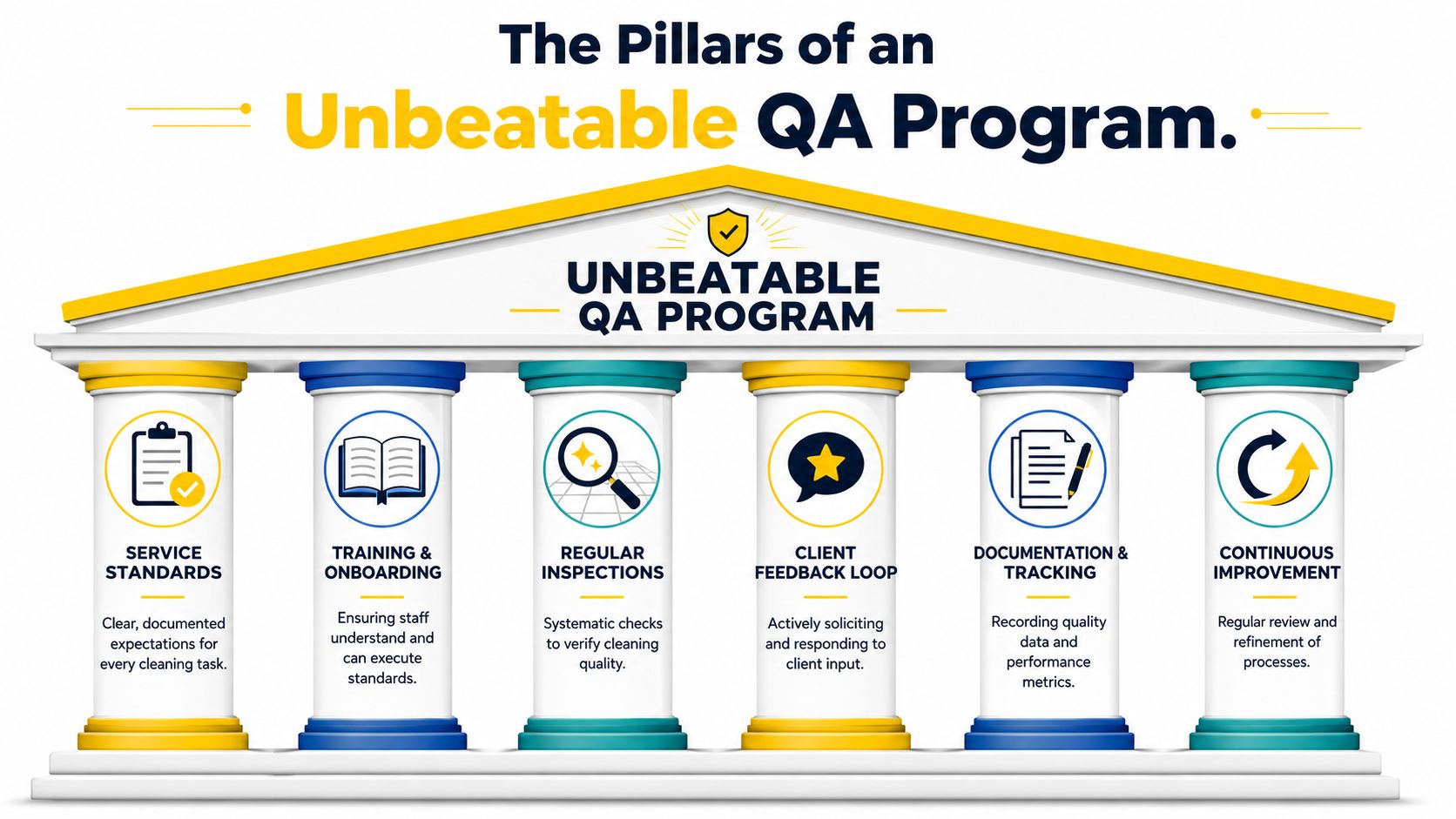
A robust program combines KPI-based inspections, standardized protocols, and feedback loops to improve consistency across teams and locations, while helping you correct issues before they turn into complaints, according to this cleaning QA guidance.
Service standards. This is your definition of clean. Not “clean the restroom.” Instead: mirrors streak-free, dispensers stocked, fixtures wiped, floors free of visible debris, trash removed, touchpoints sanitized if included in scope. If the standard isn't written down, every cleaner creates their own version.
Checklists. These turn standards into repeatable action. A good checklist prevents missed tasks during rushed shifts, substitute coverage, and first visits. It also protects you when a client claims something was skipped that was never part of the agreement.
Inspections. A checklist tells the cleaner what to do. An inspection tells the company whether it happened. Inspections should be scheduled, simple to complete, and tied to actual job scopes. Random walk-throughs help, but they don't replace a routine.
Some companies build a binder full of SOPs that nobody uses. That's not QA. The system has to live in daily work.
Here's what matters most:
| Pillar | What it does in practice |
|---|---|
| Standards | Defines the expected result |
| Checklists | Translates standards into tasks |
| Inspections | Confirms the result on site |
| KPIs | Shows recurring issues over time |
| Training | Makes quality executable |
| Feedback loops | Catches blind spots fast |
KPIs. Don't overcomplicate this. Track patterns that lead to action. Common examples include inspection outcomes, repeat issues by site, missed task categories, and corrective action follow-through. The goal isn't reporting for reporting's sake. The goal is knowing where quality breaks down.
Training and onboarding. Most quality failures happen when owners assume a new hire “already knows how to clean.” They may know how to clean a home. They may not know your sequence, your products, your client promises, or your finishing standard. If you're building your team, the hiring side matters too, and this article on hiring cleaning employees pairs well with a QA rollout.
Customer feedback loops. Clients notice patterns before dashboards do. A quick follow-up after first cleans, periodic review requests, and a simple process for addressing concerns give you information you won't get from an internal audit alone.
Practical rule: If a cleaner, supervisor, and client would describe “quality” differently, your system isn't ready.
Most quality problems don't start on cleaning day. They start when the job is sold.
A vague estimate creates a vague promise. Then the office tells the team one thing, the customer expects another, and everyone feels like the job went wrong. In reality, the job was never defined well enough to go right.
Owners often call these “quality issues,” but many are scope issues wearing a QA label.
Common examples include:
When that happens, the cleaner is set up to fail. They either rush and underdeliver, or they stay longer and wreck the schedule. Neither outcome is profitable.
This is the part many QA guides miss. The estimate isn't just a price. It's the first control document in your quality system. It should define what's included, what's excluded, the service level, special conditions, and how the job was classified.
If your team still relies on memory, text messages, or “we'll figure it out on site,” your QA problems will keep showing up downstream. Safety issues often come from the same weak intake habits, which is why this piece on how better intake systems can protect your team when a cleaning job turns dangerous matters operationally, not just legally.
A clean handoff from sales to operations does three things:
If you want fewer callbacks, tighten the estimate before you tighten the audit.
The companies with the smoothest QA usually aren't doing magic on the back end. They're being disciplined on the front end. Clear estimates reduce disputes, prevent rushed improvisation, and make inspections far more objective because everyone is judging the same promised result.
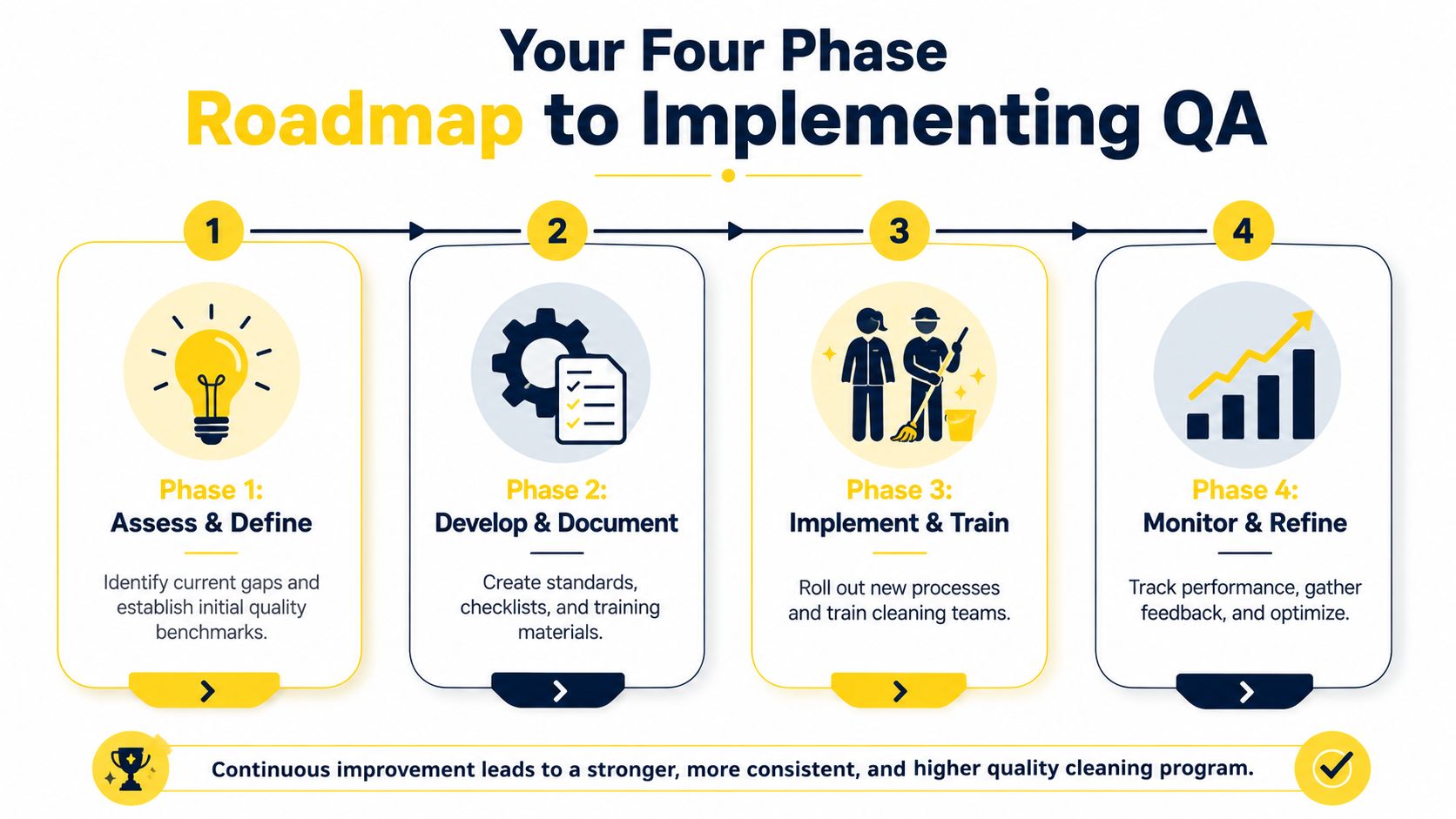
Most owners delay QA because they think it requires a full operations department. It doesn't. It requires sequence. Build it in phases, and the system becomes manageable.
Start with the visual roadmap below.
Technology is changing how this works in the field. Industry trends show a shift toward technology-assisted QA, where software-driven checklists and structured reporting connect inspections, communication, and corrective actions, helping companies scale quality under labor pressure, according to this overview of quality management in cleaning.
Define your standards before you inspect anything. Pick your service types, list required tasks by room or zone, and decide what “pass” means for each category. Keep the language plain enough that a new cleaner can follow it without interpretation.
Your first master checklist shouldn't try to cover every edge case. Build around the work you do most often. Residential recurring clean, deep clean, office maintenance, restroom service, common area touch-up. Get those right first.
Once the standard exists, train to it. That means onboarding with live demonstrations, shadowing, and checklist-based practice. Don't hand someone a document and call it training.
If staffing is a choke point, better recruitment and process discipline need to work together. Teams that hire carelessly usually end up inspecting constantly. Teams that hire with intent and train against written standards can inspect strategically.
A simple rollout checklist helps:
A quick field example helps clarify the rhythm:
QA is put into practice. Start regular inspections. Ask for customer feedback after early visits. Document issues the same way every time. The purpose isn't to catch people. It's to spot patterns before clients do.
Field note: Inspect the highest-risk areas first. Restrooms, kitchens, floors, trash, entry glass, and touchpoints create most of the complaints.
Use photos when helpful, but don't drown the team in admin. If an inspection takes too long, supervisors stop doing it consistently.
After a few weeks, the data starts talking. You'll see which tasks get missed, which sites produce the most friction, and which cleaners need coaching versus retraining. That's where QA starts paying back.
Review trends monthly. Update checklists when a recurring issue keeps showing up. If one service package constantly produces complaints, fix the package definition, not just the crew. A business that treats QA as a live operating system gets better over time. A business that treats QA as paperwork stays stuck.
A checklist only helps if it's specific enough to audit and simple enough to use during a real shift. The best version usually starts as an inspection tool, then becomes a training guide, then becomes the template for how you scope future work.
That's especially useful when onboarding new hires through systems such as pipehirehrm.com and when aligning job setup with room-by-room standards. It also helps when you build supply expectations by service type. If you're refining that side of operations, this guide to a cleaning supplies list for service businesses is a practical companion.
ISSA notes that data-driven cleaning depends on tracking measurable variables such as cleaning frequency, duration, and resources used, and that quality plans should include monitoring, corrective actions, and continuous improvement. Their guidance also points to checks like duplicate records, out-of-range values, and missing data as part of stronger monitoring, which supports the use of detailed checklists and reviews in daily operations, as described in ISSA's discussion of data-driven cleaning.
| Area | Task Item | Score/Status | Notes |
|---|---|---|---|
| Entry | Glass free of smudges and fingerprints | ||
| Entry | Floor free of debris and visible soil | ||
| Reception or Office Area | Desks and reachable surfaces dust-free if included | ||
| Reception or Office Area | Trash emptied and liner replaced | ||
| Reception or Office Area | Carpet vacuumed or hard floor mopped | ||
| Kitchen or Break Room | Countertops wiped and free of residue | ||
| Kitchen or Break Room | Sink cleaned and faucet polished | ||
| Kitchen or Break Room | Exterior appliance surfaces wiped | ||
| Restroom | Toilet cleaned inside and outside | ||
| Restroom | Sink, mirror, and fixtures free of streaks | ||
| Restroom | Supplies stocked if included | ||
| Restroom | Floor edges and corners checked | ||
| General | High-touch points addressed if included in scope | ||
| General | Final walk-through completed |
Facility teams often need broader documentation tools than cleaning companies do, so these practical tools for facility managers can be useful if you support larger properties or mixed-use sites.
The principles of cleaning quality assurance stay the same at every size. The way you apply them should change with the business model. A solo operator doesn't need corporate layers. A multi-location brand can't rely on instinct and memory.
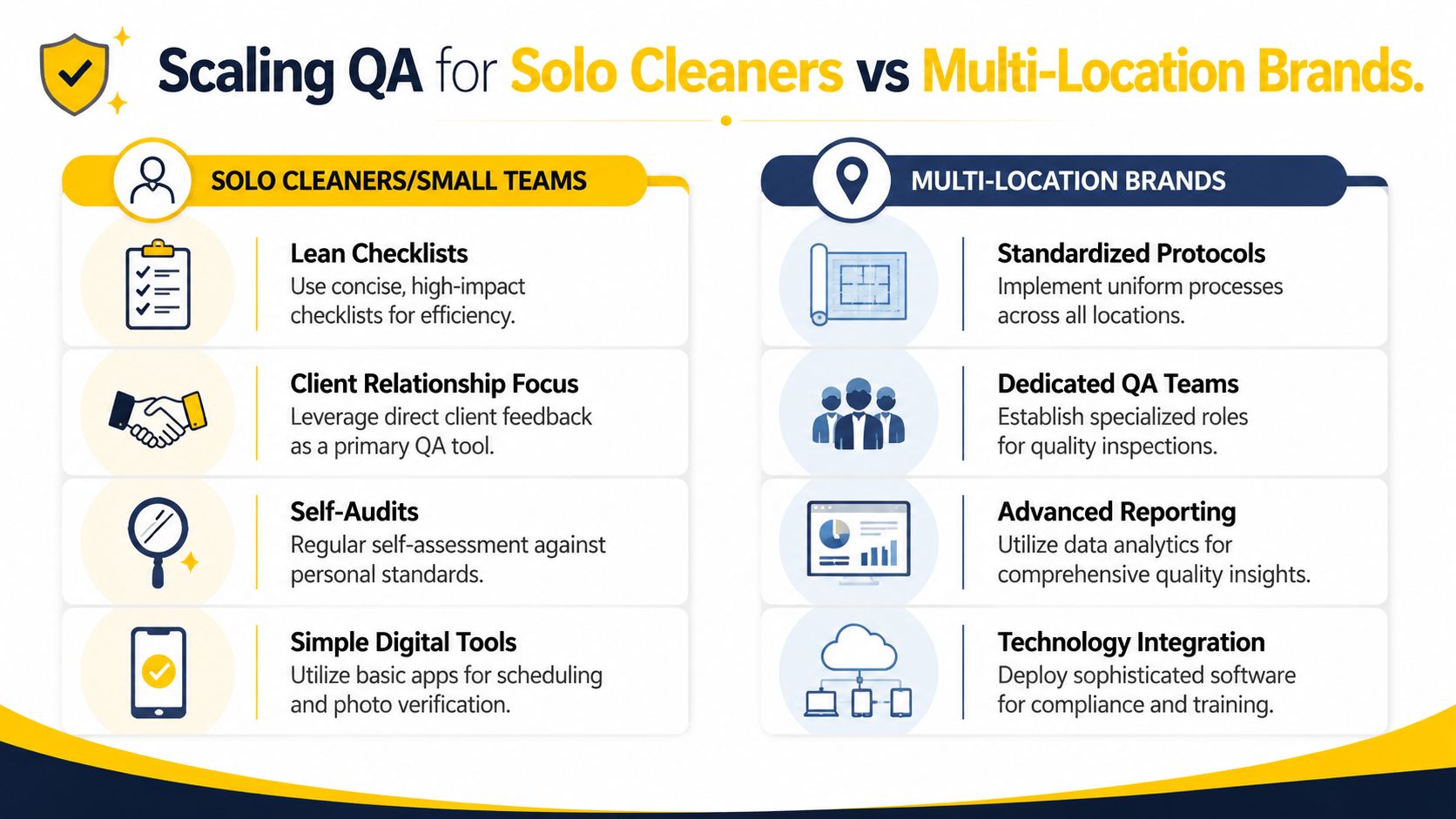
If you clean personally or run a tight crew, speed matters. Your QA system should be light and fast.
Use a short self-audit at the end of each job. Focus on the few categories that trigger most complaints. Take photos for unusual conditions, special requests, or completed detail work. Ask for direct feedback early in the relationship, because clients will often tell you the truth before they leave a public review.
For this stage, the best system usually includes:
If you're building toward a larger operation, this article on how to scale a service business connects well with the QA side.
At scale, personal oversight disappears. That's where formal structure becomes essential. You need standardized protocols, supervisor calibration, and reporting that shows where service quality drifts by location, shift, or team lead.
This is also where objective measurement starts to matter more. Industry models such as NEN 2075, INSTA 800, QLT-100, LVS 1051, and GOST R 51870 are identified as standards used to determine cleaning quality levels and customer minimum expectations in this overview of cleaning quality measurement models.
For advanced commercial or industrial settings, visual inspection can still miss the underlying problem. A surface may look clean and still fail the next process. In those environments, contact-angle measurement is used as a standardized, non-destructive way to verify surface cleanliness beyond appearance, as explained in this discussion of contact-angle measurement for cleanliness evaluation.
Clean-looking isn't always clean enough. That matters much more when the customer depends on downstream performance, not just appearance.
A growing brand should think in layers:
| Business type | Best QA approach |
|---|---|
| Solo cleaner | Self-audit, client feedback, simple photo proof |
| Small team | Lead checks, task-specific checklists, recurring review |
| Multi-crew company | Supervisor inspections, site scoring, documented corrective action |
| Multi-location brand | Standardized protocols, central reporting, objective measurement where needed |
The mistake is copying enterprise process too early or staying informal too long. Good QA fits the business you are now, while preparing you for the one you want to become.
Most cleaning companies compete on price because their service looks interchangeable from the outside. Strong QA changes that. It gives you consistency, fewer disputes, cleaner handoffs, better reviews, and more control over labor quality.
The biggest shift is mental. Stop treating quality as something you inspect at the end. It starts when the work is defined, continues in training and execution, and finishes with proof. Owners who build that system move out of commodity selling and into premium service. For more operational ideas, the resources on the Estimatty blog are a solid place to keep sharpening the process.
If you want cleaner handoffs, more consistent estimates, and fewer scope-driven callbacks, take a look at Estimatty. It helps cleaning businesses standardize front-end estimating so operations starts with a clear scope instead of guesswork.