
October 12, 2026
Cleaning Office Prices: A Practical Pricing Guide for 2026
Learn how cleaning office prices really work in 2026. Compare per square foot, hourly, and monthly models, plus tips to estimate and present winning quotes.

Friday, April 10, 2026
Build a professional cleaning supplies list and inventory system. Our guide helps cleaning businesses manage costs, customize for jobs, and scale efficiently.
.png)
Saturday should be quiet. Instead, a crew texts that they are out of microfiber cloths, the backup spray bottles are cracked, and the last gallon of all-purpose cleaner was already diluted wrong by the night crew. Now someone is driving to a big-box store, paying retail, losing route time, and hoping the shelf is not empty.
That is how a simple cleaning supplies list turns into an operations problem.
Most owners start with a shopping list. The businesses that scale treat supplies like a system. They know what each item is for, where it sits, who signed it out, when it gets reordered, and whether it is earning its place in the van. That difference shows up in margins, crew speed, and customer consistency.
The expensive part of supply management is rarely the chemical itself. It is the chaos around it.
A missing toilet bowl cleaner does not just mean buying another bottle. It means a team works slower, substitutes the wrong product, risks surface damage, or leaves a detail unfinished. Then the office fields a complaint, sends someone back, and turns a profitable job into a thin one.
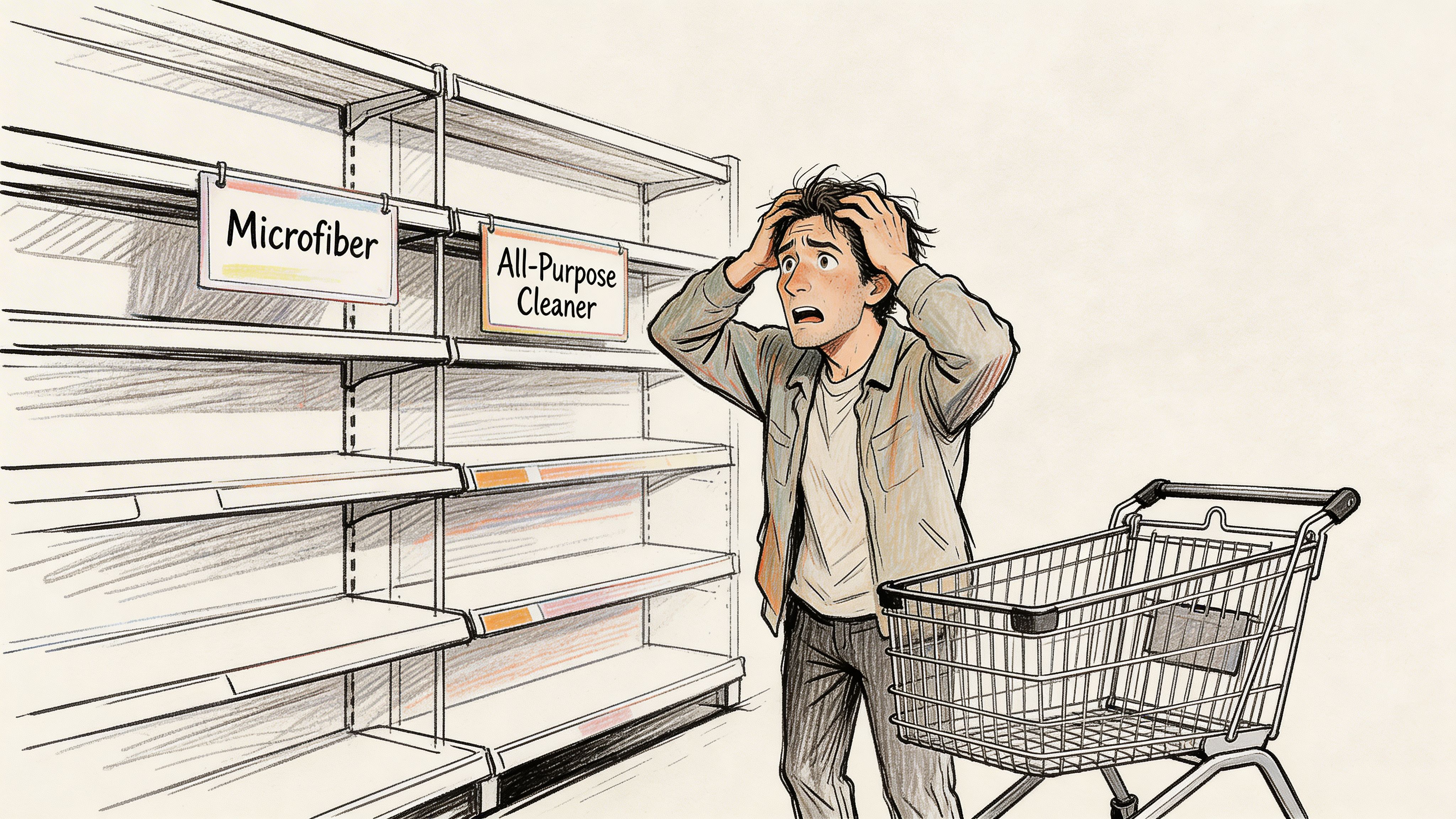
I have seen owners track labor tightly and still bleed money through sloppy inventory habits. They buy duplicate tools because nobody can find the original. They over-order low-value items and under-order essentials. They let each technician build a personal stash in the trunk, which feels efficient until products expire, leak, or disappear.
Common profit leaks look like this:
Tip: If your team ever says “we always run out of the same stuff,” you do not have a supply problem. You have a reorder-point problem.
The cleaning products space is not standing still. The global household cleaners market was valued at approximately 42 billion U.S. dollars in 2023 and is projected to reach roughly 47 billion U.S. dollars by 2026 according to Statista’s cleaning products market data. More products, more specialization, and more customer expectations mean a looser system gets punished faster.
A strong inventory setup does three jobs at once. It protects service quality, supports cleaner training, and helps owners understand true overhead. If you are still lumping supplies into a vague expense bucket, this breakdown of how to calculate overhead costs is worth reviewing because supply chaos often hides inside “miscellaneous.”
A proper cleaning supplies list is not a printable checklist taped to a wall. It is a controlled operating asset.
When it works, crews leave stocked, finish with the right products, and return unused items to a known location. The office can predict spend. New hires can follow the same setup as veterans. You stop buying reactively and start buying intentionally.
That shift is what makes a supply closet profitable instead of annoying.
A professional cleaning supplies list should cover routine residential work, recurring commercial work, and the odd mess that would otherwise send a team scrambling. The mistake is buying random products because they “might be useful.” The better approach is building a core inventory around a few dependable categories.
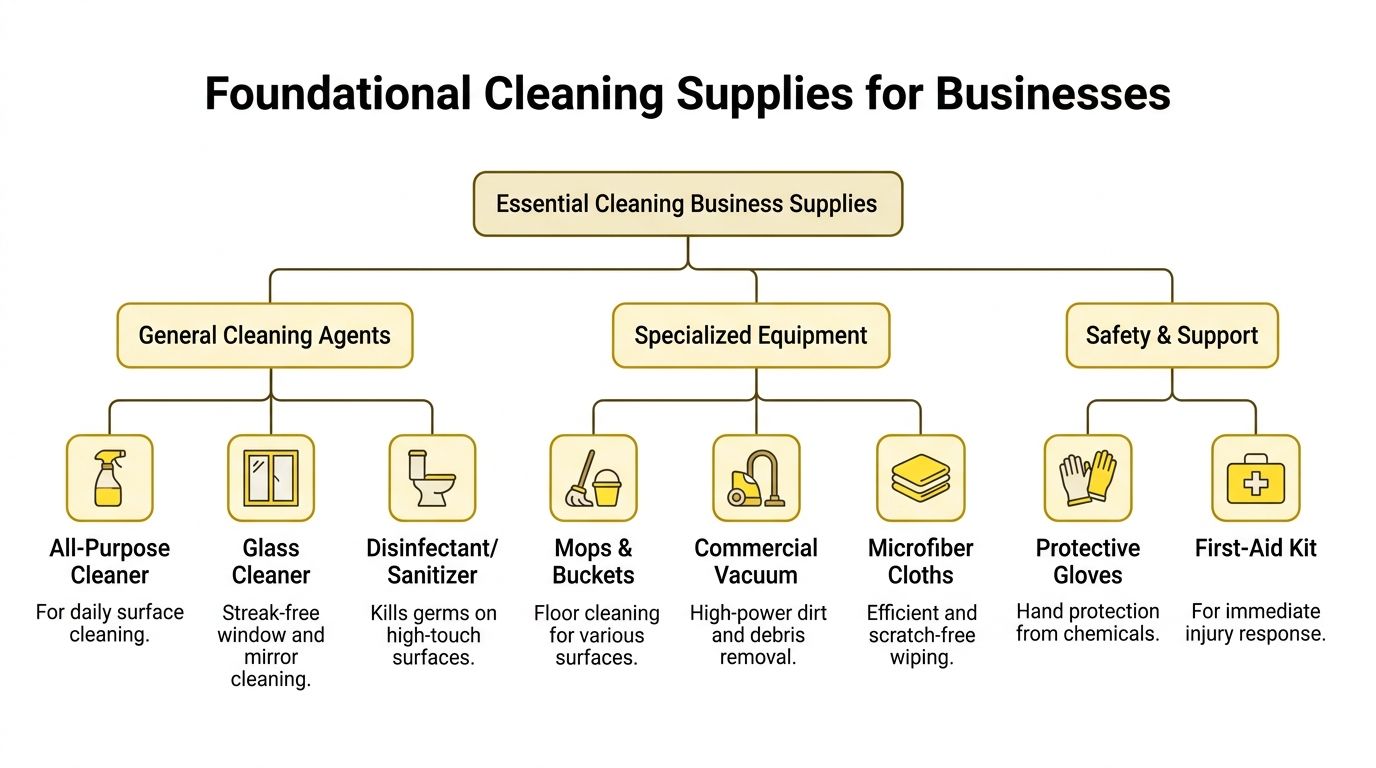
These are the liquids and powders that do the cleaning work. Keep the lineup tight. Too many overlapping products confuse crews and increase misuse.
All-purpose cleaner
Your default for counters, exterior surfaces, doors, light switch plates, and general wipe-downs. For a two-person team, stock multiple labeled spray bottles plus reserve concentrate or ready-to-use refill.
Disinfectant or sanitizer
Use this on high-touch points and bathrooms when the service scope calls for it. Do not let staff use it as their only cleaner. Soil has to be removed first.
Glass cleaner
Needed for mirrors, glass partitions, and interior windows. A dedicated glass product usually saves time over trying to force an all-purpose cleaner to do streak-free work.
Bathroom cleaner
Soap scum, mineral film, and toilet-area buildup need a product made for them. This is one category where “close enough” wastes labor.
Degreaser
Useful in kitchens, break rooms, backsplashes, and around trash enclosures. Keep it controlled because crews will overuse it if they think stronger means better.
Floor cleaner
Match it to the floor type you service most. Neutral floor cleaners earn their keep because they are versatile and less likely to create residue issues.
Spot remover
For carpet spots, upholstery touch-ups, or isolated marks on soft surfaces.
Drain opener or enzyme treatment
Not every company offers this, but having a limited supply can help when drain odor or buildup appears during service.
Tools carry your labor efficiency. A strong chemical lineup with bad tools still produces slow jobs.
Here is the starter equipment I would put in the hands of a two-person crew:
If you are comparing options for bulk handling, shelving, carts, and storage, this overview of janitorial equipment and supplies is useful because the equipment side gets overlooked when owners focus only on chemicals.
Key takeaway: The best tool is not the one with the longest feature list. It is the one a new hire can use correctly on a rushed Tuesday.
Owners often undercount consumables because they look cheap one unit at a time. They are not cheap when they vanish every week.
Keep these under close watch:
Microfiber deserves special attention. When crews use the same cloth for glass, toilets, and kitchen detail work, quality drops and cross-contamination risk climbs. Color coding fixes a lot of that without making the system complicated.
PPE is part of the cleaning supplies list, not a side note. If staff do not have it on hand, they will improvise.
A practical starter set includes:
| Category | Item | Recommended Starter Quantity | Primary Use |
|---|---|---|---|
| Cleaning Agent | All-purpose cleaner | 2 spray bottles plus refill stock | Daily surface cleaning |
| Cleaning Agent | Disinfectant or sanitizer | 2 spray bottles plus refill stock | High-touch and bathroom sanitizing |
| Cleaning Agent | Glass cleaner | 2 spray bottles plus refill stock | Mirrors and glass |
| Cleaning Agent | Bathroom cleaner | 2 bottles | Toilets, tubs, sinks, tile |
| Cleaning Agent | Degreaser | 1 to 2 bottles | Kitchens and greasy buildup |
| Cleaning Agent | Neutral floor cleaner | 1 container | Hard floor cleaning |
| Cleaning Agent | Spot remover | 1 bottle | Carpet or upholstery spotting |
| Tool | Commercial vacuum | 1 | Carpet and hard floor debris removal |
| Tool | Microfiber flat mop | 1 handle with multiple pads | Efficient hard floor cleaning |
| Tool | Mop bucket set | 1 | Wet mopping |
| Tool | Broom and dustpan | 1 set | Sweeping debris |
| Tool | Extendable duster | 1 | High dusting |
| Tool | Toilet brush | 1 to 2 | Toilet bowl cleaning |
| Tool | Hand scrub brushes | 2 to 3 | Detail scrubbing |
| Tool | Squeegee | 1 | Shower glass and windows |
| Consumable | Microfiber cloths | Multiple color-coded sets | Wiping, polishing, dusting |
| Consumable | Scrub pads and sponges | Small weekly reserve | Soil removal |
| Consumable | Trash bags | Ongoing reserve | Waste removal |
| Consumable | Paper towels | Ongoing reserve | Quick cleanup and backups |
| PPE | Gloves | Multiple boxes or packs | Hand protection |
| PPE | Safety glasses | 2 pairs | Splash protection |
| PPE | First-aid kit | 1 | Minor injury response |
For deep-clean work, do not use your recurring maintenance setup as-is. Add heavier bathroom chemistry, extra detail brushes, and backup cloth inventory. This professional deep cleaning checklist is a good companion for deciding what belongs in a standard kit versus a deep-clean add-on kit.
A generic cleaning supplies list fails the moment you leave theory and walk into real buildings. A dental office, a small law firm, a family home with pets, and a condo with a chemically sensitive client do not need the same loadout.
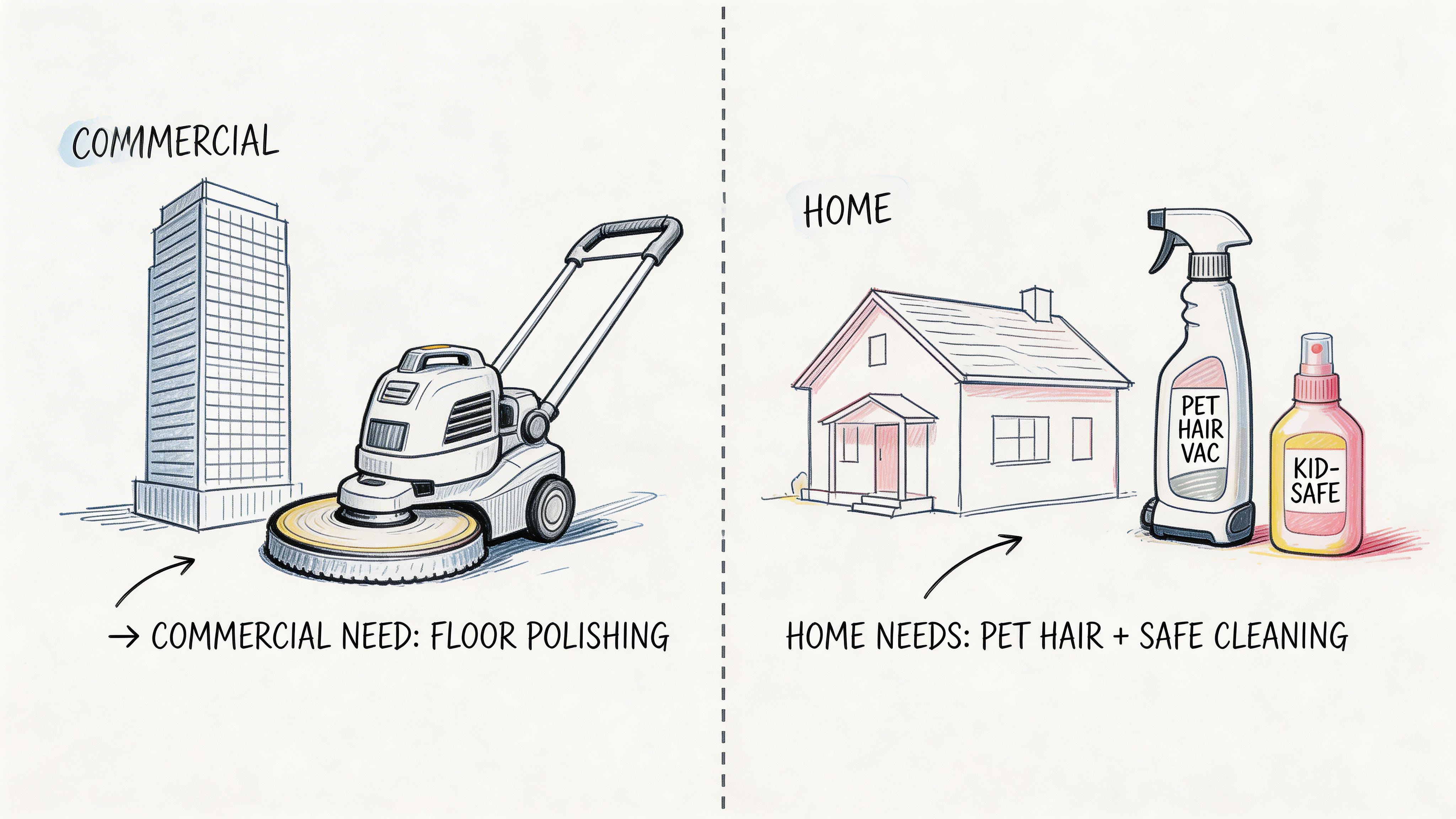
Commercial work usually rewards standardization. Many sites have repeated layouts, predictable restrooms, and larger floor areas. That means stronger focus on floor tools, restroom stock, liner replacement, and speed-oriented setups.
Residential work is less uniform. Homes have mixed surfaces, personal belongings, specialty finishes, pet hair, laundry areas, toys under furniture, and kitchens used in very different ways. Your team needs more adaptability and better product judgment.
Here is the practical difference:
| Job Type | Supply Priority | Typical Focus |
|---|---|---|
| Residential | Surface-safe products, detail brushes, microfiber variety, spot treatment | Kitchens, baths, dust, pet hair, touchpoints, personal spaces |
| Commercial | Floor tools, restroom chemicals, liners, larger refill volumes | Restrooms, break rooms, high-traffic floors, repetitive touchpoints |
If commercial work is part of your growth plan, this guide on how to start office cleaning business helps frame the operational differences before you buy the wrong equipment mix.
One of the biggest blind spots in common cleaning content is customization. Most generic cleaning supplies lists fail to account for household variables like children, pets, or allergies. This creates an opportunity for businesses using smart estimators to ask these questions upfront, providing customized estimates and demonstrating a higher level of service, as noted in this Apartment Therapy discussion of the gap in standard cleaning supply advice.
That is true in daily operations too. The right list depends on who lives there.
Pet homes usually need:
Pet hair breaks weak systems fast. If crews use the same cloths and pads from house to house without sorting them properly, wash loads become less effective and vans get messy.
Child-heavy homes change both product selection and storage habits.
The issue is not only safety. It is speed. Family homes generate clutter and irregular messes, so your supply caddy has to support quick switching between kitchen grease, bathroom cleanup, and floor spot work.
These clients often care about residue, fragrance, ventilation, and dust control more than “strong smell equals clean.”
Tip: For sensitivity-focused homes, fewer products usually works better than more. Bring a tighter kit, label everything, and avoid introducing extras just because they are in the van.
In these jobs, a HEPA-style vacuum setup, cleaner microfiber discipline, and fragrance awareness matter more than a broad chemical arsenal.
A scalable business does not send the exact same tote everywhere. It creates base kits and job-specific add-on kits.
A simple version looks like this:
That is easier to train, easier to restock, and easier to estimate accurately than one oversized kit packed for every possibility.
Buying cheaper is not the same as buying smarter.
A low sticker price can still be an expensive product if crews use too much of it, if it cleans slowly, or if it creates redos. The supply decisions that help margins are the ones that account for use rate, training burden, and job fit.
Two bottles can look similar and perform very differently in the field. One leaves residue and doubles wipe time. Another works faster but requires proper dilution. Owners who only compare invoice prices miss the labor side of the equation.
Review products using a simple filter:
The goal is a lean lineup. Every item should either solve a recurring problem or make crews faster.
Do not bulk-buy everything. Bulk makes sense for stable, high-turn items. It is risky for niche products that move slowly or may not survive staff changes, service changes, or customer preference shifts.
Use three purchasing levels:
Bulk staples
Gloves, trash bags, microfiber, liners, common refills.
Controlled mid-volume products
Bathroom cleaner, glass cleaner, floor cleaner, scrub pads.
Low-volume specialty items
Stain removers, odor products, specialty surface products.
This approach protects cash flow and storage space at the same time.
A reliable distributor often saves more money than hopping between retail stores and online carts. You get steadier availability, easier repeat ordering, and fewer last-minute substitutions.
That does not mean blind loyalty. It means tracking what each supplier does well. One may be stronger on chemicals, another on paper goods, another on equipment parts. Split categories intentionally if needed.
For owners who want cleaner bookkeeping around this process, this guide on how to manage business expenses is useful because supply purchasing only improves margins when the tracking is disciplined too.
Key takeaway: A product is profitable when it cleans well, trains easily, stores safely, and gets reordered without drama.
Eco-friendly supplies are often discussed like a moral choice. In practice, they can also be a positioning choice.
Some clients care about lower-odor products, gentler formulas, or a greener image. If that is your market, a green line can help you stand apart and justify a more specialized service package. If it is not your market, forcing a full switch before your crews are trained may create confusion.
The practical move is to test a limited green kit first. Use it where the fit is clear. Compare field performance, crew feedback, and customer response. Then decide whether it belongs in the standard lineup or as an optional package.
Before changing purchasing strategy, revisit your pricing logic too. If your supply standards are improving but your estimates still ignore those costs, you are funding the upgrade out of your own margin. This breakdown of how to price cleaning jobs helps connect supply spending to actual service pricing.
A good cleaning supplies list tells you what to own. A workflow tells you how not to lose control of it.
Most inventory failures happen in handoff points. Products arrive and never get logged. Teams pull supplies without recording them. Dirty microfiber comes back in random bags. Reorders happen only when somebody notices an empty shelf.
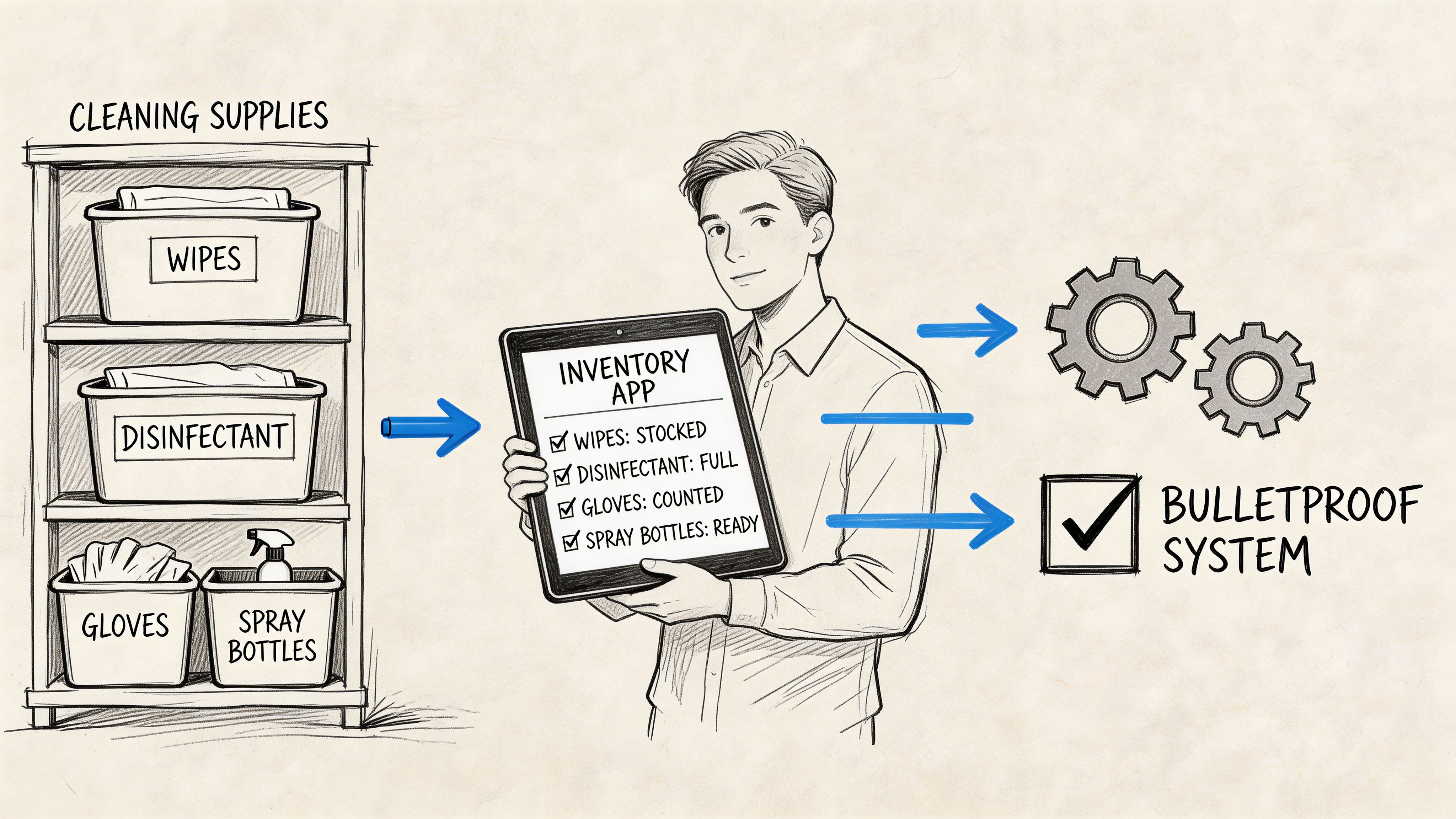
Do not let supply storage spread across office closets, personal vehicles, and random shelving in the laundry room. Set one main stock location and treat it like a mini warehouse.
A workable setup includes:
This does not need to be fancy. It needs to be consistent.
Complicated tracking gets ignored. Use a short, repeatable process.
At the start of the day, each team checks out:
Upon returning, they provide:
The person receiving returns should inspect quickly, not casually toss things back onto shelves.
Tip: If damaged spray heads and half-empty mystery bottles keep appearing, your issue process is too loose or your labels are poor.
The right time to reorder is not “when we run out.” It is when stock drops to the level that still gives you breathing room.
Create a minimum level for every fast-moving item. When stock hits that mark, reorder immediately.
A simple example:
| Item | Normal Storage Level | Reorder Point | Action |
|---|---|---|---|
| Microfiber cloths | Full shelf bin | Low visible reserve | Place restock order and flag laundry loss |
| Gloves | Standard case or box reserve | Final backup box opened | Reorder same day |
| All-purpose cleaner refill | Routine refill stock | Last reserve container in use | Reorder and review dilution use |
| Trash bags | Standard stack | Final reserve bundle opened | Add to next supplier order |
| Mop pads | Full rotation set | Limited clean backup available | Reorder and inspect laundry process |
You do not need advanced software on day one. You do need rules.
A shared spreadsheet can work for a small company if one person owns it. Include item name, storage location, unit type, reorder point, last purchase date, and preferred vendor. That is enough to bring order to a messy room.
As the business grows, inventory usually intersects with scheduling, field communication, purchasing, and team accountability. At that point, software starts saving more time than it costs. If you are evaluating tools across the business, not just inventory, this look at best cleaning business software is a helpful starting point.
This walkthrough is worth watching if you want a practical visual on organizing stock and process:
Do not tell new hires to “just keep an eye on supplies.” Give them a sequence.
A solid training checklist includes:
If you want accountability, tie the process to named responsibility. One person owns ordering. One person owns daily issue. Team leads own end-of-day returns. Shared responsibility sounds nice and fails in practice.
Growth breaks weak systems. More teams, more vans, and more locations create more chances for silent waste.
The fix is not more product. It is more standardization:
Once that is in place, the supply room stops being a source of surprise. It becomes predictable, auditable, and easy to hand off.
Start with fewer products, not more. New technicians make fewer mistakes when your core kit is tight and labels are obvious.
Use hands-on training for three basics:
Then test in the field. Ask the hire to build a caddy, label bottles, and explain which cloth color goes where. That catches confusion early.
Waste usually comes from poor bottles, bad training, or a belief that more product means better cleaning.
Fixes that work:
If one team burns through product faster than the others, inspect technique before blaming theft.
Keep an approved backup list. Do not force field crews to make last-minute substitutions on their own.
For each critical item, decide in advance:
This keeps your standards intact even when availability changes.
Review it any time your service mix changes, a recurring complaint appears, or a product sits untouched for too long.
A healthy list evolves. It gets tighter as you learn what crews use, what slows them down, and what creates unnecessary overlap.
No, not if you want quality control.
Company-provided supplies create consistency, cleaner training, better cost tracking, and fewer customer surprises. When each technician brings personal favorites, the business loses standardization. That makes results harder to manage and margins harder to understand.
Hire for reliability and process-following, not just speed. A fast cleaner who ignores labels and leaves half-used bottles in every van creates hidden costs.
If you need help finding cleaning staff, pipehirehrm.com is worth reviewing. It is also smart to use hiring content built around this industry instead of general recruiting advice. The get.pipehirehrm.com/blog can help with staffing process ideas for cleaning teams.
During interviews, ask practical questions:
Those questions reveal more than generic “are you detail-oriented” prompts.
Do not start by buying containers.
Start by removing junk, duplicates, and mystery products. Then sort what remains into four groups: chemicals, tools, consumables, and PPE. Label shelves. Create one sign-out sheet. Set reorder points for the items you always run out of first.
That simple reset solves more problems than a fancy storage makeover.
If you want faster, more consistent estimates for residential or commercial cleaning jobs, Estimatty helps you capture job details, standardize pricing, and respond around the clock without adding office workload.