September 21, 2026
Inside and Out Cleaning: A Practical Pricing Guide
Learn what inside and out cleaning really includes, how pricing works, and which add-ons actually pay off for residential and commercial estimates.

Monday, June 29, 2026
Build a policies procedures manual for your cleaning business. Our guide covers SOPs, safety, HR, pricing, and tech integration like Estimatty for growth.
.png)
Your phone rings while a team lead is texting about a lockout. A client wants to know why her “standard clean” didn't include baseboards. A new hire used the wrong chemical in a bathroom. Someone on your staff gave an estimate that doesn't match what the office would've sent. By the end of the day, you haven't just managed work. You've managed preventable confusion.
Such is the job of a cleaning business owner without a strong manual. You become the policy, the pricing desk, the trainer, the quality inspector, and the complaint department.
A solid policies procedures manual fixes that. Not because it looks professional in a binder, but because it turns tribal knowledge into an operating system your team can use. In cleaning, that changes everything. It tightens service quality, protects margins, reduces avoidable callbacks, and gives employees a clear standard when you're not standing next to them.
Most cleaning companies don't break because they can't clean. They break because they can't deliver the same result the same way, across different people, houses, crews, and client expectations.
When there's no written standard, every cleaner builds their own version of the job. One person folds towels. Another doesn't. One team remakes beds unless told otherwise. Another skips it because they're trying to make time. Then the office gets blamed for “bad communication” when the actual problem is that the business never documented the standard in the first place.
A manual matters most when the business starts growing. The owner can hold a lot in their head at five recurring clients. At fifty, that same style turns into bottlenecks, rework, and frustrated staff.
According to a 2023 SHRM survey summary on policy manual development, nearly 60% of HR professionals identified maintaining compliance with changing regulations as a top reason for developing and updating policy and procedure manuals. In practical terms, that tells you something simple. Serious operators treat documentation as protection, not paperwork.
For a cleaning business, the issues are broader than compliance alone:
Practical rule: If a problem repeats twice, it belongs in the manual.
The strongest manuals aren't written like legal lectures. They read like operational instructions from someone who knows what can go wrong on a real route day.
That means your manual should answer working questions fast. What happens if a cleaner breaks an item. Who documents before-and-after photos. How key handling works. What a recurring clean includes. When a team should call the office before adding extra tasks.
A good manual also supports quality control. If you're already tightening inspections with a cleaning quality assurance process, the manual becomes the standard your audits point back to. Without that source of truth, quality checks turn into opinions.
Owners sometimes resist documenting procedures because it feels slow. In reality, not documenting is what keeps the business slow. Every question returns to the owner. Every exception becomes a custom decision. Every new hire depends on memory and whoever happens to be training them that week.
A manual strengthens the company's position. It lets you delegate with confidence because “how we do it here” is written down, accessible, and trainable. That's how a cleaning company moves from personality-driven to system-driven.
A useful manual has to be easy to scan, easy to update, and hard to misread. If your team can't find the rule in under a minute, they won't use it in the field. They'll text a supervisor, guess, or do what they did at their last cleaning job.
That's why structure matters as much as content.
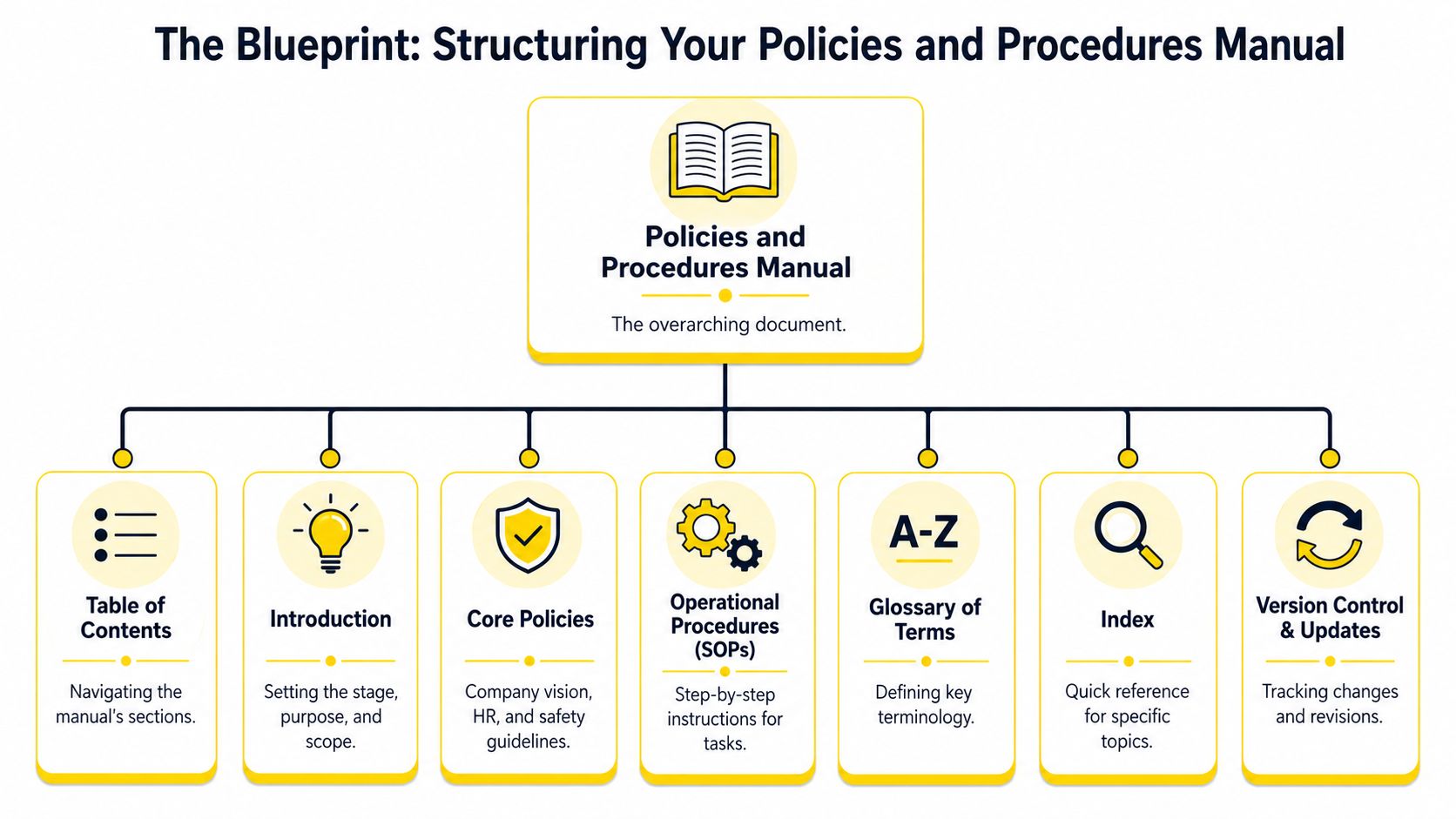
The cleanest framework I've seen is the one outlined by PowerDMS on writing policies and procedures. It identifies seven core components for policy manuals: Document Header, Purpose Statement, Policy Statement, Definitions, Procedures, Conduct Guidelines, and Reporting Requirements. Their benchmark data also says manuals that include all seven achieve a 92% employee comprehension rate, which correlates to 25% fewer operational errors in high-volume sectors like cleaning services.
For cleaning companies, each part has a direct use case:
| Component | What it does in a cleaning business |
|---|---|
| Document Header | Shows title, revision date, approver, and department so crews know they're using the current version |
| Purpose Statement | Explains why the rule exists, such as protecting client property or standardizing move-out cleans |
| Policy Statement | Sets the non-negotiable position, like no unauthorized add-on work without office approval |
| Definitions | Clarifies terms like standard clean, deep clean, post-construction, touchpoint disinfection |
| Procedures | Gives step-by-step instructions the team can follow on site |
| Conduct Guidelines | Covers behavior, professionalism, phone use, uniforms, and consequences |
| Reporting Requirements | Tells staff how to report incidents, damages, complaints, hazards, and time issues |
Most owners underestimate the definitions section. In cleaning, that's a mistake.
A client says she booked a deep clean. Your dispatcher says it was a first-time standard clean. The cleaner says the work order didn't mention inside cabinets. If those service terms aren't defined in the manual and mirrored in your estimate process, you're setting up your team for conflict.
Use definitions for:
A detailed cleaning schedule checklist system works much better when those terms are already standardized in the manual.
The wrong way to write a manual is to dump policy language into long pages no one reads. The right way is to write for the moment of use.
That usually means:
A manual only works when the cleaner in the driveway can understand it faster than they can text the office.
If you want a strong blueprint, think less like a writer and more like an operations manager. Your manual should tell people what the rule is, why it exists, what steps to follow, and what to do when the situation goes sideways.
Once the structure is right, the next step is writing the sections your team will use. During this phase, most manuals either become practical or become dead weight.
A cleaning business manual needs to reflect route reality. Late arrivals. Pets. Key codes. Damaged items. Chemical handling. Scope creep. Team no-shows. Client complaints sent by text after the crew has already left. If the manual doesn't address field conditions, it won't survive first contact with daily operations.
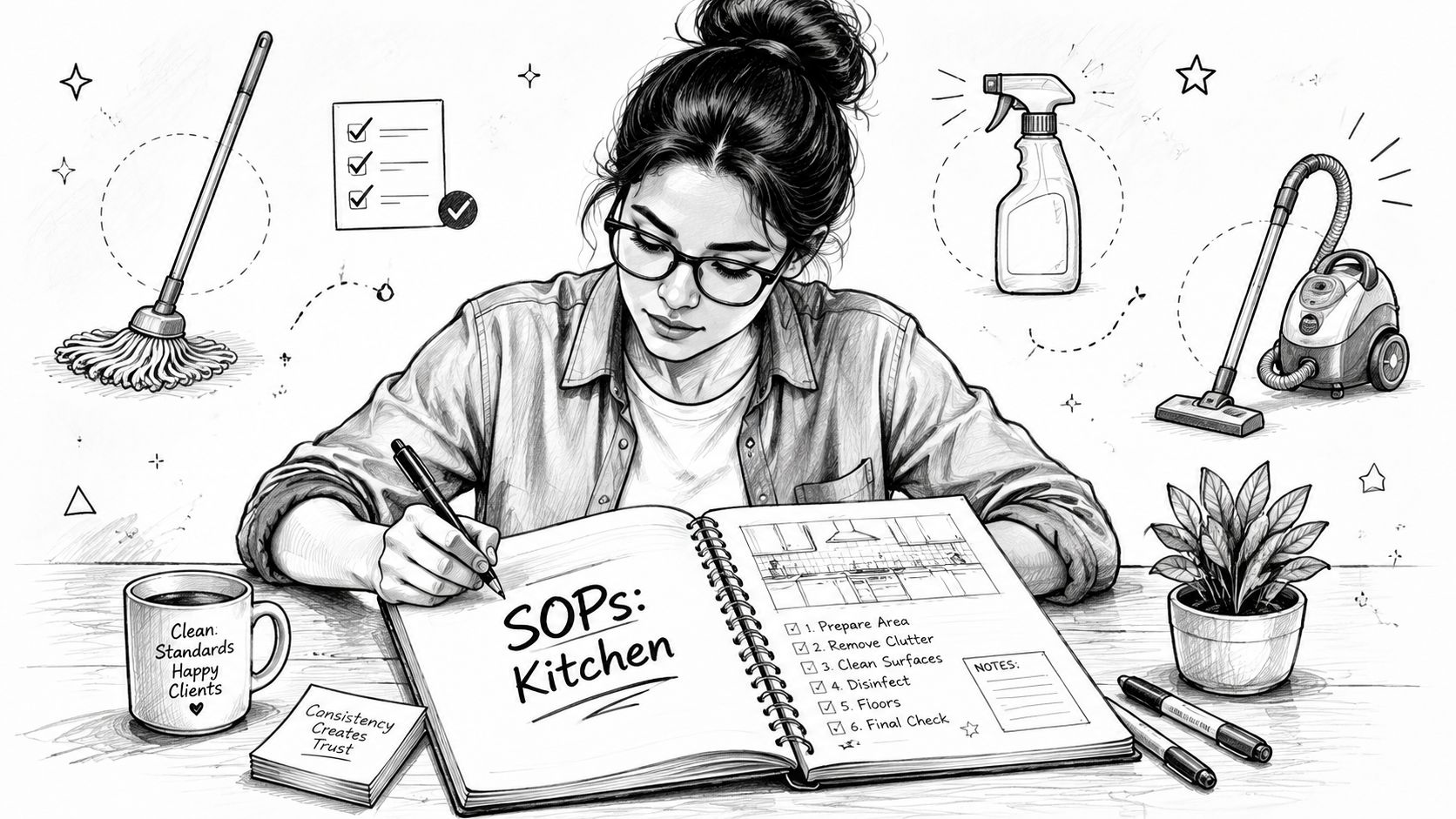
Your SOPs should tell a cleaner exactly how to complete the job, in what sequence, and what standard counts as done.
Take kitchens. A weak SOP says “clean all kitchen surfaces.” A usable SOP breaks out sink, counters, appliance exteriors, stovetop, visible fingerprints, trash removal, floor edges, and final reset. It also states what isn't included unless added, such as inside oven cleaning or hand-wiping individual pantry items.
For homes, I usually recommend organizing SOPs three ways:
A broken-item procedure is another key requirement. It should answer four questions immediately:
Without that, teams either hide mistakes or overpromise fixes.
Safety language has to be direct. Don't bury it under corporate wording.
If a cleaner is using chemicals, the manual should specify approved products, dilution rules, storage rules, PPE expectations, and what combinations are prohibited. If ladders aren't allowed above a certain task threshold, say so plainly. If blood or sharp-object exposure requires escalation, make that rule unmistakable.
A short safety policy table works better than a long essay:
| Situation | Required action |
|---|---|
| Unknown chemical in client home | Do not use it unless the company approves it |
| Needle, broken glass, or bodily fluid | Stop work, isolate area, report immediately |
| Aggressive pet or unsafe occupant behavior | Exit if needed and contact supervisor |
| Damaged electrical outlet or active leak | Do not continue cleaning in the affected area |
This part of the manual drives culture more than owners think. It sets the rules for attendance, appearance, phone use, respectful conduct, payroll reporting, mileage if applicable, and how performance issues are handled.
Hiring should also connect to the manual. If your recruiting process keeps producing mismatched hires, your manual and your job posts are probably describing different jobs. Tools like pipehirehrm.com can help streamline cleaning employee hiring, but the operational standards still have to live in the policy framework. The person you hire should know exactly what “punctual,” “client-ready,” and “team-fit” mean before day one.
If you're tightening this side of your operation, a practical read on developing HR policies for 2025 can help you think through modern handbook language without turning your document into legal mush. For cleaning-specific recruiting workflow ideas, the posts on hiring cleaning employees are also worth reviewing.
Write conduct policies for the employee you want to keep, not just the one you might need to discipline.
Many cleaning businesses lose money. They document how to clean, but not how to sell, scope, approve extras, reschedule, collect payment, or handle dissatisfaction.
Your manual should define how estimates are built and what has to appear before a client approves service. It should also state who can change scope and when the team must stop and call the office.
For residential recurring cleaning, one accepted estimating guideline is about 1.5 hours of labor for every 1,000 square feet before applying hourly rates, according to Cleaning 4 Profit's house cleaning estimating guide. For commercial work, standard recurring cleaning often falls in the $0.07 to $0.20 per square foot range, though labor time should drive the final estimate, as noted in Housecall Pro's commercial cleaning pricing overview.
Then comes the part owners skip. Profit.
A transparent, itemized estimate should include a profit margin of 10% to 20% after operating expenses like wages, supplies, and taxes are calculated, based on Connecteam's cleaning estimate calculator guidance. If your manual doesn't spell that out, staff will underbuild estimates under pressure and call it “being competitive.”
Here's the trade-off in plain terms.
What works
What doesn't
A policy manual becomes far more useful when your systems enforce it automatically. That's the gap most cleaning companies miss. They document a pricing policy, then let three different people answer leads three different ways.
That's how revenue leaks start. Not from dramatic failures, but from small inconsistencies repeated every day.
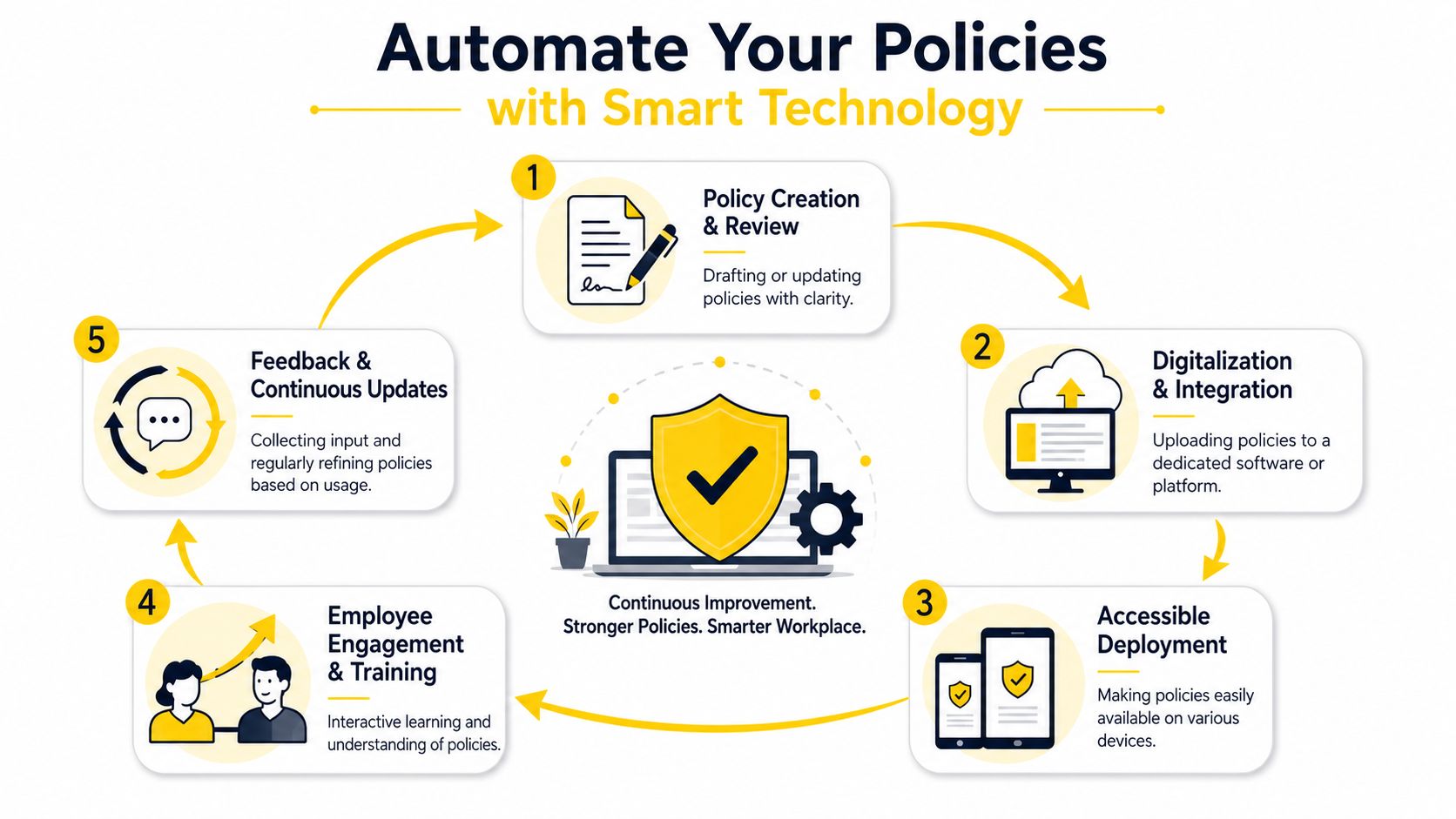
In a modern cleaning business, your manual should connect to the tools your team already uses. Scheduling software should reflect arrival windows and service durations. Hiring workflows should reflect screening standards. Estimate systems should reflect service definitions, add-ons, exclusions, and approval rules.
This matters most in pricing. A manual can say, “All estimates must follow approved service packages and add-on rules.” But if staff can still freestyle pricing over text or phone, the policy has no teeth.
Data from the No Surprises Act FAQs on good faith estimates shows AI-enabled good faith estimates reduce billing disputes by 30% to 40% in other sectors. Cleaning businesses can adapt the same idea by using AI-driven, real-time estimate standardization inside their own policy framework.
The biggest wins usually happen in four places:
If you're evaluating systems that support that kind of structure, look at tools that improve document workflow software for operations, not just generic file storage. A policy no one can trigger from daily workflow is still manual in the worst sense.
AI can help draft process language, standardize intake, and support consistency. It still needs human review. That's especially true when you're writing operational rules that affect employee conduct, customer communication, or incident reporting.
For owners who want a starting point on the legal-document side, AI legal document drafting is useful as a drafting aid. It's not a substitute for operational judgment, and it won't know your cleaning routes, your add-ons, or what your crews face in occupied homes.
A quick walkthrough helps make the point:
The best automation doesn't replace policy. It applies policy the same way every time.
That's the core shift. Your manual stops being a document your team is supposed to remember, and starts becoming a set of standards your systems actively reinforce.
A manual fails for one of two reasons. Either the content is weak, or the rollout is sloppy. I've seen well-written manuals die in a shared drive because nobody trained the team on how to use them in live situations.
Rollout needs the same discipline as route planning. People need to know what changed, why it changed, where to find it, and what happens when the policy and a real-world exception collide.
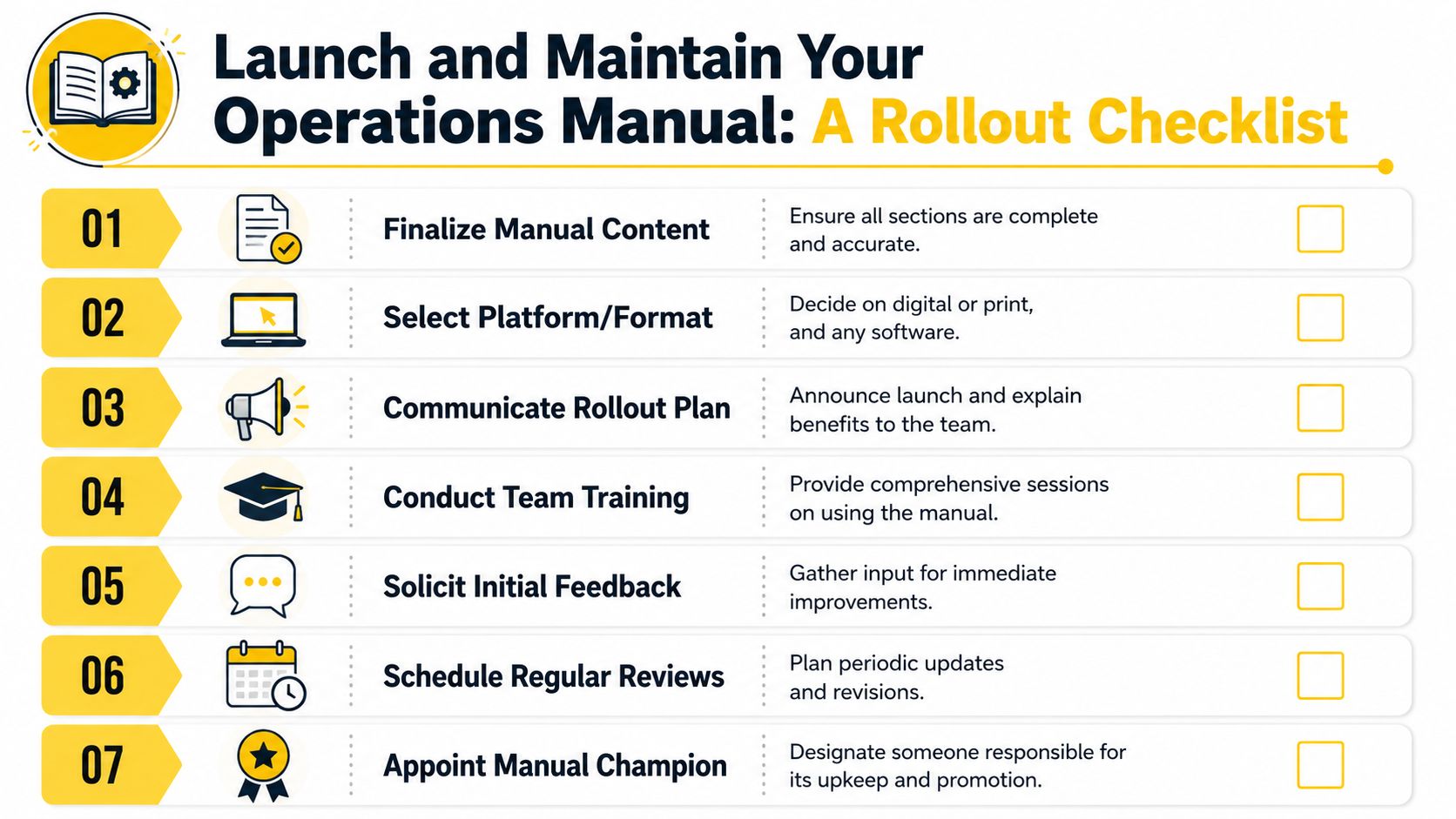
Don't just send the manual and ask for signatures. Pull the team together and walk through the operational changes.
Use actual scenarios:
Those conversations turn policy into behavior. They also surface vague language before it causes field problems.
A simple rollout sequence works well:
Someone has to own updates. In a small company, that may be the owner or office manager. In a larger operation, it may be operations or HR.
That person's job is to collect recurring issues, revise unclear sections, remove outdated procedures, and control version history. If nobody owns the manual, old copies spread fast and your team starts following different rules in different branches.
For support-heavy businesses, it can also help to deploy AI support agents around internal knowledge workflows, especially for routine staff questions. Used correctly, that can reduce the back-and-forth around where a policy lives or which version is current.
The maintenance standard should be clear. Policy and procedure manuals should be reviewed and updated at least once a year, or whenever there are significant changes in laws or internal processes, according to ClickHelp's guide to policy and procedure manuals.
For a cleaning business, “significant changes” usually include:
| Change event | What likely needs updating |
|---|---|
| New service added | Scope definitions, estimate rules, SOPs, quality checks |
| New chemical or equipment | Safety rules, handling instructions, training notes |
| Hiring model changes | Onboarding steps, probation expectations, role definitions |
| Scheduling changes | Arrival windows, route communication, missed-appointment rules |
Digital access matters too. If your crews work from phones, the manual has to be readable there. If scheduling is central to your operation, keep policy references close to the workflow. A system tied to online employee scheduling helps staff use the manual in the same environment where they see routes, timing, and job notes.
When a policy changes, train the change. Don't assume the PDF did the work for you.
The best cleaning companies don't rely on memory. They rely on standards. That's what a strong policies procedures manual gives you. It captures how your company sells, hires, cleans, communicates, escalates, and protects margin, then makes those decisions repeatable across people and locations.
That's why this document matters far beyond compliance. It improves the handoff from sales to operations. It sharpens training. It reduces avoidable disputes. It helps new hires ramp faster because they aren't decoding unwritten rules. And it gives managers something objective to coach against when performance slips.
For modern operators, the main advantage comes from connecting policy to tools. Hiring workflows can align with platforms like pipehirehrm.com so recruiting reflects the actual standards of the role. Estimate workflows can reflect approved scope, exclusions, and profit rules instead of gut-feel pricing. Educational content on estimatty.com/blog and get.pipehirehrm.com/blog can help owners think more systematically about those links between process, staffing, and growth.
If your company still depends on the owner to answer every edge case, the business isn't really scalable yet. It's busy, but it's still fragile.
Write the manual. Use it in training. Tie it to daily operations. Review it before it gets stale. A cleaning company with clear standards runs differently. It feels calmer, looks more professional, and protects profit in places most owners don't notice until the money is already gone.
If you want your estimate process to match the standards you've documented, take a look at Estimatty. It helps cleaning businesses deliver fast, consistent estimates around the clock, so your pricing policy doesn't fall apart after hours, on weekends, or when the office is slammed.