September 21, 2026
Inside and Out Cleaning: A Practical Pricing Guide
Learn what inside and out cleaning really includes, how pricing works, and which add-ons actually pay off for residential and commercial estimates.

Friday, March 27, 2026
Master online employee scheduling with this guide for cleaning businesses. Boost efficiency, cut costs, and empower your team with proven strategies.
.png)
If you're still juggling cleaning shifts in a spreadsheet, you're not just wasting time—you're actively leaving money on the table. Think about it. Every double booking, every missed job, and every no-show chips away at your hard-earned profits. Moving to online employee scheduling isn't just a minor upgrade; it's about building a solid operational foundation that can actually support your growth, instead of holding it back.
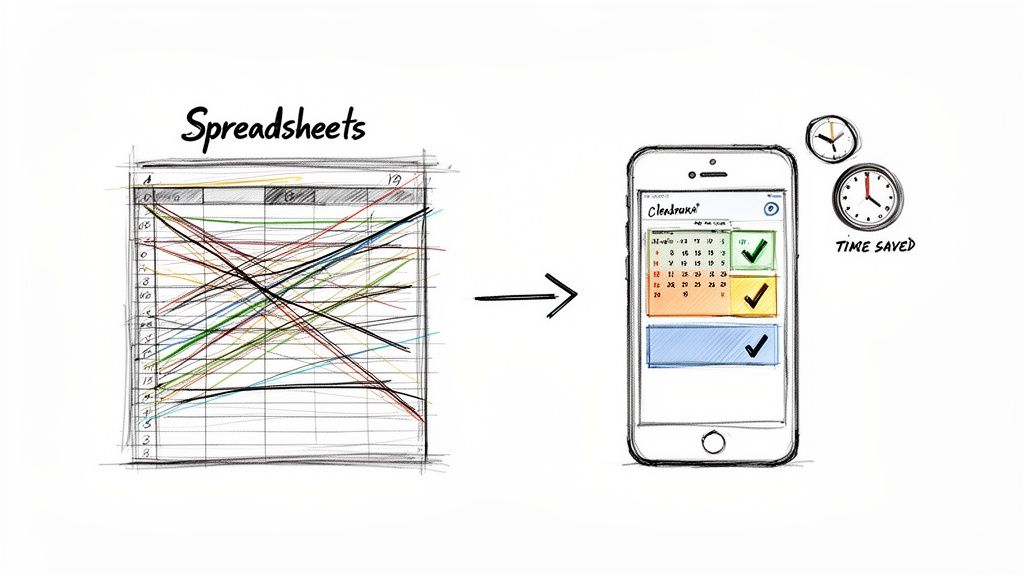
For too many cleaning business owners, scheduling is a chaotic mess of spreadsheets, endless text message chains, and a desk covered in sticky notes. We’ve all been there. But what starts as a "free and easy" system quickly turns into your biggest bottleneck. The constant back-and-forth just to confirm availability, scramble to cover a last-minute sick call, and make sure everyone has the right address is more than just a headache. It's a massive time suck.
And that lost time has a very real cost. In the world of small business, managers spend an average of 7.4 hours per week just trying to piece schedules together. Even worse, some studies show that a staggering 35% of a small business's revenue can be lost each year to simple scheduling mistakes like no-shows and being understaffed for big jobs.
Before you can see the true value of an online system, it's crucial to understand what your current manual process is really costing you.
We've put together a quick comparison to highlight the business impact.
| Metric | Manual Scheduling (Spreadsheets) | Online Employee Scheduling |
|---|---|---|
| Time Spent | 7+ hours per week on manual updates, calls, and texts. | 1-2 hours per week with automated assignments and templates. |
| Error Rate | High risk of double bookings, missed jobs, and payroll mistakes. | Near-zero errors with conflict detection and automated rules. |
| Employee Experience | Stressful. Constant uncertainty, last-minute changes, poor communication. | Empowering. Mobile access, self-service for availability and shift swaps. |
| Client Satisfaction | Inconsistent. Missed appointments and last-minute reschedules damage trust. | Reliable. Consistent service delivery builds loyalty and positive reviews. |
| Scalability | Extremely difficult. More clients and staff mean exponential chaos. | Effortless. The system grows with you without adding administrative burden. |
The table makes it clear: sticking with spreadsheets isn't saving you money, it's costing you growth opportunities and peace of mind.
The time drain is obvious, but the hidden costs of manual scheduling are what truly stunt your growth.
The fundamental problem with spreadsheets is that they treat your team like static data on a grid. In reality, your cleaners are your most dynamic assets. A proper scheduling platform gives you a live, interactive view of your whole operation, so you can make smart decisions on the fly.
Smart business owners know these outdated systems are a liability. That’s why so many are looking for modern tools to effectively replace spreadsheets and build a more resilient, professional operation.
Making the switch to an online employee scheduling platform is about more than just organization. It's a strategic move to reclaim your time and energy. It brings every scheduling task into a single, accessible hub that gives you and your cleaning crew total clarity and control.
The benefits are immediate. For example, when your scheduling tool talks directly to your booking system, you create a perfect, automated workflow from the moment a client books to the moment your team marks the job as complete. Our guide on the best house cleaning booking software dives deeper into how these integrations work. You can find more articles like this at estimatty.com/blog.
Ultimately, the goal is simple: automate the tedious work so you can focus on what actually grows your business—finding new clients, delivering five-star service, and thinking about your next move. It’s time to trade the administrative nightmare for true operational excellence.
When you're looking for the right online employee scheduling software, it's easy to get lost in a sea of features. But here’s the truth: most of those platforms were built for people sitting in offices or standing behind a retail counter. They weren't designed for the organized chaos of a cleaning business, where your crew is always on the move.
Picking the wrong tool isn't just an inconvenience; it can bleed your profits, kill your team's morale, and tie you to your phone all day. The key isn't to find the flashiest software, but to find the one that actually solves your biggest headaches—from last-minute bookings to making sure your team is at the right house with the right instructions.
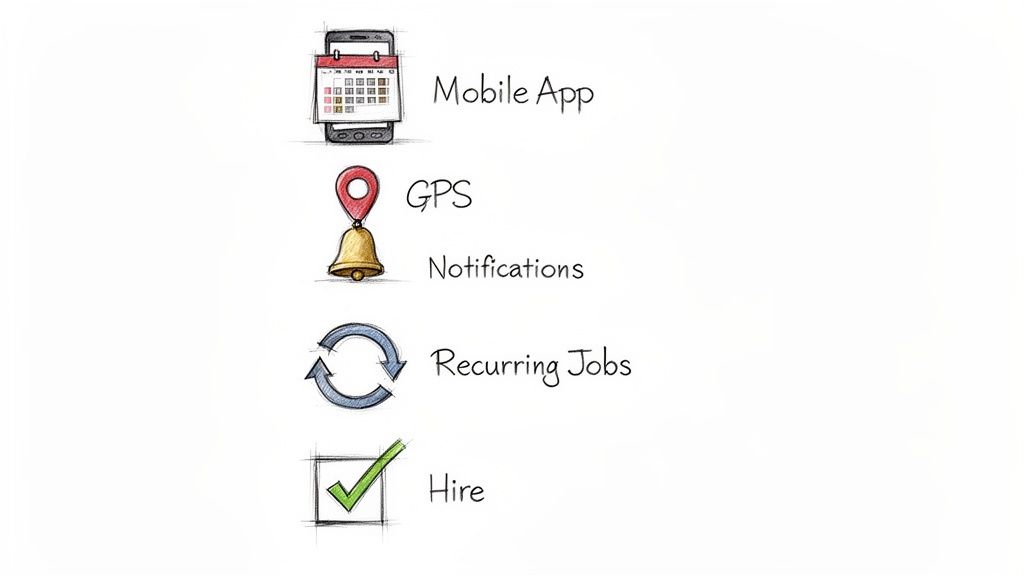
Don't even consider a generic scheduling app. Your business runs on a specific set of needs, and your software has to meet them. As you're comparing options, think of these features as your absolute must-haves.
A great scheduling tool does more than just fill a calendar. It becomes the command center for your entire operation, giving you a real-time view of where your people are and what they need to knock the next job out of the park.
What you need today might not be what you need in a year. The best software choice is one that not only solves your current problems but also has the power to handle more complexity as you scale.
Think about managing multiple teams in different parts of town. Can the software let you filter by service area to see who's free for an urgent call-out? And we all know last-minute changes are part of the game. A good platform lets you drag-and-drop a job to another cleaner without creating a scheduling nightmare. When you're ready to dive deep, a solid guide on small business scheduling software can give you a solid framework for making a smart choice.
Let’s be honest: the best software in the world won’t help if you don’t have reliable people to schedule. This is where you need to think about your entire process, from hiring to scheduling. If you need help hiring cleaning employees, you can visit pipehirehrm.com.
Using a specialized hiring platform built for the cleaning industry, like Pipehire, can be a game-changer. It helps you find and screen cleaners who are a good fit from the start. Once you’ve made a hire, they can be onboarded directly into your scheduling system for training and then assigned to regular routes. It creates a seamless flow from applicant to top-performing team member. As we explore in our guide to the best cleaning business software, connecting these systems is what truly builds a resilient, efficient business.
With remote and hybrid work becoming the new normal—forecasts show over 36 million people will soon be working from home part-time—the demand for reliable cleaning services is only growing. This makes sharp online employee scheduling more critical than ever. In fact, modern systems have been shown to slash scheduling time by up to 75% and can even help reduce turnover by creating fairer, more predictable shifts for your team.
Alright, you’ve picked out your online employee scheduling software. That’s a huge first step. But right now, it’s just an empty box. The real magic happens when you turn that software into a well-oiled machine that runs your daily operations so smoothly you’ll wonder how you ever managed without it.
Let's get it set up for maximum efficiency. This initial work is everything. It's the foundation that will save you from scheduling chaos, keep your team happy, and ensure every single clean is flawless.
First things first, we need to feed the system the right information. This isn’t just about plugging in names and addresses. We're talking about the nitty-gritty details that allow the software to think for you and make smart, automatic assignments.
Create Rich Employee Profiles: Don't just stop at a name and phone number. A truly useful profile gives you a complete picture of each team member.
Flesh Out Your Client Locations: Every client site is more than an address on a map. It’s a unique environment with its own set of rules.
When your system is dialed in, a new job for a "pet-friendly, bi-weekly client in the north suburbs who needs a deep clean" will instantly trigger a recommendation for the best-qualified, available cleaner in that area. That’s the kind of automation you're aiming for.
With all that core data in place, it’s time to create templates. This is where you’ll start reclaiming hours of your life every single week. The goal is to stop building every schedule from scratch and start using repeatable, pre-built blocks.
Your best friend here is the shift template. For every recurring job you have—whether it’s a bi-weekly residential clean or a nightly office contract—you should build a template. This pre-made shift already includes the client, location, time estimate, and any special instructions.
When you’re building out next week’s schedule, you’re not typing everything in. You’re just dragging and dropping these templates onto the calendar. It’s faster, simpler, and it guarantees consistency. You’ll never again forget that one special request from your most valuable long-term client, because it's already saved in the template.
One of the hardest parts of running a cleaning business is dealing with the unexpected. A great online employee scheduling platform lets you build in flexibility for your team without giving up control. You do this by setting clear, automated rules from the get-go.
Key Rules to Establish From Day One:
By putting in this work upfront, you're building a system that respects your team's lives while protecting your business needs. You'll prevent burnout by honoring their availability and ensure your best clients are always cared for by your best cleaners.
And speaking of automation, once your schedule is humming, think about how you can streamline the sales process that feeds it. For more on that, check out our guide to AI sales automation for cleaning services. Moving from a blank slate to a fully automated system is how you grow your company without multiplying your stress.
Your scheduling software can't just be a digital calendar sitting off on its own. It only truly starts working for you when it talks to the other tools you use to run your cleaning business. Think of it as creating a central nervous system for your company, connecting everything from sales to payroll.
This isn't about making things more complicated. It's about building a smooth, automated path from the moment a new client books a job to the moment you pay your team for their work. When your systems are connected, you eliminate the tedious manual work and get a clear, honest picture of your entire operation.
The single most powerful connection you can make is between your sales process and your online employee scheduling software. Let's be real: the moment a customer decides to buy is a critical one. You want to make that process as seamless as possible.
Without an integration, this is where things get clunky. A client accepts an estimate, and now you have to manually copy their name, address, and job details from your CRM or email into your scheduling tool. Then you have to hunt for an available cleaner. It’s slow, prone to typos, and creates a delay that can feel unprofessional to a new client.
Now, imagine this instead:
The job is locked in and ready for you to assign to the right cleaner with a single click. You’ve just cut out the data entry, minimized the chance of errors, and captured that booking while the client was still excited. If you're curious how this works in the real world, check out how tools like the Estimatty and Jobber integration make this happen.
The next non-negotiable link is between scheduling and payroll. Manually tallying hours from paper timesheets or confusing spreadsheets is a nightmare. It’s a huge time-suck, and even small mistakes can lead to overpaying, underpaying, and a whole lot of frustration from your team.
You're not just running a cleaning business; you're running a data business. When data flows automatically from your sales form to the schedule and then to payroll, you've built a machine that runs itself, freeing you up to actually grow the company.
When your crew uses the scheduling app to clock in and out for each job—especially with GPS stamping to verify their location—you get a perfect, undeniable record of their time. A proper integration will sync these hours directly with your payroll system.
This means when it's time to run payroll, your job is simply to review and approve. The system has already done the heavy lifting, automatically calculating:
This connection doesn't just save you a headache. It ensures your people are paid correctly and on time, every single time. That’s how you build a professional reputation and a team that trusts you.
Finally, make sure your scheduling platform can talk to your primary communication channels, especially SMS. Most apps have their own notifications, but direct SMS integration offers a rock-solid backup for urgent updates.
For example, a client calls to cancel their appointment for this afternoon. You can simply delete the job from the schedule, which then triggers an automatic text message to the assigned cleaner. This instant alert saves them from wasting gas and time driving to a canceled job.
This web of connections transforms your online employee scheduling tool from a simple calendar into the command center for your entire business. It makes sure that from the first estimate to the final paycheck, your operations run on accurate, live information. This is how you stop just managing tasks and start leading a smarter, more profitable cleaning company.
Let’s be honest: high employee turnover is a nightmare for a cleaning business. It's a constant drain on your profits, your time, and your sanity. You're not just losing a person; you're losing the money you spent on hiring and training, the trust you've built with clients, and the quality consistency that defines your brand.
But what if I told you one of your most powerful tools for keeping great employees isn't a bonus or a perk, but your scheduling software? When you get smart about scheduling, it stops being about just plugging holes in a calendar. It becomes how you show your team you respect them. A happy, stable crew is your ultimate competitive advantage—and it's something your clients will notice immediately.
Think of your business as a connected system. A new job is booked, it flows to the schedule, and that schedule dictates your payroll. When it works smoothly, it’s a thing of beauty.
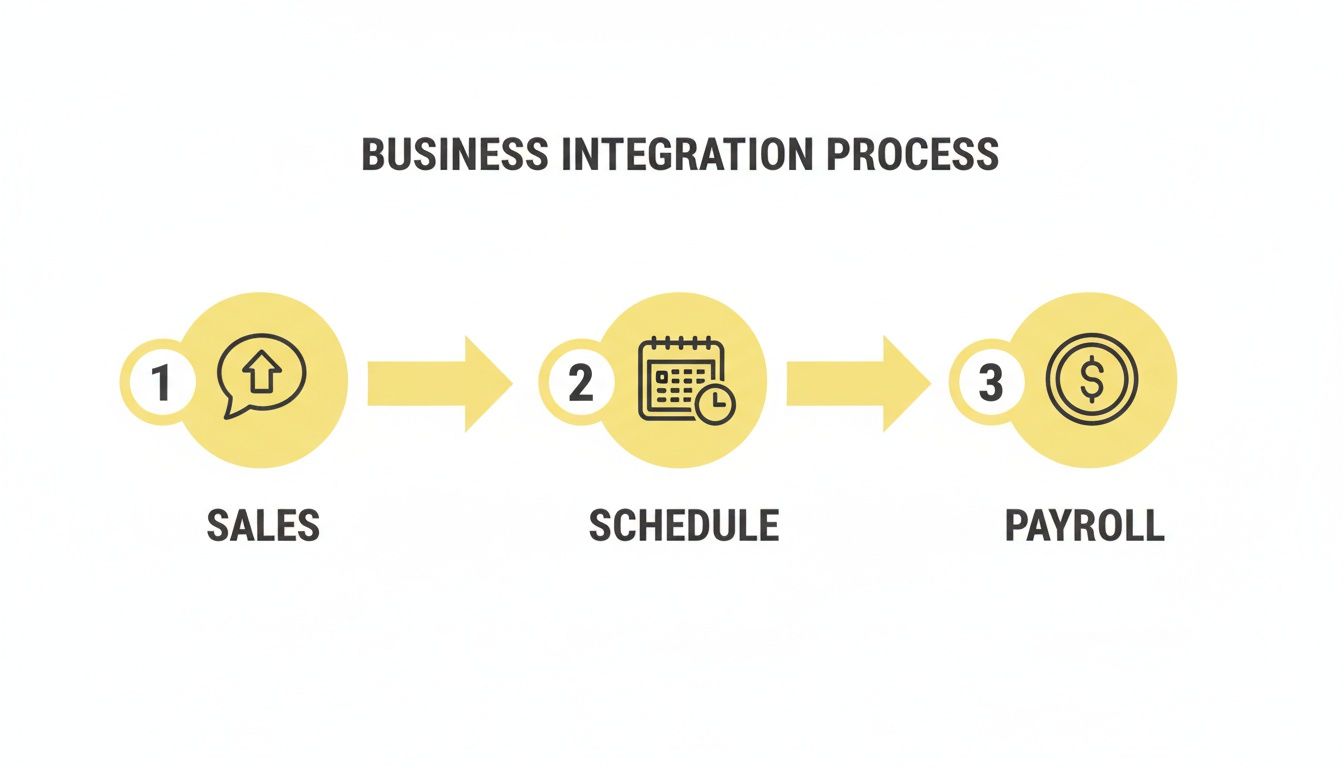
When you nail this flow, a booked estimate automatically populates the schedule, which then feeds perfectly accurate hours to payroll. It's a seamless loop that saves you headaches and makes your entire operation run better.
I’ve seen more great cleaners burn out and walk away over a chaotic, unpredictable schedule than for any other reason. It’s exhausting and it feels disrespectful. Your scheduling software is your chance to flip that script and prove you have your team’s back.
Here are a few ways to build a schedule that makes people want to stay:
When you put your team’s well-being first, you’re not just being nice—you’re building a rock-solid foundation of loyalty. That’s how you create a team that clients know by name and ask for specifically.
Your scheduling platform is spitting out valuable data every single day. Are you using it? Don't just look at who’s clocked in; look at how they’re working. This is your early warning system for employee burnout.
Ignoring the warning signs is costly. While 15-20% of businesses still wrestling with spreadsheets can lose up to 35% of their revenue to sheer inefficiency, a modern system can turn that around. In fact, with 67% of customers wanting to book online anyway, adopting the right tools can give you a 27% revenue lift. It’s about working smarter.
Keep a close eye on these red flags in your dashboard:
Nothing kills morale faster than a schedule that feels unfair. Your team absolutely notices if the same person always gets stuck with the grueling Friday night jobs or if another cleaner gets all the easy, high-tip residential gigs.
Use your software to be a better, fairer boss. You can set up rotations for less desirable shifts or use tags to track who’s done the last few heavy-duty deep cleans, ensuring that tough work is distributed equitably.
This proactive and fair approach doesn't just keep the team you have; it helps you attract an even better one. When you build a reputation as a great place to work, top talent will seek you out. To learn more about building that talent pipeline from the very beginning, see our guide on using an applicant tracking system for your cleaning business. Ultimately, a company culture focused on employee well-being is the cornerstone of any successful service business.
Making the leap to a new scheduling system is a big decision. I get it. You've got a crew to manage, clients to keep happy, and a business to run. You need to know that any new tool is going to make your life easier, not more complicated.
Let's walk through some of the most common questions I hear from other cleaning business owners so you can feel confident you're making the right move.
This is always the first question, and the answer is probably less than you think. Most scheduling software runs on a simple per-user, per-month price.
For a typical cleaning business with a team of 5-10 cleaners, you’re looking at around $2 to $5 per user each month for a plan that has everything you really need—like mobile apps for your crew and GPS time tracking. That puts your total monthly bill in the very reasonable range of $25 to $100.
But here’s the thing: don’t just look at the cost. Think about the return. If a $50/month platform saves you five hours of scheduling headaches every single week (and trust me, it will), it’s paying for itself many times over. Always look for companies with clear pricing and, most importantly, run a free trial to see how it works for your team before you pull out your credit card.
I get this question all the time, and it’s a big one. Your team is out in the field, not sitting at a desk. The last thing they need is some clunky, confusing app slowing them down.
Here's the good news: the best platforms are built for exactly this reality. They have dead-simple mobile apps that are as easy to use as sending a text. Your cleaners should be able to see their schedule, clock in with one tap, and put in a time-off request without any fuss.
My advice: Don’t just trust the sales pitch. Before you commit, grab two or three of your most reliable (and maybe most tech-resistant) cleaners and run a short trial. Let them see how convenient it is to have their entire work life in their pocket. Once they get a taste of that, any hesitation usually vanishes pretty quickly.
Plus, many of the top scheduling tools now offer their apps in multiple languages, which is a game-changer for the diverse and hardworking teams that form the backbone of our industry.
This is where a great scheduling tool stops being just a calendar and becomes the true command center for your business. Smart integrations are what unlock its real power.
Think of your scheduling software as the central hub. For example, when you use a tool like Estimatty to send an estimate and the customer hits "accept," that job can pop up automatically in your schedule, ready for you to assign. No more double-entry, no more missed jobs because of a typo. It just works.
The same goes for hiring. When you bring on a great new cleaner you found through a service like the one at pipehirehrm.com, you can add them to your scheduling system in a couple of clicks. From there, you can immediately assign them to training shifts and get them on the schedule, making your whole hiring-to-first-shift process incredibly smooth. You can find more helpful articles at get.pipehirehrm.com/blog.
Ready to stop chasing down leads and start booking jobs automatically? Estimatty provides an AI-powered sales agent on your website and phone line, delivering instant, accurate estimates to prospects 24/7. Turn more inquiries into booked jobs and feed your schedule with a steady stream of work, all without lifting a finger. See how it works at https://www.estimatty.com.