
November 20, 2026
10 Best Carpet Cleaners Rochester NY: Compare & Choose
Compare 10 carpet cleaners Rochester homeowners trust — services, pricing transparency, coverage, and guarantees to help you pick the right provider.

Saturday, November 21, 2026
Compare 10 AI voice agent services for businesses: real pricing, use cases, integrations, and honest limits so you can match one to your call volume.
The best AI voice agent can't fix a broken estimate process. Most service businesses don't lose jobs because nobody answers the phone. They lose them when the person or software answering can't turn the conversation into a usable estimate and a booked appointment.
Say someone calls at 7:45 p.m. about a three-bedroom deep clean. A receptionist collects a name and promises a callback. A capable sales agent asks about bathrooms, approximate size, property condition, surfaces, add-ons, and timing, then applies your approved pricing rules. The difference isn't whether someone answered. It's whether the customer can confidently take the next step.
Before comparing voices, fix how to price a cleaning job. If your team hasn't defined what deep cleaning includes or when a property needs manual review, software will repeat that uncertainty faster.
The buying rule: Score the completed transaction, not how convincingly the agent says hello.
These AI voice agent services for businesses get evaluated through two lenses: can the agent produce a consistent, usable estimate, and what does a booked job cost after overages, telephony, model fees, and human intervention? The readiness verdicts below are editorial assessments of workflow fit, not results from a controlled product test.
The order starts with cleaning-specific estimating, moves through turnkey receptionists, and ends with configurable platforms. Every price shown comes from the vendor's published information, not a third-party pricing roundup. Included minutes aren't interchangeable with calls, customers, or conversations, so don't compare subscription totals without understanding the billing unit.
A pleasant conversation is useful. A correctly priced job, confirmed in your scheduling system without another round of callbacks, is the outcome worth paying for.

Priced-and-booked readiness: Cleaning-specific fit. The limitation comes first: this is built for cleaning businesses, not every service category. And even a purpose-built estimator needs your pricing rules configured correctly before it should represent your business.
Our bilingual AI voice agent answers under your brand, handles service and availability questions, gathers job details, and guides prospects toward booking. Matty also engages website visitors, sends estimates by SMS or email, and alerts your team when someone raises their hand. That connection between web inquiries and phone conversations matters when customers switch channels before deciding.
Our starting price is $25/week. Treat that as a starting subscription figure, not a per-minute rate or a promise that every configuration costs the same. Dividing an availability-based subscription by hours doesn't tell you what a qualified estimate or completed booking costs.
For a deep-clean inquiry, the useful work isn't taking a message. It's capturing square footage, surfaces, service requirements, and urgency, then applying your own pricing consistently. Our guide to AI voice agents explains the broader role of voice automation in that process.
Setup is no-code: establish the account, customize pricing and add the widget to your existing website, then choose the agent's voice and add FAQs. Zapier integration and lead notifications help move the resulting inquiry into the team's existing workflow.
Verdict: A strong starting point for cleaning owners who want estimating and booking together. Test the estimate against your approved pricebook, then verify that the booking and customer summary contain the same scope.
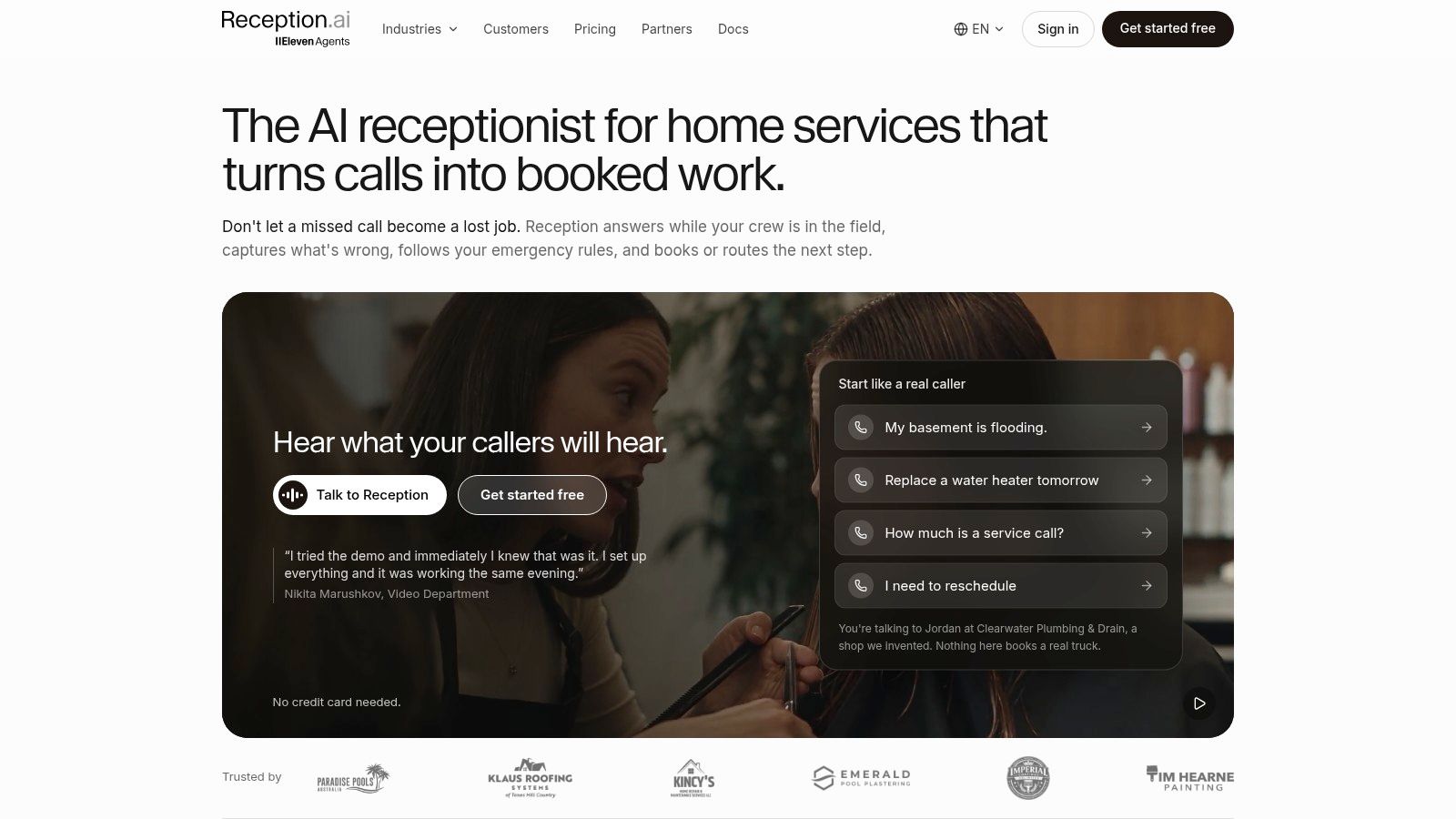
Priced-and-booked readiness: Reception-ready, estimating needs proof. Reception targets home-service call handling, but that doesn't make it a cleaning pricebook. Expect the biggest disappointment when a caller wants a condition-sensitive deep-clean estimate rather than an appointment or callback.
Reception's home-services page lists a free start and $29/month for 75 minutes, which works out to approximately $0.39 per included minute if you use the full allowance, before any additional charges. That's subscription-allocation math, not its published overage rate.
The product can gather caller and job information, follow business rules, and book or route inquiries. For an owner who mainly needs after-hours coverage, that's a more direct starting point than assembling a developer platform.
Give the agent a normal cleaning request, then change the scope mid-call. Add an oven, mention heavy buildup, and ask whether the original estimate still applies. You need to hear whether it recalculates through approved rules, escalates, or merely collects another note.
The distinction between an answering service and a sales workflow is covered in this virtual receptionist guide for small businesses. Choose this service when reception is the immediate gap, but make estimate generation a separate acceptance test.
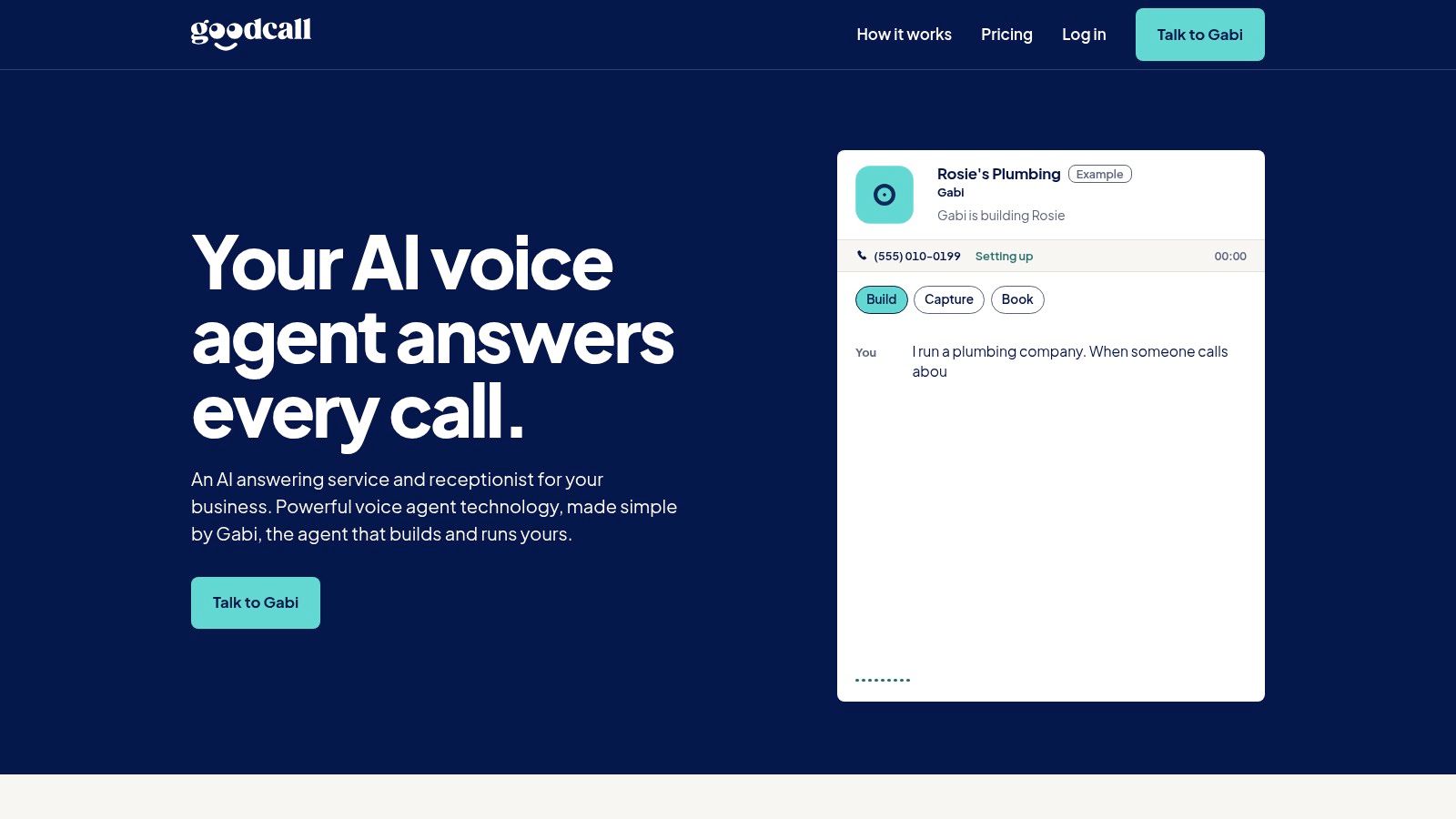
Long calls aren't automatically expensive here. Goodcall bills around unique customers rather than minutes, which changes the economics for businesses whose callers need time to explain access, pets, parking, and cleaning priorities.
Goodcall lists its Starter plan at $79/month for up to 100 unique customers, with additional customers billed at $0.79 each. Repeat calls from the same phone number count as one customer within the month, according to its published billing approach.
Priced-and-booked readiness: Strong answering fit, downstream workflow unproven. The weakness is not necessarily conversation length. It's whether the agent can move beyond answering and routing into your actual estimating and booking systems.
A billing model that tolerates long conversations is useful only if those conversations finish useful work.
Goodcall includes a local number and supports forwarding an existing number. Its demo agent gives you a way to assess conversation behavior before purchasing, without building an agent from individual infrastructure components.
A company with repeat callers may prefer this model to minute-based billing. A business receiving many brief calls from new numbers should model those contacts carefully, including inquiries that never qualify for service.
Use the demo to test an existing customer calling back about a previously discussed cleaning. The agent should preserve the distinction between a new lead, a scope change, and an operational question.
Verdict: Sensible for answering and routing when per-minute uncertainty bothers you. It will disappoint on an end-to-end estimate workflow if your required pricing logic, calendar write, or CRM update isn't supported. Require a completed booking record, not just a convincing conversation.
Managed setup removes configuration work, not your responsibility for pricing. Wellgrow's team trains the receptionist on services, service areas, pricing, and operating rules. That can suit an owner who doesn't want to become the household expert on voice-agent prompts.
The Wellgrow home-services website lists plans from $199/month and says most setups take 5–7 days. Treat the setup timeframe as the provider's expectation, not a substitute for accepting the finished workflow.
Priced-and-booked readiness: Promising managed fit, integration-dependent. Its published capabilities include qualifying leads, booking appointments, capturing addresses, applying service-area rules, and supporting multiple languages.
The disappointing scenario is a caller who qualifies geographically but needs a service combination your scheduling system represents differently. A generic appointment can look successful while leaving your dispatcher to rebuild the job.
Ask the implementation team to demonstrate a booking in your actual software environment. Confirm the address, requested service, estimate status, customer notes, and appointment ownership before considering the workflow complete.
Verdict: A practical candidate for companies that want a managed receptionist connected to field-service software. The higher starting subscription is easier to justify when it replaces implementation work and manual re-entry, not merely when the agent answers pleasantly.
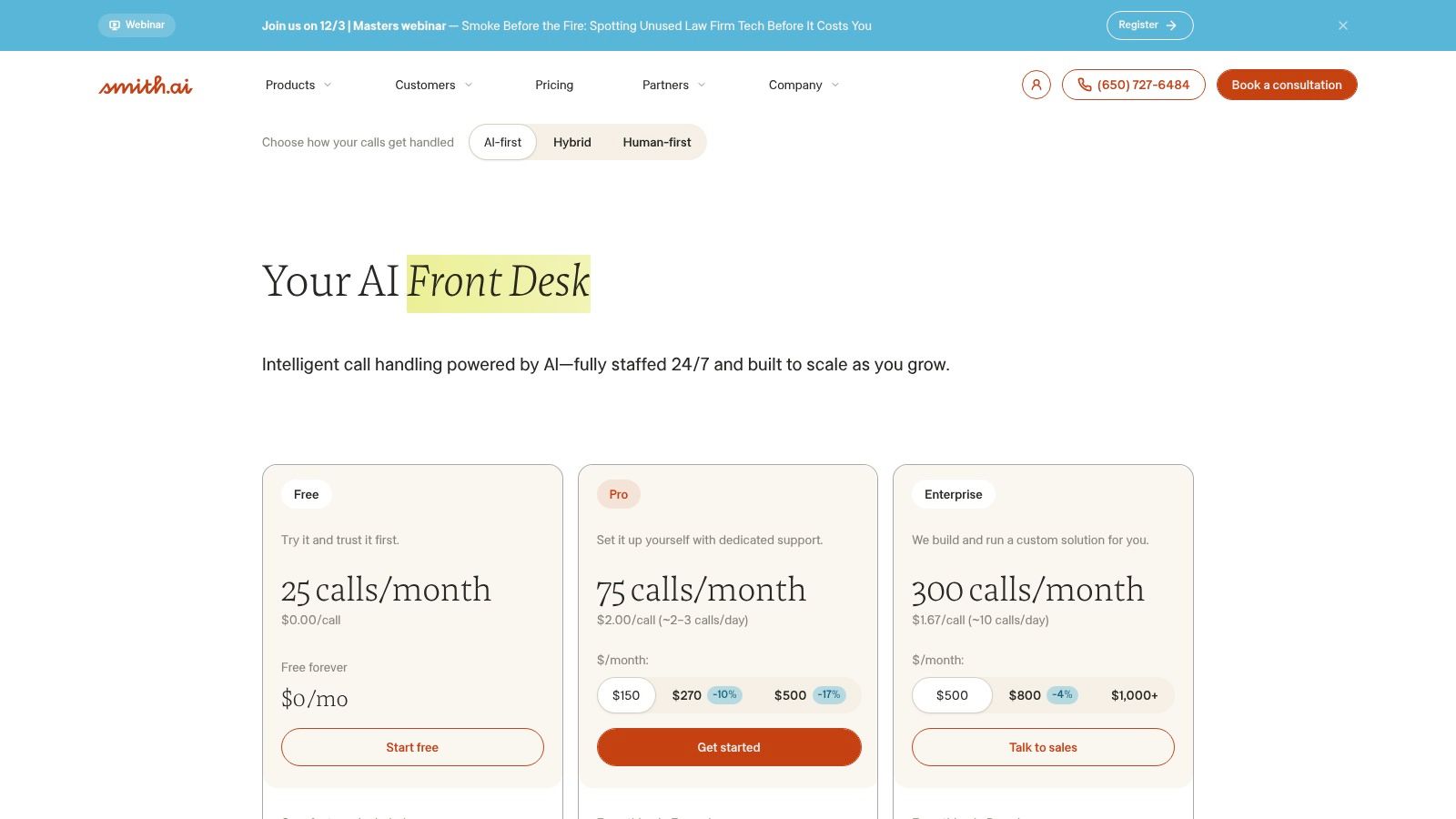
Human escalation is the reason to shortlist this service. Smith.ai combines AI answering and lead qualification with access to live North America-based receptionists. That matters when a caller disputes pricing, describes an unusual property, or refuses to continue with automation.
The Smith.ai AI Receptionist pricing page lists a free tier with 25 calls per month and Pro at $150/month for 75 calls, equivalent to $2 per included call at full allowance. That derived allocation isn't an overage rate or a complete estimate of live-receptionist costs.
Priced-and-booked readiness: Escalation strength, estimate workflow needs validation. Per-call billing doesn't rise solely because an individual conversation runs longer, but unsuccessful inquiries can still consume the allowance.
Test whether the receiving receptionist gets the cleaning scope, customer's concern, and information already collected. Otherwise, your customer has to repeat the same conversation to another person.
This AI receptionist pricing guide helps distinguish the billing units that make superficially similar plans difficult to compare.
Verdict: Worth considering when a reliable route to a person matters more than minimizing the headline subscription. Check spam treatment, call-counting rules, and live-assistance charges before forecasting cost per booked cleaning.
Priced-and-booked readiness: Multichannel intake fit, pricing logic needs proof. XBert makes sense when prospects contact your business through phone, SMS, and web chat. Its limitation is that unified communication doesn't automatically produce a unified cleaning estimate.
Nextiva's XBert page lists $99/month for 100 AI conversations, then $1.50 per additional conversation, alongside a 30-day money-back guarantee. The vendor's conversation definition matters because the billing unit isn't interchangeable with a phone call.
XBert can answer FAQs, qualify leads, book appointments, and hand requests to staff. Transcripts, analytics, and listed calendar and CRM integrations give an operations manager useful places to inspect what happened after an interaction.
Acceptance test: The customer, estimate, and booking should describe the same service, regardless of which channel the customer used.
Say a prospect starts in web chat and then phones to add a refrigerator cleaning. Your test shouldn't stop when XBert recognizes the caller. Confirm that the revised scope reaches the customer record and that the booking reflects the updated work.
The workflow most likely to disappoint is a cross-channel scope change that produces duplicate leads or disconnected notes. Test identity matching and booking updates before treating multichannel support as one continuous sales process.
Verdict: A reasonable shortlist choice for companies that want reception within a broader communications setup. Confirm compatibility with your cleaning CRM, understand exactly what starts another billable conversation, and don't equate a booked calendar event with a validated service estimate.
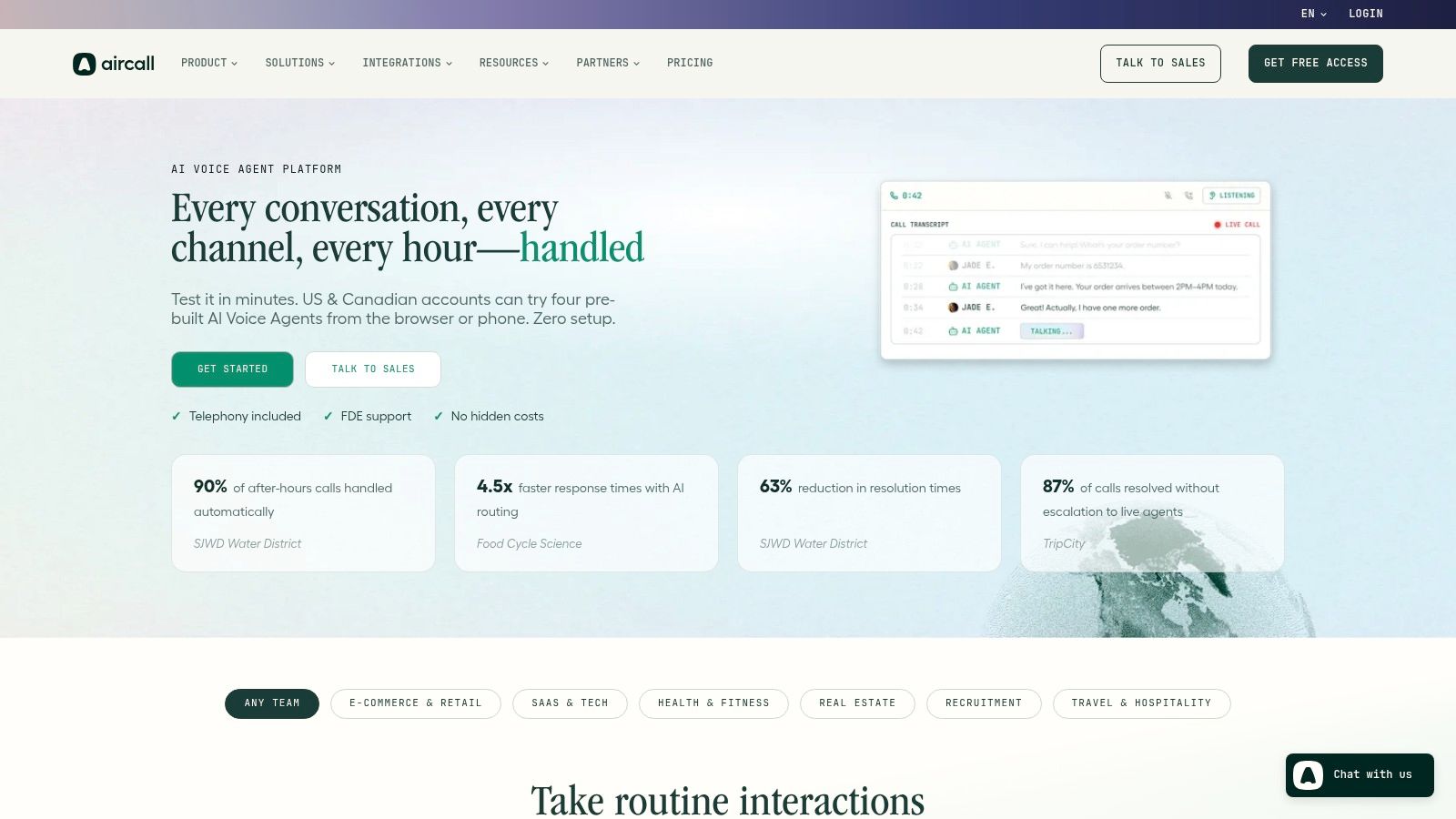
The useful distinction is action during the call. Aircall says its agent can read or update business records while speaking with the customer. That's more relevant to revenue than an attractive transcript delivered after somebody else has to finish the work.
Aircall's AI Voice Agent page lists $0.29 per minute after 50 free monthly minutes, plus bundles starting at $250/month for 1,000 minutes, a derived $0.25 per included minute at full utilization. Its published bundles include voice-agent and telephony pricing, but review the selected package's commitment and inclusions.
Priced-and-booked readiness: Action-capable, cleaning logic must be supplied. Listed connections include HubSpot, Salesforce, Zendesk, Shopify, Stripe, and Calendly. No-code templates and plain-language instructions reduce setup friction, but they don't define your service rules.
Force a calendar conflict during testing. The agent should acknowledge the failure, offer an approved alternative, and avoid telling the customer the job is booked.
Aircall can operate with or without its broader phone system, which gives existing communications teams flexibility. For a solo cleaner, however, those broader capabilities may add more operational surface than the business needs.
Verdict: Attractive for teams whose revenue workflow already runs through supported business tools. Buy it for verified actions and integration fit, not for an assumption that no-code means no operational design.
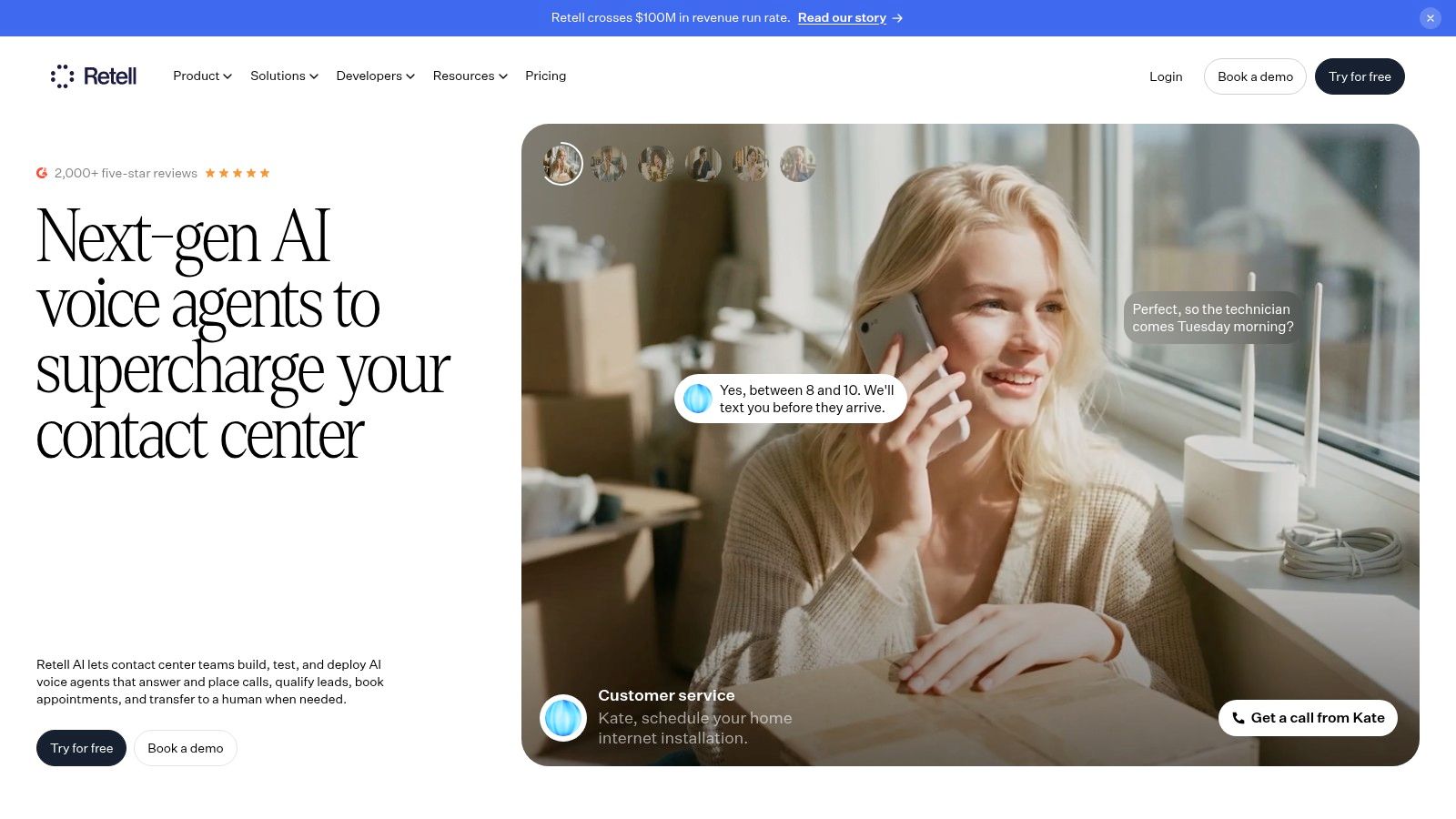
Customization is the benefit and the workload. Retell offers templates, simulation testing, transcripts, analytics, webhooks, and API access. Your team still has to connect those capabilities into a dependable estimate-to-booking process.
Retell AI lists voice-agent pricing from $0.07 to $0.31 per minute, depending on configuration, with $10 in free credits and 20 concurrent calls in its self-serve offering. That range shouldn't be treated as a single all-in rate without selecting the models, voice, telephony, and add-ons.
Priced-and-booked readiness: Buildable, not turnkey. The platform can support a custom cleaning workflow, but its flexibility doesn't establish that your implementation is ready to sell.
Keep the estimate calculation in a versioned pricebook or deterministic business service. Let the agent collect inputs and explain the returned estimate, rather than inventing arithmetic in conversation.
Simulation testing is particularly useful for incomplete addresses, uncertain square footage, interrupted calls, and failed booking writes. Store structured fields alongside transcripts so your team can distinguish a hearing error from a pricing-rule error.
This AI voice-agent pricing guide explains why an infrastructure rate and a finished service cost are different numbers.
Verdict: A credible platform for building a specialized workflow. Choose it when customization solves a real operational constraint and someone owns testing after every change.
Vapi is a development choice, not a receptionist purchase. It lets teams select transcription, language-model, and voice providers, connect telephony, and build custom workflows. That control is valuable only when someone can manage the components and their failure modes.
Vapi lists $5 in free credits and a Core success package at $29/month; model and provider usage may cost extra. Don't mistake that package price for the complete operating cost of a deployed agent.
Priced-and-booked readiness: High design freedom, substantial implementation responsibility. Configurable phone numbers, concurrency, retention options, and higher-tier support provisions can matter to a technical team. They don't replace a working integration with your pricebook and booking system.
Build a configuration-specific budget rather than comparing the subscription against another vendor's bundled minutes. The voice-agent ROI calculator guide is useful for separating usage costs from booked-job economics.
The disappointing workflow is the seemingly straightforward change request: a caller revises the cleaning scope after the estimate has been calculated. Your implementation must invalidate the old estimate, recalculate through approved rules, and prevent a stale booking.
Verdict: Suitable for a technical operator or implementation partner building something specific. For a cleaning owner who wants dependable after-hours sales without software ownership, the component flexibility may create more work than value.
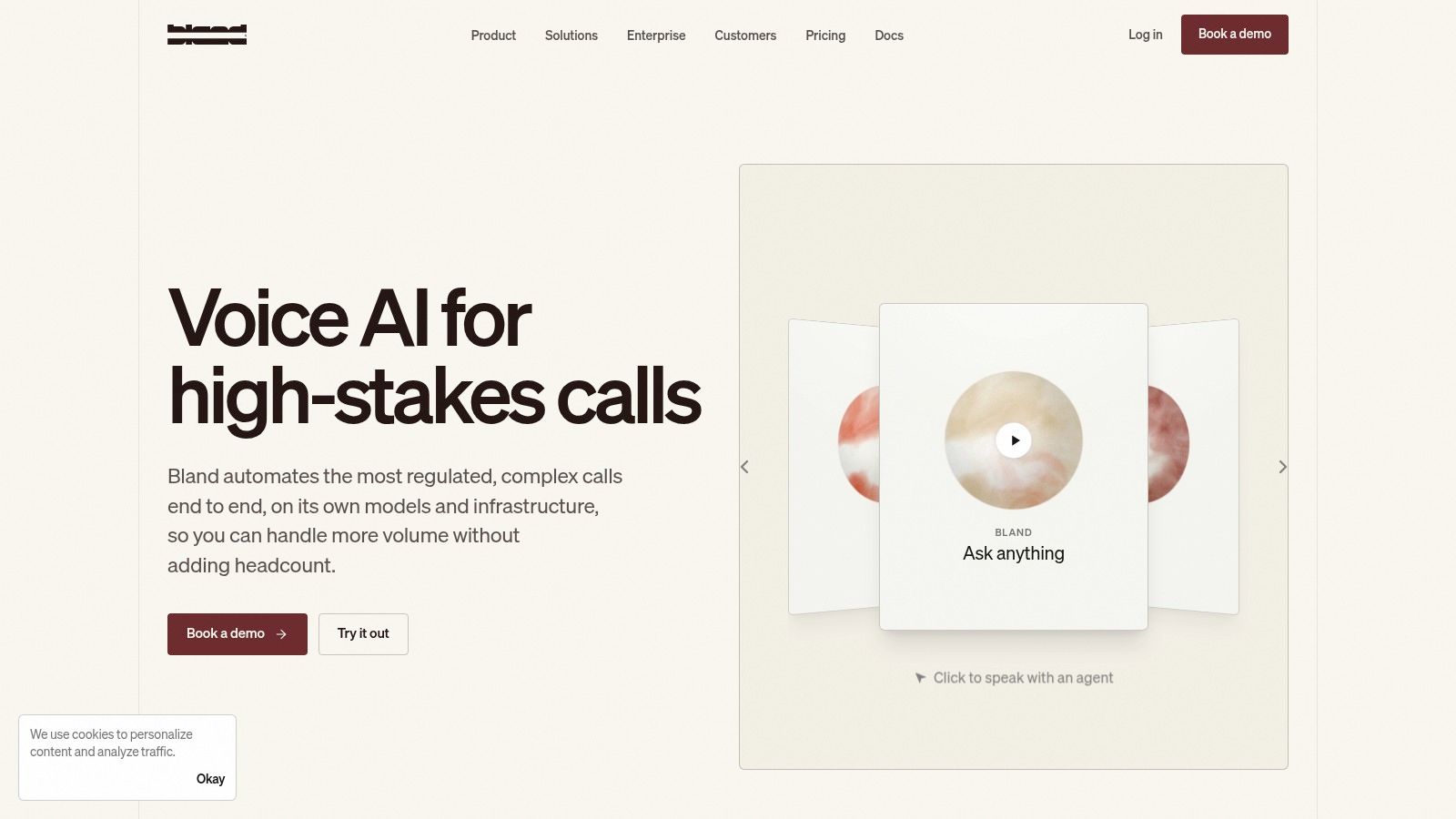
Bundled AI pricing is easier to read, but it isn't the whole phone bill. Bland combines language-model, speech-to-text, and text-to-speech costs within its AI rate. Phone service and transfers remain separate considerations.
Bland AI lists its Start plan at $0.14 per minute with no platform fee, excluding separately billed phone service and transfers. That makes the AI portion clearer than a stack of individual model and speech-provider charges, without establishing the final cost per call.
Priced-and-booked readiness: Workflow-capable, business rules are your responsibility. Visual workflow tools can support involved call handling, but your team must configure and test the estimating logic, integrations, and recovery paths.
Start with what happens when a caller can't provide reliable property size. Then test an unavailable appointment, an out-of-area address, a disputed estimate, and a requested human transfer.
The workflow most likely to disappoint is an interrupted transaction: the estimate was generated, but the booking system didn't accept the appointment. Unless your implementation checks the resulting system state, the caller may leave believing the job is confirmed.
Verdict: A practical building block when bundled AI costs and existing phone infrastructure matter. It isn't a substitute for a cleaning pricebook, a capacity-aware scheduler, or a person responsible for testing what happens when integrations fail.
The column that decides revenue is priced-and-booked readiness: can the agent capture details, apply your price rules, book the job, and hand off exceptions cleanly. Use starting price as a screen, then test the workflow each row warns about.
| Service | Starting price | Best for | Setup effort | Watch out for |
|---|---|---|---|---|
| Estimatty | $25/week | Cleaning businesses needing estimates and 24/7 lead handling | Low; no-code setup | Estimate quality depends on configured pricing rules, FAQs, and add-ons |
| Reception by ElevenLabs | Free start; $29/month for 75 minutes | Home-service businesses needing basic call coverage | Low; ready-made receptionist | Limited minutes; verify overage pricing and estimate workflow |
| Goodcall | $79/month for 100 unique customers | Businesses with repeat callers or longer conversations | Low to moderate | Extra charges above the allowance; verify booking and CRM fit |
| Wellgrow AI Receptionist for Home Services | $199/month | Home-service companies wanting managed setup and field-service integrations | Low for the business; setup takes about 5–7 days | Confirm cleaning estimate workflows and test integrations |
| Smith.ai AI Receptionist | Free tier for 25 calls/month; Pro is $150/month | Businesses wanting AI call handling with live-human escalation | Low to moderate | Calls count toward the quota; test cleaning-specific booking needs |
| Nextiva XBert | $99/month for 100 AI conversations | Businesses seeking AI across calls, SMS, and web chat | Moderate | Extra conversations cost more; verify CRM and estimate compatibility |
| Aircall AI Voice Agent | 50 free minutes/month, then $0.29/minute; bundles from $250/month | Teams connecting voice agents to CRM and business tools | Moderate | Bundles can cost more; integrations may not support cleaning estimates |
| Retell AI | $10 in free credits; $0.07–$0.31/minute | Teams building customized phone agents | High; configure and test workflows | Total cost varies by configuration and add-ons |
| Vapi | $5 in free credits; Core package is $29/month, plus usage | Technical teams building custom voice agents | High; technical setup or implementation partner recommended | Model, voice, transcription, and telephony costs may be additional |
| Bland AI | $0.14/minute, plus phone service | Businesses automating customized voice-call workflows | High; configure and test the agent | Telephony and transfers cost extra; usage and concurrency limits apply |
Read the last column as the pilot script. If a row mentions estimates, booking, CRM, integrations, or transfers, make the vendor complete that exact call before you judge the monthly price.
Run the agent in shadow mode beside a human for the first week. Have the human review the details, calculate the approved estimate, and compare the proposed next step before relying on automation. During the following week, release only the call types that passed, while keeping exceptions with your team.
Script the ten estimate questions callers ask, using your call notes rather than a vendor's demonstration script. Include service scope, bathrooms, property size, condition, add-ons, recurring frequency, timing, access constraints, exclusions, and whether the estimate can change. Write down the handoff rule before launch, especially for disputed pricing, uncertain conditions, complaints, and failed booking actions.
Don't optimize for fewer transfers. Optimize for the right completed jobs and the right transfers.
Estimate quality depends entirely on the pricing rules configured before launch. Define what's included, which conditions change the estimate, and when the agent must stop. A natural-sounding voice shouldn't have authority to improvise service policy.
Track qualified estimates, verified bookings, cancellations, completed jobs, contribution margin, and human takeover. Attribute the booking to its original inquiry and inspect after-hours results separately, so you don't count an existing customer's routine call as new revenue.
Calculate cost per completed booked job by dividing the agent's subscription, usage, telephony, model fees, human assistance, and allocated setup costs by completed jobs attributable to that workflow. For break-even, divide incremental operating cost by contribution margin per additional job, not by the job's sales price.
Customer satisfaction deserves its own review. In Twilio's global study of consumers and business leaders, 90% of business leaders believed customers were satisfied with AI interactions, compared with 59% of consumers. Listen to unsuccessful calls instead of relying on the management dashboard alone.
Disclose automation, confirm critical details, and send a written estimate summary. Limit collection of household information, set access and retention rules, and establish consent controls appropriate to your operation; the NIST Generative AI Risk Management Profile identifies transparency, consent, and purpose specification as privacy concerns.
Use the estimating and growth blog and cleaning operations blog for deeper reading. Comparing the best AI receptionists for clinics can also sharpen your questions about sensitive intake and escalation, without assuming clinic workflows fit cleaning.
Finally, don't automate demand you can't fulfill. If hiring cleaners is the constraint, work on staffing through Pipehire before expanding call coverage. Scale only when your team can deliver the jobs the agent sells.
Estimatty combines cleaning-specific estimates, online booking, and around-the-clock voice sales, with U.S.-based human receptionists available when a prospect needs help. Visit Estimatty to configure your pricing and test whether your next after-hours inquiry can become a consistently priced, booked cleaning job.