October 7, 2026
A Quote on Consistency and Success for Cleaning Businesses
Discover a powerful quote on consistency and success tailored for cleaning professionals, with practical tips to apply it to marketing and teams.

Thursday, October 1, 2026
Explore AI voice agent pricing for cleaning businesses. Compare models, find hidden costs, and get cost estimates from pipehirehrm.com insights.
Standard AI voice agent pricing for production deployments typically lands between $0.12 and $0.25 per minute, which is roughly 50 times cheaper than a human receptionist. The advertised rate is only the starting point, though, because telephony, transcription, language-model processing, voice generation, setup, and integrations can all change the actual bill.
It's 8:15 on a Monday morning. A cleaner is driving to the first house, another employee is calling about a schedule change, and three new inquiries arrive while the owner is carrying equipment through a client's hallway. One caller reaches voicemail, another hangs up after waiting, and the third leaves a vague message that won't be returned until the afternoon. In a cleaning business, that delay can mean a lost estimate, an empty slot, or a prospect who books with the company that answered first.
That's why AI voice agent pricing needs to be judged as an operating cost, not just a software subscription. The right system can capture service details, answer routine questions, qualify leads, and move a caller toward an estimate while the team is working. The wrong plan can look cheap on a pricing page and become expensive after separate provider charges appear.
A cleaning business morning can turn into a dispatch desk without warning. The owner is checking supplies, assigning teams, solving a lockbox issue, and trying to keep the first appointment on time. Meanwhile, homeowners ask about recurring service, property managers request turnover cleaning, and existing customers need schedule changes.
An unanswered call can become a lost estimate or an empty appointment slot. The caller may submit another form, contact a competitor, or decide the company is difficult to reach. Even when no booking follows, the conversation can reveal the service area, property size, urgency, and budget expectations.

A voice agent can manage the first conversation while the crew is on site. It can collect the address, cleaning type, square footage, preferred date, and special requirements, then send the details to the team or route the caller to the right person. Complaints, unusual commercial requests, and sensitive situations still need a human handoff.
The cost difference can be substantial. MarketsandMarkets reports that an inbound call handled by a human agent averages USD 7.16, compared with about USD 0.07 to USD 0.15 per minute for a voice AI agent. These figures do not represent the complete cost of ownership. Configuration, call supervision, integrations, and corrections still require time and money. They do show why cleaning owners compare voice agents with receptionist labor, not only with another software subscription.
Practical rule: Price the system against the calls you currently miss, not only against the calls your staff already answers.
For a small residential company, after-hours coverage may offer the clearest starting point. A multi-location operator may gain more from consistent intake, routing, and lead qualification across branches. A commercial cleaner may need the agent to separate recurring janitorial work from one-time post-construction cleaning before a salesperson responds.
A 24-hour phone answering service for cleaning businesses can help frame the operational question. Affordability is only one test. The system must turn captured conversations into accurate estimates, booked appointments, and follow-up tasks without adding another administrative burden for the owner.
A per-minute rate hides a small technology stack. During a live call, the system receives audio, converts speech into text, interprets the request, creates a response, converts that response back into audio, and keeps the telephone connection active. Each layer can be bundled into one rate or billed separately.
The four main layers are speech-to-text, LLM inference, text-to-speech, and telephony. A vendor using a basic voice, a lightweight model, and bundled carrier costs may price the call very differently from a vendor using premium voice quality, advanced reasoning, and separate provider accounts.
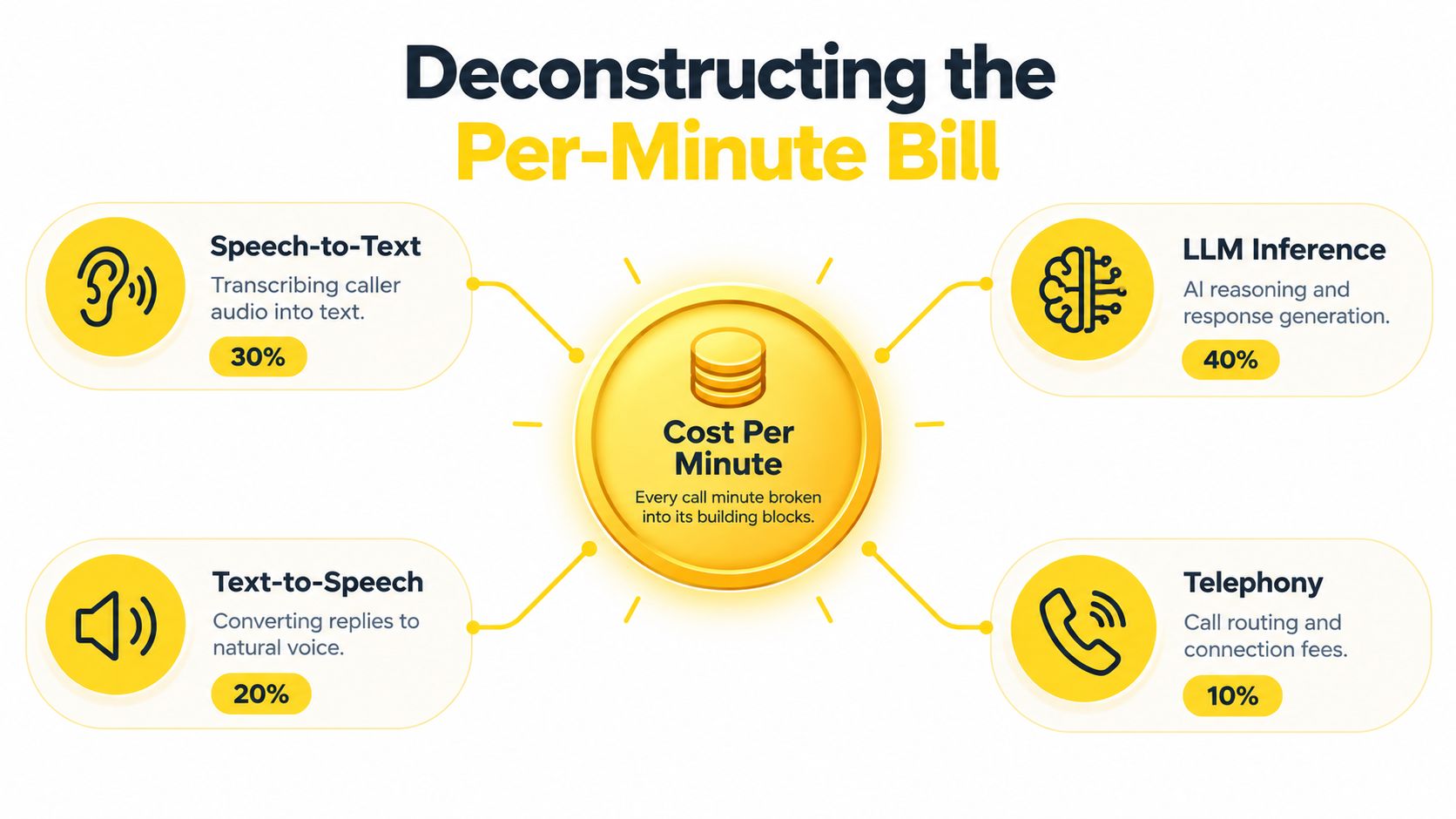
Speech-to-text, or STT, transcribes what the caller says. This matters when a homeowner gives a long address, spells a name, or describes surfaces and access instructions. Poor transcription creates downstream errors, especially when the agent repeats an incorrect detail.
LLM inference supplies the reasoning and response generation. It determines whether the caller wants a recurring house clean, a move-out service, a commercial estimate, or a human callback. More capable models can support complex conversation flows, but they can also raise usage costs.
Text-to-speech, or TTS, turns the response into a spoken voice. Voice quality matters in sales and service calls because awkward pauses, robotic pronunciation, or incorrect emphasis can make callers lose confidence. A natural voice may cost more than a basic one.
Telephony covers the phone connection, routing, and related carrier usage. It's the layer owners often forget when a platform advertises a low AI rate.
The HighLevel pricing explanation shows how voice AI minute costs can be decomposed into voice-engine usage, TTS usage, and LLM token usage rather than treated as one indivisible charge. That structure explains why a low platform fee can become a higher all-in cost.
Cleaning calls often contain pauses while the caller checks room counts, finds an address, or asks a spouse for information. A system that charges for active conversation can behave differently from one that measures every connected second. The agent also needs enough context to avoid repeating questions, but excessive prompts and verbose answers can extend calls.
For a cleaning operation, the practical test is simple: ask the vendor to show the full cost of a call that collects property details, answers a service question, sends an estimate, and transfers a complex inquiry. Don't evaluate only the voice-engine line item.
A virtual receptionist for a small business should reduce interruptions, not force the owner to reconcile separate invoices for every technical layer. The more components the buyer must manage, the more important transparent metering and clear escalation rules become.
For a cleaning company, the right pricing model depends on call volume, call length, and how much operational work the vendor handles. AI voice agent pricing commonly uses usage measured by the minute. Quiq's voice AI pricing guide places production costs in the mid-teens or low-twenties of cents per minute, though the invoice can rise when integrations, transfers, and support sit outside that rate.
A solo cleaner with irregular demand may choose pay-as-you-go to avoid a large commitment during slow weeks. A growing residential team with steady inbound calls may prefer a subscription that includes usage and states its overage rate plainly. Commercial cleaning firms often need managed implementation because bid scheduling, access details, compliance questions, and CRM handoffs are harder to configure than a basic appointment flow.
| Model | Best For | Typical Cost Range |
|---|---|---|
| Usage-based | Uneven or seasonal call volume | About $0.05 to $0.35 per minute for many self-serve offers, with production systems often higher once all layers are included (Kommunicate) |
| Subscription plus usage | Teams seeking a predictable base cost | Varies by included features, minutes, and overage rules |
| Managed service | Businesses needing setup, integrations, and support | Often materially higher than self-serve pricing (CloudTalk) |
| Outcome or resolution pricing | Larger operations focused on completed tasks | Contract-specific, with enterprise offerings potentially starting in the six figures |
Residential calls are often short and repeatable. Callers ask about availability, rates, pets, square footage, or recurring frequency. Commercial calls can run longer because the agent may collect building details, access windows, supply requirements, compliance information, and bid timing. Per-minute billing usually fits predictable intake calls. A package or outcome model may be easier to forecast when call length varies widely.
Seasonality can change the result. A plan that works during a quiet month may become expensive during move-out periods if overage charges are steep. Confirm whether unused minutes expire, whether transferred calls keep accruing charges, and whether voicemail or abandoned calls count.
A property manager handling short-term rentals has a different coverage pattern from a house-cleaning owner. The guide to Airbnb property manager pricing provides useful adjacent context for turnovers, maintenance coordination, and guest-facing requests.
Compare completed, usable conversations rather than headline rates. Ask each vendor to price the same workflow: capture property details, answer a service question, schedule or send an estimate, and transfer a complex inquiry. Tools covered in no-code AI tools for business may reduce setup work, but verify whether your team still has to maintain the workflow, integrations, and call rules.
The headline minute rate rarely captures the entire ownership experience. A cleaning business may pay for onboarding, custom call flows, CRM or calendar connections, premium voice options, phone numbers, recording storage, human transfers, and overage usage. A BYOK arrangement can add separate bills for the language model, transcription, voice generation, and telephony.
Those costs don't all appear on the same invoice. That makes it easy to approve a platform because the base rate looks low, then discover that the actual system requires several provider accounts and ongoing troubleshooting.

Start with the operating workflow. If a caller asks for an estimate, the agent should capture the information once and pass it into the correct system. If the owner still has to listen to a recording, copy the address into a CRM, calculate the service manually, and send a follow-up message, the business has paid for automation without removing the administrative task.
Watch these cost sources closely:
Some vendors track each call to the nearest second and bill the total accumulated minutes at the end of the billing cycle, as described on Retell's pricing page. That granularity can help a high-volume cleaning business avoid broad rounding, but owners still need to know whether every connected second is billable.
The hidden upside is operational. A voice agent can answer while cleaners are on-site, provide coverage outside normal office hours, and collect structured information before a human steps in. That can reduce interruptions and help the team reserve human time for complicated estimates, complaints, and closing conversations.
A free estimating app for cleaning businesses can also illustrate the broader principle. The value isn't just the calculation. It comes from connecting intake, pricing rules, follow-up, and booking into one process. If the agent captures a lead but doesn't move it forward, the business has purchased minutes instead of revenue-producing workflow.
Cost test: Add every recurring platform, provider, integration, transfer, and support charge before comparing the result with receptionist coverage.
The safest way to evaluate AI voice agent pricing is to start with the call process, not the vendor dashboard. Write down what a successful conversation must accomplish for each major call type. A recurring residential inquiry may need an estimate and preferred schedule, while a commercial inquiry may need qualification and a sales callback.
Separate simple calls from calls that need judgment. The agent can often handle service-area questions, basic availability, intake, estimate requests, and appointment preferences. A human should usually receive complaints, billing disputes, unusual access issues, and requests that fall outside the pricebook.
Then define the data handoff. At minimum, the team may need the caller's name, phone number, address, cleaning type, property details, urgency, and requested next step. If those fields don't arrive in the CRM or scheduling workflow, the automation hasn't finished the job.
Request a written example using your own call pattern. Ask what happens when a caller pauses, requests a transfer, leaves voicemail, changes the service type, or calls outside business hours. Confirm whether the quoted rate includes telephony, STT, LLM processing, TTS, phone numbers, recording, integrations, support, and overages.
Use this checklist during vendor reviews:
Some usage-based plans charge only for the seconds the agent is on a call, with no idle time, no per-seat fees, and no minimums, according to Aloware's per-minute pricing guidance. That structure can suit a cleaner with fluctuating demand, but confirm how the vendor defines active time.
A cleaning-specific platform can be practical when its estimator, pricebook, voice intake, SMS follow-up, and CRM connection reflect the actual workflow. Estimatty is one example of a system built for residential and commercial cleaning operations, with a web and voice estimator that collects service details and delivers estimates through configured pricing rules. For the workforce side, owners can also review operational guidance on pipehirehrm.com so technology decisions don't ignore recruiting, scheduling, and employee management.
At 7:30 p.m., a homeowner calls for a move-out clean while the owner is driving and the crew is finishing a commercial site. If nobody answers, the advertising spend may produce no job. An AI voice agent can capture the address, property size, service type, timing, and contact details, then send a usable lead for follow-up.
For cleaning businesses, the value comes from recovered opportunities, not a low advertised minute rate. As noted earlier, human handling averages USD 7.16 per inbound call. A voice agent may cost less to operate, but the total bill can also include setup, call routing, integrations, monitoring, revisions to service rules, and staff time for exceptions.
A practical test is to compare the system with the calls your team currently misses. For a business receiving 120 inbound calls a month, a 15% improvement in answered calls creates value only if those conversations produce qualified estimates or bookings. At USD 0.15 per minute, short intake calls may remain inexpensive, while long conversations, repeated callers, or transfers can change the result. Track cost per qualified lead and cost per booked job, not minutes alone.
Judge the system by operational outcomes:
The AI sales automation guide for cleaning services supports this broader view. A voice agent earns its place when it connects calls with estimating and booking.
Choose a plan that matches residential peaks, commercial inquiries, and seasonal volume. Reject both the cheapest-minute pitch and an oversized contract that adds little to a simple intake workflow.
Estimatty helps cleaning businesses handle website and phone inquiries, collect property details, apply configured pricing rules, and send estimates while the team works. Visit Estimatty to review its no-code web and voice estimating workflow.