
November 18, 2026
Code Setup for Your Cleaning Estimator: Step by Step
Code setup for a cleaning business website: embed an instant estimator widget, test pricing, and fix the problems that stop leads.

Thursday, November 19, 2026
Instant Quote MSC explained: what the term means, which details cleaning estimates need, and how to send fast, accurate estimates to prospects.

Which MSC do you mean, and why should an instant price be trusted just because it arrived quickly? A search for instant quote MSC can lead to container shipping rates or leave a cleaning-business owner looking at the wrong kind of pricing tool. For cleaners, the useful outcome isn't an impressive-looking number. It's a fast, defensible estimate with clear assumptions that helps a prospect decide whether to book.
MSC most often refers to Mediterranean Shipping Company, where an instant quote means a real-time container freight rate. That's a different product from an estimate for cleaning a home, office, or rental property. Don't confuse a shipping carrier's rate tool with a cleaning estimator because both promise an immediate answer.
The search term needs context before it needs a calculator.
Three readings of instant quote MSC
| Reading | Where You See It | What You Get | Fit for This Guide |
|---|---|---|---|
| Mediterranean Shipping Company (MSC) | Carrier and freight websites | Real-time container shipping rates | No, shipping only |
| Unclear acronym | Search results with no context | Meaning depends on the page | Confirm the context before reading further |
| Cleaning instant estimate | Website chat or phone line | A budget range from home details within moments | Yes, this guide |
For a cleaning business, an instant estimate is pricing feedback a prospect receives within moments of asking, rather than after a callback hours or days later. The customer supplies the job details, your estimator applies your rules, and the customer receives a useful starting range.
The analogy with freight is straightforward. A freight rate needs container size and route; a cleaning estimate needs home size and service type. Neither calculation becomes reliable merely because software produces it quickly.
A customer comparing cleaners needs to know what the service includes, not just what the total might be. Does standard cleaning include the inside of the oven? Are interior windows separate? Is this a maintenance visit or a reset for a neglected property?
The same distinction appears in other service businesses. Nanak Car Wash's explanation of what detailing prices actually include is a useful comparison when you're deciding how to describe inclusions and optional work.
Keep your documents equally clear. Our guide to proposals and different pricing documents helps separate an initial pricing response from a fuller scope or commercial commitment.
Your first response should help the customer make a decision without pretending the property has already been inspected.
This guide covers cleaning estimates. If you're shipping freight, use the carrier's own rate tool rather than a cleaning-service calculator.
Inputs that change a cleaning estimate
| Input | Why It Changes the Price | Example |
|---|---|---|
| Service type | Standard, deep and move-out cleans need different labor | Standard clean vs deep clean |
| Home size in square feet | Labor hours rise with the area to cover | Smaller apartment vs larger detached home |
| Bedrooms | Each room adds time per visit | 3 bedrooms |
| Bathrooms | Bathrooms need the most detailed work per room | 2 bathrooms |
| Days since last clean | An overdue home takes longer to reset | Two weeks vs six months |
| Pets | Hair, odor and extra cleaning add time | One dog and one cat |
| Add-ons | Priced separately from the base clean | Inside oven, fridge, windows |
| Frequency | Recurring visits often get a different rate | Weekly vs one-time |
Treat the examples as hypothetical intake answers, not pricing benchmarks. Your labor plan determines how much weight each answer receives.
Start with service type, because square footage alone doesn't describe the assignment. A standard visit maintains an agreed condition. A deep clean addresses buildup and more detailed work, while a move-out clean may involve empty cabinets, appliance interiors, and other tasks that belong in a separate scope.
Time since the last clean is a practical screening question, but it isn't a complete condition assessment. A regularly maintained home can still need extra work after renovation, a party, or a long period of illness. Give prospects an easy way to flag unusual buildup without asking them to diagnose cleaning methods.
Pets deserve similar care. Don't automatically treat every pet-owning household as the same job: shedding, upholstery, floor coverings, and where animals spend time all affect the work. Ask a follow-up question only when the answer can materially change the labor allowance.
Bathrooms also need a sensible definition. A lightly used guest bathroom and a heavily used bathroom with mineral buildup shouldn't automatically receive identical labor assumptions because each counts as one room.
For add-ons, identify the exact unit being sold. Window work might involve interior glass, exterior access, screens, or tracks. Aloha Window Bros offers a useful way to compare local window cleaning price ranges when you're separating window-related scope from the base cleaning service.
Preferred dates and access notes help you deliver the job, but they don't all belong in the initial pricing calculation. Ask whether stairs, parking restrictions, or difficult access affect labor or travel. Collect actual key codes through your approved access process after the customer moves toward booking, not in an anonymous estimate conversation.
Use your lead qualification criteria to distinguish essential pricing answers from useful sales information. A prospect's referral source may help your marketing team, but it shouldn't block the estimate.
Shorter intake isn't about ignoring complexity. It's about asking the question at the right moment.
Intake test: If a missing answer wouldn't move the estimate beyond a small range, remove that field from the initial intake.
Build the workflow around delivery of usable pricing, not merely delivery of an automated greeting. An instant acknowledgment is helpful, but it isn't an estimate.
At Estimatty, our AI steps in the moment a prospect raises their hand, gives a price, and chats with them. We work 24/7/365 on the business's website, so an owner doesn't need to stop cleaning to handle every initial inquiry.
The diagram separates the calculation into its component stages. Owner alerts and exception handling support that customer-facing process.
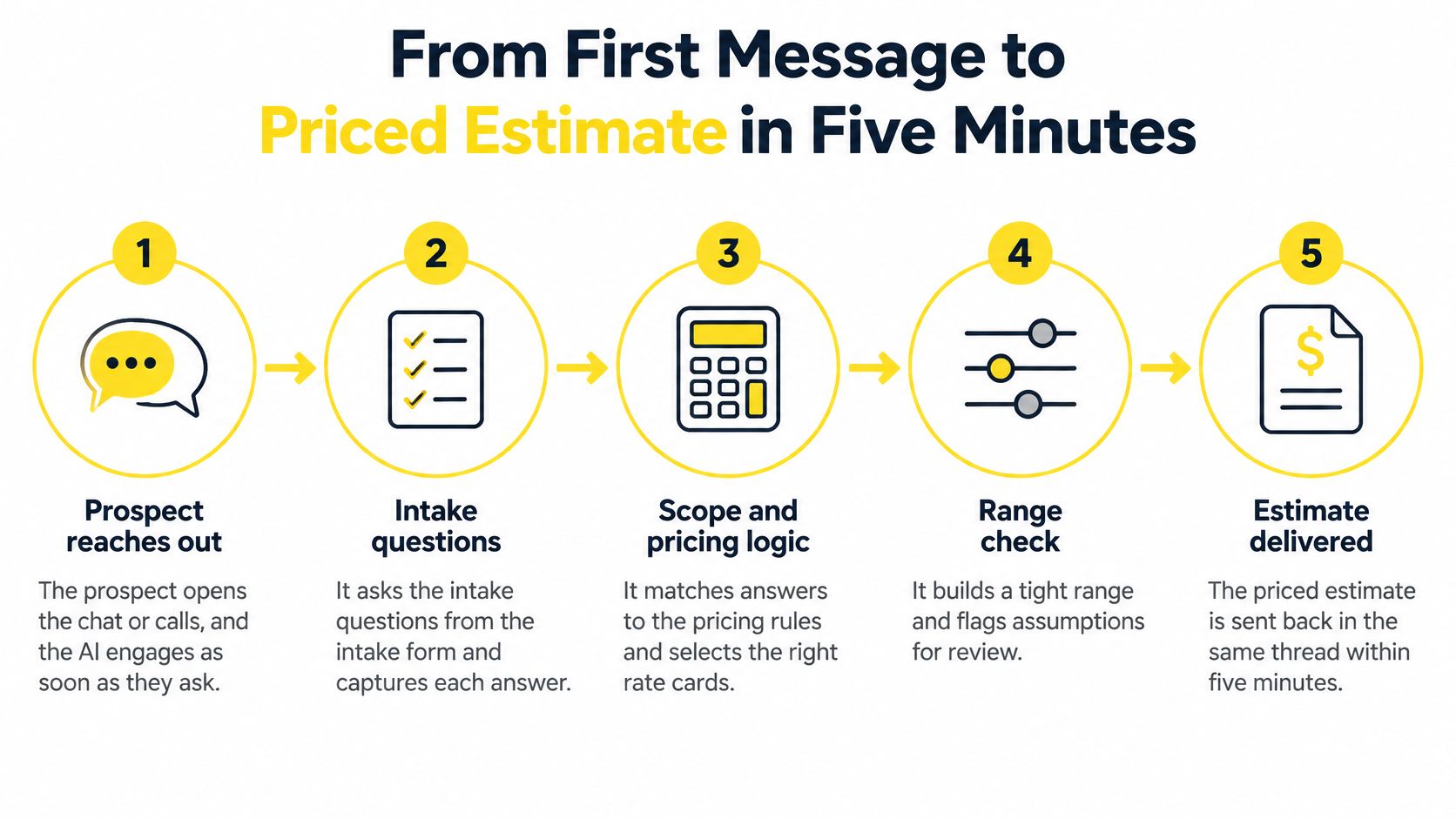
An InsideSales audit of web inquiries to 4,723 companies found that only 7.7% received a response within five minutes and identified that window as an operational best practice. A cleaning owner can use it as a service target without assuming that a reply alone guarantees a booking.
A separate 2021 InsideSales analysis covering 5.7 million inbound leads found conversion rates eight times higher when the first response attempt occurred within five minutes rather than later, while only 0.1% of inbound leads were engaged that quickly. Those findings concern inbound sales across companies, not a promised performance lift for cleaning businesses.
The speed-to-lead evidence summarized by Vida reports that 37% of audited companies responded within one hour, the average response among eventual respondents took 42 hours, and 23% never responded; a separate lead dataset found contact within one hour was nearly seven times more likely to qualify a lead than waiting an additional hour.
Response benchmarks for instant estimates
| Benchmark | Figure | What It Tells You |
|---|---|---|
| First response target | Within five minutes | Only 7.7% of web leads in the cited audit got a reply this fast |
| Fast response share | 37% within one hour | Most audited companies didn't respond within the hour |
| Average reply when sent | 42 hours | Eventual responses can still arrive well after the buying moment |
| Qualification gap | Nearly 7 times | Contact within one hour outperformed waiting another hour in the cited dataset |
The practical issue is attention. A prospect comparing cleaners can act on clear pricing now; a voicemail promising a later callback gives them no reason to pause their search.
Don't turn these findings into a claim that speed fixes poor scope, unavailable appointments, or uncompetitive service. Fast, usable estimates are the objective. Fast mistakes create another kind of follow-up work.
Record the inquiry timestamp before any automation runs. Then record estimate generation, SMS delivery, email delivery, human handoff, and the booking outcome under the same inquiry identifier.
Distinguish “sent” from “delivered.” If an email fails or a text can't reach the phone number, the customer hasn't necessarily received the estimate. Keep channel failures visible rather than counting them as successful responses.
Calculate these measures:
Keep a separate acknowledgment metric so an instant greeting can't disguise delayed pricing. Exclude duplicate messages from the same inquiry when you calculate booking rates.
After thirty days, compare booked jobs for estimates delivered within your five-minute target against slower ones. Treat this as an operating review, not proof of causation: compare similar service types and channels, inspect failed deliveries, and identify where customers waited for a human decision.
A single exact number doesn't automatically build trust. If the customer's answers leave meaningful uncertainty, an exact figure can disguise it. A defensible range is better than false precision.
A budgetary estimate is a price range based on what the prospect has told you. A guaranteed price is a confirmed commitment after a cleaner has seen the home and verified the scope. Label them differently so the customer knows what they can rely on.
The distinction should be visible wherever the price appears.
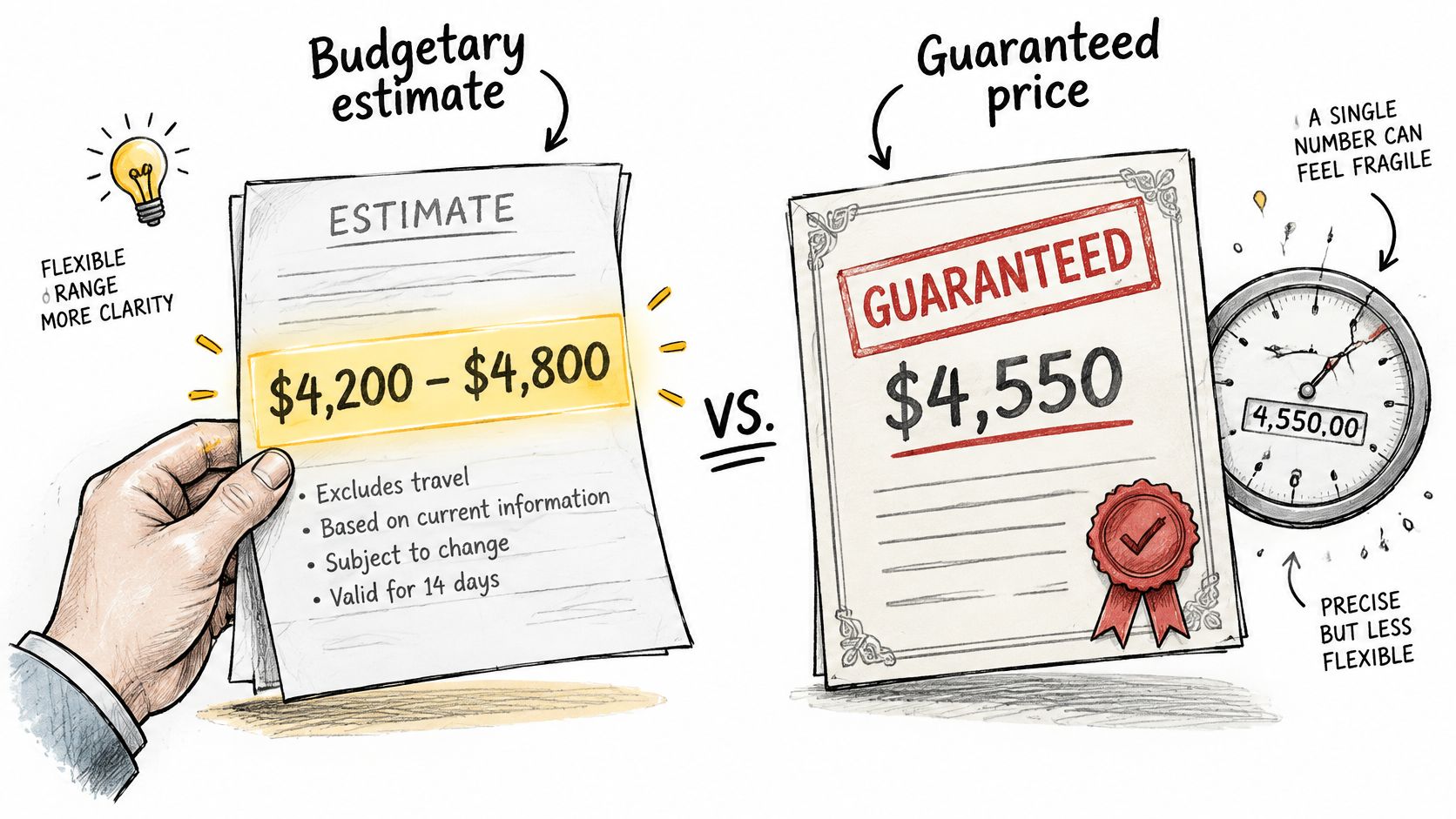
The U.S. Bureau of Labor Statistics reported a 2025 median wage of $17.71 per hour for janitors and building cleaners. That's an occupational wage benchmark, not your customer billing rate.
Your calculation must account for estimated labor hours, travel, payroll burden, supplies, overhead, and the margin you need. Estimatty applies your business's pricing rules to each estimate; you remain responsible for making those rules economically sound.
Other property services face the same scope problem. Ventura County Roof Cleaners' explanation of factors that drive roof cleaning prices is a useful comparison when deciding which property conditions require review instead of a routine calculation.
Say you're estimating a 1,500-square-foot home with two bathrooms. Set the working total, B, using your configured hourly labor rate multiplied by estimated labor hours, plus travel and payroll burden, with supplies, overhead, and margin accounted for in your pricing rules.
For this example, use a plus-or-minus 10% presentation band. It's an illustrative rule, not an industry standard.
Budgetary estimate: 0.90 × B to 1.10 × B.
Assumptions: Standard cleaning of an occupied home, two pets, last cleaned six weeks ago, and stairs to the second floor. Normal clutter and safe access are assumed.
Confirmation: The exact price is confirmed only after an on-site assessment visit, before cleaning begins.
Don't use that band when the uncertainty is wider. Request photos or a human review for conditions your normal pricing model doesn't cover.
State the adjustment policy before the visit: explain what triggers a revision, present the changed scope and price, and obtain approval before additional work. For recurring service, distinguish an exceptional reset visit from a permanent change to the maintenance rate.
Use clear estimate terms and conditions to document exclusions, cancellations, and approval requirements. Never show a price without the assumptions that produced it.
Tell prospects when they're interacting with AI. Concealing it creates an avoidable trust problem, especially when someone is sharing information about their home.
Twilio's consumer research on conversational AI reports that 51% of consumers are uncomfortable sharing personal or financial information with AI agents. Collect the information needed to estimate the work, not every detail that might someday help your sales team.
Introduce the assistant at the beginning of the conversation and explain its purpose. Make the route to a person easy to find, rather than forcing the prospect to argue with the system.
For SMS, explain what the prospect is agreeing to receive and record their consent through your approved process. Customers can stop our text messages at any time by replying STOP, which triggers one confirmation message and no further texts; replying START resubscribes. Message and data rates may apply.
Don't invent a retention promise. Document which conversation records your business retains, who can access them, and how customers can raise a privacy concern. Keep payment details and sensitive access information out of ordinary estimate chat.
Write escalation triggers into the operating procedure:
A warm transfer should carry the service requested, intake answers, estimate status, and unresolved question to the receptionist or owner. The customer shouldn't have to repeat the conversation.
If nobody is available, give an honest follow-up expectation and assign a named owner internally. Don't describe a callback request as a completed transfer.
Use these script lines as a starting point:
Disclosure: I'm an AI estimating assistant for this cleaning business. I can help with an initial estimate or request a person to review your needs.
Transfer rule: If you request a person or your job needs review, I'll pass your details and unresolved questions to our team.
Launch a controlled process, not every possible service and exception at once. Give your team a small, testable workflow before expanding it.
Our setup takes minutes and requires no code. The chat widget starts working immediately once it's live on your website; use the website setup guide to prepare the installation.
Plans start at $25 per week, so you can evaluate the cost before committing. For further guidance, use the cleaning pricing and workflow guides and cleaning-team operations articles.
Today, write the pricing rule for your most frequently requested service and test whether another team member can apply it without asking you a question.
Estimatty offers instant cleaning estimates, SMS and email delivery, and continuous website coverage using your business's pricing rules. Visit Estimatty to build an estimate flow that responds immediately while keeping scope, assumptions, and human review clear.