
November 17, 2026
Area Rug Steam Cleaning: Which Rugs Are Safe to Clean
Learn how area rug steam cleaning works, which fibers tolerate heat, safe temperatures, costs and when to choose a specialist wash instead.

Monday, November 16, 2026
Compare standard cleaning prices by home size, service type and region, and learn how to build consistent estimates that win more bookings.

Standard cleaning prices in the U.S. typically run $146–$202 per visit, with a separate professional-cleaning benchmark averaging $176. Adjust that starting band for your local labor costs, the home's condition, service frequency, and the work your team needs to complete.
The mistake isn't charging above or below a national average. It's choosing a price without knowing whether your crew can deliver the promised service profitably. Build your estimate around labor, define the scope, and give the customer a clear explanation of what changes the total.
Use the national standard-cleaning range as a starting band, not a fixed price. Thumbtack's marketplace benchmarks, compiled in Mark Studios' house-cleaning pricing overview, put standard cleaning at $146–$202 per visit, while the separate HomeAdvisor benchmark reports a $176 average, with most homeowners spending $118–$238.
Typical cleaning prices per visit by service type
| Service type | Typical price per visit | Benchmark source |
|---|---|---|
| Standard cleaning | $146–$202 | Thumbtack national marketplace data |
| Biweekly recurring cleaning | $160–$220 | Thumbtack national marketplace data |
| Deep cleaning | $190–$265 | Thumbtack national marketplace data |
| Move-out cleaning | $200–$286 | Thumbtack national marketplace data |
| Average house cleaning | $176 average, most homeowners $118–$238 | HomeAdvisor |
These are different service categories and benchmark populations, not interchangeable prices for the same home. The recurring range doesn't mean every biweekly visit costs less than every one-time standard visit. Compare the same property and scope before deciding what discount makes sense.
Your standard tier should describe maintenance cleaning, not whatever the customer hopes the crew can finish. A practical scope covers accessible surface dusting, vacuuming and mopping, routine bathroom cleaning, and kitchen surfaces. State whether dishes, bed-making, appliance interiors, and interior windows are included or excluded.
Give your sales team the same written scope your cleaners receive. Otherwise, the customer hears one promise while the crew works from another, and the owner pays for the mismatch through extra labor or a return visit.
Recurring customers can earn a lower per-visit rate because the company can plan routes, staffing, and supplies around a dependable schedule. Maintained homes also give estimators a clearer picture of the work. Discount predictability and a maintainable scope, not the customer's willingness to ask for a lower price.
Deep cleaning and turnover work require a different production allowance. Built-up residue, detailed surface work, and empty-home requirements shouldn't disappear inside a maintenance price just because the property has a familiar square-footage total.
Practical rule: Establish a standard tier around the mid-hundreds to low-hundreds benchmark band only when your operating costs support it. Give deep, move-out, urgent, and oversized jobs their own pricing rules.
Don't advertise a low standard price and rely on the crew to negotiate the difference at the door. Define eligibility during intake, explain exclusions before booking, and move unsuitable jobs into the correct tier. A useful starting band helps you check your estimate. It doesn't replace your price list.
Consider a hypothetical 1,200-square-foot apartment with three bathrooms, pet hair, and heavy buildup. It can require more work than a lightly used 2,000-square-foot house because the cleaner must spend more time scrubbing fixtures and removing residue, not merely covering floor area.
That's why square footage should start the intake, not finish it. Your estimator needs to identify what makes the property labor-intensive before assigning a maintenance price.
Factors that change a standard cleaning price
| Factor | What it changes | Pricing response |
|---|---|---|
| Service type | One-time, deep and move-out work takes more labor | Separate tier with its own base rate |
| Frequency | Recurring visits are easier to plan and staff | Frequency discount tied to a commitment |
| Bathrooms and kitchen condition | Buildup adds hours beyond square footage | Bathroom and kitchen modifiers |
| Pets and clutter | Extra prep and detail time | Itemized surcharge |
| Location | Regional labor and cost of living differ | Local labor-rate multiplier |
| Urgency | Short-notice scheduling takes priority capacity | Priority surcharge |
Start with service type. Use a clear deep-cleaning versus regular-cleaning distinction so customers don't select maintenance service for a home that needs restoration-level attention. Then establish the desired frequency and explain what happens to the recurring rate if the customer pauses service.
Bathrooms and kitchens deserve specific questions. Ask about shower buildup, grease, dishes, and whether counters are accessible. A room count won't tell you how long those tasks take.
Pet ownership alone shouldn't trigger an unexplained penalty. Ask about shedding, affected surfaces, and the condition your team will encounter. Treat clutter the same way: distinguish cleaning around belongings from moving, sorting, or organizing them.
Use a consistent intake checklist:
Location adjustments should reflect your actual recruiting costs and service routes. Urgency charges should cover a real scheduling accommodation, not appear because a prospect sounds eager.
Show every applicable modifier as a visible line item. Customers can evaluate an explained condition adjustment. They can't evaluate a total that rises without a reason.
The Bureau of Labor Statistics' May 2023 occupational wage table reports a $16.66 mean hourly wage and $16.08 median hourly wage for maids and housekeeping cleaners. Those are employee wage benchmarks, not customer-facing service rates.
For an illustrative 2,000-square-foot recurring home, applying the routine productivity assumption of 650–750 square feet per labor-hour gives approximately 2.7–3.1 labor-hours. Using those rounded hours produces about $44–$51 in direct wages and an illustrative $111–$128 labor portion at a 2.5× multiplier. These are worked calculations, not a recommended selling price.
Labor cost layers for a 2,000 sq ft recurring home
| Cost layer | Basis |
|---|---|
| Direct wages at BLS mean $16.66 per hour | 650–750 sq ft per labor-hour, approximately $44–$51 using rounded labor-hours |
| Implied labor portion at a 2.5x multiplier | Approximately $111–$128, an illustrative target calibrated per company |
| Supplies, travel, insurance and admin | Company-specific overhead entered from actual operating costs |
A cleaning price isn't wages plus a small markup. You must account for employer payroll costs, paid preparation, transportation, equipment, insurance, scheduling, supervision, and the time spent resolving service problems.
Use your payroll records and operating ledger to build a labor and burden calculation. Then decide which expenses your labor-hour rate includes and which appear separately. If travel is already recovered through the rate, don't charge for the same expense again without a distinct reason.
The multiplier must reflect your company's economics:
A competitor's hourly rate isn't evidence that your company can afford to charge it.
Run the uncomfortable test before publishing your standard cleaning prices. Add actual travel and administrative time to completed jobs, then recalculate the margin. If your expected profit disappears, raise the labor-hour rate or revise the operating assumptions before sending another estimate.
Use a repeatable calculation instead of asking your office staff to remember what you charged for a vaguely similar house. The customer's intake answers should lead to the same pricing logic regardless of who handles the inquiry.
Use this process map to organize the customer-facing workflow.
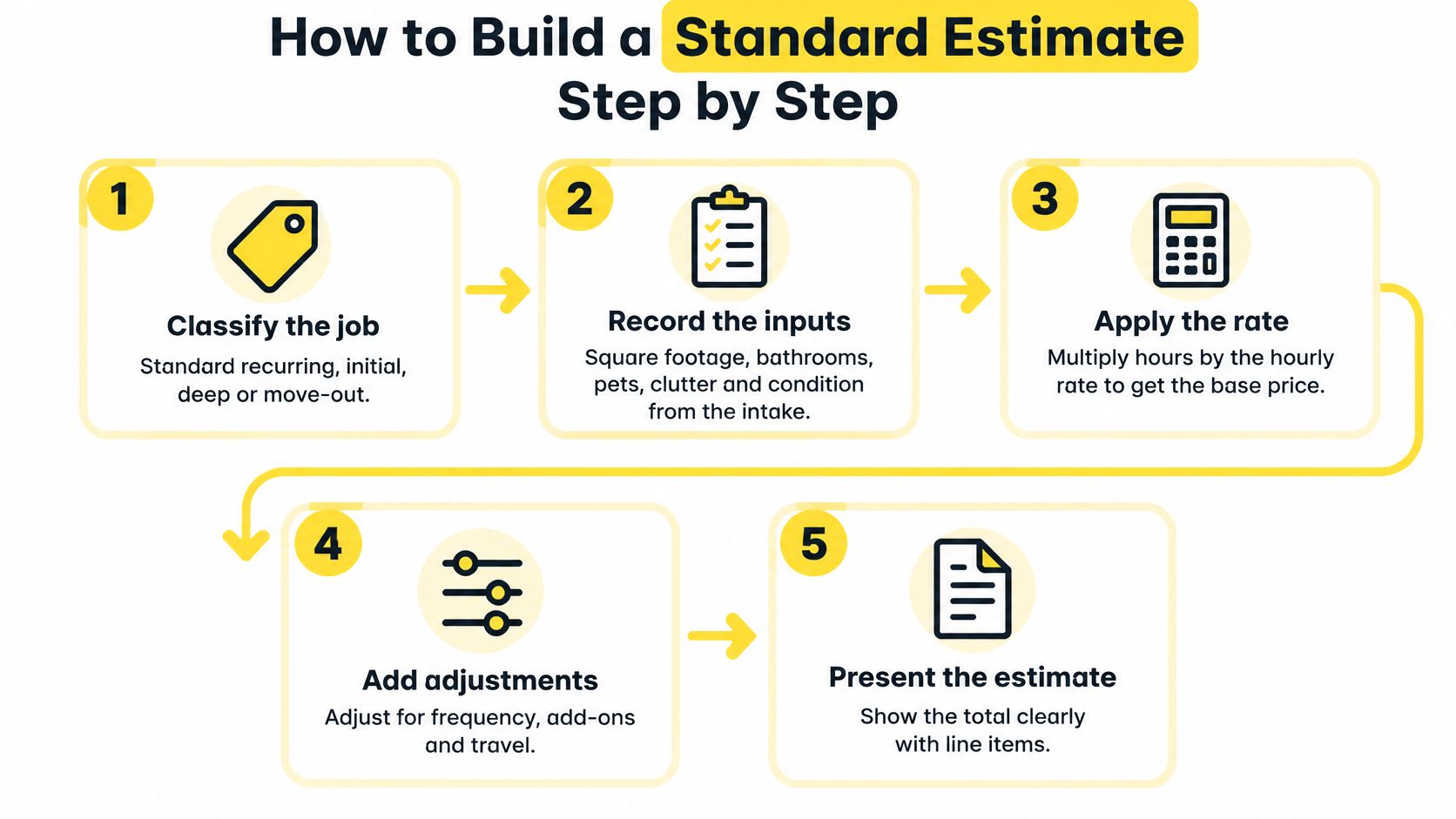
Classify the job. Select standard recurring, initial, deep, or move-out service before calculating a price. Don't let a customer's choice of label override the condition they describe.
Record the inputs. Capture square footage, bathrooms, pets, clutter, and kitchen condition, plus access requirements. Missing information should prompt a follow-up or an explicit assumption, not an optimistic guess.
Convert area into labor-hours. ISSA's residential pricing guidance gives approximately 650–750 square feet per labor-hour for routine biweekly cleaning, compared with about 500 for an initial clean. For a 2,000-square-foot home, that implies approximately 2.7–3.1 labor-hours for recurring service versus 4 for the initial visit, before property-specific adjustments.
Apply your fully loaded rate. Multiply the estimated labor-hours by a rate that recovers the costs you've assigned to it. If you use internal cost rather than a customer-facing selling rate, apply your profit requirement before presenting the total.
Add separate adjustments. Include supplies, travel, urgency, and selected extras only where they aren't already recovered elsewhere. Show what each adjustment pays for.
Check the result. Review an estimate that falls outside your standard benchmark band. A larger total can be correct, but you should be able to identify the scope or cost assumption responsible.
Reconcile completed work. Record actual crew labor-hours, not just the appointment's elapsed duration. Multiply each cleaner's time on the job by the number of cleaners involved, then compare that total with the estimate.
A sample estimate line can read: Standard recurring service + bathroom condition adjustment + selected oven interior + travel outside the core service area = estimated total. Underneath it, state that floors and counters must be accessible and describe how unreported buildup will be handled.
Use a consistent house-cleaning estimate workflow to keep those assumptions attached to the customer record. Otherwise, the office may calculate correctly while the crew arrives without the information that justified the price.
Estimatty's instant price tool asks for service type, when the last clean was done, home size in square feet, beds, baths, pets, and add-ons. Our Pricebook computes prices across every service, home size, and configuration, and every estimate the agent gives is built from it. Configure the rules from your operating numbers rather than expecting software to repair an unprofitable rate.
For a video walkthrough, use the demonstration below.
Start with a hypothetical 2,000-square-foot house. Applying the rates in HomeAdvisor's maid-service cost guide, $0.10–$0.20 per square foot produces a $200–$400 standard estimate, while deep cleaning at up to $0.25 produces up to $500, and move-out work at up to $0.35 produces up to $700.
Those totals demonstrate a useful distinction: changing the service can matter as much as changing the property size. The following worked examples apply those same published rates to different home sizes.
Standard and specialty estimates by home size
| Home and service | Rate per sq ft | Estimate range |
|---|---|---|
| 1,200 sq ft apartment, standard recurring | $0.10–$0.20 | $120–$240 |
| 2,000 sq ft house, standard | $0.10–$0.20 | $200–$400 |
| 2,000 sq ft house, deep clean | Up to $0.25 | Up to $500 |
| 2,000 sq ft house, move-out | Up to $0.35 | Up to $700 |
| 3,000 sq ft house, move-out | Up to $0.35 | Up to $1,050 |
For the apartment, the lower end is a candidate when the home is maintained, surfaces are accessible, and your measured production time supports it. Move upward when intake reveals extra bathroom work, pet-hair removal, or neglected kitchen surfaces. Don't assume an apartment is easy merely because it's smaller.
For the middle-sized house, standard service covers the maintenance scope you've defined. Deep service changes the required work, so don't add an arbitrary percentage just because the customer used the word deep. Confirm the surfaces, buildup, and detail tasks that require the higher allowance.
Move-out service requires another scope check. Confirm whether the property is empty, whether utilities are available, and whether cabinet and appliance interiors are included. A vacant home can offer better access while still requiring substantial detail work.
The larger move-out example is useful for planning capacity, but it isn't a guarantee or a universal ceiling. An empty, maintained property and a heavily neglected property can have matching floor areas without matching workloads.
Estimator's check: If your area-based total and labor-based total disagree, investigate the assumptions. Don't automatically choose the cheaper result.
Published per-square-foot estimates can also exceed national per-visit benchmarks because they describe a different pricing method and property size. That isn't a reason to force the total downward.
Use area pricing for consistent intake and an early ballpark. Use condition, scope, and production time to support the final estimate, with assumptions the customer can read before booking.
Labor is the first cost to examine when a customer challenges an increase. ISSA's industry overview reports that wages and benefits account for roughly 80%–90% of cleaning-company costs, with cleaner wages rising about 4.3% annually.
The same overview reports that the residential-cleaning producer price index increased from 150.2 in 2019 to 172.098 in 2025, a 14.6% rise, while a domestic-services consumer index rose 32.4% from October 2019 to October 2024. These measures cover different categories and periods. Don't combine them into a customer surcharge or treat either as your company's required increase.
Use a clear financial review to separate an operating-cost increase from a change in service scope.
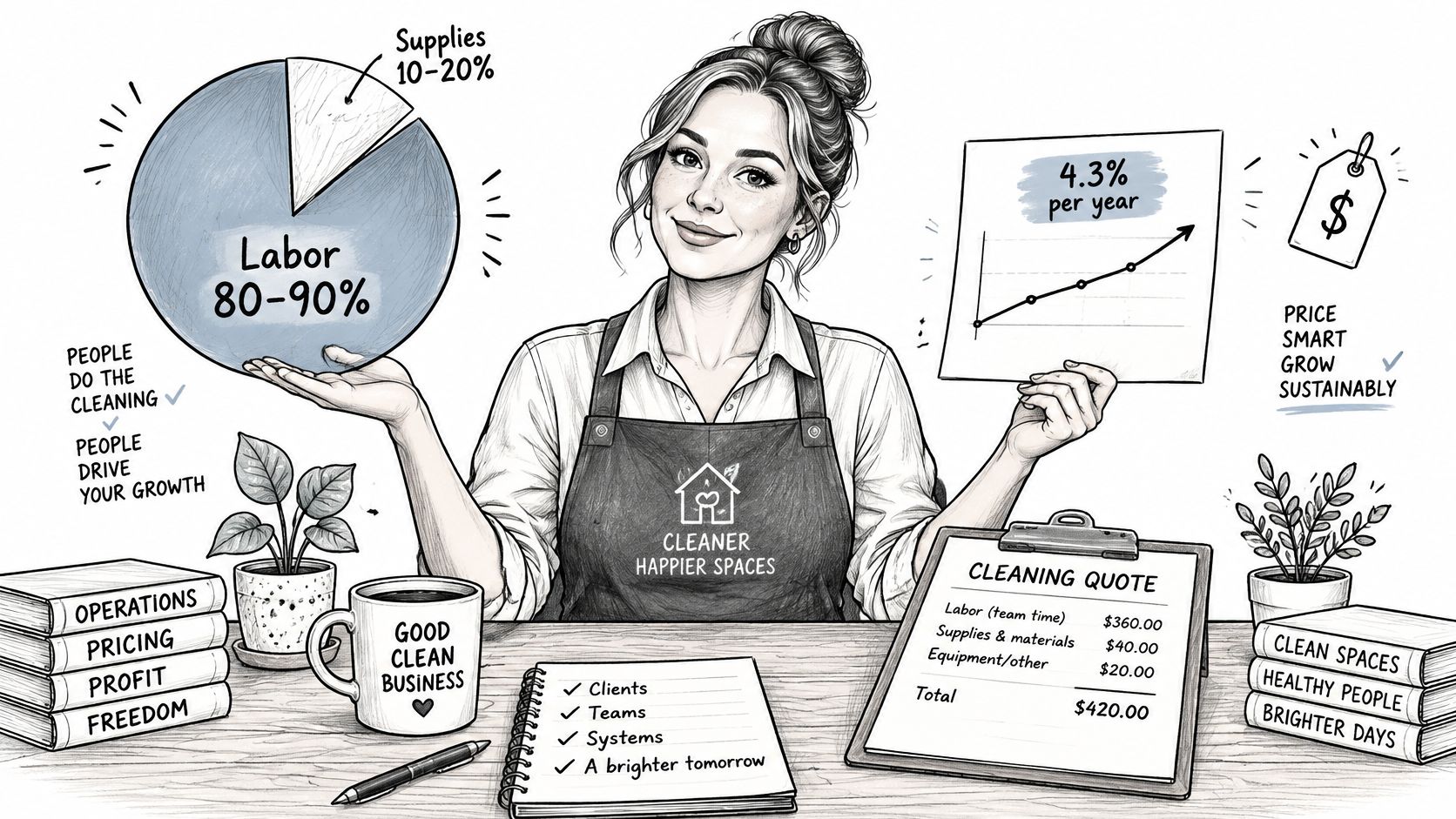
Before defending the price, identify what changed. A higher estimate may reflect increased costs, added work, inconsistent intake, or an error. Inflation isn't a substitute for checking your calculation.
Your explanation should establish:
A useful explanation might say that the previous appointment covered maintenance, while this appointment includes accumulated buildup and appliance interiors. That gives the customer something concrete to evaluate without making unsupported claims about competitors.
In Estimatty's booking flow, add-ons such as inside oven, steam cleaning, AC vents, and blinds appear automatically. Customers can see the options before the price is set instead of discovering extra work on the invoice.
When you handle price objections, offer a scope choice before a discount. The customer can remove an optional task or select an appropriate recurring plan. Don't promise the same work for less unless your costs support it.
A detailed estimate won't persuade every prospect. It does let you defend a higher price with a defined service instead of a sales pitch.
Confirm your standard tier this week. Audit your last ten completed jobs as a manageable internal exercise, comparing estimated labor-hours with actual crew-hours and flagging totals outside your intended benchmark band.
Separate the causes of missed margins. Underestimated condition calls for better intake. Longer travel calls for route or service-area changes. A rate that fails even on accurately estimated work needs a pricing adjustment.
Use the mid-hundreds to low-hundreds benchmark band as a check, not a requirement to undercharge. Maintain separate rules for deep, move-out, and urgent work, and list included tasks on every estimate.
A higher, well-explained price is a better business decision than a low figure you must revise after arrival. Use consistent cleaning-business pricing strategies to make that decision repeatable.
Estimatty was built specifically for cleaning businesses, and our pricing tools apply your rules across services and home sizes. Our blog offers additional pricing guidance, but your completed-job records should decide whether the numbers work. Before the next estimate leaves your office, confirm that the standard tier covers the work you're promising.
Turn your standard cleaning prices into consistent estimates with Estimatty, starting at $25/week. Set your service rules in the Pricebook, capture the home details through the instant price tool, and give prospects a clear estimate they can use to book.