November 14, 2026
Commercial Cleaning Cost Per Hour: 2026 Rates Explained
Commercial cleaning cost per hour in 2026: typical U.S. rates, what drives them, and how to price every bid to win work and keep margin.

Friday, November 13, 2026
Deep Cleaning vs Regular Cleaning compared on scope, time, frequency and cost, with a checklist of included tasks and guidance on when to quote each.
The advice you'll find almost everywhere is that everyone should book a deep clean first, then settle into a regular schedule. It's tidy advice for a blog post and a poor default for a business. Plenty of homes don't need the reset, and quoting one anyway teaches customers to expect a premium visit you can't justify.
Deep cleaning isn't a bigger regular cleaning. It's a triggered scope reset. Something changed at the property, the routine route no longer restores it, and the scope expands to fix exactly that thing. The trigger is usually guests, illness, a move, a renovation, or a long gap without professional service. Read the trigger correctly and your estimate gets accurate. Ignore it and you're selling a longer checklist that may never touch the customer's actual problem.
Here's how the two services differ on paper, what each one covers room by room, what the price gap really looks like, and when the cheaper visit is the honest recommendation.
| Criterion | Regular cleaning | Deep cleaning |
|---|---|---|
| Purpose | Maintain a baseline | Reset accumulated buildup |
| Typical frequency | Weekly to monthly | Quarterly, before guests, after illness, first visit or move-in and move-out |
| Scope | Visible soil and high-touch points | Baseboards, vents, behind appliances, grout, cabinet interiors |
| Typical time, three-bedroom home | About 2-3 hours | About 4-6 hours or more |
| Cost | About $230 per standard visit (2024) | Adds $100-150 or more |
| Disinfection | Only when needed | Only when label contact times can be met |
Read the columns as two different jobs rather than two intensities of the same one. Cost is where estimates drift: Forbes reported that standard house cleaning averaged about $230 per visit in 2024, with deep cleaning generally adding $100 to $150 or more. That premium describes a home that already receives service. Buildup, pets and access behind appliances change the labor, and no percentage markup over a maintenance price covers them.
The comparison below maps each service to the areas it's built for.
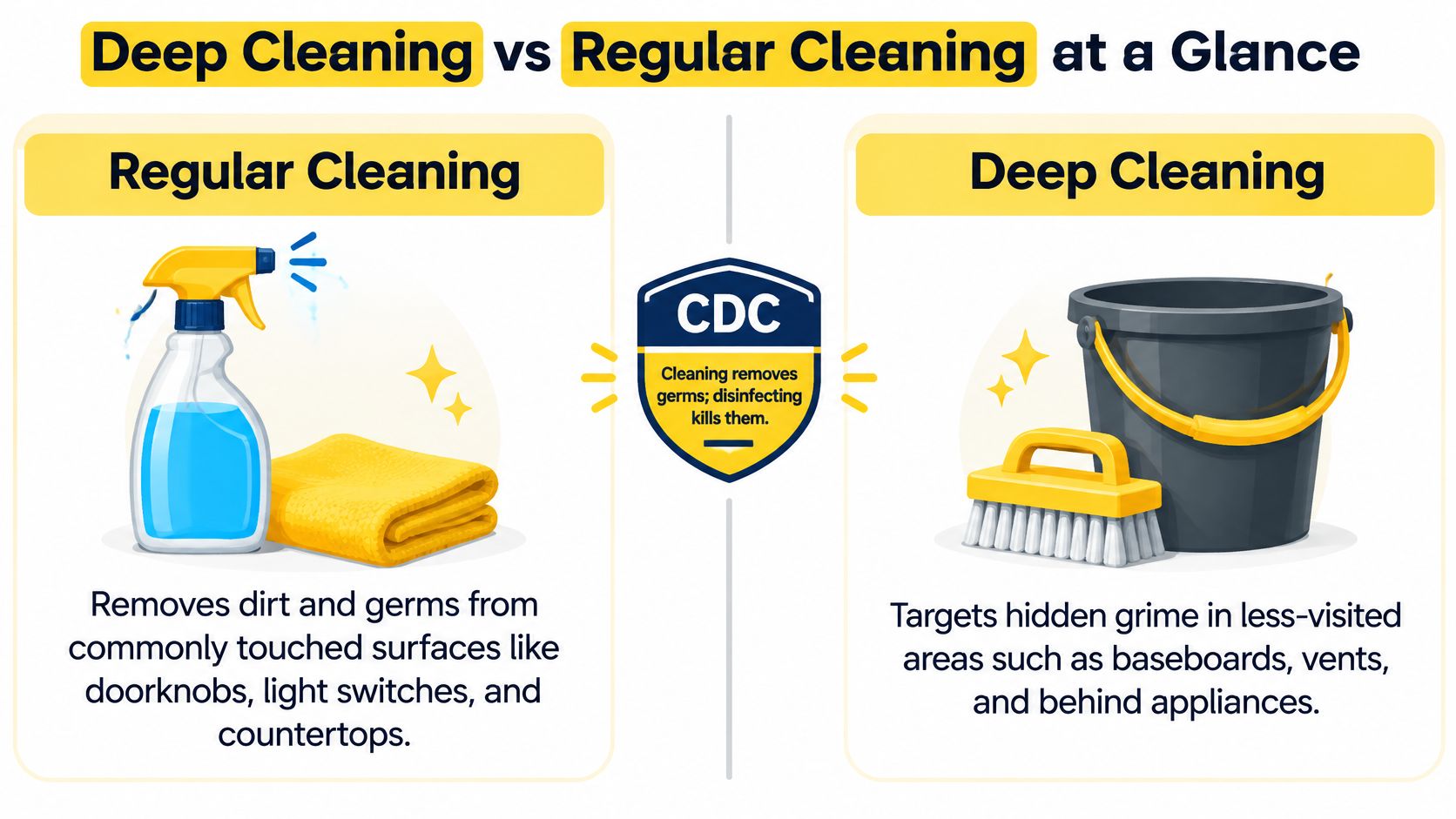
The U.S. Centers for Disease Control and Prevention defines routine cleaning as the ongoing removal of dirt and germs from commonly touched surfaces, and it names them: doorknobs, light switches, countertops, handles, toilets, faucets, phones and keyboards. Other household surfaces get cleaned when they're visibly dirty rather than automatically every day, according to the CDC's household cleaning guidance. That's a narrower job than most customers picture, and it's the job a maintenance visit exists to do.
Deep cleaning extends past the normal checklist into baseboards, vents, behind appliances, detailed fixtures, grout, cabinet interiors, and accumulated scale or grease. Those areas aren't failures of regular cleaning. They sit outside its cycle by design. The distinction matters on a quote because it tells the customer what they're buying: not a more thorough version of last month's visit, but a one-time restoration of surfaces that have drifted.
Working rule: regular service holds a home at its baseline, and deep cleaning brings the areas that fell below that baseline back up to it.
The time column is a typical range, not a promise. Two to three hours fits a maintained three-bedroom home; four to six hours or more fits the reset. Two dogs, a wood stove, hard water and a kitchen that hasn't seen a degreaser in a year push the second number upward, and it's better to say so in the estimate than to explain it after the visit.
Some jobs leave the residential checklist entirely. When a deep clean follows water damage, smoke or a long vacancy, the work overlaps with property restoration, and Eagle Restoration's cleaning and restoration services cover the cases where cleaning and remediation are the same visit.
A regular visit follows a fixed route, and the route is why it's fast. The cleaner works top to bottom, dry before wet, and leaves the dirtiest items for last so a bathroom cloth never touches a kitchen counter. A professional house cleaning routine built that way is repeatable, and repeatability is what makes a maintenance price possible at all.
That route is the baseline. Everything below it is what separates a deep clean from a regular one, and it's the list worth arguing about before a booking is confirmed.
| Area | Regular visit | Deep clean |
|---|---|---|
| High-touch points (doorknobs, switches, handles, phones) | Wipe and clean | Wipe, plus detail on fixtures and edges |
| Kitchen counters and sink | Clean and wipe daily-use surfaces | Degrease, cabinet fronts, and inside appliances as an add-on |
| Bathrooms | Clean and restock | Grout, tile scale, and exhaust vents |
| Baseboards, vents, ceiling fans | Not included | Included |
| Behind and under appliances | Not included | Included, usually at move-out or quarterly |
| Blinds and windows | Spot clean | Full detail as an add-on |
| Inside oven | Not included | Add-on |
High-touch scope runs wider than the short list most residential checklists carry. The CDC's facility cleaning guidance names pens, counters, shopping carts, door handles, stair rails, elevator buttons, touchpads, restroom fixtures and desks as regular cleaning targets. In a house that means remotes, switches, fridge handles and touchscreens; in a multi-unit building it means every shared surface a resident grabs.
Bathrooms are the other area where scope shifts. In a workplace covered by OSHA's Bloodborne Pathogens Standard, the bathroom row stops being a checklist item and becomes a written schedule, with decontamination methods set by facility location, surface types, amount of contamination and the tasks performed in that area, per OSHA's housekeeping requirements.
Inside the oven, blinds and moving furniture are usually add-ons rather than defaults, so a service labeled deep cleaning doesn't automatically include them. Grout restoration, tile scale removal and exhaust vents are where labor rises fastest, because they're slow work with hand tools rather than spray-and-wipe.
A move-out clean is the same conversation with the furniture gone, and what a professional move-out clean includes shows how much scope changes when every cabinet and closet interior counts.
A cleaning schedule works best when it follows the home's condition, not a fixed calendar. A 2022 peer-reviewed study of household hygiene practices reported an average cleaning-and-disinfecting frequency score of 5.30 out of 7, indicating frequent cleaning.
The study also found at least weekly cleaning reported for 96.8% of dining tables, 95.7% of toilet seats, 95.5% of floors, 81.4% of dining chairs and 77.8% of door handles. Regular visits maintain surfaces that see frequent use. A deep clean serves a different purpose: it resets areas that routine upkeep leaves behind.
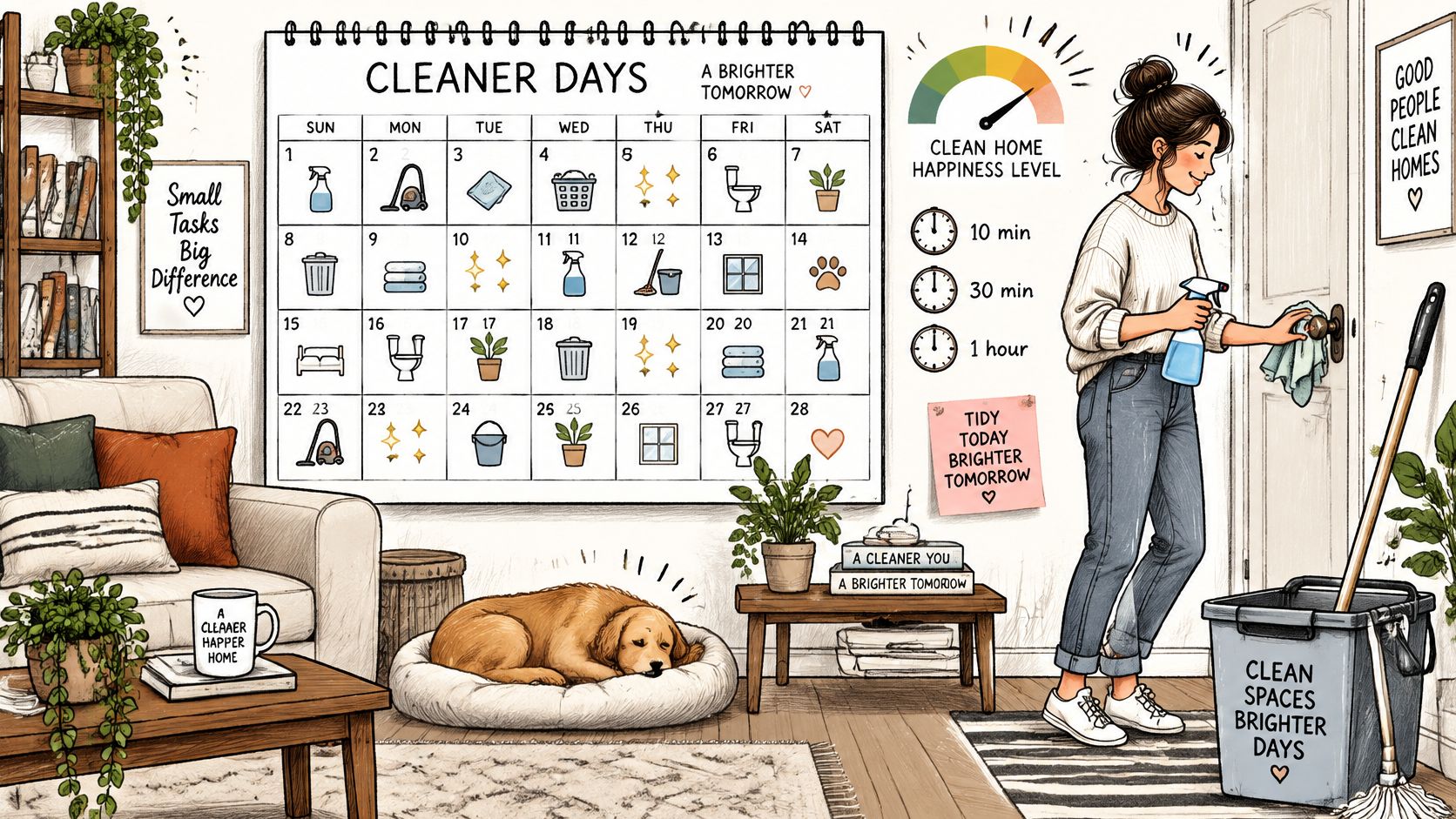
A deep clean is a scope, not a cadence. If the baseboards are still clean when the next visit arrives, the schedule is working.
If the home stays maintained between visits, keep the recurring plan rather than buying another reset. If specific areas fall behind each cycle, add those details to the recurring scope or schedule a deeper visit less often. A written cleaning schedule checklist helps make the choice based on what the home needs, not memory.
A deep clean and a disinfection are two different services sold under one word. Cleaning removes soil and the germs riding on it. Disinfecting is a chemical process with a clock attached, and it only works when the clock is respected.
The U.S. Environmental Protection Agency defines contact time as the period a treated surface must remain visibly wet for the product to work. If the label specifies ten minutes, the surface stays wet for ten minutes; if it dries at five, more product goes on. Wiping a counter and letting it air dry thirty seconds later doesn't meet that condition, regardless of how the bottle is labeled, per the EPA's guidance on selected registered disinfectants.
Contact times run from seconds to ten minutes or more, and the same product can carry different approved uses and post-rinse requirements across porous, hard nonporous and food-contact surfaces, as the EPA disinfectant selection tool sets out. On a real job that translates into explicit time allowances for soil removal before application, dwell-time management, reapplication where surfaces dry, ventilation, PPE and surface compatibility.
Those minutes are labor, and they belong in the estimate when disinfection is in scope. A team that sprays and immediately wipes has done a cleaning task and called it something else.
Name the visit a deep clean, and describe disinfection only where the label conditions can be met. A kitchen wiped with a product that flashed off in forty seconds is a clean kitchen. Saying so protects the customer from a false expectation and protects the business from a complaint it can't answer.
Write the exact label requirement onto the job sheet rather than a round number someone remembers from training. Contact time varies by product and by target organism, so a standardized checklist should record the specific figure for the product in the van, not a universal one.
Coverage is the second half of the problem. A surface missed by two inches wasn't treated either, which is why disinfection work is priced by touchpoint count and dwell management rather than by square footage alone.
Where disinfection earns its place is the illness scenario: someone in the home is sick or was recently sick, and high-touch points are the transmission route. That's also the scenario where process discipline matters most. If your crew is trained to cleaning industry standards that include label reading and dwell time, put that in the sales conversation instead of leaving it in the training binder.
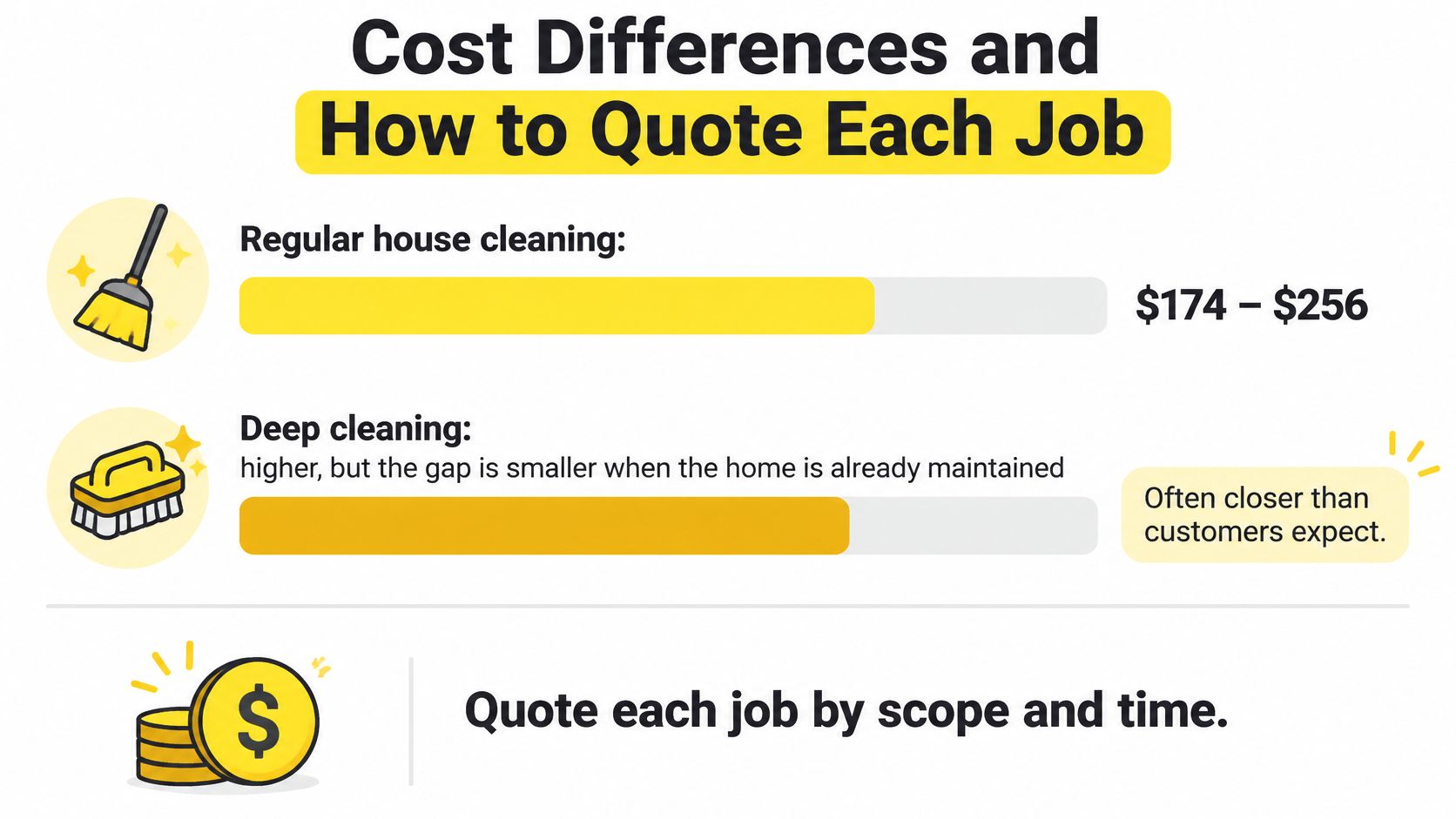
The gap between the two services is often smaller than customers expect, and that's the first thing worth saying out loud. 2026 pricing coverage from The Pricer places ordinary house cleaning at roughly $174 to $256 and deep cleaning at about $190 to $265 in one consumer dataset, while broader deep-clean ranges extend from about $180 to $600 depending on size, condition, labor and inclusions. The premium is modest on a maintained home and substantial on a neglected one.
The chart below shows where the two price points sit.
| Scenario | Typical cost | What drives it |
|---|---|---|
| Standard recurring visit | About $230 per visit (2024 average) | Home size and visit frequency |
| Deep-clean add-on to a recurring visit | Adds $100-150 or more | Buildup, priority rooms, extras |
| Full deep clean of a neglected home | $200-400, or $0.10-0.30 per square foot (2024) | Size, condition, labor |
| Broader deep-clean range (2026) | About $180-600 | Inclusions, labor, condition |
Neglected-property resets sit at the top of that spread. Homedit, cited by Maid in America, estimated the average professional residential deep clean at $200 to $400 in 2024, with typical pricing of $0.10 to $0.30 per square foot. Square footage sets the floor of the price. Buildup sets the ceiling.
Two outputs get confused constantly, and the confusion costs money. An estimate is the number you give before you've seen the condition of the house. A quote is the confirmed price you stand behind after you've asked about it. Keeping those words straight protects both sides when the oven turns out to be the worst one the crew has seen this month.
Our instant price tool collects the inputs that move a deep-clean number: service type, when the last clean was done, home size in square feet, beds, baths, pets and add-ons. Add-ons such as inside oven, steam cleaning, AC vents and blinds appear automatically during the booking flow, so the customer sees what raises the price instead of discovering it at the door.
Quoting rule: an estimate is what you offer before you know the condition, and a quote is what you stand behind after you've asked about it.
A home serviced every two weeks for a year doesn't need a full reset. It needs the normal visit plus the two or three detail items the crew keeps flagging, such as the oven interior or the shower grout. A property that hasn't seen professional service in a year is the opposite case, and pricing that visit as maintenance underprices the first job and disappoints the customer on the second.
A line-item deep cleaning price list shortens that conversation, because the customer can point at the item they want rather than negotiating a category. More cleaning-business guidance sits on Estimatty's blog for owners building out the quoting side.
Demand for deep cleaning is situational, and the survey numbers show it. In the Cleaning Institute's 2025 fall cleaning survey, 29% of U.S. adults change cleaning habits only when someone is sick, 27% when guests are coming, and 17% when illness numbers rise, while another 17% said their home had not been deep-cleaned during the previous year.
That's the argument in one paragraph. Customers don't buy deep cleaning as a category; they buy it as a response to something. A guest-driven job and an illness-driven job carry the same label and need different work, different priorities and often a different price.
| Trigger | Priority areas | Service to book |
|---|---|---|
| Routine upkeep | High-touch points, kitchen, bathrooms | Regular cleaning |
| Guests arriving | Floors, glass, kitchen, bathrooms, high-visibility surfaces | Deep clean scope on visible areas |
| Someone sick | High-touch points, with label contact times met | Regular cleaning plus targeted disinfection |
| First recurring visit | Accumulated detail work | Deep clean, then regular cleaning |
| Move-in or move-out | Full scope, including inside appliances | Deep clean |
| Home not deep-cleaned in a year | Full scope with buildup | Deep clean, then regular cleaning |
The contrarian part is worth saying plainly to a customer who asks for the biggest package on the list: deep doesn't automatically mean more disinfecting, and a longer checklist doesn't automatically solve the problem that prompted the call.
Before the booking is final, put three things on paper: the priority rooms, whether inside appliances, blinds and the oven are included, and which contact times apply if disinfection is part of the job. Those three lines prevent most disputes, because they answer the question the customer will ask at the door.
On the operations side, scope discipline is also a hiring question. Most cleaning company owners are up and running the same day they sign up with us, and Estimatty starts at $25/week, which helps when the alternative is a slow web form and a callback the next morning. When deep-clean volume forces a hire, PipeHire HRM's cleaning hiring blog covers recruiting for the roles.
If you want the deep-clean scope spelled out by room before the call, residential deep cleaning services breaks down what belongs in each visit.
Ask why the customer called before you ask how big the house is. The answer decides the scope, and the scope decides the price.
Every booking comes down to two questions that no service label can answer for you: which rooms matter most, and what condition are they in?
Estimatty gives residential cleaning businesses instant estimates, online booking and a 24/7 voice agent, so a customer choosing between a deep clean and a regular clean gets two different, defensible numbers in under a minute instead of a callback tomorrow. The instant price tool asks for service type, when the last clean was done, square footage, beds, baths, pets and add-ons, then sends the estimate by SMS and email while the lead is still on your site. Visit Estimatty to see how it handles the deep cleaning vs regular cleaning question on your own booking flow.