
November 11, 2026
AI Lead Qualification for Cleaning Companies Explained
AI lead qualification explained for cleaning companies: scoring, scripts, SMS and CRM setup, KPIs and handoff rules to turn more inquiries into booked jobs.

Thursday, November 12, 2026
Discover what is commercial cleaning services cover, how office, retail and industrial service types differ, and how to compare providers before you hire.
The U.S. Bureau of Labor Statistics counted 2,199,900 janitors and cleaners, excluding maids and housekeeping cleaners, in May 2024. That workforce runs on contracts, not chore lists. Commercial cleaning services are scheduled cleaning, hygiene and maintenance work for nonresidential sites such as offices, retail stores, schools, factories and transportation interiors, delivered under a contract or per-visit agreement and priced site by site.
The figure that decides what you pay isn't the square footage on your lease. It's the scope you write down.
Which is why the same office can attract two commercial cleaning estimates thousands of dollars apart, both honest. One prices floors and trash. The other prices floors, trash, restroom sanitizing, kitchen surfaces, entrance glass, a written checklist and a supervisor walk-through. A buyer who compares the bottom line without comparing the scope is buying a number rather than a service.
Treat commercial cleaning the way an operator does: a scoped operations contract with line items, frequencies, standards and inspection. Get that right and the price conversation gets short.
The definition is the easy part, and most pages stop there. The U.S. industry classification system files this work under NAICS 56172, Janitorial Services, covering establishments that clean building interiors, the interiors of transportation equipment including aircraft, rail cars and ships, and windows. The Census Bureau industry profile counted 67,799 employer establishments in the narrower NAICS 561720 category, which tells you this is an organized service market with tens of thousands of employers, not a person with a mop.
Why the classification matters to a buyer: it separates nonresidential building upkeep from household housekeeping by the setting, not by the chemical. If the site isn't a home and the work has to fit around other people's operations, you're buying commercial work.
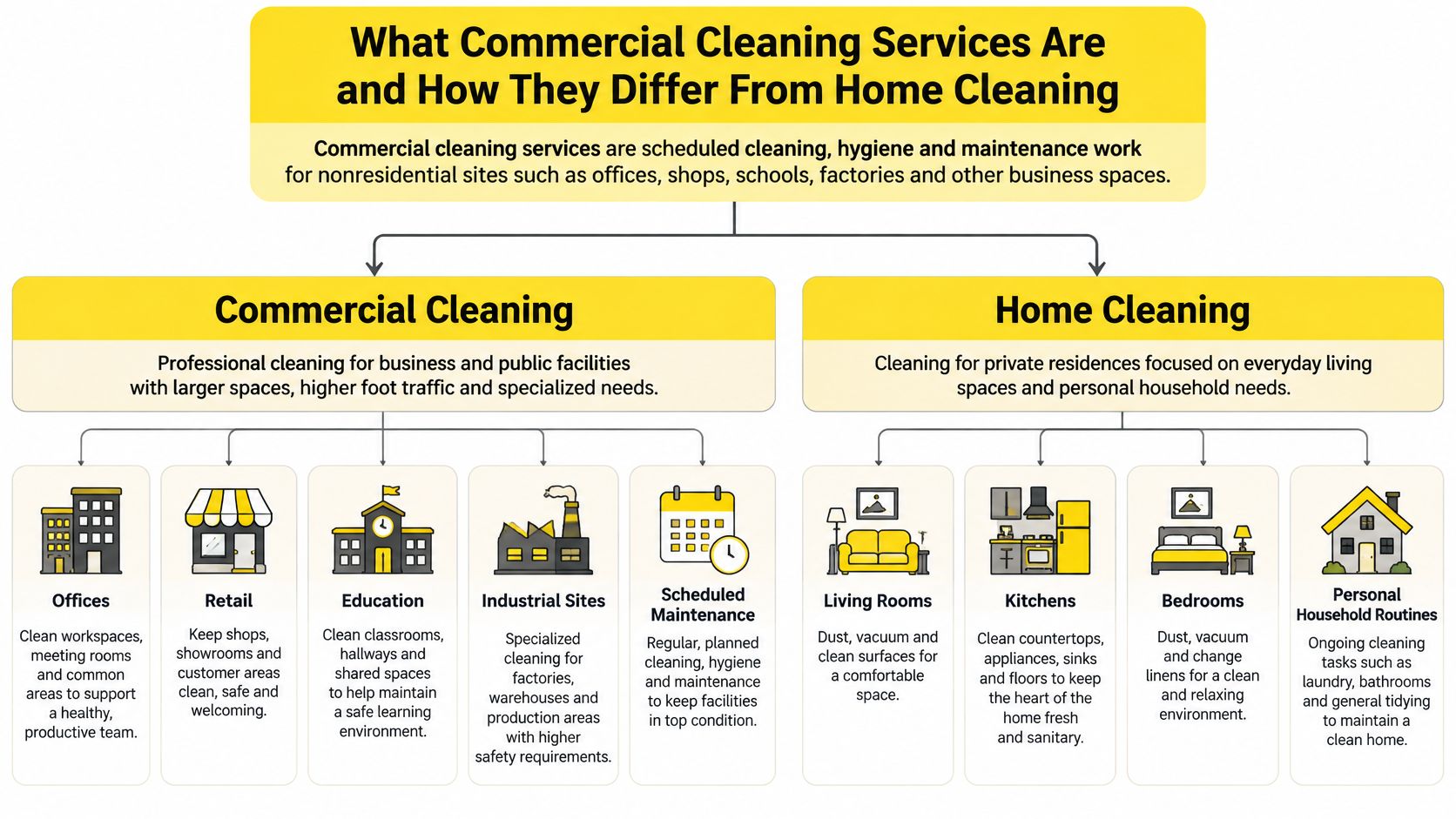
Where it splits from home cleaning, in four places:
A home cleaner keeps one kitchen tidy. A commercial team runs a building's routine upkeep the way a maintenance crew works from a route and a checklist: same zones, same sequence, signed off. Ask three questions to classify any job. Who pays, who uses the space, and when must the work happen. A business account, a shared population and a service window outside operating hours mean commercial.
Practical rule: if the person receiving the invoice doesn't live in the space being cleaned, you're in commercial territory and need a specification.
Match your site to a row before you talk to anyone about price.
| Service type | Typical sites | Core tasks | Usual frequency |
|---|---|---|---|
| Office cleaning | Offices, corporate suites, coworking spaces | Dusting, restrooms, kitchens, floors, trash | Nightly or several times a week |
| Retail cleaning | Shops, showrooms, shopping centers | Sales floor, entrances, glass, restrooms | Nightly or before opening |
| Industrial cleaning | Factories, warehouses, plants | Floor scrubbing, dust control, equipment areas | Weekly to monthly, with periodic deep cleans |
| Institutional cleaning | Schools, clinics, government buildings | High-touch surfaces, sanitizing where required | Daily |
| Transportation interiors | Aircraft, rail cars, ships | Seats, cabins, galleys, restrooms | Between trips or turnarounds |
Office cleaning is restroom and kitchen work wearing a floor-care costume. Desks get a wipe, waste gets emptied, but the hours land on restrooms, break rooms, entry glass and the traffic lanes between them. That's why after-hours access matters more than square footage. A crew locked out of the suite at 7 p.m. can't clean the kitchen.
Retail cleaning is a presentation deadline. Entrances, glass and high-traffic floors have to be finished before the doors open, and the front 20 feet of the store take more wear than the back room. A shopping center with shared corridors needs the common area and the tenant space priced separately, or the landlord and the tenant both assume the other is paying for the mat and the glass.
Industrial cleaning brings hazards into the estimate: airborne dust, oil and coolant on floors, equipment perimeters, lockout rules and production schedules. Most plants sit on weekly to monthly service with periodic deep cleans built in, because scrubbing a plant floor nightly is rarely the cheapest way to hold conditions.
Institutional sites, meaning schools and clinics, are driven by high-touch surfaces and sanitizing where the facility's policy requires it, and transportation interiors are tied to the turnaround clock, so the work compresses into the window before the next trip. The cleaning industry standards that govern tasks and frequencies are worth reading before you write your own spec, because the vocabulary you use decides what providers price.
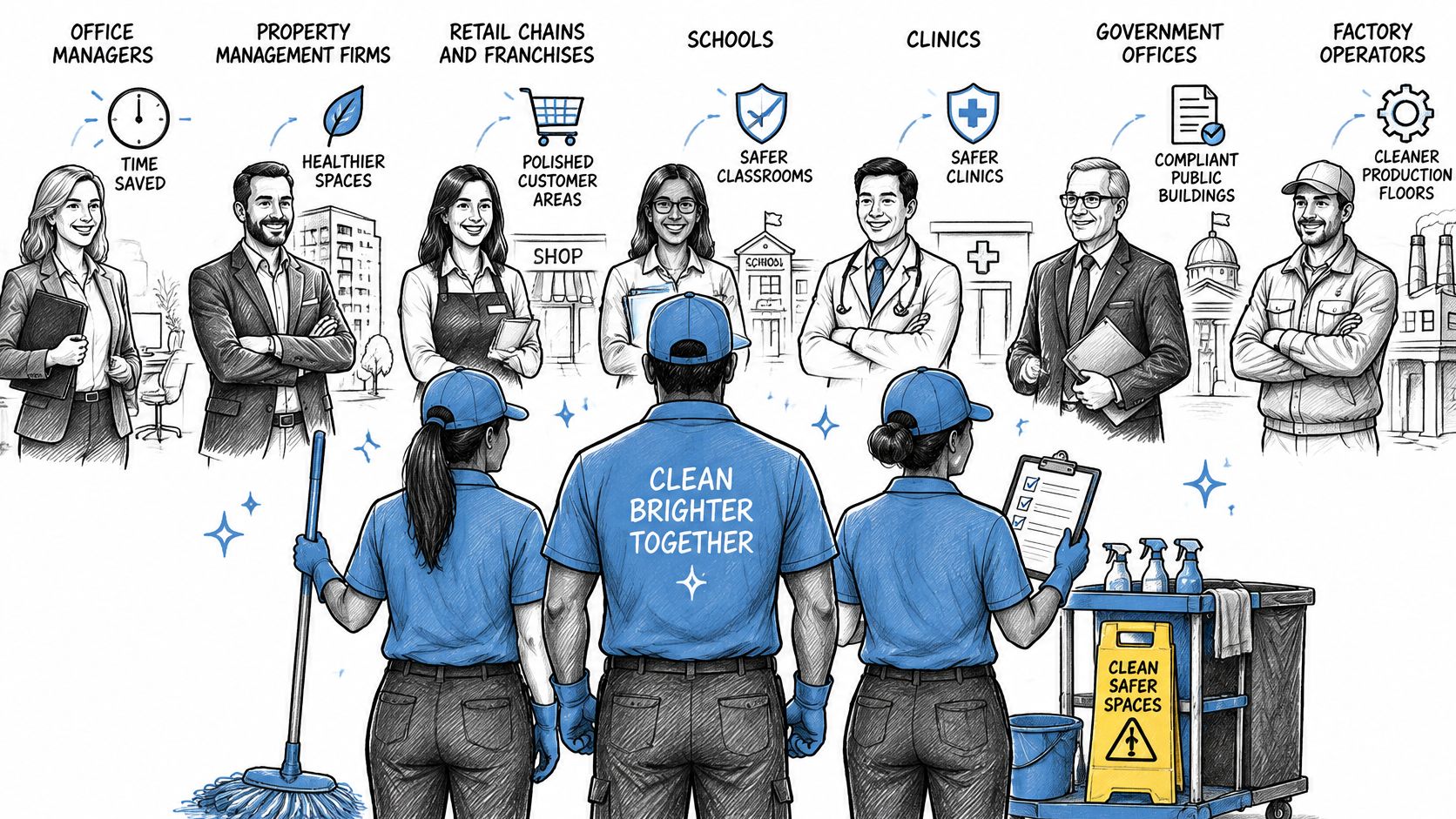
The buyers are specific people: office managers, property management firms, retail chains and franchise operators, school districts, clinic administrators, government offices and factory operators. What they're buying is a fixed monthly obligation instead of a hiring problem.
That framing holds up under the labor data. The CMM building service contractor benchmarking survey found 75% of responding contractors name recruiting qualified cleaning staff as their most pressing labor challenge, with 56% citing competitive pay and 44% citing retention. The market is also concentrated at the small end: 89% of U.S. janitorial firms had no more than 20 employees in 2022, while 0.47% of firms employed 43.1% of industry workers.
Read those two findings together and the case for outsourcing writes itself. The gain is access to a bench, and the bench is part of the scope. A provider with trained substitutes covers a sick day; a two-person crew with no backup misses a shift and tells you afterwards. The pipeline behind that bench stays thin as well, with the U.S. Bureau of Labor Statistics projecting building and grounds cleaning occupations to generate hundreds of thousands of openings a year over the coming decade. Continuity is a service feature, and it's the first one to interrogate.
Ask every provider one question before price: "Who cleans my building when my regular cleaner calls in sick at 4 p.m.?"
This is also where the money goes. Two bids on the same building can sit thousands of dollars apart because one prices a trained bench, supervision and a response plan when something fails, while the other prices a body in the building and leaves the coverage risk on your desk. Scope, not square footage, explains the gap.
Signs it's time to outsource: restroom complaints repeat monthly, your own staff get pulled off their jobs to vacuum before a client visit, results differ depending on who's on shift, or the building has outgrown one person's week. The limit is real, though. A small office with light traffic may be cheaper with a part-time in-house cleaner, especially if the work stays under a few hours a day.
Clean buildings carry less pest pressure too, a gain that never appears on the estimate. Residue in break rooms, moisture around trash rooms and cluttered storage give pests harborage, and the same residue-and-moisture logic behind sanitation tips for Texas homeowners applies to any building with a kitchen or compactor room. When the scope covers sanitation discipline in those rooms, you're buying prevention, not appearance.
Frequency is the biggest lever on a commercial cleaning estimate and the one buyers negotiate last. Two buildings of identical size can carry labor hours that differ by half, purely because one runs five nights and the other three.
| Frequency | Typical use | What it covers |
|---|---|---|
| Daily or nightly | Busy offices, schools, high-traffic retail | Trash, restrooms, kitchens, floors, high-touch points |
| Weekly | Smaller offices, lighter traffic | Restrooms, dusting, vacuuming, floor care |
| Monthly | Detailed upkeep | Deep detail work, interior glass, baseboards, vents |
| Quarterly or annual | Specialized jobs | Carpet extraction, floor stripping and refinishing, high dusting |
The interval sets the labor, and the scope sets the interval. Daily service exists because waste, restrooms and entry floors reset every day in a busy building. Weekly works for a suite where three people share one restroom. Monthly detail keeps buildup from becoming visible, and the quarterly or annual block covers restoration work that never belongs inside a nightly price.
Then separate cleaning from disinfection, because providers that blur the two are either overcharging or under-delivering. Cleaning uses soap or detergent to remove dirt and reduce the quantity of germs. Disinfection uses a registered chemical to kill targeted microorganisms only after the surface is clean, and the CDC's facility cleaning and disinfection guidance sequences it that way because organic soil interferes with disinfectant performance.
Specification rule: every sanitizing task needs a product, a dilution and a dwell time written next to it. "Wipe down restrooms" is not a task description.
Price then moves on surface types, occupancy, touch frequency, soil load, chemicals, equipment, dwell time and quality checks. A small, high-touch medical reception can need more labor and chemical control than a larger, quiet office with the same square footage, which is exactly why per-square-foot pricing alone gets facilities into disputes. Labor costs keep climbing underneath all of it: hourly compensation in U.S. janitorial services reached an index value of 146.753 in 2025 against a 2017 base of 100, per Federal Reserve Bank of St. Louis data drawn from the Bureau of Labor Statistics.
Floor work deserves its own line item for a reason. Carpet extraction, stripping and refinishing, and wood care follow different methods and different schedules, and a Denver commercial wood floor maintenance program is a useful model for how specialty floor work gets quoted separately from routine sweeping and mopping.
Send every provider the same package: room-by-room areas, frequencies, add-ons, who supplies products and equipment, and any infection-control requirement. A cleaning schedule checklist makes that intake repeatable across three bidders. Then compare labor hours, not just totals.
Take one building: 12,000 square feet, six restrooms, about 40 staff, nightly service. Both totals below are illustrative, not market rates, but the gap they show is the normal shape of a commercial cleaning decision.
| Item | Estimate A | Estimate B |
|---|---|---|
| Price level | Lower illustrative total | Higher illustrative total |
| Tasks | Floors and trash only | Floors, trash, restroom sanitizing, kitchen wiping, entrance glass |
| Frequency | Nightly assumed, tasks unspecified | Nightly with a written checklist |
| Supervision | None stated | Monthly supervisor inspection |
| Likely result | Missed tasks, change orders, rework | Matched scope, fewer callbacks, inspection record |
Estimate A isn't lying. It priced what it wrote down: vacuum, mop, empty bins. Estimate B priced the building. The difference lives in three places. Tasks included, since restroom sanitizing and kitchen wiping are the labor-heavy lines in any office. Frequency stated, since "nightly" means nothing if the task list is silent on which nights cover what. And after-hours access, because a crew that can't get in until 8 p.m. bills differently from one with keys and an alarm code.
Labor explains the spread. OSHA classifies the category broadly as janitorial service, office cleaning, window cleaning and floor waxing, per its SIC manual entry for building cleaning services, and that vagueness is precisely why buyers can't tell two bids apart. The cost structure is unforgiving: 42% of building-service contractors report labor at more than 60% of operating costs, and 23% report it above 70%, according to the same CMM contractor benchmarking survey.
When a bid comes in far under the others, you're not looking at efficiency. You're looking at hours that were never priced.
Do the arithmetic on a missing task. An extra 20 minutes per visit, five nights a week, is more than 80 hours of labor across a year before supervision and supplies are added. Multiply that against wage levels for the broader maids and housekeeping cleaners occupation, which averaged $16.66 an hour and $34,650 a year in May 2023 according to BLS occupational wage data, and the "cheap" estimate gets expensive through complaints, extra visits, change orders and rework.
The better deal is the estimate whose written scope and measurable results match the building. To get one, a provider needs square footage, occupancy, restroom count, surface types, access limits, frequency, who supplies products, and how fast you need service to start. An intake that captures those details before anyone prices the job removes most of the ambiguity, which is the problem Estimatty's automated estimator was built to solve. Compare scopes, compare assumed hours, and compare labor and burden assumptions side by side.
Procurement is five steps, in this order.
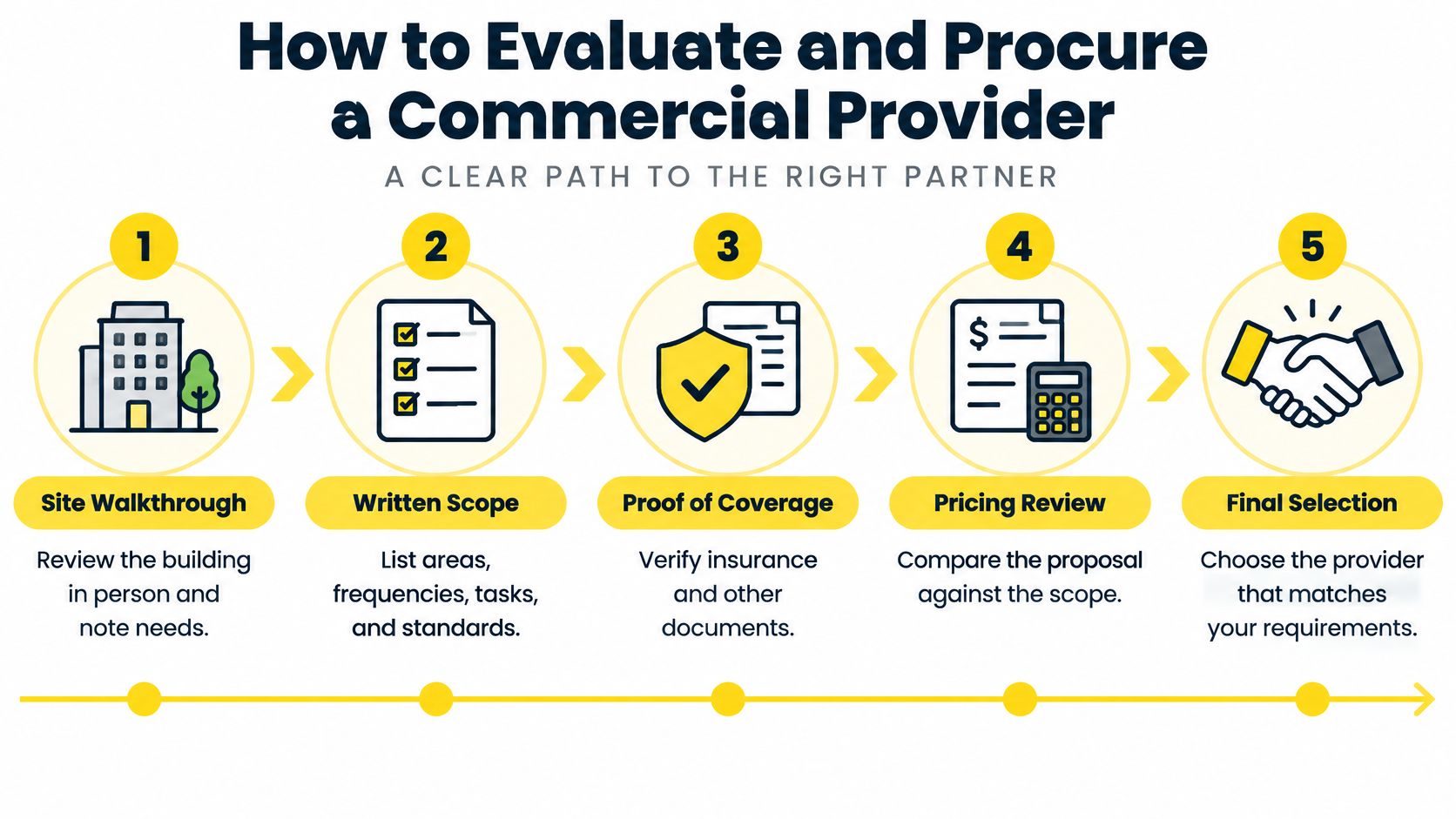
1. Walk the building with the provider. Not a phone call. Walk it, open the restrooms, show the freight entrance, name the rooms that get skipped. Anything you don't show becomes an exclusion.
2. Demand a written scope. Areas, frequencies, tasks and the standard each task is measured against. If a provider resists putting frequency next to each task, that's the answer to your evaluation.
3. Verify proof of coverage. Insurance and bonding, background checks, training records, the supervisor inspection process, incident reporting, key and alarm handling, and the substitute-worker procedure for absences. Then read references from your building type, not from a similar-sounding office downtown.
4. Interrogate green claims by product category. A general sustainability label means nothing. The EPA's custodial model contract language recommends that products and services supplied under a contract use recognized standards or ecolabels to the maximum extent practicable, and it names examples: EcoLogo/UL 2759 for hard-surface cleaners, EcoLogo/UL 2795 for carpet and upholstery-care products, and Green Seal Standard GS-37 for industrial and institutional cleaning products. Write the certification into the spec for each product category rather than accepting a brochure.
5. Review the price against the scope, then select. Cost per visit divided by tasks completed tells you more than the monthly total. Ask what happens when a task is missed: who reports it, how fast, and what the remedy is.
Green claim test: if a vendor can't name the ecolabel and the product category it applies to, treat the sustainability line as marketing.
Operational controls belong in the same conversation. EPA guidance on federal green purchasing identifies sustainable cleaning systems and products, chemical-concentrate and dilution systems, proper employee training, minimized use of antimicrobial hand soaps, and measures to reduce indoor air quality impacts. Each one shows up somewhere in a facility: purchasing, storage, dispensing, worker procedure and occupant exposure.
Staffing questions decide continuity. If you're weighing whether to hire your own cleaners instead, hiring advice from Professional Window Cleaning covers the questions worth asking a specialist contractor about crew, insurance and equipment before you sign.
Your request should include a checklist: references from your building type, measurable quality scores, cancellation terms, key and alarm handling, supervision frequency, and one named contact for escalation. A bid for cleaning contracts built on those items gives you three responses you can compare.
Match the rows first. Take the service-type row that fits your site and the frequency row that fits your traffic, and write them into one document. That document is your scope, and it's the only thing that makes three estimates comparable.
Send the identical scope to three providers. Same rooms, same frequencies, same add-ons, same answer on who supplies products and equipment, and the same stated process when a task is missed. Don't let anyone substitute their own template.
Compare every line, then sign. Sign only the response that prices every area and names the frequency for each task. Missing areas are the most common source of a cheap estimate that gets expensive in month three. The contract terms worth reading twice are covered in this guide to cleaning contracts for small business.
Estimatty was built specifically for cleaning businesses, so a provider running on it can answer scope questions with square footage, surfaces and urgency already captured before anyone prices the job. Buyers should still confirm that any estimating flow covers multi-site, after-hours and recurring commercial work rather than defaulting to residential assumptions. For longer walkthroughs, the Estimatty blog covers scope, pricing and scheduling in detail, and operators who are hiring cleaners rather than buying a service can use pipehirehrm.com, with staffing articles on the PipeHire HRM blog. Attach the scope, request the estimates, then compare price.
Two commercial cleaning estimates that look alike almost never are, and the difference is always written down somewhere in the scope, the frequency or the assumed hours. Estimatty is an AI sales and estimating agent built specifically for cleaning businesses: it engages a prospect the moment they visit your site or call, captures square footage, surfaces and urgency, and sends a consistent estimate by SMS or email in under a minute, day or night. If your team is losing commercial inquiries to slow callbacks and gut-feel pricing, visit Estimatty and see how the estimator handles your price book.