October 23, 2026
How to Start Commercial Cleaning in 2026
Learn how to start commercial cleaning in 2026 with proven steps for pricing, staffing, licensing, and automation that win recurring contracts.
Friday, August 28, 2026
Master cleaning industry standards in 2026 with this practical guide covering OSHA, EPA, infection control, green cleaning, SOPs, KPIs, and consistent quoting.
You can usually tell when a cleaning business is drifting from standards to guesswork. The schedule looks full, the crews are busy, and the invoices go out, but the quote on the next account is built from memory, the disinfectant on the shelf isn't tied to the label dwell time, and the supervisor is checking “done” without a real pass or fail rule.
That's where margin gets lost and trust gets fragile. In 2026, cleaning industry standards aren't background paperwork, they're the operating system that shapes quoting, scheduling, training, documentation, and quality control on every site.
A solo cleaner can do everything right for months, then lose a medical office because one detail was off. The bid assumed residential-style turnover, the crew used an unverified disinfectant, and nobody could show a documented process for the work the client needed. That kind of gap doesn't just cost a contract, it can trigger a bad review, a client walkaway, and a closer look from regulators when the job touches regulated hazards.
The market is moving toward proof. OSHA's cleaning-industry overview says cleaning hazards are handled through general-industry standards, not one single cleaning code, and it notes that about 1.4 million people work in the U.S. cleaning industry, including roughly 305,000 housecleaners OSHA cleaning industry overview. That scale makes standardization matter, because a small process failure can spread across a very large labor base.
Practical rule: if you can't show how a task is done, you're only selling confidence, not compliance.
Insurance carriers, property managers, and healthcare buyers usually don't say “standards maturity” in plain language, but they measure it every time they review a vendor. They look for consistent pricing, documented training, clear chemical controls, and a QA trail that proves the crew can repeat the same result on Tuesday night, not just during the walkthrough. That's why operations with stronger systems tend to win even when they're not the cheapest line on the page.
The rest of the work falls into five buckets. Legal floor, chemicals, infection control, sustainability, and quality systems. The owners who treat those as an operating system, not a binder on a shelf, can turn standards into cleaner estimates, smoother scheduling, and fewer callbacks. A useful starting point is how branding influences trust in cleaning services, because the market usually buys the promise first and the proof second.
Cleaning rules work like building codes. Some rules tell you what's legally required, some tell you what chemicals can touch a surface, some govern high-risk spaces, and some define what good management looks like when no one is standing over the crew.
At the bottom is the legal floor. For U.S. employers, OSHA's general-industry framework covers the major safety obligations that apply to cleaning work, and OSHA's Bloodborne Pathogens standard at 29 CFR 1910.1030 covers exposure control, universal precautions, PPE, housekeeping, hepatitis B vaccination, post-exposure follow-up, training, and recordkeeping OSHA Bloodborne Pathogens standard. That's the layer that keeps a job from becoming a safety incident.
The next layer is chemical control. EPA-registered disinfectants have label-directed contact times, also called dwell times, and the product must stay visibly wet for the full time on the label. EPA notes that those times can be as short as 10 seconds or as long as 10 minutes EPA disinfectant guidance. For bloodborne-pathogen cleanup, OSHA says the surface must remain wet for 30 seconds for HIV-1 and 10 minutes for HBV OSHA BBP fact sheet.
Specialty spaces bring tighter rules. In cleanrooms, ISO 14644-13:2017 requires cleaning methods to hit surface cleanliness targets measured by particle and chemical contamination, so appearance alone isn't enough ISO 14644-13. That's a very different standard from a routine office turn, which is why one-size-fits-all SOPs fail.
For management systems, ISSA's CIMS has become a widely referenced benchmark for consistency and accountability in commercial cleaning, while green programs and facility requirements add another layer of product and process selection. Owners who need practical help translating these layers into daily workflows can also review professional cleaning chemicals guidance, and teams looking for structured support sometimes use AI-powered janitorial support as a reference point for internal process design.

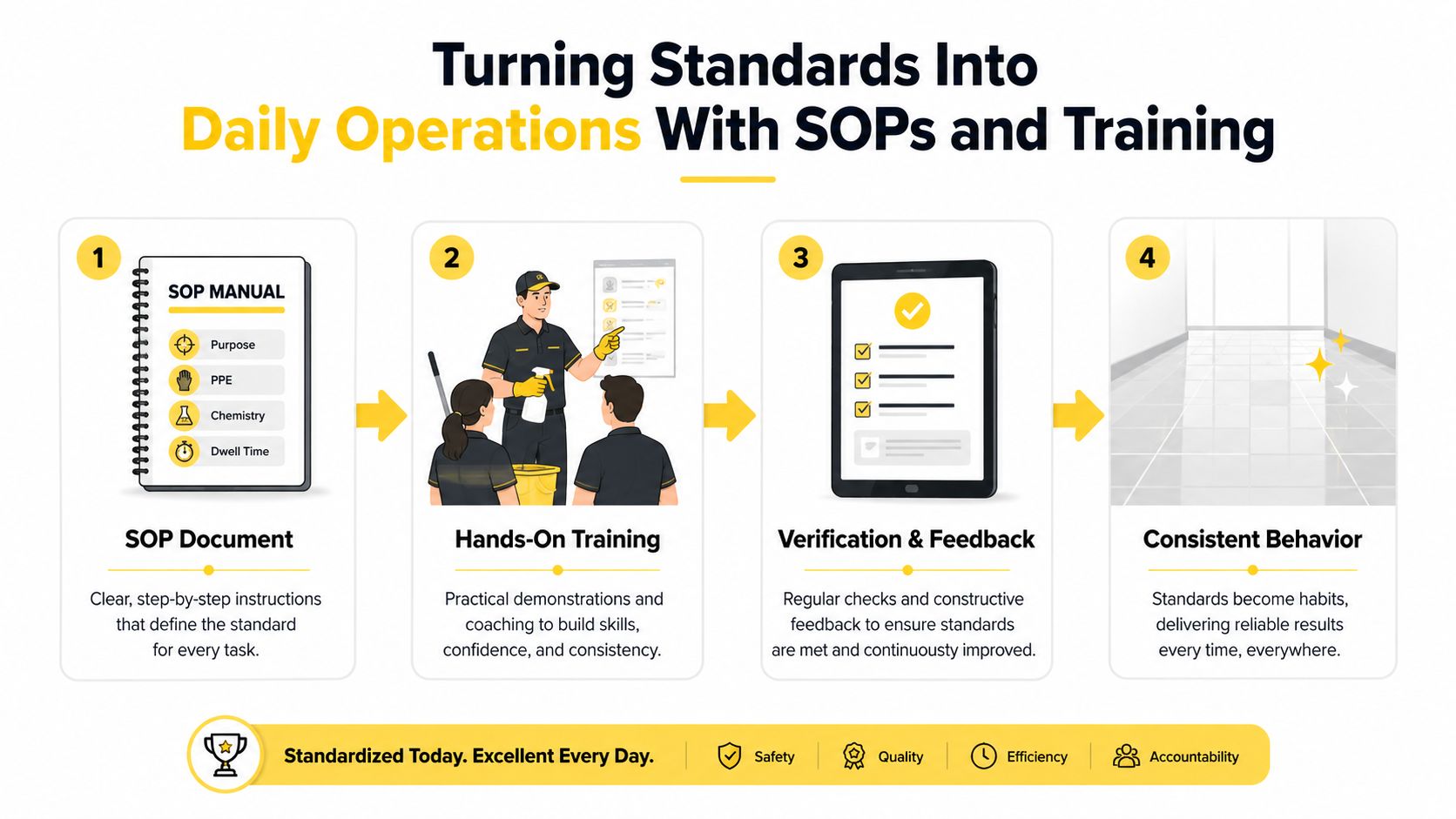
A standard only matters when a worker can follow it on a tired Tuesday with gloves on and a phone buzzing in the pocket. That's why the job turns on four pillars, SOPs, training, verification, and feedback.
A good SOP has a purpose, scope, PPE, chemistry, dwell time, and sequence. A restroom restock doesn't need the same controls as a terminal clean, but both need written steps that the crew can repeat without interpretation. If you lump every task into one generic checklist, supervisors start making judgment calls in the field, and that's where quality drifts.
Operational rule: every task should answer the same six questions, what is it, where is it used, what PPE is required, what chemistry is approved, how long does it stay wet, and what order do steps happen in.
Training works when it includes a live demo, a buddy shift, and a competency check, not just a video and a signature. Quarterly refreshers matter most after SDS updates, new product swaps, or a client's infection-control change. A crew that can explain why a surface needs a full dwell time is less likely to wipe it dry too early.
Paper or mobile checklists make the work visible. Photo proof, QR-coded room scans, and supervisor spot audits turn “done” into something you can review later, which is what protects the business when a client questions a room or a crew lead is off-site. A useful shortcut is to make the checklist reflect the SOP, not a separate version of it.
For owners who want to automate routine process documents, a guide to Supatool automation templates can help them think through how SOPs, follow-ups, and task routing fit together. The same logic sits inside policies and procedures manual guidance, because the document only works when the field team can use it without hunting through a binder.
The last layer is measurement. ATP swabs, inspection pass rates, rework tickets, and customer satisfaction scores tell you whether the standard is real or just written nicely. If the metric never moves, the SOP probably doesn't match the job.
A clean operation runs on records as much as it runs on product. The point isn't paperwork for its own sake, it's being able to show who did what, with what, under which rule, and when the result was checked.
Worker records should cover injury logs, BBP training rosters, and access to SDS sheets. OSHA's Bloodborne Pathogens standard requires training, housekeeping, and recordkeeping, so the training trail matters as much as the task itself OSHA 1910.1030. Facility records should cover disinfectant use logs, chemical inventories, and any site-specific air or sanitation requirements that the contract calls for.
Contract records need the scope, service levels, insurance certificates, and product lists that match the site. Audit records should include internal QA scores, client sign-off sheets, and corrective action forms. If a room fails twice, the paper trail should show whether the issue was staffing, chemistry, or the standard itself.
The practical problem for owners is timing. A separate compliance guide flags 2026 to 2028 changes in OSHA hazard-communication label and SDS requirements, plus higher penalty exposure, which means the risk isn't just inspection day, it's the slow buildup of outdated documents and old product data OSHA EPA compliance guide. That's why the calendar belongs in the same folder as the SOPs.
A clean documentation system doesn't need to be complicated, but it does need ownership. One person should update records, one person should review them, and one person should know where the latest version lives. The simplest setups usually fail because nobody owns the update cycle.
For teams that want ready-made structure, compliance templates by VideoLearningAI can be a useful reference for organizing the paperwork before the next client review. If you also need the licensing side tied down, cleaning business license guidance is worth keeping close to the rest of the admin files.
Not every standard belongs in every building. Padding a residential estimate with medical-grade controls is the fastest way to price yourself out, while underbuilding a clinical SOP can create real exposure on the first complaint.
Home cleaning usually relies on EPA product labeling, basic OSHA safety, and any green-preference the homeowner asks for. Documentation stays light, training stays practical, and speed matters because profit depends on turning jobs efficiently and keeping referrals strong. A home office doesn't need the same evidence trail as a treatment room.
Commercial spaces reward consistency. CIMS-style quality control, nightly checklists, and reporting to the facility manager help the crew stay aligned with what was promised. Vendor onboarding, access rules, and site-specific security checks also become part of the job because office properties usually have more moving parts than houses.
Medical and clinical spaces add the hardest layer. Infection-control rules, terminal cleaning, biohazard handling, documented competencies, and often background checks are part of the role, and the contract usually expects more than a clean-looking room. OSHA's BBP standard and EPA label compliance both matter here because the tasks touch exposure risk and chemical control at the same time.
| Standards Required by Facility Type | Residential | Commercial Office | Medical / Clinical |
|---|---|---|---|
| Standard Area | Basic OSHA safety, EPA label use, homeowner preferences | CIMS-style QA, checklists, access rules | Infection control, BBP controls, documented competencies |
| Documentation | Light, mostly service notes | Moderate, inspection and reporting logs | Heavy, training, competencies, incident trail |
| Chemical Control | Simple product selection | Approved site list and dwell-time discipline | Strict product approval and surface-specific protocols |
| Staffing Rules | General training | Site onboarding and supervisor review | Competency checks, role-specific authorization |
A smart SOP library loads the right checklist for the right building type instead of forcing one master form across every job. That protects margin on the low end and protects the company on the high end.
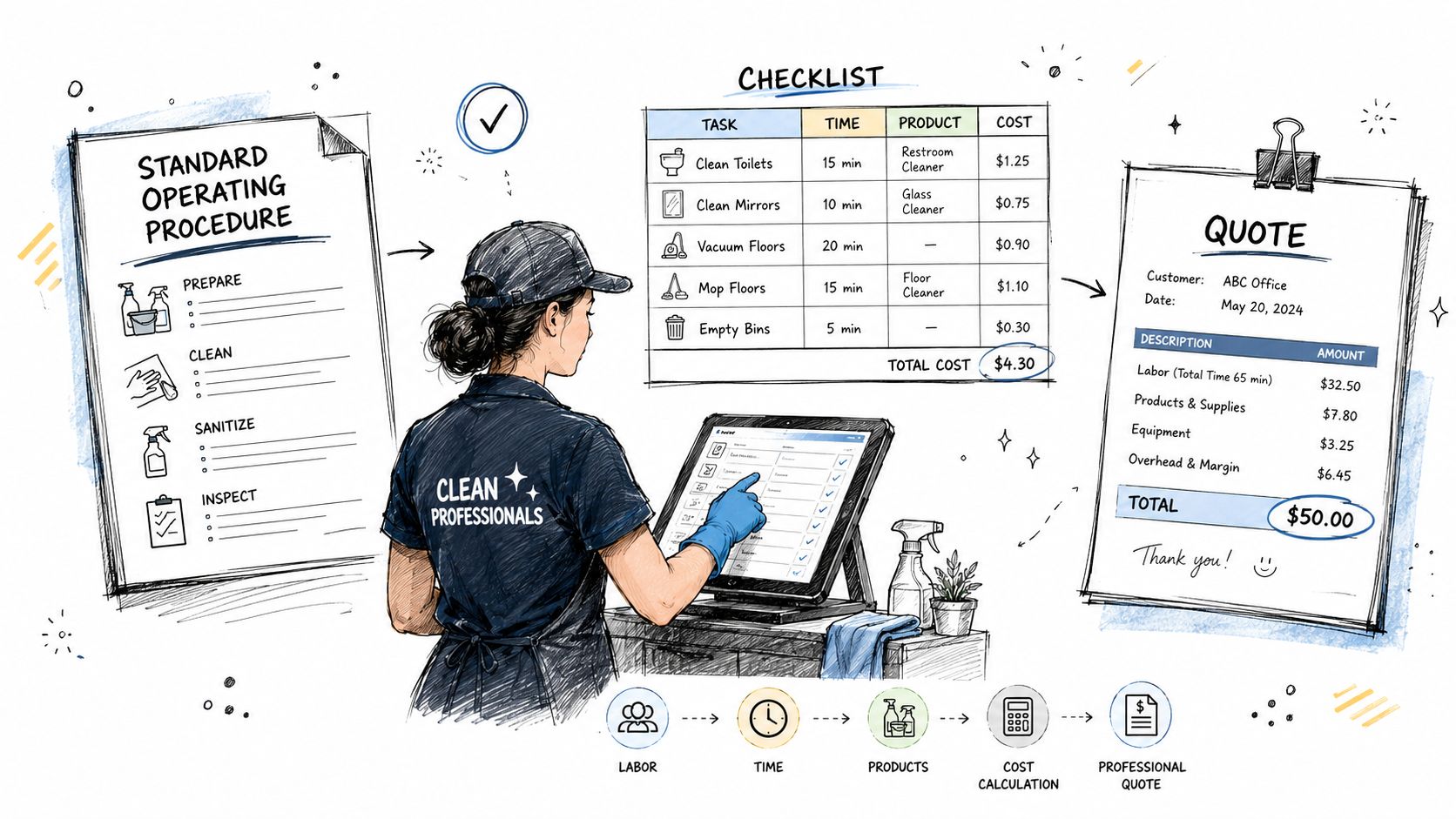
Standards stay abstract until they hit the quote. Once that happens, every SOP becomes labor minutes, every chemical rule becomes product cost, and every inspection promise becomes a service-level clause.
The first leak is square footage that's off because nobody verified the layout. The second is a generic time-per-room factor that ignores the actual work in the scope. The third is skipping the walkthrough, which leaves the estimator guessing about access, soil load, and add-on tasks. Those three mistakes can chew through margin because the bid was never grounded in the field reality.
A consistent estimate should start from the standard, not the salesperson's memory. If a restroom needs two extra dwell cycles, or a breakroom needs a different chemistry set, the estimate has to show that cost. Otherwise the field team carries the burden later.
An AI estimator like Estimatty can take SOP minutes, local labor rates, and product costs, then turn them into a repeatable estimate that matches the work the crew will perform. That matters because the quote and the SLA should point to the same tasks, the same frequency, and the same quality expectation. Used well, the estimator becomes the front end of the operating system, not a separate sales tool.
The point isn't to replace judgment. It's to stop two reps from quoting the same medical suite with different assumptions and then arguing about margin after the job is won. When pricing is tied to standards, the sales promise and the field process stop drifting apart.
If you want a deeper look at the quoting side, AI estimates software for cleaning shows how estimate consistency can be built into the sales workflow.
Start small, but start in the right order. A standards rollout works when it touches the work crews already do, not when it waits for a perfect manual that never gets deployed.
Write one scope sheet per account, refresh the bloodborne-pathogen training for anyone who needs it, set up a chemical SDS binder or digital folder, and issue a five-line QA checklist that gets used on every visit. That gets the business out of memory-based decisions and into visible process.
Build SOPs for the five room types you clean most often, run a 60-minute onboarding module for every new hire, calibrate job costing by square foot, and issue a monthly QA scorecard tied to renewals. At this point, supervisors should be able to see which jobs are profitable and which ones keep creating rework.
Switch one product line to a green-cleaning option where the client allows it, write an infection-control protocol for at least one healthcare site, align SLA clauses with the QA metrics you inspect, and run a documentation audit as if a client or regulator asked for it tomorrow. That last step is the one that exposes whether the system is real.
A simple rollout checklist helps the team stay honest:
Track three KPIs each week during rollout, QA score, callback rate, and estimate-to-job margin. Those three numbers tell you whether the standards are improving the operation or just adding paperwork.
If you want your estimates to reflect the standards your crews work under, build them from the field up instead of guessing from the desk. Estimatty helps cleaning businesses turn scopes, task times, and service levels into consistent estimates that match daily operations, so you can price with more confidence and defend your margin with less friction.