November 10, 2026
AI Receptionist Pricing: What You Really Pay in 2026
AI receptionist pricing for cleaning businesses: plan types, 2026 price ranges, cost drivers and ROI, so you compare real costs, not headline fees.

Wednesday, November 11, 2026
AI lead qualification explained for cleaning companies: scoring, scripts, SMS and CRM setup, KPIs and handoff rules to turn more inquiries into booked jobs.
It's Saturday night, your teams are off, and the good inquiries are still landing on a form nobody will read until Monday. By then those homeowners haven't waited. They've booked the competitor who answered first. That gap between inquiry and first real conversation is where cleaning companies lose profitable work, and it's exactly where AI lead qualification earns its keep.
A homeowner submits a contact form at 9 p.m. on Saturday. She wants a deep clean before guests arrive next weekend. Your office sees it Monday morning, calls back, and learns she's already booked someone else. The lead wasn't weak. Your response was late.
AI lead qualification is an automated first conversation that asks the questions a good sales coordinator would ask, sorts each inquiry by fit and readiness, and passes the strongest ones to a person. It doesn't just collect a name and email. It finds out whether you can serve the job, price it, and staff it.
Think of a hospital triage nurse. She doesn't treat everyone in arrival order. She decides who needs attention now, who can wait, and who needs a different department. Your AI does the same work for inquiries. It decides which prospect needs an estimate now, which one needs nurturing, and which one sits outside your service area.
A static contact form can't ask a follow-up question. If a prospect writes "big house, needs cleaning soon," you're stuck guessing. Gut feel estimates have the opposite problem. They change depending on who answers the phone, how rushed that person is, and whether they remember to ask about pets, buildup, or stairs.
A qualification conversation works through three jobs:
Other service businesses use the same triage logic to protect scarce sales time, and a useful parallel from outside cleaning is AI lead qualification for golf clubs, where membership inquiries also need fast sorting by fit and urgency. The industry differs, but the principle doesn't. Don't make your closer interview every browser.
For cleaning, every qualified inquiry needs enough facts to price the work: residential or commercial, size, surfaces, service type, preferred date, and ZIP code. Collect those one question at a time, and you've got the raw material for a consistent estimate. Skip them, and you're pricing blind.
Buying intent is hottest in the first minutes after someone asks for help. The prospect is still on your site, still comparing cleaners, and still ready to make a decision. Wait until tomorrow and you're not continuing a conversation. You're trying to restart one.
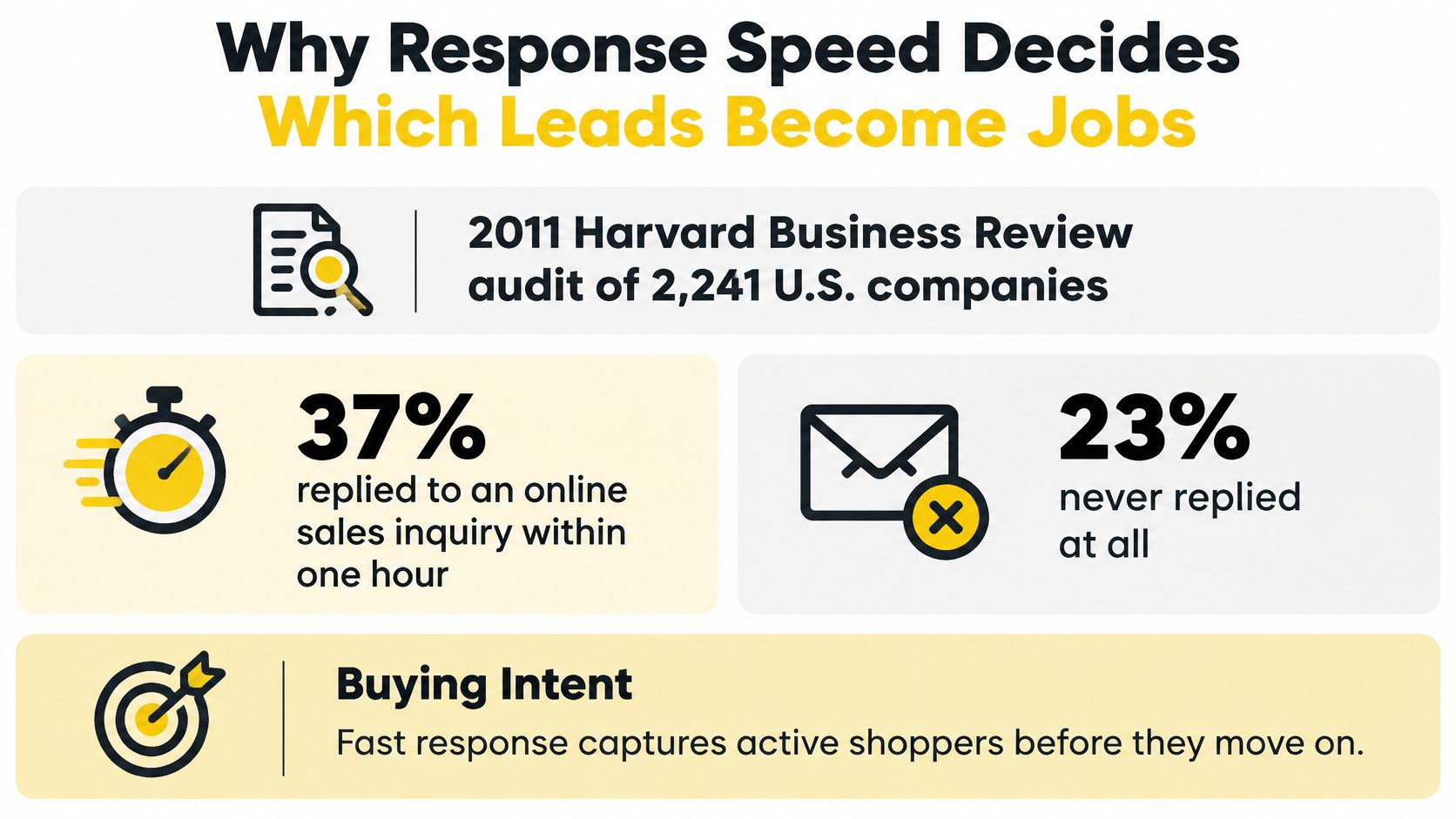
That's not opinion. A 2011 Harvard Business Review audit summarized by Vida submitted online sales inquiries to 2,241 U.S. companies. Only 37% replied within one hour, while 23% never responded at all. Among companies that did respond within 30 days, the average response time was 42 hours.
The MIT and InsideSales Lead Response Management Study analyzed more than 15,000 web leads across six companies. Calling a lead within five minutes produced 100 times higher odds of making contact than waiting 30 minutes, while the odds of qualifying the lead were 21 times higher. Moving from five minutes to 10 minutes reduced the odds of qualifying by approximately four times.
| Response time | Odds of making contact | Odds of qualifying the lead |
|---|---|---|
| Within 5 minutes | Baseline (best case) | Baseline (best case) |
| 10 minutes | Lower than at 5 minutes | About 4 times lower than at 5 minutes |
| 30 minutes | About 100 times lower than at 5 minutes | About 21 times lower than at 5 minutes |
Read that middle row carefully. You don't need to be hours late to lose ground. Ten minutes is already materially worse than five. A manual callback queue can't reliably hit that window at 10 p.m. on a Friday, over a holiday weekend, or during a spring cleaning rush when your coordinator is already handling schedule changes.
Practical rule: If your first reply waits for office hours, your best inquiries will buy during someone else's office hours.
An AI agent removes that timing gap because the AI steps in the moment a prospect raises their hand, gives a price and chats with them. The prospect gets questions, answers, and an estimate while intent is active. You get a sorted lead instead of a cold form entry.
Start by measuring your current baseline. Pull the median time between form submission and first reply over the last 30 days and compare it with the practical steps in our guide on how to improve response time for cleaning inquiries. If that median is measured in hours, fix speed first.
Speed alone isn't enough, though. A fast reply with weak questions only produces fast, low quality conversations. The agent also has to ask the right things, in the right order, every time.
A lead list sorted by arrival time treats every inquiry as equal. They aren't. A recurring customer inside your zone who needs service this week deserves a different response from a one time inquiry 40 minutes outside it.
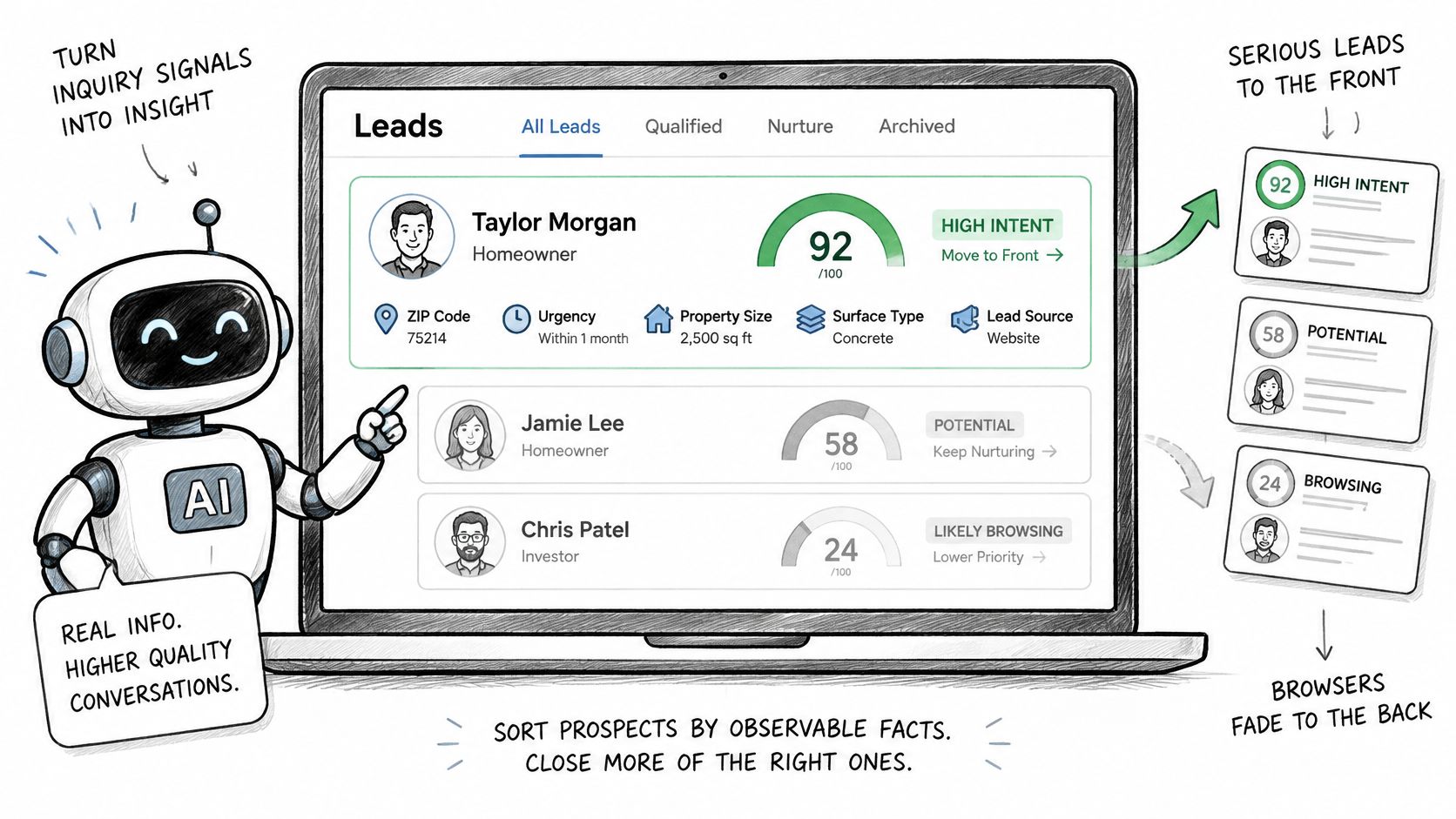
Qualification starts with signals, the observable facts attached to an inquiry. The table below covers the signals that matter most for cleaning work.
| Signal | Example | What it suggests |
|---|---|---|
| Service area | ZIP code inside the service zone | The job can be scheduled and staffed |
| Service type | Recurring weekly or biweekly plan | Higher lifetime value than a one time clean |
| Property size | 2,500 sq ft or larger, or 4+ bedrooms | Longer job, larger ticket, needs an accurate estimate |
| Urgency | Move out or event date within 7 days | The decision window is closing |
| Lead source | Referral or a named service search | Stronger intent than a broad social click |
| Engagement | Asked about price or availability | Active buying intent |
Don't build a checklist that adds arbitrary points for every answer. Treat the score as a probability that this inquiry becomes a booked job. A study in Frontiers in Artificial Intelligence evaluated 15 classification algorithms on CRM lead data from January 2020 through April 2024, and a Gradient Boosting Classifier produced the strongest performance using accuracy and ROC-AUC comparisons. Feature importance analysis identified lead source and lead status as especially informative variables.
Calibration keeps that probability honest. If a group of leads scores 0.70, about 70% of them should book within the same segment and time window. If only a third book, your score is flattering you and your routing rules are built on sand.
Watch a qualification agent collect those signals in a live conversation below, rather than inferring them after the fact from page visits alone.
When a signal is missing, the agent shouldn't guess. It should ask. Say a prospect reports a home of about 2,000 square feet with two cats. The next question covers surfaces and pet hair before any estimate goes out. That's the same discipline good operations teams apply when prioritizing incoming service tickets, where incomplete information gets clarified before work is assigned.
I would also train any scoring you use against booked and completed jobs, not submitted forms. Engagement is easy to inflate. A prospect who clicks often isn't always a prospect who books, shows up, and pays.
Copy this sequence, then adjust the wording to sound like your company. The order matters. You're confirming fit before price, and price before you ask a closer to spend time.
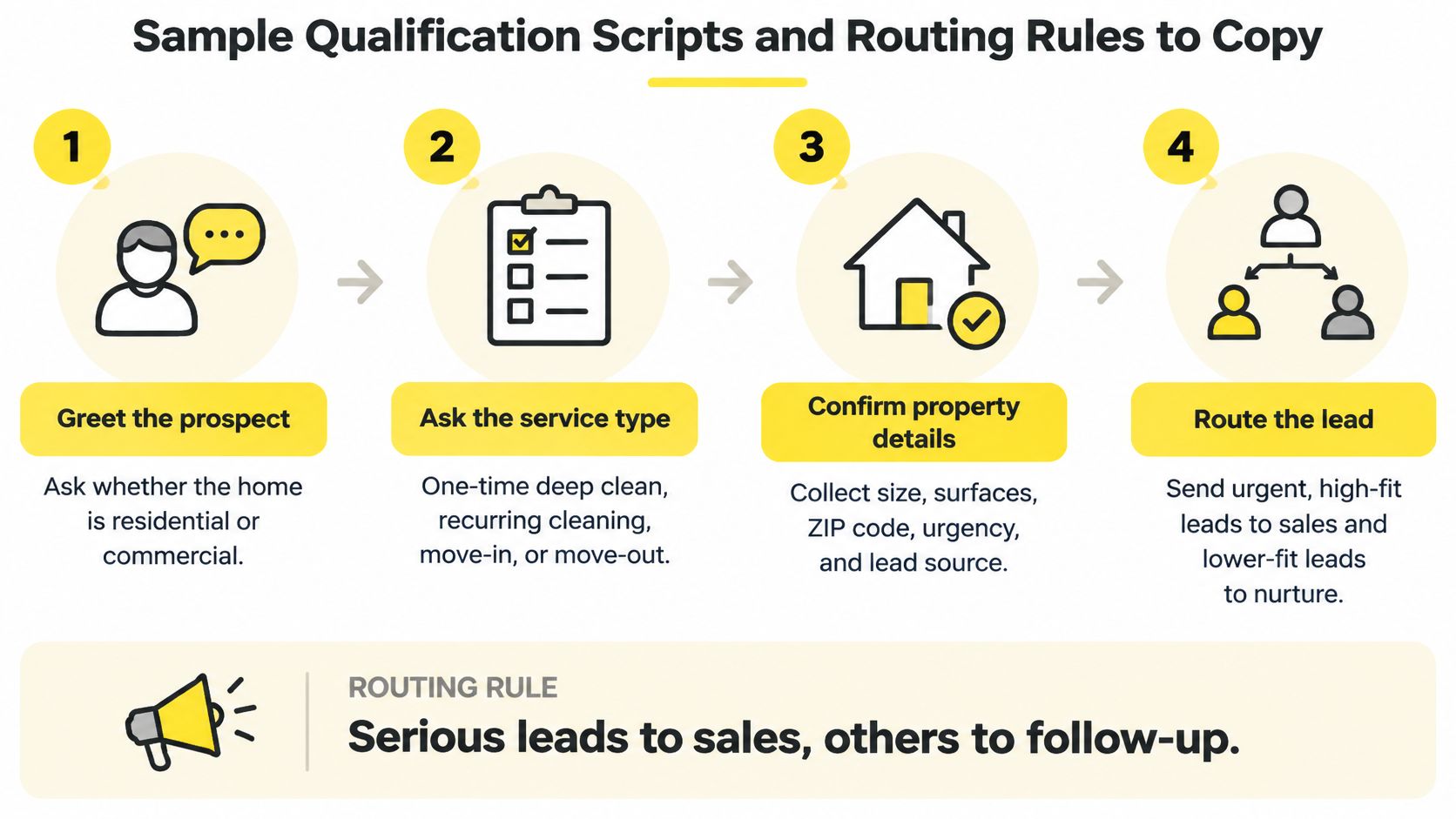
That last step protects you. An estimate built on "three bedrooms, two bathrooms, standard buildup, no inside oven work" gives the customer something concrete and gives your team a scope to defend if the home turns out differently on arrival.
| Condition | Action | Who acts |
|---|---|---|
| Outside the service zone | Polite decline with a waitlist option | AI |
| Score 0.70 or higher, in zone, date within 7 days | Immediate SMS estimate and owner alert | AI, then human closer |
| Score 0.40 to 0.69, in zone | Estimate, one missing field asked, follow up within 24 hours | AI |
| Commercial, post construction or over 5,000 sq ft | Route to a human estimator | Operations manager |
Out of zone inquiries shouldn't consume closer time, but they also shouldn't vanish. A polite decline plus a waitlist option keeps the door open if you expand. High scoring, urgent, in zone leads get the opposite treatment: estimate immediately and alert a person while the prospect is still engaged.
Mid range leads usually need one missing fact, not a sales call. Ask for square footage or timing, then follow up within 24 hours using the cadence in our guide on following up after sending an estimate. Large or commercial properties go straight to a human estimator because access, frequency, and scope rarely fit a standard residential price table.
Treat these thresholds as starting points, not truths. Review them monthly against booked job outcomes. If leads scoring 0.70 aren't booking at anything close to that rate, tighten what earns the score before you blame your closers.
A route is only as good as the score behind it. Fast routing of badly scored leads just wastes your best people's time sooner.
Counting leads is the trap. A system can hand you more "qualified" inquiries every month while sending your teams farther, into less-prepared homes, on schedules you can't staff. Volume goes up. Profit goes down.
Judge qualification by booked, completed, and profitable jobs. That standard is stricter, and it's the only one that pays wages. It also matches where serious evaluation is heading. Microsoft's Dynamics 365 benchmark report reported that its sales qualification agent scored 6% higher than ChatGPT on research tasks and 20% higher on outreach tasks, while explicitly evaluating accuracy, relevance, completeness, trustworthiness, and handoff timing, not merely lead volume.
| KPI | How to calculate it | What it tells you |
|---|---|---|
| Speed to first reply | Median minutes from inquiry to first message | Whether the AI engages while intent is active |
| Qualified rate | Qualified leads divided by all inquiries | Share of inquiries worth a person's time |
| Precision | Qualified leads that booked divided by qualified leads | Whether the scoring is accurate |
| Recall | Booked jobs that scored as qualified divided by all booked jobs | Whether good jobs are being missed |
| Override rate | Routed leads a human rejected or re-scored divided by routed leads | How much the team trusts the routing |
| Show rate | Appointments that happened divided by bookings | Whether confirmed bookings are real |
| Gross margin per job | Revenue minus labor, travel and supplies | Whether qualified jobs are profitable |
| Revenue per inquiry | Booked revenue divided by all inquiries | The overall value of the funnel |
Then check the cleaning specific numbers. Show rate tells you whether confirmed bookings turn into actual appointments. Gross margin per job tells you whether the work pays after labor, travel, and supplies, which matters more than the topline price on the estimate.
Run a monthly review. Pull 30 days of inquiries, compare scores against booked and completed outcomes, check whether estimates sent to routed leads were accepted, and flag any segment where precision drops below your own baseline. Track the results alongside your booking conversion rate so you can see whether faster qualification is producing better bookings or just more activity.
If precision rises but margin falls, your system is finding easy bookings, not good ones. That's a scoring problem, not a sales problem, and no amount of closer effort will fix it.
Automation should never be allowed to book work your team can't deliver. Before the first live lead, write down exactly when the AI stops and a person takes over. Don't leave that judgment to the software.
When information is incomplete, the agent should say so without losing the booking. Give a provisional estimate, label the assumptions in plain language, and offer a human callback to confirm. "I'm not sure yet" builds more trust than a confident price your team has to retract at the door.
Privacy needs the same clarity. Decide how call recordings, addresses, access codes, and household details are stored, how long you keep them, and how a customer can request deletion. Disclose that the first contact is automated, especially on voice calls, because prospects can easily assume they're speaking with a person. Good disclosure also supports the broader relationship work covered in our guide on how to improve customer engagement.
"As we grew, we were missing too many calls and estimates. Estimatty now qualifies leads, and the U.S. team books and collects payment. In 90 days, our close rate jumped, and revenue grew $2,500+ a month.", Eliana, Founder, Sweet Home Cleaning
That handoff is the model I recommend. When a lead is ready to buy, a closer from Estimatty's team takes over the conversation and turns the lead into a booked job. The AI handles speed and consistency. The person handles judgment, exceptions, and commitment.
Start narrow. Pick one channel, write your handoff triggers on one page, review twenty transcripts in the first two weeks, and only then expand. You can find more practical operating guidance at estimatty.com/blog.
A good conversation that never reaches your CRM is just a chat log. Connect the pieces in this order so every answer the prospect gives you lands somewhere your team can act on it.
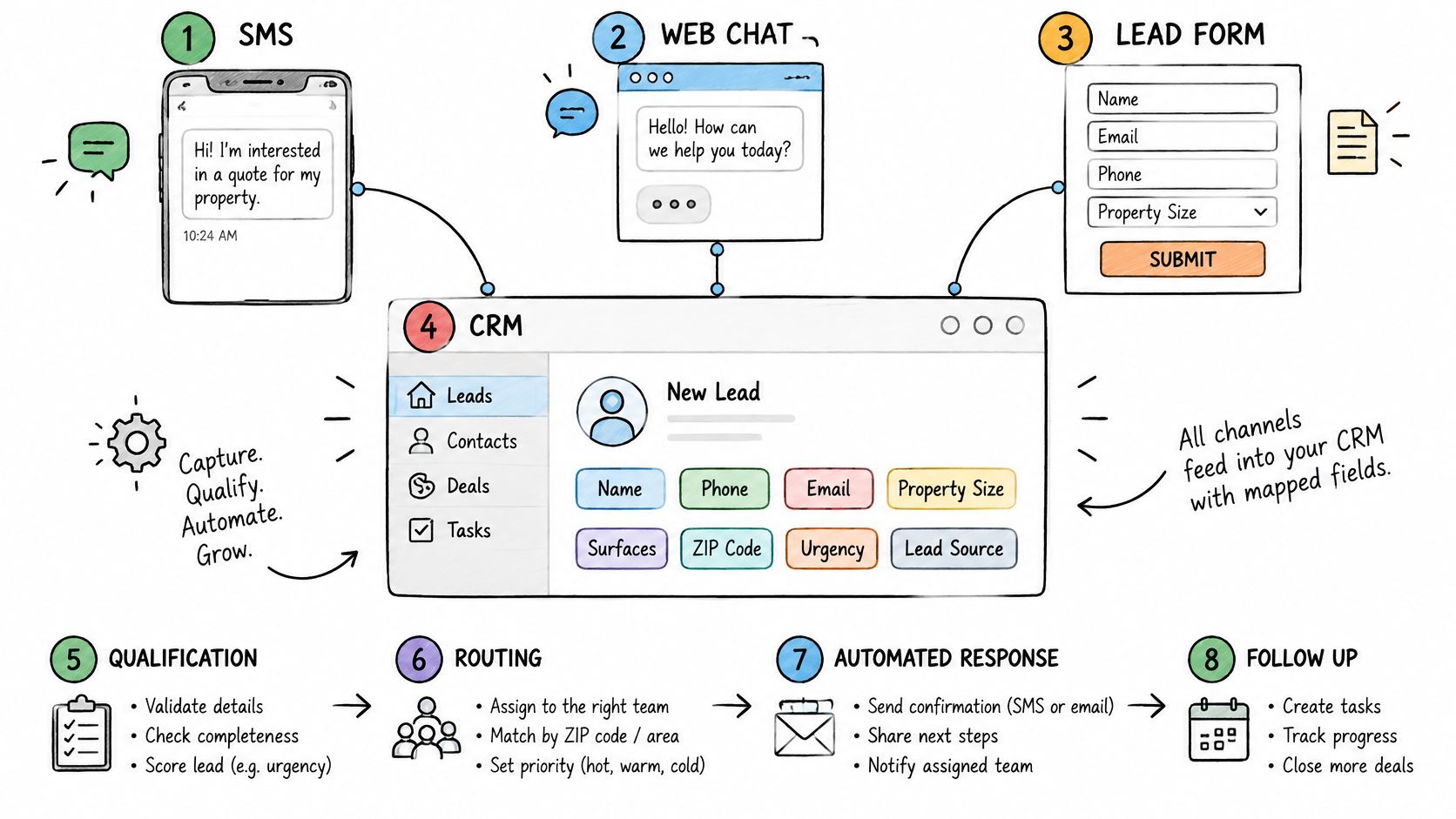
Our Zapier and CRM integration guide walks through the connection work in detail. The practical point is simpler: Estimatty captures lead names, contact details and service requests automatically and organizes them, and the no code setup lets you adjust pricing and FAQs without hiring a developer. Carry the qualification labels into the CRM too. Estimatty tags every lead by how far it got: Schedule, Property, Payment, or Booked. When those stages map to CRM statuses, your closer sees exactly where each conversation stalled instead of reopening a blank record, and leads that got furthest sit at the top of the list where follow up pays best.
Two integration tips matter most. First, keep the source of traffic field on every lead. Source tracking records each lead's channel and referral URL when they engage the widget, so you learn whether Google, Facebook, or another channel produces booked jobs instead of just inquiries. Second, never remove the human closer from the path for high value bookings. Automation should deliver a prepared, priced, motivated prospect to that person. The final conversation is where trust and commitment get decided, and the strongest setup lets the closer step in with the full transcript and estimate already in hand.
Stop letting Saturday night inquiries wait until Monday while competitors answer in minutes, and put AI lead qualification in front of every web chat, call, and SMS inquiry. Estimatty asks the right questions, sends consistent estimates, sorts serious buyers from browsers, and hands ready leads to a human closer so your team books profitable, serviceable jobs instead of chasing forms. Visit Estimatty to see how it would handle your next inquiry tonight.