
November 7, 2026
Carpet Cleaning Quote Online: How to Get an Accurate Price
Learn how to get an accurate carpet cleaning quote online: what details to share, what drives the price, and how to compare quotes before you book.

Sunday, November 8, 2026
Learn cleaning costs per hour for 2026: US wage benchmarks, billable rate math, pricing models and ways to stop revenue leaks. Price jobs with confidence.
The US median wage for janitors and building cleaners was $17.71 per hour in May 2025, but a sustainable billable rate sits well above that wage once labor burden and billable-time utilization are added. Cleaning costs per hour must cover the business delivering the service, not just the employee holding the mop.
That distinction decides whether an owner earns a profit or subsidizes the job. Start with wages, account for every paid hour, and publish estimates that make the scope and pricing unit clear.
US cleaning wages provide a starting point in the high teens per hour, not a customer-facing price list. For residential housekeeping, the Bureau of Labor Statistics occupational wage release reports a $17.39 mean hourly wage and $16.66 median hourly wage for maids and housekeeping cleaners in May 2024.
US wage benchmarks for cleaning occupations
| Occupation | Mean hourly wage | Median hourly wage | Reference year |
|---|---|---|---|
| Maids and housekeeping cleaners | $17.39 | $16.66 | 2024 |
| Janitors and cleaners, excluding maids | $17.43 | Not stated in this benchmark | 2023 |
| Janitors and building cleaners | Not stated in this benchmark | $17.71 | 2025 |
| Building and grounds cleaning and maintenance | $18.43 | Not stated in this benchmark | 2023 |
| Building cleaning workers, all other | Not stated in this benchmark | $19.18 | 2023 |
| Cleaners of vehicles and equipment | $16.95 | Not stated in this benchmark | 2023 |
The mean is the arithmetic average; the median separates the lower-paid half of workers from the higher-paid half. Neither represents the full cost of employing someone, and neither tells you what a customer should pay.
Don't select the lowest wage in the table because it makes your estimate attractive. Residential housekeeping, commercial janitorial work, vehicle cleaning, and the broader grounds-maintenance category aren't interchangeable jobs.
Consumer-facing prices sit higher: BroomBook's house-cleaning pricing guide describes coverage around $25 to $50 per cleaner-hour, with some guides citing $40 to $55. Those are service-price reference points, not employee take-home pay or a universal local rate.
Vacation-rental turnovers need their own scope assessment. Global's guide to cleaning fees for vacation rentals is useful when you need to distinguish ordinary housekeeping from guest-ready turnover responsibilities.
Practical rule: Choose the occupation that matches the work, record the benchmark year, and treat wages as the starting floor, never the finished selling price.
A national benchmark also isn't a hiring offer. Check what qualified local applicants expect, then build your estimate around the wage you'll pay.
Build your rate from your costs, not your competitor's advertised price. You don't know their staffing model, insurance expense, route density, or profit requirements.
Use this sequence to keep each cost visible.
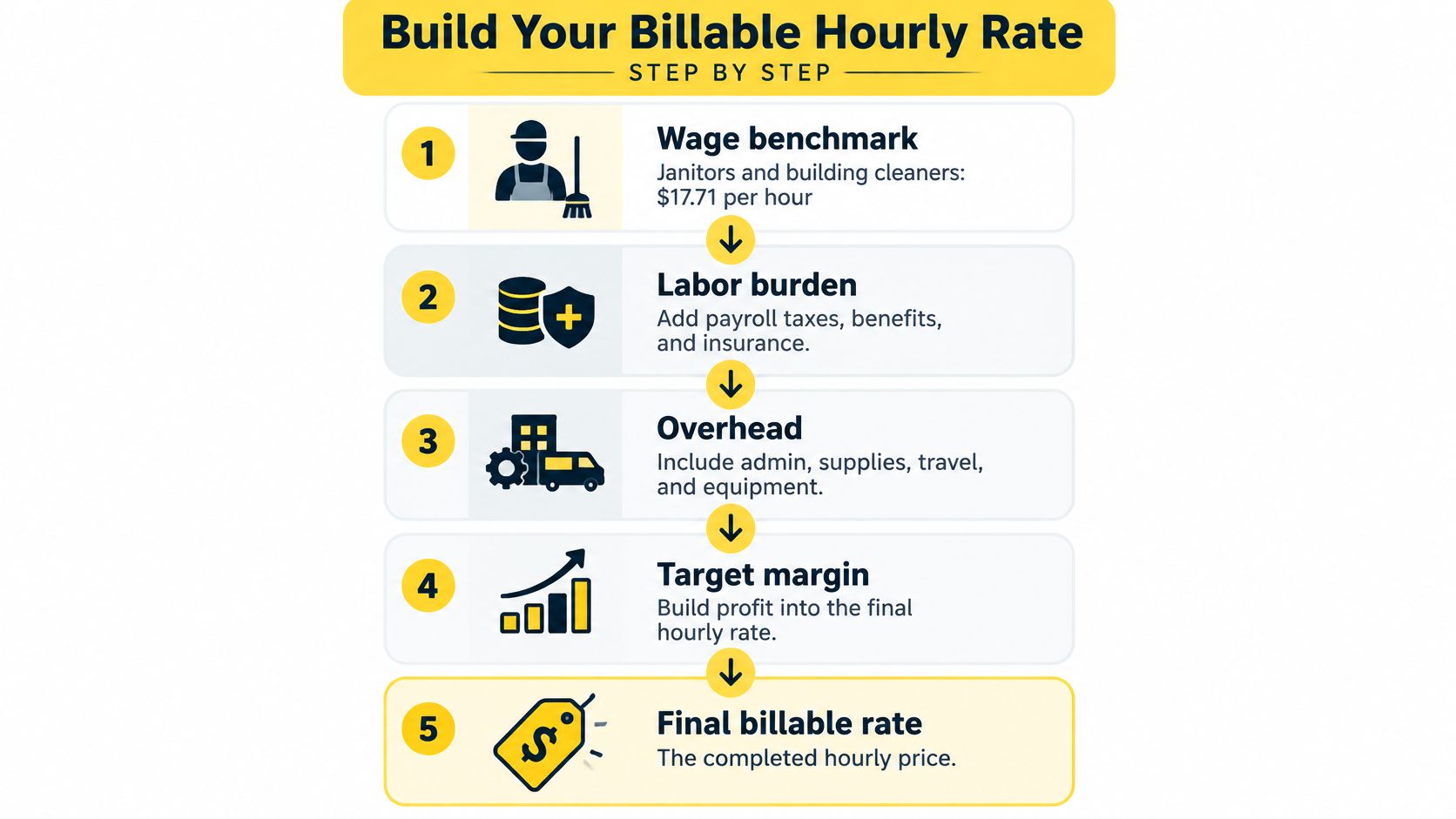
Choose the direct wage. The Bureau of Labor Statistics janitors and building cleaners profile reports a May 2025 median of $17.71 per hour. Use that occupational benchmark to orient the calculation, then substitute your actual payroll wage.
Add labor burden and adjust for utilization. In a hypothetical calculation, a 40% burden produces $17.71 × 1.40 ≈ $24.79 per paid hour. At 80% billable utilization, the wage-and-burden component becomes $24.79 ÷ 0.80 ≈ $30.99 per billable hour. These are planning assumptions, not statutory rates.
Add nonlabor operating costs. Allocate supplies, equipment depreciation, vehicle expenses, general liability insurance, scheduling, supervision, recruiting, and training across productive hours. Use separate entries so you can update a wage without rebuilding the entire estimate.
Driving, loading equipment, and handling cancellations still consume paid time. If you divide expenses by every scheduled hour rather than the hours you can sell, you'll understate the cost of delivering service.
Keep the accounting clean. If workers' compensation sits inside labor burden, don't add it again under insurance; if training payroll sits in paid nonproductive time, don't charge the same payroll expense to overhead too. Our guide to labor and burden helps separate these categories.
Apply your target margin. Use billable rate = fully loaded cost per productive hour ÷ (1 − target margin). Margin isn't the same as markup: adding a percentage to cost doesn't produce that same percentage of profit on revenue.
Publish an estimate range with explicit assumptions. State the expected cleaner-hours, what travel treatment applies, which services are included, and whether the unit means an individual cleaner or the whole team. A range should reflect identifiable uncertainty, such as condition or access, rather than an unexplained cushion.
For the staffing math, two cleaners working two hours create four cleaner-hours. Crew size changes elapsed time, but you still pay for every worker's time.
A billable rate isn't profitable merely because it's higher than the wage. It must recover the cost of the hours you can't sell, too.
Check the finished estimate against your labor share of revenue before approving it. Keep that check separate from the cost calculation so you can spot an unrealistic margin assumption rather than forcing the arithmetic to match a desired price.
Specialty services need separate production assumptions. Cultivate House Detailing's guide to price storefront window cleaning jobs provides useful context when glass work belongs in a separate service line.
Estimatty works with your existing website, starts at $25/week, and most cleaning company owners are up and running the same day they sign up. If hiring is the constraint, Pipehire's cleaning employee hiring resources address staffing; our pricing articles support the estimating side.
Separate factors that increase labor hours from factors that increase cost per labor hour. A dirty kitchen usually requires more time; an after-hours assignment may also require a different selling rate.
Ask for condition photos when the intake description is vague. A homeowner's description of lightly used can mean something very different from your crew's definition of maintenance cleaning.
According to Yahoo Finance's report on janitorial wages, the national median for janitors and building cleaners rose from $13.98 in May 2020 to $17.71 in May 2025, approximately 26.7%; the reported industry medians ranged from $17.21 in services to buildings and dwellings to $20.76 in government, excluding state and local education and hospitals.
A rate built on an old payroll assumption can understate current labor expense. Institutional employers also compete for applicants, even when your own business cleans homes rather than public buildings.
Don't hide every adjustment inside a higher hourly number. Add expected time for heavier work, specify a travel or urgency charge where appropriate, and allocate shared expenses through a consistent overhead calculation.
List the factors that apply to your jobs and give each a visible place in the estimate. Your crew should understand what changed and why.
Sample residential jobs priced at $31 per billable labor hour
These are hypothetical planning examples, not market averages. The billed amounts use the same assumed rate so the effect of labor hours stays visible.
| Job | Crew | Elapsed time | Labor hours | Billed amount |
|---|---|---|---|---|
| 1,200 sq ft standard clean | 1 cleaner | 3 hours | 3 labor hours | $93 |
| 1,800 sq ft standard clean | 2 cleaners | 2.5 hours | 5 labor hours | $155 |
| 2,400 sq ft deep clean | 3 cleaners | 4 hours | 12 labor hours | $372 |
Use the visual as a calculation checklist, not as a universal production promise.
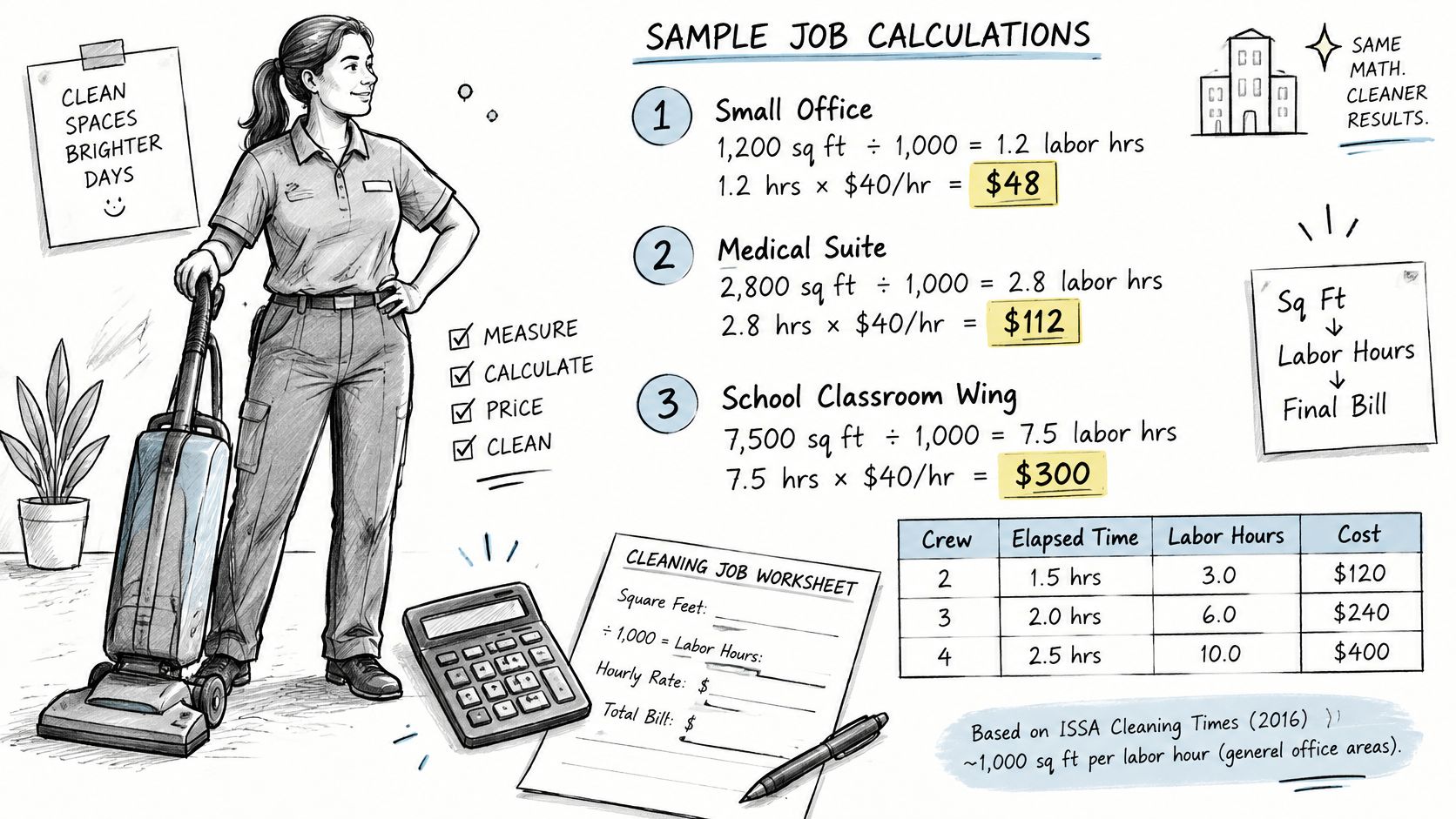
For the hypothetical 1,200 sq ft standard clean, the calculation is 1 × 3 × $31 = $93. The solo cleaner's elapsed time and labor hours match because only one person is working.
For the hypothetical 1,800 sq ft standard clean, calculate 2 × 2.5 × $31 = $155. Billing only the elapsed time would omit the second cleaner's labor.
The hypothetical 2,400 sq ft deep clean requires 3 × 4 × $31 = $372. Its size alone doesn't explain the bill; the assumed deep-clean scope drives the larger labor allocation.
These examples demonstrate multiplication, not rate adequacy. A rate that barely recovers loaded payroll still needs an allowance for operating expenses and profit before you use it commercially.
ISSA's discussion of cleaning productivity reports roughly 2,500 square feet per hour with a standard upright vacuum, versus up to 7,000 square feet per hour for a trained operator using a properly fitted lightweight backpack vacuum. At a hypothetical $30 loaded labor cost per productive hour, dividing cost by those production rates gives approximately $0.012 versus $0.0043 per square foot, about a 64% reduction using the rounded figures.
That's a vacuuming comparison, not a whole-home cleaning forecast. Furniture, edges, surface detailing, kitchens, bathrooms, setup, and travel all require separate attention.
This video offers another way to approach the calculation.
Measure your own crew's output by service type instead of importing an equipment benchmark into every room. Record the scope alongside the time so a maintenance clean doesn't become the reference for a neglected move-out.
Use a consistent process to estimate cleaning jobs: convert the property and its tasks into expected cleaner-hours, then apply your billable rate. Area is an input, not the finished estimate.
Each pricing model works best when its unit matches the job. Use the table to compare what the customer pays and where your margin is most exposed.
| Pricing model | Best for | Main risk | Reference range |
|---|---|---|---|
| Hourly per cleaner | Recurring jobs with stable scope | Hours creep when condition changes | $25 to $50 per cleaner-hour, according to the BroomBook guide |
| Hourly per team | Multiple cleaners on one visit | Customers compare incompatible units | Cleaner-hour rate multiplied by crew size |
| Flat rate per visit | Standard repeat cleans | Heavy jobs get underpriced | $150 to $300 per standard visit |
| Per square foot | Large, open spaces | Clutter and detailed work are overlooked | About $0.012 per square foot for vacuuming at 2,500 square feet per hour and a $30 loaded labor cost |
| Scope-based estimate | Mixed homes and first-time cleans | Inaccurate intake produces inaccurate timing | Built from labor hours and billable rate |
Hourly per cleaner suits time-based work with a clear task list. Set a process for approving extra time before the crew starts, so the customer knows how added work affects the bill.
Use hourly per team only when the estimate states the crew size and whether the rate applies to each cleaner or the whole team. Otherwise, customers may mistake a team-hour price for an individual cleaner's rate.
Flat-rate visits fit repeatable maintenance work. Put the included tasks in writing and specify how changes in condition, occupancy, or requested work affect the price.
Per-square-foot pricing can work for open, repetitive areas. It is a weak standalone method for detail-heavy homes, where a square foot of cluttered space can take longer to clean than an open area. Gather condition details before treating the whole property as equally demanding.
Choose a scope-based estimate for mixed properties and first-time work. Define the tasks, estimate the labor internally, then show the customer a total tied to that scope.
The Jobber guide linked in the table also cites a $75 to $110 one-worker hourly estimate for a typical visit. That figure describes a visit estimate, not necessarily a per-cleaner-hour rate. Keep those units separate when comparing providers.
Compare the service, labor allowance, and total, not just the smallest number on the page.
Before choosing a pricing model, establish the expected cleaner-hours and whether the rate applies per cleaner or per team. Show minimum charges and add-ons before booking.
Estimatty's instant price tool asks for service type, when the last clean was done, home size in square feet, beds, baths, pets, and add-ons. Consistent intake gives each prospect the same core questions, making estimates easier to compare.
Use hourly pricing for stable, time-based work, flat rates for repeatable visits, and scope-based estimates when the property needs closer assessment.
Homeowners searching for cleaning costs per hour usually want a dependable total, not a lesson in payroll. The useful price is the amount you'll pay for a defined result, including any minimum, travel treatment, and selected extras.
A professional service price covers more than the cleaner's wages. The business must fund employment costs, insurance, supplies, administration, and a margin, so the difference between employee pay and customer price isn't automatically profit.
Ask for the expected total and included tasks in writing. If the provider cannot confirm the condition remotely, the estimate should explain how additional work will be approved before it starts.
For a move-out, compare obligations rather than labels. Home Removals Sydney's discussion of DIY versus professional bond cleaning helps frame the difference between ordinary housekeeping and a more demanding handover clean.
A total below a standard-visit reference deserves scrutiny, not automatic rejection. The home may be smaller, the scope narrower, or the service may exclude tasks you assumed were included.
A higher total may reflect detailed kitchen work, neglected surfaces, or a move-out scope. A larger crew alone doesn't justify a higher total if the same labor requirement finishes sooner.
Before you approve: Make sure the written estimate describes the result you expect, not merely the time the business plans to spend.
Declutter accessible surfaces before the visit and identify delicate finishes, access restrictions, and priority rooms. Those details help the cleaner spend the scheduled time cleaning rather than resolving avoidable surprises.
Our house-cleaning prices guide provides additional context for evaluating the service behind the amount.
A low hourly rate doesn't mean low operating costs. It can mean the owner is leaving paid work out of the estimate.
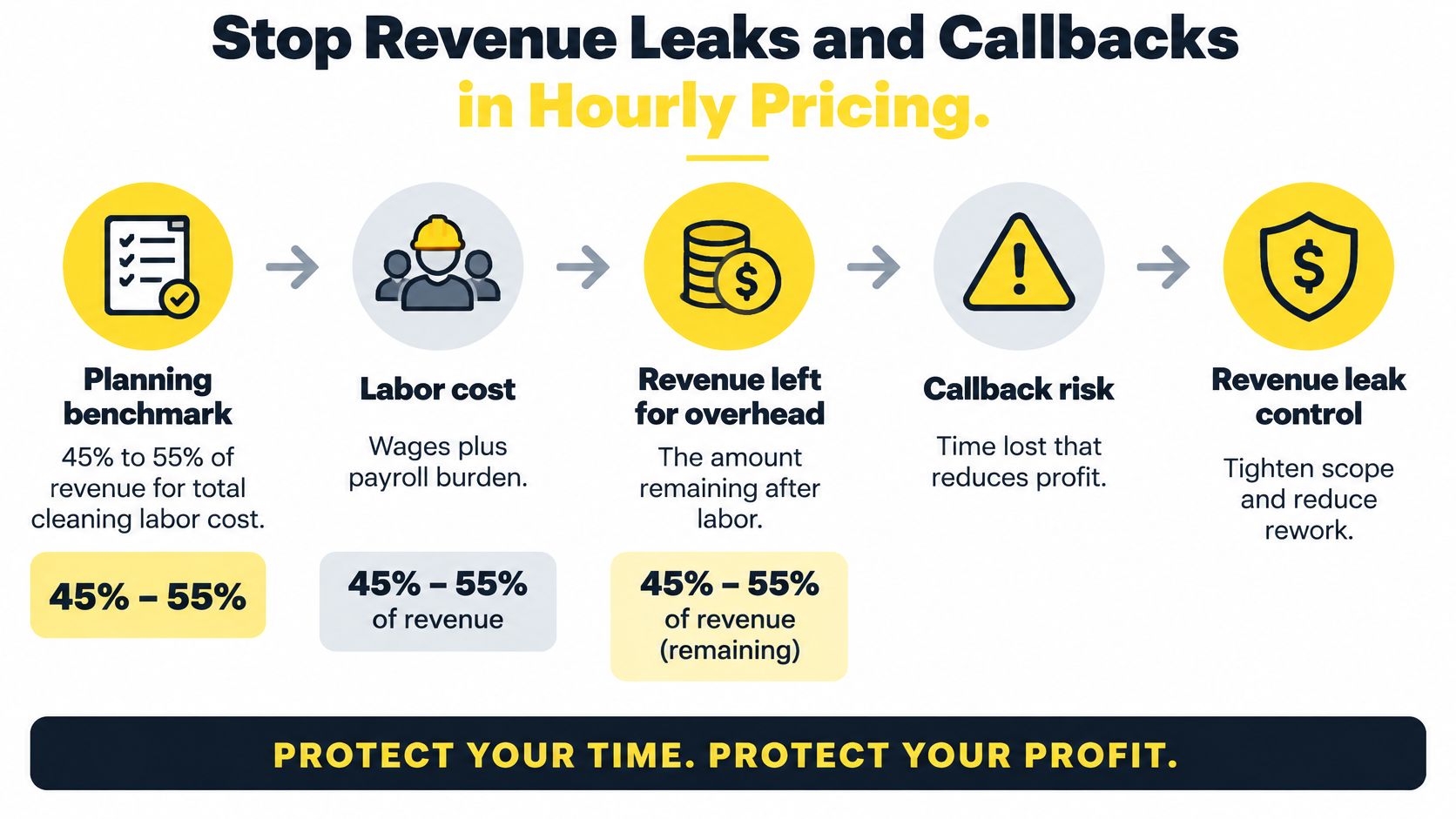
Level CFO's cleaning-industry benchmarks recommend 45% to 55% of revenue as a planning range for total cleaning labor, including wages, payroll taxes, workers' compensation, and benefits where available. The same source distinguishes commercial janitorial direct labor at roughly 50% to 55% of revenue from 75% to 90% of total direct job cost.
These denominators aren't interchangeable. On a $200 hypothetical job, a 50% labor-to-revenue target allows $100 for total cleaning labor, leaving the remainder for other expenses and profit. Treat the percentage as a management benchmark, not a universal rule.
Use this revenue-flow view to keep labor, overhead, and rework separate.
Don't solve every overrun by raising every customer's rate. Identify whether the cause is a bad time allowance, inefficient routing, missed scope, or avoidable rework, then change the relevant input.
Run a 30-day review comparing actual labor hours with estimated hours for each job. Adjust the assumptions where the gap is largest, and verify that the next completed visit supports the change.
Estimatty gives cleaning businesses instant website estimates, online booking, and round-the-clock voice sales. Visit Estimatty to turn your hourly pricing assumptions into consistent customer estimates and capture inquiries while your team is working.