
October 12, 2026
Cleaning Office Prices: A Practical Pricing Guide for 2026
Learn how cleaning office prices really work in 2026. Compare per square foot, hourly, and monthly models, plus tips to estimate and present winning quotes.

Friday, July 10, 2026
Learn how to improve response time for your cleaning business. Get actionable steps on automation, staffing, and tools like Estimatty to convert leads faster.

A slow response doesn't just hurt service quality. It drains booked jobs from a cleaning business.
Responding to sales leads within 5 minutes is 21 times more effective in converting prospects than responding after 30 minutes, and leads contacted in that window are 100 times more likely to qualify. Meanwhile, the average B2B company takes 29 to 42 hours to respond according to Demand Local's lead response time analysis. In cleaning, that gap is even more expensive because most prospects don't submit one request and wait patiently. They reach out to several companies, often while they still need the problem solved today.
A residential customer with a move-out clean, or a facility manager needing janitorial coverage, usually books the company that responds first with clarity. Not the company with the nicest logo. Not the company with the longest service list. The company that answers, asks the right questions, and gets an estimate moving.
Cleaning leads are unusually time-sensitive. Someone who wants recurring house cleaning may be comparing options on a lunch break. Someone dealing with a post-construction mess, turnover clean, or last-minute office issue usually wants an answer now. If your process depends on checking voicemail later, reading emails in batches, or building every estimate by hand, you're already behind.
That's why improving response time is a sales problem first. Customer service matters, but the first consequence of delay is lost revenue. A prospect who has to wait while you chase square footage, ask the same intake questions twice, or promise to “get back to them tomorrow” often moves on.
Practical rule: If a lead has enough intent to call, fill out a form, or message your page, assume they're evaluating competitors at the same time.
The hard part is that many cleaning owners aren't ignoring leads. They're overloaded. They're in the field, managing callouts, replacing no-shows, answering client texts, and trying to keep schedules full. Response time suffers because manual estimating sits in the middle of everything. It creates a bottleneck at the exact moment a lead is hottest.
A better approach is to treat responsiveness like an operating system. Calls, web inquiries, and after-hours requests need a process that works even when you're cleaning, driving, hiring, or handling staff issues. If after-hours phone coverage is part of your gap, this guide on a 24-hour phone answering service for cleaning businesses is worth reviewing.
Most delays in cleaning companies come from a short list of operational habits:
If you want to know how to improve response time, start by accepting one thing. Speed isn't a nice add-on. In this industry, it's part of the sale.
Most owners guess their response time. That guess is usually wrong.
If you want improvement that lasts, you need a baseline by channel. Phone, website forms, Facebook messages, email inquiries, and even missed-call texts should each be measured separately. A company can feel responsive on calls and still be slow on web leads.

Use first response time, or FRT, as your core metric. Track the time between the customer's first inquiry and your first meaningful reply. That reply can be a live call, a text, an email, or a chat response. The key is that it acknowledges the request and moves the sale forward.
For cleaning businesses, best practices call for responding to all new customer inquiries within 2 to 4 hours, and many top-performing companies already respond within minutes according to YourAspire's cleaning sales guidance.
Create a simple audit sheet for one week and log:
Don't document the ideal process. Document what happens.
In many cleaning companies, the flow looks something like this: lead comes in, voicemail sits, office manager sees it later, sends a text, waits for square footage, owner reviews pricing, then an estimate goes out. Every handoff adds lag.
A quick way to find friction is to ask these questions:
| Question | What it reveals |
|---|---|
| Who sees the lead first | Ownership gaps |
| Where does intake information live | Context switching |
| What happens after business hours | Coverage gaps |
| Who approves pricing | Decision bottlenecks |
If your team sends email replies but prospects say they never received them, fix deliverability before you judge staff speed. This practical guide on how to stop email from going to spam in Gmail can help you rule out that issue.
Response problems in cleaning businesses tend to cluster around the same situations:
If you haven't set up proper attribution, start with lead source tracking for cleaning businesses. It helps you see which inquiries deserve the fastest follow-up and where delays cost the most.
Slow response isn't always a staffing problem. Sometimes it's a visibility problem. Teams can't fix what they never measured.
A good audit usually shows that the issue isn't effort. It's a messy system.
The fastest way to improve response time is to remove waiting from the first touch.
That doesn't mean replacing your team. It means letting software handle the first moments that humans routinely miss. A lead lands on your site at night, calls during a crew dispatch scramble, or asks for pricing while your office manager is on another line. If nobody engages immediately, that opportunity cools off.
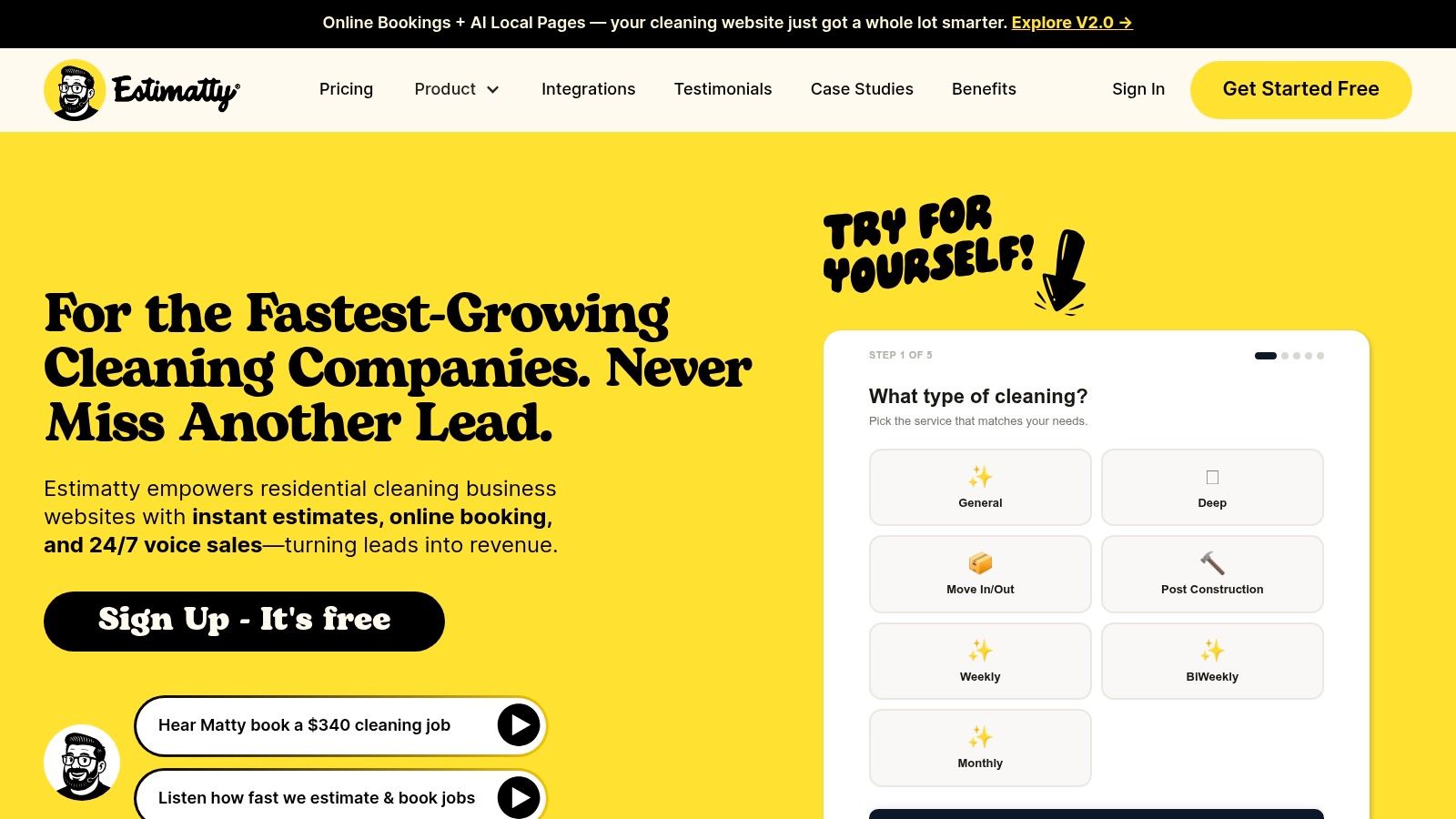
A basic contact form is better than nothing, but it usually creates delay. The prospect fills it out, waits, and hopes someone follows up. In cleaning, that gap is dangerous because urgency is common and pricing questions come early.
That's where AI estimators change the game. Instead of forcing the lead into a dead-end form or voicemail, the system engages right away, asks the intake questions your staff would ask, and keeps the buyer moving.
Calling a lead within one minute of their inquiry increases conversion rates by 391% according to Velocify research summarized by Voiso. You don't need to interpret that creatively. It means the businesses that respond first get more chances to sell.
Many owners hear “AI” and think of something vague, expensive, or hard to manage. In practice, a useful estimator for cleaning should do very specific work:
That matters because generic automation often fails in cleaning. It greets people, but it doesn't gather enough usable information. Then your staff still has to call back and restart the conversation from scratch.
If automation doesn't reduce callbacks, it isn't solving the real problem. It's just moving the delay.
A cleaning business doesn't just need quick replies. It needs structured intake that supports accurate estimates.
One practical method is the standard cleaning time formula: (Square Footage to be Cleaned ÷ Production Rate per Hour) × 60 as outlined in ISSA's explanation of cleaning time calculations. ISSA also gives a clear example where 23,400 square feet divided by a production rate of 1,800 sq. ft/hr equals about 13 work hours in that article. That's the kind of logic an estimating workflow should support. Not random numbers. Not guesswork.
If you're evaluating what this kind of workflow looks like in software, review an AI estimates platform built for cleaning businesses.
A useful setup should also include guardrails:
Here's a short walkthrough to visualize how automated engagement can replace a slow first-touch process:
The most common mistake is automating only the greeting. The second most common mistake is sending every lead to the same generic inbox.
A strong response system routes based on complexity. Straightforward residential jobs can move quickly. Complex commercial opportunities, specialty work, or unusual scope should be escalated with all intake details attached. That saves your staff from asking repetitive questions and lets them focus on selling, not clerical cleanup.
Another mistake is thinking this only applies to bigger operations. Small teams usually benefit more because they have fewer people available after hours. That matters in underserved and microbusiness settings where owners often lack enterprise-grade infrastructure, a gap discussed in Brookings' piece on supporting microbusinesses in underserved communities.
If you want to know how to improve response time without adding headcount first, this is usually the most effective approach. The machine handles the first contact instantly. Your people handle the jobs that truly need judgment.
Automation gets you speed. People still close complicated jobs, calm nervous buyers, and handle exceptions.
That handoff has to be tight. If the lead gets an instant first reply and then waits half a day for a human follow-up, you've only fixed half the problem. The sales experience still feels fragmented.
Your team shouldn't open a lead record and wonder what to say next.
Top teams reduce FRT by using dedicated service software, autoresponders, time-based alerts, and text shortcuts for rapid, consistent replies according to SuperOffice's guidance on response times. In a cleaning company, that means your office manager, estimator, or sales rep should have instant access to a clean summary of the inquiry and a short library of ready-to-send responses.
Build templates for the questions you get every week:
Not every lead deserves the same handling. A one-time apartment clean and a multi-site office request need different workflows.
Use simple escalation rules such as:
| Lead type | Best handoff |
|---|---|
| Standard residential | Office staff or estimator |
| Large home or specialty service | Senior estimator |
| Commercial recurring | Sales manager or owner |
| Unclear scope or urgent issue | Immediate callback |
This keeps speed high without sacrificing judgment.
A fast reply builds trust. A fast reply with context closes more work.
Many teams make the mistake of chasing reply time while still sending weak responses. “We got your message” is better than silence, but it won't always move the sale. Staff need to know how to answer in a way that reduces friction.
Good responses usually do three things:
For example, don't send five back-and-forth messages when two questions will provide the estimate. And don't force customers to repeat what they already told the system.
For businesses trying to improve both response speed and callback volume, issue prevention matters just as much as first contact. One contrarian point raised in this discussion about preventing repeat issues and revenue leaks is that many small businesses track problems without fixing the root causes that create repeat inquiries. In cleaning, that often shows up as vague intake and inconsistent pricing rules.
Your people should step into conversations with context, not start from zero. That's how human follow-up stays fast and useful.
A lot of response-time problems are really scheduling problems.
If your best leads arrive when nobody is assigned to watch the inbox, answer calls, or review estimate requests, the process breaks no matter how good your scripts are. Cleaning companies often see this on evenings, weekends, early mornings, and during crew dispatch windows when the office is busy handling operations.
Start with your own lead flow. Look for patterns by day, time, and channel. Then schedule around those patterns instead of around habit.
If website inquiries spike after business hours, assign the next-morning follow-up block with clear ownership. If commercial calls tend to come in during business hours while residential leads stack up at night, don't make one person responsible for both with no backup.
A practical staffing review should answer:
One of the most expensive mistakes I see is using the same people to handle cleaning operations and new lead response without clear boundaries. The owner is on-site, a supervisor is handling callouts, and the office manager is buried in schedule changes. New inquiries become an interruption instead of a priority.
That setup creates inconsistent service because response work gets squeezed between urgent tasks.
A better model is simple:
If you need help structuring availability around demand, this guide on online employee scheduling for cleaning companies is a practical place to start.
As you grow, faster response creates more booked work. That means staffing pressure shifts from “who can clean” to “who can support a fast-moving sales and service process.”
For office and field growth alike, hiring matters. If you're building a team that can support scheduling discipline, rapid communication, and cleaner handoffs, resources like PipehireHRM for cleaning employee hiring can help you build the bench.
You should also train new hires to understand your communication standards from day one. A strong cleaner who ignores messages, misses updates, or doesn't relay job changes creates downstream delays for the whole company.
The team that responds fastest usually isn't working harder. They've matched staffing to reality.
Response time improves when staffing, scheduling, and lead handling all line up. Without that alignment, even great software turns into another inbox your team can't keep up with.
Most cleaning companies don't need another theory about speed. They need a sequence.
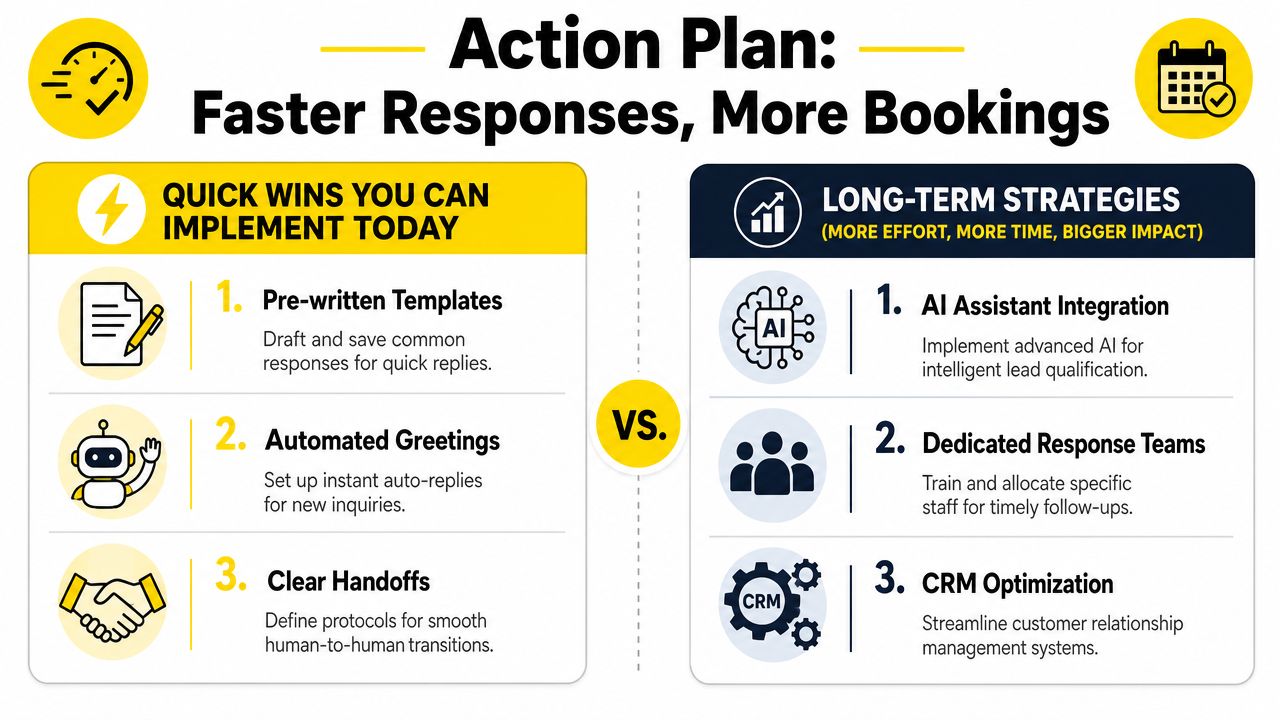
The right sequence starts with small operational fixes, then adds systems that scale. If you try to overhaul everything at once, your team will resist it or use the tools poorly. If you only make tiny changes, you'll still lose after-hours leads and inconsistent estimate opportunities.
These moves don't require a major rebuild. They close obvious gaps fast.
For owners juggling multiple responsibilities, operational discipline matters as much as tools. If your day is split across sales, staffing, and service delivery, this article on mastering time management for multiple ventures has useful ideas for protecting response windows.
Once the basics are working, build the system around consistency.
That usually means:
| Strategy | Why it matters |
|---|---|
| Standardized estimating logic | Reduces pricing hesitation |
| Better booking workflow | Moves leads from inquiry to scheduled job faster |
| Staff training on response expectations | Prevents drift as the team grows |
| Ongoing review of closed jobs | Keeps estimates profitable |
If online scheduling and customer self-service are still weak points, review online booking software for cleaning businesses. Faster response matters most when the next step is also easy.
You should also watch the metric that tells you whether your speed is producing good business, not just more activity. Cleaning businesses should aim for a close rate between 40% and 60% from inbound leads. This is calculated by dividing jobs booked by total inbound leads, and a close rate above 60% may suggest your prices are too low based on this cleaning sales benchmark discussion.
A simple monthly review keeps response time from slipping back.
For continued improvement, it's worth regularly reading both the Estimatty blog for cleaning operations and estimating and the PipehireHRM blog for staffing and hiring insights.
Improving response time isn't about sounding busy or looking modern. It's about building a cleaning business that answers while intent is high, sends estimates without delay, and hands the right jobs to the right people before the lead disappears.
If you want a faster way to handle after-hours inquiries, capture job details, and send consistent estimates without relying on slow forms or voicemail, take a look at Estimatty. It's built specifically for cleaning businesses that want to respond faster, reduce callbacks, and turn more inbound leads into booked work.