November 9, 2026
Missed Call Text Back: Templates and Setup Workflow
Missed call text back turns unanswered calls into booked estimates. Get templates, consent rules, tool options and a setup workflow.

Tuesday, November 10, 2026
AI receptionist pricing for cleaning businesses: plan types, 2026 price ranges, cost drivers and ROI, so you compare real costs, not headline fees.

Most AI receptionist plans cost $19 to $249 per month, with a median entry plan of $49, and usage charges can change the final bill. That's the useful answer, and it's also where most buying advice goes wrong.
Popular advice tells you to sort vendors by the lowest monthly fee and pick the cheapest plan that answers the phone. Don't do that. A low fee attached to a tiny minute allowance, repeat caller charges, or paid SMS follow-up can cost more than a higher plan that completes the work. Judge AI receptionist pricing by cost per qualified estimate and cost per booked cleaning job, not by the advertised starting price. A plan that answers calls but leaves you to call back, gather home details, and build every price by hand hasn't removed your most expensive bottleneck.
Most cleaning businesses will shop in the $19 to $249 per month range, but that range hides very different assumptions about volume. A 2026 pricing dataset from PlainScout reported paid starting prices from $9.99 to $4,500 per month, with the middle half of listed prices between $49 and $249. A separate 2026 review in that dataset covered 20 products, found 16 publishing pricing, and placed flat monthly plans from $19 to $199, with a median starting price of $49.
Use those bands as a starting map, not as a promise of your invoice.
| Plan Tier | Advertised Monthly Price | What It Usually Includes | Best Fit |
|---|---|---|---|
| Entry self-service | $19 to $49 (median starting price $49) | Small minute or call allowance, basic answering | Solo cleaner |
| Mid-market | $49 to $249 (middle half of listed prices) | Larger allowance, integrations, SMS follow-up | Small cleaning team |
| Enterprise or custom | Up to $4,500 | Custom volume, multiple locations, dedicated support | Multi-location brand |
The cheapest plan isn't automatically the cheapest to own. One standardized pricing comparison from GetVoIP priced 250 calls at two minutes each, or 500 total minutes, at approximately $129 to $500 per month across offers. Another comparison cited by Metadata Marketer's 2026 small business guide found apparent costs of roughly $79 to $212.50 for 100 monthly calls. Same basic job, wildly different bills, because vendors count calls, conversations, minutes, and unique callers differently.
Practical rule: Force every vendor onto your workload. Give each one the same call count, average call length, and estimate requirements, then compare the total.
Count your average monthly inbound calls and web inquiries before you shop. Then find the band where that volume fits without overage in a normal month and still holds up in a busy month. If you're building a shortlist, the receptionist software picks from Mojolin give you a useful cross-check on how differently vendors package similar answering features.
Our entry point is different because the job is different. Estimatty starts at $25 per week, priced for a cleaning business that wants instant estimates, not only call answering. That distinction matters when you compare it with a basic plan that takes a message and leaves the selling to you.
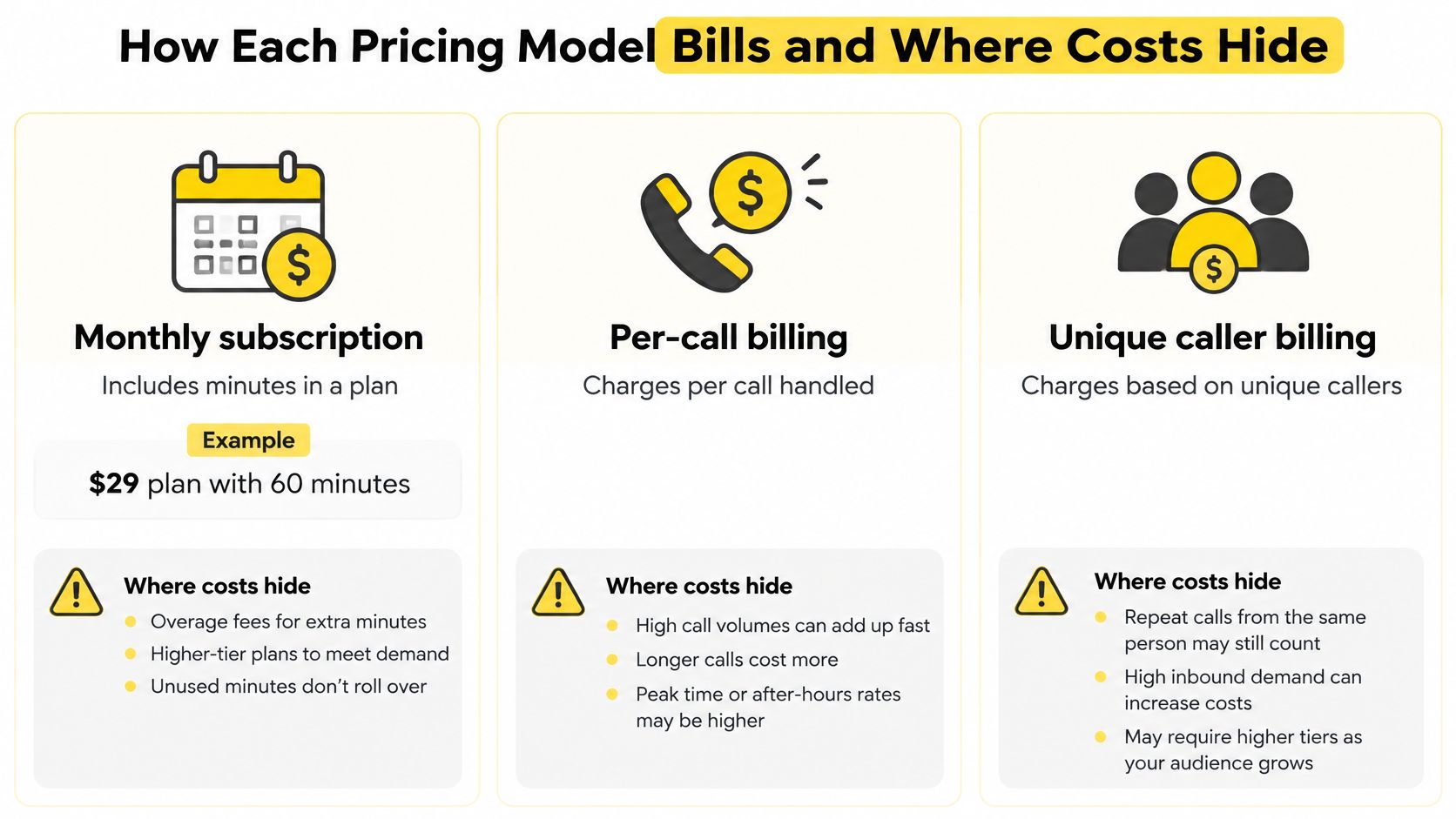
The monthly fee is the least useful number on the page. The billing unit decides what you pay per booked job. Primores' AI receptionist pricing examples show monthly plans with included minutes ($29 for 60 minutes and $99 for 200 minutes) plus plans ranging from $79 to $299 based on unique callers per month.
Per-call billing is the third common model. With it, the number that matters is how the vendor defines a billable call, not the rate on the landing page. A prospect who calls three times about pets, parking, and availability can cost you three calls under per-call billing. Under unique-caller billing, that same prospect counts once, which looks cleaner, but follow-up texts, transfers, and extra usage can still add charges elsewhere.
The chart below puts the mechanics side by side.
| Pricing Model | Billing Unit | Market Example | Hidden Cost to Check |
|---|---|---|---|
| Monthly subscription with included minutes | Minutes per month | $29 for 60 minutes; $99 for 200 minutes | Overage rate after the allowance |
| Per-call billing | Answered calls | Vendor-quoted fee per answered call | Repeat calls from the same number |
| Unique-caller billing | Unique callers per month | Plans from $79 to $299 | Repeat contacts and follow-up usage |
| Per-minute usage | Billed minutes | Vendor-quoted per-minute rate | Transfers, SMS and call recording fees |
| Per-lead or per-estimate | Qualified leads or completed estimates | Rare, vendor must define the unit | Definition of a qualified estimate |
Each model has a trap. Use 90 minutes on a 60-minute plan and you pay overage on 30 minutes at whatever rate the contract sets. That overage rate is your real marginal cost for every extra estimate past the cap. Per-minute plans need the closest reading. Transfers, SMS, and call recording fees can sit on top of the minute rate, so the rate you're sold isn't the rate you pay for a completed conversation. Per-lead or per-estimate pricing is rare and hard to compare. Ask any vendor for its price per completed estimate in writing, then divide that by your close rate to see cost per booked job.
Send this checklist to every vendor:
If after-hours coverage is the reason you're buying, test those terms against nights and weekends, not office hours. Our breakdown of a 24 hour phone answering service shows what coverage should include before you accept a low headline fee.
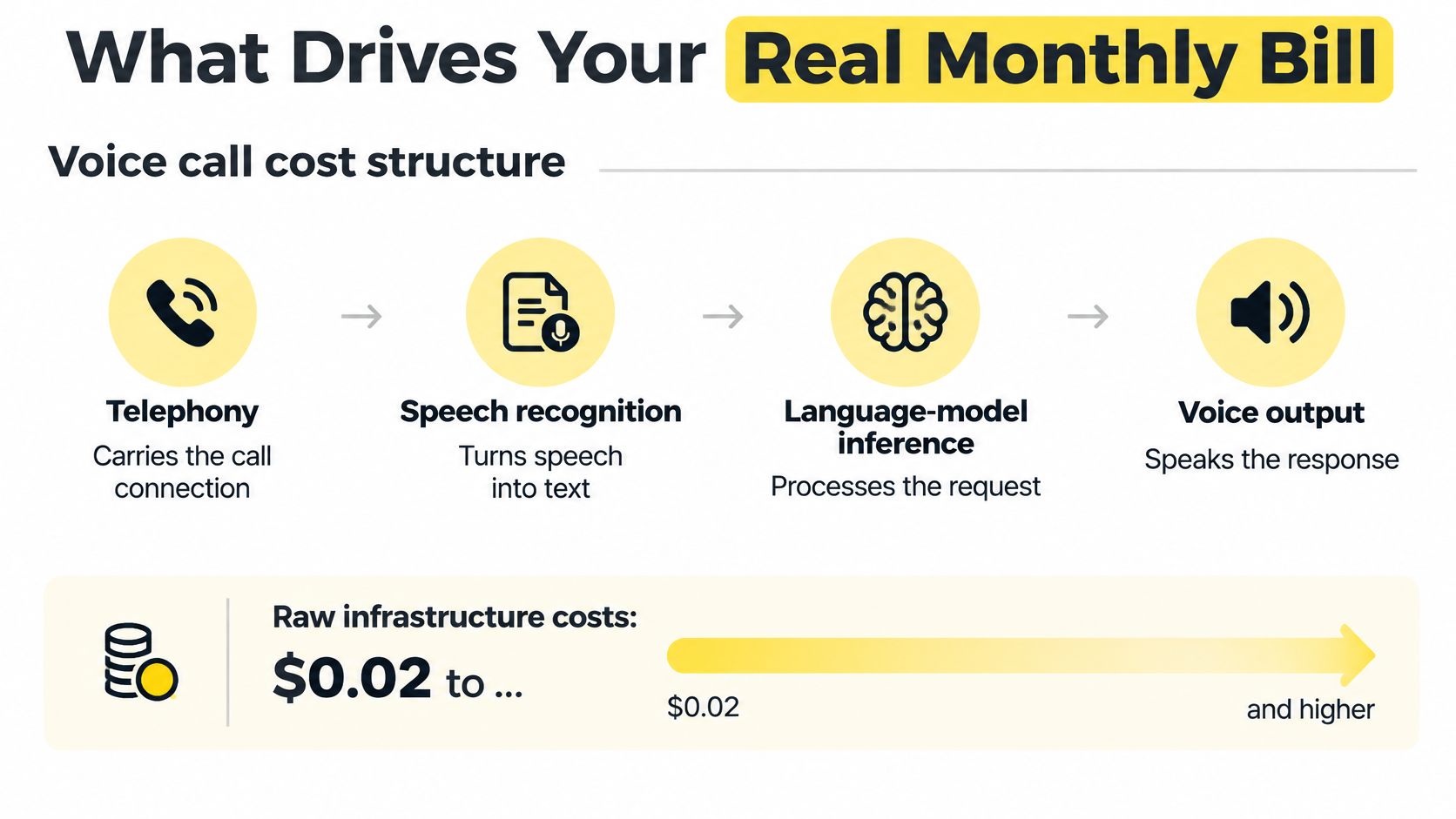
A voice call isn't one product. It's telephony, speech recognition, language model inference, and voice output running together, and each layer carries a cost. Published infrastructure analysis cited by Plura's cost per call breakdown estimates raw combined costs of roughly $0.02 to $0.04 per minute before platform margin, while managed configurations commonly land around $0.09 to $0.15 per minute depending on model, voice, and carrier selection.
You won't buy at the raw rate, because you're also paying for the platform, support, reliability, and margin. Use the managed range to stress-test your own volume.
| Monthly Scenario | Calls and Length | Billed Minutes | Indicative Usage Cost |
|---|---|---|---|
| Solo cleaner | 100 calls at 3 minutes | 300 | $27 to $45 |
| Small residential team | 250 calls at 2 minutes | 500 | $45 to $75 |
| Busy residential operation | 300 calls at 3 minutes | 900 | $81 to $135 |
| Multi-location brand | 1,000 calls at 3 minutes | 3,000 | $270 to $450 |
Those figures cover indicative usage at $0.09 to $0.15 per minute, before any fixed subscription, CRM integration, human transfer, recording, or setup fees. A busy residential operation with 300 three-minute calls uses 900 minutes, which produces the $81 to $135 usage range in the table.
Call length is the lever owners underestimate. Cutting one minute from a three-minute call reduces usage cost by a third, provided you don't cut the details that make the estimate usable. A short service area check and a full estimate covering square footage, surfaces, frequency, urgency, add-ons, and scheduling are not the same conversation, and they shouldn't be priced as if they were.
Other variables move every row:
Normalize every plan the same way. Divide total monthly cost by completed conversations, then divide again by qualified estimates, then by booked jobs. A cheap plan that answers only half your inquiries can lose to a pricier plan that captures details and prices every lead.
Pull last month's call log today. Total the minutes, separate after-hours calls, and calculate cost per qualified estimate for two plans. If response delays are part of the problem, our guide on how to improve response time will help you separate an answering problem from a follow-up problem before you spend anything.
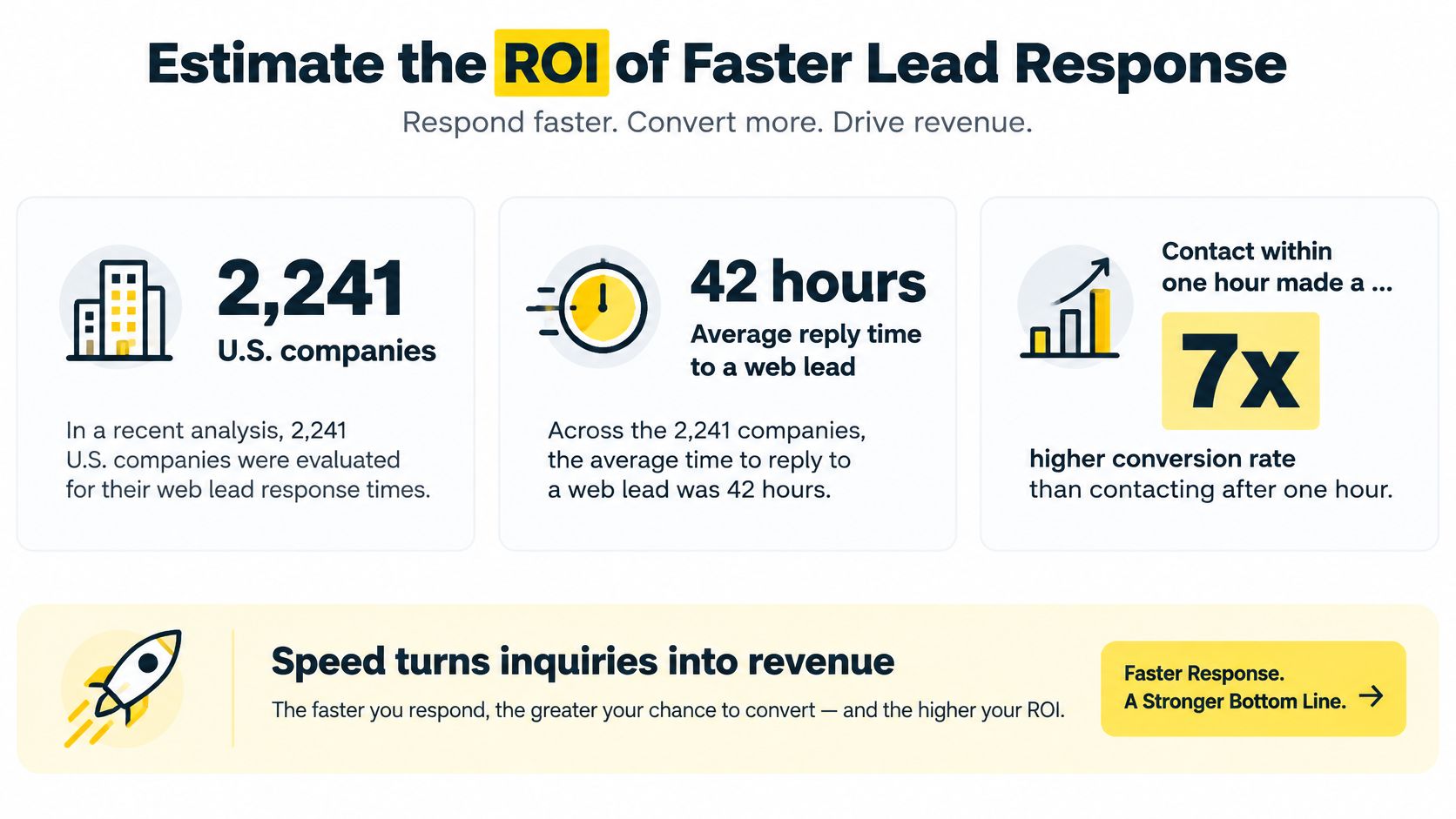
Speed is where AI receptionist pricing turns from an expense into revenue math. A study of 2,241 U.S. companies cited in Vida's speed to lead analysis found the average response time among businesses that eventually replied to a web lead was 42 hours. Companies that contacted a lead within one hour were nearly seven times more likely to qualify it than companies that waited an additional hour, and more than 60 times more likely than companies that waited at least 24 hours.
For a cleaning owner, that gap is familiar. A prospect asks for a price at 9 p.m., gets voicemail, and books the competitor who answered. Or the lead waits overnight for a callback while the owner is on a job, then goes cold.
| Monthly Cost | Average Job Value | Bookings to Break Even |
|---|---|---|
| $49 | $150 (illustrative) | 1 |
| $129 | $150 (illustrative) | 1 |
| $299 | $150 (illustrative) | 2 |
| $499 | $150 (illustrative) | 4 |
The math is simple. Divide monthly plan cost by your average job value, then round up to whole bookings. The $150 average job value in this table is illustrative, so replace it with your own number, and use recurring customer value if most jobs repeat. A plan that books one extra job a month often pays for itself, but only if your close rate and job value support it.
Availability has commercial value beyond the table. A 2025 survey of 1,000 U.S. consumers cited by Primores' analysis of AI receptionist value found 78% said they had permanently left a business after an unanswered call. Be rigorous, though. That survey doesn't prove every AI conversation produces revenue, and available coverage notes the absence of independent before-and-after studies showing AI receptionists reduce missed calls. Test it with your own call log.
We reduce the follow-up delay a different way. We ping the owner's phone with each lead's details, including square footage, surfaces and urgency, so you see a qualified lead without listening to a voicemail and calling back cold.
Measure three numbers for 30 days: after-hours inquiry count, close rate on those inquiries, and average job value. Then run them through an AI voice agent ROI calculator instead of trusting a vendor's savings claim. If the recovered bookings don't clear the total bill, don't buy the plan.
Vendors sell four different approaches under the same AI receptionist label. Compare what each one finishes, not what it answers.
| Approach | How It Prices | Estimate Handling | Main Limit |
|---|---|---|---|
| General AI phone answering | Subscription with minutes or per-minute billing | Takes messages, rarely builds an exact price | Estimates still need manual follow-up |
| Estimates-focused web and voice agent (Estimatty) | Starts at $25 per week | Builds estimates from your pricing rules and sends them by SMS and email | Built for cleaning businesses, not general call answering |
| Human answering service | Hourly or per-call staffing | Depends on staff training and scripts | Costs rise with coverage hours |
| Hybrid, AI first with human handoff | Subscription plus staffing | Routine estimates automated, complex jobs escalated | Higher monthly cost |
General AI phone answering is often cheaper per month. It's also often a message service with better manners. If you only need call answering and messages, it may be enough, especially alongside broader options like the Brandwise AI customer support options that some businesses review for general customer support. If you price recurring residential jobs all day, messages don't remove your manual work.
An estimates-focused web and voice agent prices each inquiry from your own rules. Our Pricebook computes prices across every service, home size and configuration, and every estimate the agent gives is built from it. Estimates go out by SMS and email within a minute, and our human agents are backed by real U.S. receptionists when a prospect needs a person. For setup context, our overview of no-code AI tools explains what owners can configure without developers.
A human answering service handles nuance well, but coverage hours drive the cost. As a labor baseline, the U.S. Bureau of Labor Statistics receptionist profile reported a median receptionist wage of $18.27 per hour in May 2025, which equals $38,001.60 in direct wages for 2,080 hours before payroll taxes, benefits, recruiting, training, equipment, management, and paid time off. That isn't a quote for an answering service, it's the wage floor behind human coverage.
Buy the approach that finishes the task you lose money on. If delayed estimates lose jobs, message taking is not a bargain at any price.
Score each vendor from 1 to 5 on estimate accuracy, handoff quality, notification speed, and cost per estimate. Add the scores, then check the winner against your busiest month's bill. Choose the highest total only if the total cost per booked job also wins.
Match the plan to your call pattern, not to the vendor's tier names. The right model changes with volume, repeat business, and location count. Judge each tier by what it costs per booked job, then negotiate the terms that keep that cost predictable.
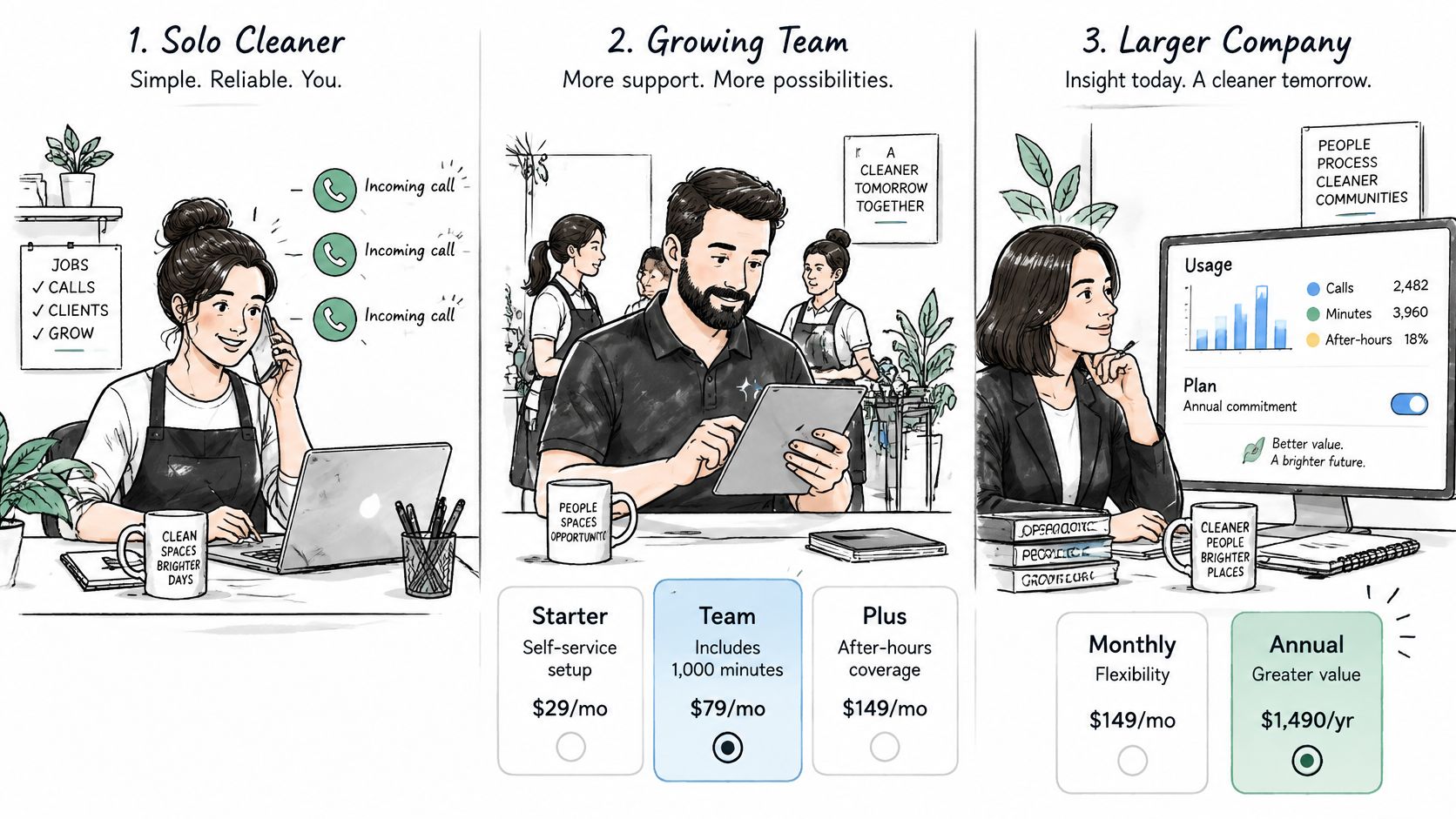
At this volume, an entry self-service plan usually fits. Calls are short and routine, so a monthly subscription with a small included allowance gives you room to learn your real usage. Check the minute allowance against your actual call length, not the vendor's average, and confirm after-hours coverage is included. Do not sign an annual commitment before you have one month of usage data. Model to choose: monthly subscription with a small included allowance. Term to negotiate: month-to-month cancellation and a written overage rate.
A team of three to five cleaners should shop mid-market plans and prioritize instant estimates, online booking, and SMS delivery over raw answering minutes. Repeat clients are the core of a recurring residential business, so unique-caller billing can turn predictable demand into an unpredictable bill. Ask how repeat callers and SMS follow-ups are charged before you compare headline prices. If you're also fixing lead flow, this guide on how to build high-converting home service funnels is worth comparing against your current intake path. Model to choose: bundled plan priced around completed estimates and bookings. Term to negotiate: how repeat callers and SMS follow-ups are billed.
Watch how a bundled approach handles the full path from inquiry to booking in the walkthrough below.
Expect custom pricing, and don't accept a single blended quote without location detail. Ask whether usage is pooled across locations or billed separately. Confirm each location can keep its own pricing rules, service area, and notifications. Model to choose: custom plan with pooled usage and location-level reporting. Term to negotiate: pooled minutes or conversations across all locations.
For ambiguous jobs, use a hybrid rule. Automate routine estimates and escalate unusual scope, access problems, or unclear surfaces to a person. Paying more per interaction is worth it when it prevents a wrong estimate from eroding margin on the job.
Estimatty packages instant estimates, online booking, and 24/7 voice sales as one offer. Compare that bundle against stacked add-ons from general vendors, line by line, including SMS delivery and handoff. The package that wins is the one with the lowest cost per booked job after you add overages, SMS, and handoff time. That is the comparison to take into your busiest month.
Do this calculation this week, before a sales call, while you still control the comparison. You'll need your call log, your web form count, your average job value, and each vendor's written overage terms.
Watch for one more detail during online booking tests. With us, the price shown during online booking is guaranteed for 7 days, so a prospect doesn't get a moving target after the estimate. Use the same standard when you test other vendors, and read our guide on how to reduce customer acquisition cost if paid leads are making every missed call more expensive.
Book a demo by calling Matty at 954-250-8284 or through the Book a Demo button on the contact page. Bring your last 90 days of call volume and your average job value, and we'll price the comparison around booked jobs. For more pricing breakdowns, use our blog rather than vendor starting prices.
The best plan is the one with the lowest cost per booked job at your real volume. It is not the plan with the lowest headline fee.
Stop paying for answered calls that still leave you doing callbacks and manual estimates. Estimatty gives cleaning businesses instant estimates, online booking, and 24/7 voice sales starting at $25 per week, so you can judge the cost against qualified estimates and booked jobs. Call Matty at 954-250-8284 or book a demo through the contact page and run your own call volume through the numbers before you sign anything.