September 8, 2026
How Much Should a House Cleaning Cost in 2026
How Much Should a House Cleaning Cost. Learn how much a house cleaning should cost in 2026, with real pricing ranges by home size, service type, and tips
Monday, March 16, 2026
Learn how to reduce customer acquisition cost for your cleaning business. This guide offers proven strategies to slash CAC and boost your profitability in 2026.
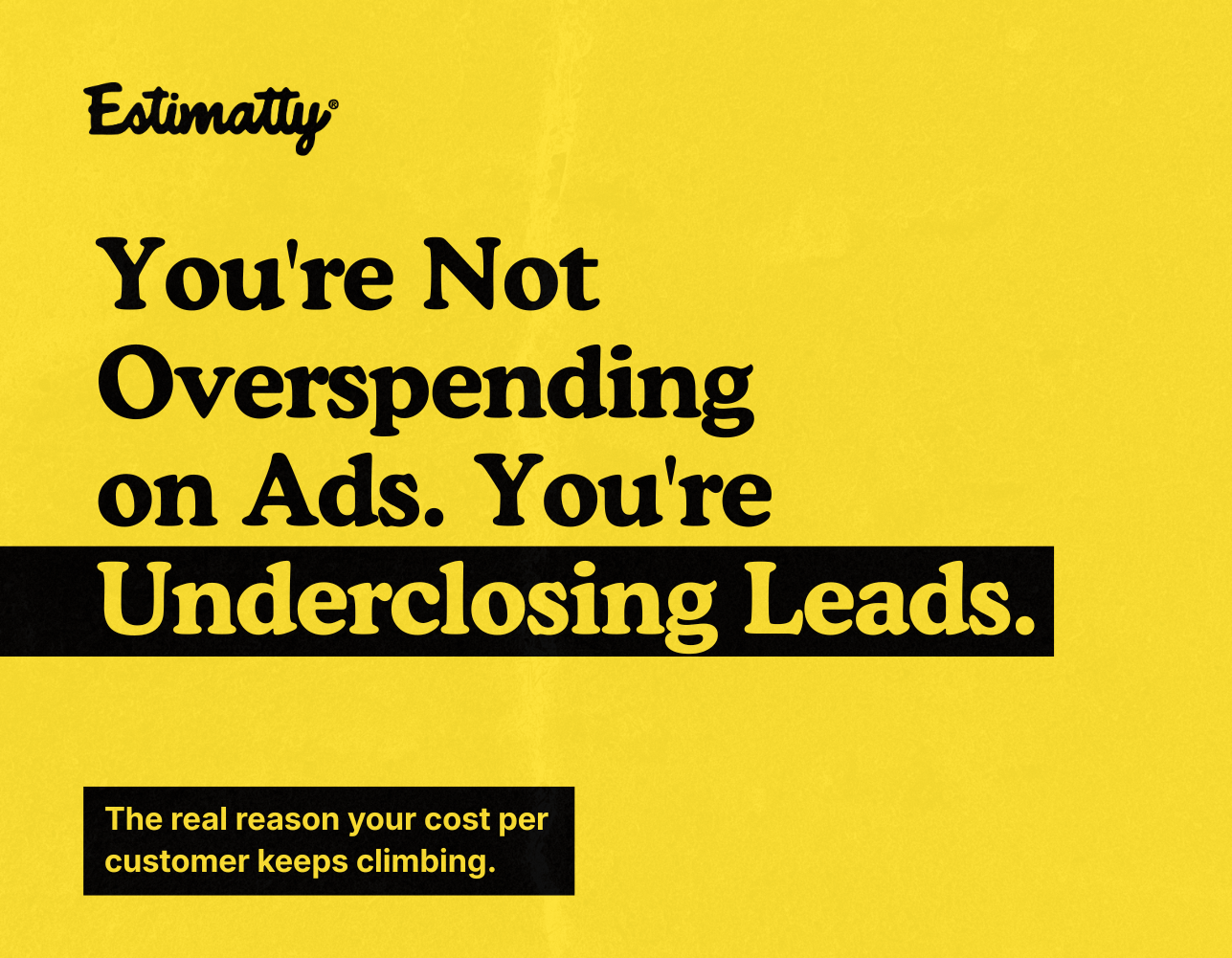
Feeling the burn from high ad spend that doesn't guarantee bookings? Let's be honest, throwing more money at ads isn't the answer. The real key to profitable growth is spending smarter, not harder.
We've built a simple playbook to help you slash your Customer Acquisition Cost (CAC). It all boils down to three core ideas: calculate what you’re really spending, see how you stack up against the competition, and then automate your sales process to stop missing out on leads.
For most cleaning business owners, the cycle is frustratingly familiar: you pour money into marketing, hoping to land a few new clients, but the results feel like a gamble. The goal isn't just to find new customers; it's to acquire them so profitably that your marketing becomes a predictable engine for growth, not a cost center.
This guide gives you the exact tools and steps to make that happen. We'll start by figuring out your baseline—what it truly costs you to win a single job. That includes everything from your Google Ads budget to the time your team spends on manual follow-ups and creating estimates. Understanding how to lower your Cost Per Acquisition is the first move in turning this around.
You can't fix what you don't measure. The first step is getting a brutally honest look at your current CAC.
This simple formula is your starting point:
(Total Sales & Marketing Costs) / (Number of New Customers Acquired) = Customer Acquisition Cost
Don't just plug in your ad spend. Be sure to include "soft costs" like the hourly wage of the staff member who answers the phone, follows up on leads, and puts together estimates. Once you have that number, you're ready to make smart decisions.
For more ideas on optimizing your spend right from the start, check out our guide on effective cleaning service advertising.
Where is your money actually going? A quick audit of your marketing channels will immediately show you which ones are working and which are just draining your budget. It's the fastest way to spot opportunities for quick wins.
Use this simple template to get a clear view of your marketing performance.
By filling this out, you’ll see exactly where your best customers are coming from and at what cost. This data is your roadmap for reallocating your budget toward what’s proven to work for your business.
Here's the good news: the home services industry already has one of the lowest average CACs, sitting around $21.68 per customer for businesses that have their channels dialed in. When you consider that repeat clients can generate about 40% of your revenue, that initial acquisition cost has a massive impact on your long-term profits.
The path to a lower CAC isn't complicated. It's a straightforward, three-part process.
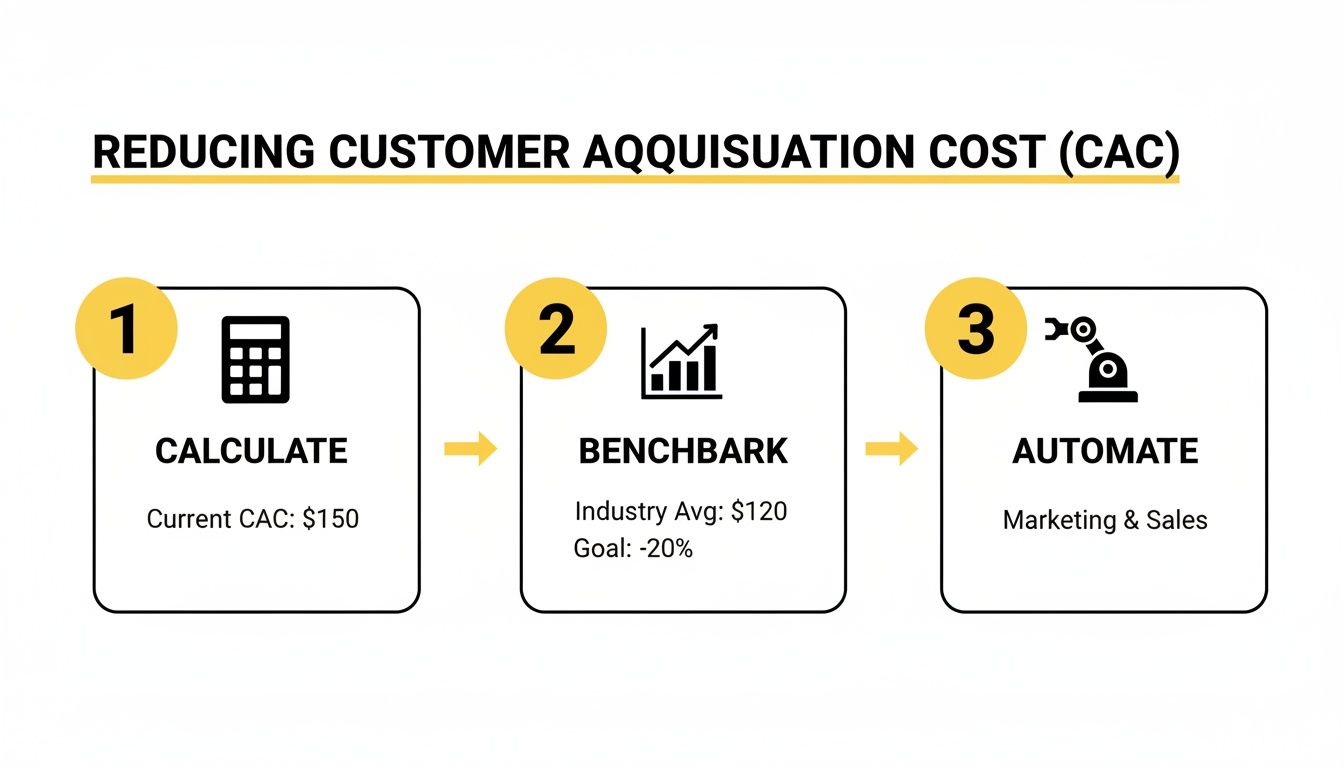
As you can see, the journey starts with understanding your costs, seeing how they compare, and then putting automation in place to boost your efficiency and capture leads 24/7.
So you've audited your marketing and know where leads are coming from. Great. But now for the hard question: how many of those hard-won leads are slipping right through your fingers?
From what I’ve seen, the single biggest leak in a cleaning company's sales funnel isn't weak marketing. It’s the gap—the agonizing delay—between someone asking for a price and actually getting one.
Every second they wait is an invitation to click over to your competitor's website. Modern customers don’t wait. A delay of just a few hours can mean a lost job, which means you paid for a click that never turned into cash. That’s how your customer acquisition cost gets bloated.
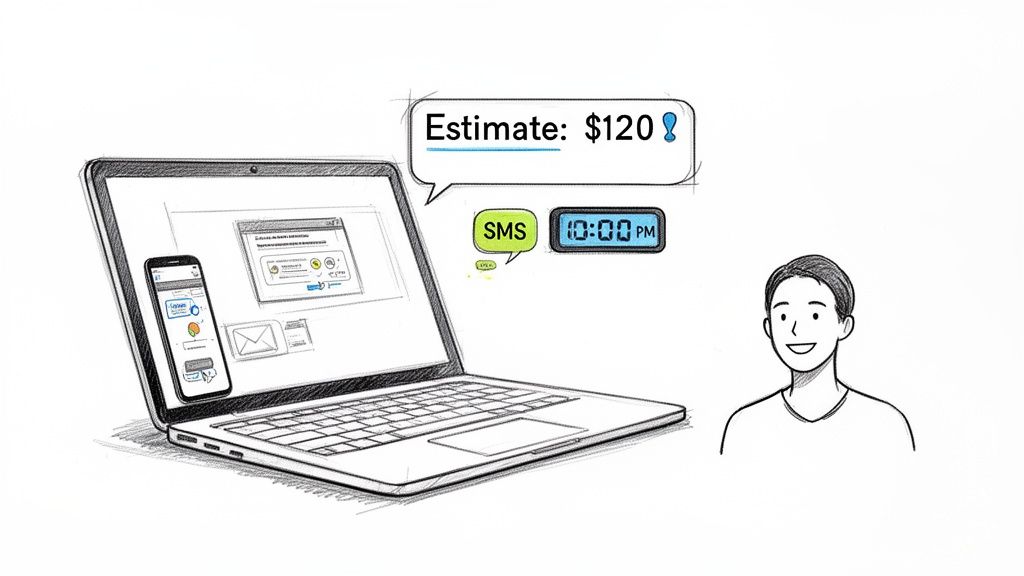
Think about the old way of doing things. A potential customer fills out your contact form at 10 PM on a Tuesday. They’re ready to buy. But they have to wait. Maybe your office manager calls them back the next morning, but they’re in a meeting and miss the call. You start playing phone tag.
By the time you finally connect to give them an estimate, their initial excitement is gone. Or worse, they’ve already booked with another company that gave them an instant price. This friction is expensive. Research from the latest B2C industry reports shows that while some industries have a CAC as high as $606, home services can stay far below that—if they’re efficient.
The antidote is simple: instant gratification. You need tools that engage and convert leads the second they show interest, no matter the time of day.
Now, picture this instead. That same person lands on your site at 10 PM. Instead of a boring form, they find an AI-powered estimator. In 60 seconds, they answer a few simple questions and get a personalized estimate sent directly to their phone and email.
You just won. You’ve captured a qualified lead, delivered immediate value, and shown them you’re the more professional, responsive choice—all while you and your team were fast asleep.
This is where AI-driven web and voice estimators like Estimatty become your secret weapon for slashing customer acquisition costs. By automating that crucial first interaction, you solve several problems at once:
This kind of instant-response system plugs the biggest leak in your sales funnel. A prospect who gets a price right away is infinitely more likely to become a paying customer. It's one of the most direct answers to the question of how to reduce customer acquisition cost.
And this doesn't just apply to your website. To make sure you never miss an opportunity, consider a similar approach for your phone lines by setting up a 24-hour phone answering service. It ensures that no matter how a customer reaches out, they get the instant response they've come to expect.
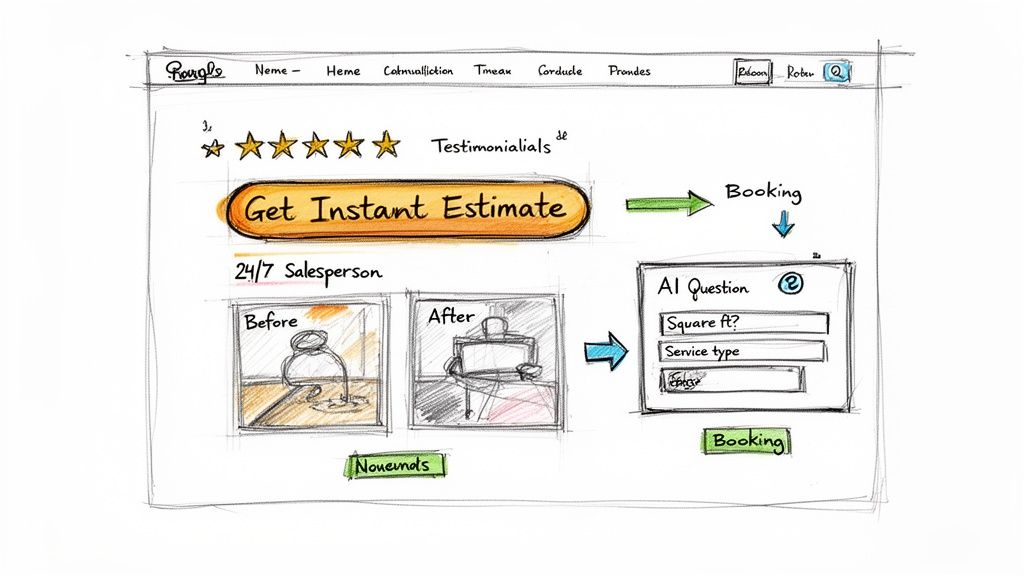
Let's be honest. Your website has one crucial job: to turn curious visitors into paying customers. Too many cleaning businesses have websites that are little more than digital brochures. They look nice, but they don't sell.
If you're serious about slashing your customer acquisition cost, you have to turn this digital front door into your most efficient and tireless salesperson. This isn't about some dark art of SEO; it's about Conversion Rate Optimization (CRO)—the science of making it incredibly easy for a visitor to say "yes."
For a cleaning service, that "yes" is getting an estimate. Every single element on your site should be engineered to guide prospects toward that one simple action.
Think about the ads you're running. The pages they link to—your landing pages—have to be laser-focused on the visitor's immediate problem. Generic, one-size-fits-all copy just won't work.
A frantic homeowner searching for "move-out cleaning" has a completely different mindset than someone looking for weekly service. Your page has to speak their language and answer their unspoken questions right away:
The quickest way to answer these is with a powerful combo of targeted copy, trust signals, and a can't-miss call-to-action (CTA).
Pro Tip: Ditch "Contact Us." It feels like a chore. Instead, use an action-oriented promise like "Get My Instant Estimate Now." This simple tweak reframes the action from work for them to a benefit for them.
Before anyone hands over their credit card, they need to trust you. For a visitor who just found you on Google, social proof is the fastest way to build that confidence. It’s the digital version of a friend's recommendation, and it's absolutely vital.
You need to strategically place these trust-builders all over your site, especially right next to your "Get Estimate" buttons:
This trifecta of evidence is what convinces a hesitant prospect that you're a safe bet, making them far more likely to take the next step.
Here’s where you can make a massive dent in your CAC. So much of the cost of a new customer is hidden in the hours your team spends playing phone tag, answering basic questions, and creating manual estimates for people who were never going to buy.
Automating this grunt work is a total game-changer.
By installing an AI estimator from a service like Estimatty, you put a system in place that qualifies leads for you, 24/7. We cover this in-depth in our guide to the benefits of a cleaning estimate calculator.
The AI instantly asks the make-or-break questions on your behalf:
This simple process instantly weeds out the tire-kickers from the hot, ready-to-buy leads. Instead of your team wasting time on manual discovery, they get a notification with a fully qualified prospect who has already received an accurate estimate.
The difference is staggering. Time-intensive follow-ups inflate your CAC, while automated nurturing lets your team focus purely on closing deals.
By automating the top of your funnel, you ensure your valuable human hours are spent on revenue-generating activities. This is one of the most direct and powerful ways to reduce your customer acquisition cost and build a more profitable business.
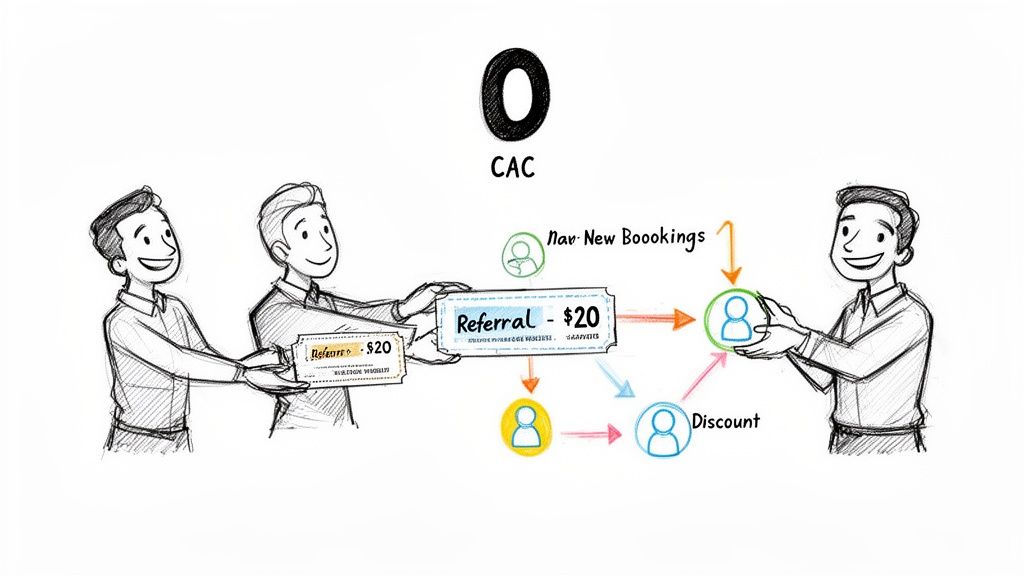
What if you could stop paying to acquire every single new client? Imagine a business that runs on word-of-mouth, powered by customers so thrilled with your service they can't help but tell their friends. This isn't just a fantasy; it’s what happens when you build smart systems that turn your happy clients into your most effective—and affordable—sales force.
This is where your CAC can truly plummet. The strategy is simple: invest in the customers you already have. By focusing on referrals and retention, you create a powerful cycle of growth that pays for itself, dramatically boosting your profit margins along the way.
Forget about complicated point systems or clunky apps. In my experience, the best referral programs are incredibly simple, offering a clear reward that benefits both the existing client and the new one. The easier it is to understand, the more people will actually use it.
A straightforward discount is a fantastic starting point. For example, offer your client a $25 discount on their next cleaning for every friend they refer who books a service. Then, give that new customer a $25 discount on their first cleaning, too. It’s a win-win-win.
Of course, you can't just set it and forget it. You have to actively promote your program. Weave a mention of it into every email you send, from booking confirmations to service reminders. Seeing the power of social proof from real people can be a game-changer, which you can see in these cleaning service testimonials.
A customer you keep is one you don’t have to pay to acquire all over again. It’s a simple truth, but it’s one that’s so often overlooked in the chase for new leads. While new clients are exciting, consider this: boosting your retention rate by just 5% can increase your profits by 25% to 95%.
Why such a huge jump? Because your acquisition cost is a one-time hit, but the revenue from a loyal client compounds over months and years. This is where you need to get obsessed with your Customer Lifetime Value (LTV). A high LTV gives you a massive strategic advantage, allowing you to outspend competitors on acquiring new customers when you need to.
By focusing on retention, you shift your spending from repeatedly acquiring new customers to maximizing the profitability of the ones you already have. This is a foundational strategy for how to reduce customer acquisition cost over the long term.
Great service isn't just about the clean itself—it’s the entire experience. Here are a few tactical ways I've seen work wonders for boosting retention and LTV:
Finally, hiring the right people is non-negotiable. A professional, friendly cleaner is often the difference between a one-time job and a customer for life. By investing in your people and your retention efforts, you aren't just saving money on acquisition—you're building a more stable, profitable, and resilient business.
If you really want to get a handle on your growth, you have to look beyond just one simple number. You can't just ask, "What's my customer acquisition cost?" and call it a day. That's surface-level thinking.
To build a cleaning business that's not just profitable but truly sustainable, you need to think like a CEO. That means getting fluent in the numbers that actually drive your business forward.
I've seen it time and time again: the companies that break away from the pack are the ones who obsess over two specific metrics. Mastering your Customer Lifetime Value to Customer Acquisition Cost (LTV:CAC) ratio and your Payback Period is what separates the businesses that are just getting by from the ones that are built to last.
Think of the LTV:CAC ratio as the ultimate report card for your marketing. It cuts through the noise and tells you a simple, powerful story: for every dollar you spend getting a new client, how many dollars will they bring back to you over their entire time as a customer?
A healthy, growing business should be aiming for an LTV:CAC ratio of at least 3:1. This is the gold standard. It means for every $100 you spend to land a new cleaning contract, you can expect to earn $300 in profit from them over time.
If your ratio is down at 1:1, you're on a treadmill to nowhere. You're spending a dollar to make a dollar, leaving zero room for profit, overhead, or reinvestment. On the flip side, a really high ratio like 5:1 might sound great, but it could be a sign you're not investing enough in marketing and are leaving growth on the table.
Getting this number right forces you to connect the dots between your ad spend and your long-term health. To get there, you first need to be able to accurately calculate your Cost Per Acquisition (CPA). Without that piece, you're just guessing.
Cash flow is king, and your Payback Period is the metric that guards the throne. It answers one of the most critical questions for any service business: how long does it take to get my money back after acquiring a new customer?
The math is straightforward:
Payback Period (in months) = CAC / (Average Monthly Revenue per Customer x Gross Margin %)
Let’s put it into practice. Say your CAC is $120. A new customer pays $150 a month, and your gross margin on that service is 50% ($75 in gross profit).
Your payback period would be: $120 / ($150 x 0.50) = 1.6 months.
In less than two months, you've not only recouped your acquisition cost but are now generating pure profit from that client. A shorter payback period is your secret weapon for growth because it means you can pour that money right back into acquiring the next customer. This creates a powerful compounding effect. Most healthy cleaning businesses I see have a payback period well under 12 months.
You don't need fancy, expensive software to get started. Honestly, a simple spreadsheet is more than enough to give you the clarity you need.
Here’s a simple way to get it done:
This simple dashboard gives you real control. When you’re deciding whether to increase your Google Ads budget, you can move past gut feelings. If you see that Google Ads has a high initial CAC but delivers loyal customers with a fantastic 4:1 LTV:CAC ratio, you know it’s a smart investment. For a deeper look at making that channel work, we've got a whole guide on running Google Ads for your cleaning business that provides more tactical advice.
Let's tackle some of the most common questions we hear from cleaning business owners who are trying to get their marketing costs under control and scale their company the right way.
When you're just starting out, a realistic CAC for a new residential cleaning client will probably land somewhere between $75 and $150. Don't panic if you're on the higher end of that spectrum—it's normal. That initial cost reflects the trial and error of figuring out which marketing channels actually work in your specific area.
Your first goal isn't perfection; it's learning. You have to spend a little to discover what brings in good leads. Maybe you find that hyper-local Google Ads deliver serious customers, even if the clicks are pricey. Once you find those winners, you double down. Over time, as your systems get dialed in, you should be aiming to push that CAC down into the $20-$30 range, which is the sweet spot for a healthy, optimized home services company.
The fastest way to get that initial CAC down is by making sure you convert the website traffic you're already paying for. A tool like Estimatty that gives visitors an instant estimate can make a huge difference, turning browsers into booked jobs before they have a chance to click away.
When you're working with a tight budget, you have to trade cash for cleverness and a bit of sweat equity. It's all about being incredibly efficient and resourceful.
Your first move is to absolutely dominate the free channels. That means treating your Google Business Profile like a prized asset—we're talking constant updates, great photos, weekly posts, and a relentless push for new 5-star reviews. Find the local Facebook community groups (the ones that actually allow business posts) and become a genuinely helpful presence there. That's free advertising.
Next, you need to squeeze every ounce of potential out of your website. If you're paying for even a trickle of traffic, you can't afford to let visitors leave without a trace. This is where an AI estimator becomes your secret weapon. Instead of just hoping someone fills out a contact form, you can instantly engage them, give them a price, and capture their info—all without spending another dime on ads. You can see more tools like this in our guide to hiring great cleaning employees.
Finally, put your focus on two powerful, low-cost engines for growth: referrals and your own team.
Automating your estimates with a tool like Estimatty isn't just a cool tech feature—it directly and measurably lowers your customer acquisition cost. Think of it as plugging the leaks in your sales funnel where money and leads typically escape.
Here’s exactly how it works:
In short, Estimatty turns your website from a passive digital brochure into an active, round-the-clock sales machine. It systematically fixes the inefficiencies that make your CAC higher than it needs to be. For more smart-automation ideas, check out our recent post on cleaning industry trends.
You need to be calculating your CAC every single month. This rhythm is the perfect balance—it's frequent enough to let you see if a new marketing campaign is working, but not so frequent that you get bogged down by daily noise. A monthly check-in tells you whether that new ad spend is actually paying off.
For LTV (Customer Lifetime Value), looking at it quarterly or semi-annually makes more sense. LTV is a long-term metric, so you need a bigger chunk of data to spot real trends in how long customers stick around and how much they spend.
But the most important number of all is the LTV:CAC ratio, and you should be reviewing that at least quarterly. This is your business's ultimate report card. A healthy ratio to aim for is 3:1 or higher. Hitting that number is proof that you're not just acquiring customers, you're acquiring profitable customers who will fuel sustainable growth for years to come.
Ready to stop wasting ad spend and start converting more visitors into booked jobs? Estimatty is the AI sales agent that works for your cleaning business 24/7, turning your website into a lead-generating machine. See how it can slash your CAC and automate your growth by visiting https://www.estimatty.com today.