October 19, 2026
Average Charges for House Cleaning in 2026
Learn the average charges for house cleaning in 2026, what drives pricing by home size and frequency, and how to set profitable rates

Tuesday, October 20, 2026
Learn how to follow up on a quote with timing, templates, and tactics that turn estimates into booked cleaning jobs. Practical advice for cleaning businesses.

It's Monday morning, you're loading supplies, and the cleaning estimates you sent before the weekend still haven't received a reply. You could send another reminder, but you don't know whether the customer missed your message, disliked the price, or couldn't tell what was included.
Learning how to follow up on a quote starts with that distinction. For cleaning businesses, the useful question isn't when to send another message. It's what the customer still needs to make a decision.
A customer who receives your estimate still may not know enough to say yes. The price is only one input. They may need to confirm whether you clean inside appliances, whether the property has to be empty, or whether your crew can finish before a move-out inspection.
On the quotes I've lost over the years, the sticking point was almost never the number on the page. It was an open question nobody answered, and a competitor who answered it first. Your careful pricing is irrelevant if the comparison never happens.
That reframes the problem. Before you send another reminder, work out which question the customer is still sitting on.
A 2007 Lead Response Management study, analyzing more than 15,000 web leads and over 100,000 call attempts, found that contact odds were 100 times higher within 5 minutes than after 30 minutes, while qualification odds were 21 times higher in that same comparison.
Those numbers come from general web leads, not cleaning jobs, so read them as direction rather than a forecast. The working principle they support: respond while the customer is still weighing options, instead of filing the inquiry for later processing.
The dollar cost is yours to calculate, and it differs between a weekly residential route and one-off move-out work. Skip generic revenue-loss math. Pull up the estimates you lost, and check whether the prospect got a useful answer before their service deadline passed.
Practical rule: Treat an estimate request as the start of a conversation, not the completion of an administrative task.
A reply doesn't require every detail resolved. It requires honesty about what is confirmed and what still needs checking.
Speed and polish pull in opposite directions. A prompt reply with one clearly flagged unknown usually survives. Silence while you prepare a perfect answer does not, because a polished estimate has limited value after the customer has booked someone else.
Make the first reply easy to understand on a phone. The customer shouldn't need to open an attachment, interpret your service terminology, and write a detailed explanation before the conversation can continue.
Keep the mobile interaction simple.

Research covering 1.25 million leads, summarized in Venture Harbour's review of lead-response research, found that companies attempting contact within one hour were nearly 7 times more likely to qualify a lead than those waiting longer, and more than 60 times more likely than those waiting at least 24 hours.
Lead with the channel the prospect requested. An email inquiry doesn't automatically justify repeated calls or texts, and a customer who specifically asks for a call shouldn't receive only an automated email.
These are adaptable scripts, not customer testimonials:
| Channel | First-touch wording |
|---|---|
| SMS | Hi [Name], your cleaning estimate is ready at the amount shown above, based on the details you submitted. Does the property need to be cleaned before a particular date? Reply here and we'll confirm availability. |
| Hi [Name], attached is your estimate for [service]. It assumes [condition] and includes [main tasks], with [add-ons] listed separately. Is [key assumption] correct? Reply to confirm or request a change. | |
| Phone | Hi [Name], this is [Business] returning your cleaning inquiry. I have your estimated price ready. Before we discuss scheduling, can I confirm [missing detail]? |
If essential information is missing, acknowledge the request immediately rather than presenting an unsupported price as settled.
Send what you can stand behind now. Explain what needs checking before the customer commits.
Build the reply around a short checklist:
Assign responsibility for incoming inquiries, including when you're cleaning or driving. The practical guidance on improving response time can help turn that responsibility into a repeatable process rather than an owner's memory test.
Use this video as a companion to your response workflow.
Before enabling any instant reply, test it from the customer's side. Check that the message arrives, the pricing explanation makes sense, and a reply reaches someone who can act.
After the initial response, choose the next contact based on the customer's deadline, not just the age of the estimate. A move-out request for an imminent inspection and a planned recurring service shouldn't enter identical reminder schedules.
The large lead-response dataset summarized by InsideSales reported 8 times higher conversion rates when the first attempt occurred within 5 minutes, compared with 5 minutes to 24 hours, while fewer than 15% of attempts happened on the first day. That supports immediate acknowledgment, not immediate pressure to decide.
Use this as a suggested schedule for a routine residential inquiry, not a universal rule.
| Day | Channel | Message Goal | Expected Behavior |
|---|---|---|---|
| Day 1 | Requested email or SMS channel | Confirm receipt and invite a scheduling discussion | Customer confirms the estimate arrived or gives a target date |
| Day 3 | Same conversation, unless the customer prefers otherwise | Clarify included tasks or an uncertain detail | Customer validates or corrects the service scope |
| Day 7 | Email, or an agreed call | Identify the unresolved decision | Customer explains a budget, timing, or confidence concern |
| Day 14 | Preferred written channel | Pause follow-up courteously | Customer reopens the conversation or receives no further reminders |
This spacing is an editorial starting point. It isn't a promised conversion formula, and a prospect who responds should leave the generic sequence immediately.
A useful Day 3 message might read: “Your estimate includes the kitchen surfaces but not inside the oven. Would you like that added before you compare options?” That gives the customer something concrete to answer.
For Day 7, ask: “Would it help to review the cleaning tasks, appointment timing, or estimated cost?” Don't pretend you already know the objection.
For urgent cleaning, ask about access and the service deadline immediately. Waiting for a scheduled reminder makes little sense if the required date will have passed.
For recurring service, allow room for a household decision. For a commercial property, replace a generic reminder with a scope-validation conversation involving whoever approves the work.
The final message should sound calm: “I'll pause follow-up on this estimate. If the cleaning is still needed, reply here and we'll review current availability.”
Never manufacture scarcity. State only real scheduling constraints or an actual price-review date, and don't claim an appointment is reserved unless you've held it.
Silence doesn't establish that someone is price shopping. It also doesn't prove your estimate is wrong. Treat both as hypotheses, then check the information before deciding what to send.
A sales follow-up analysis from InsideSales found that representatives averaged 1.3 call attempts before giving up, while companies could contact up to 90% of leads when they made at least six attempts. That supports persistence, but it doesn't mean repeating an unclear estimate is useful.
Use a quality review before adding another reminder.
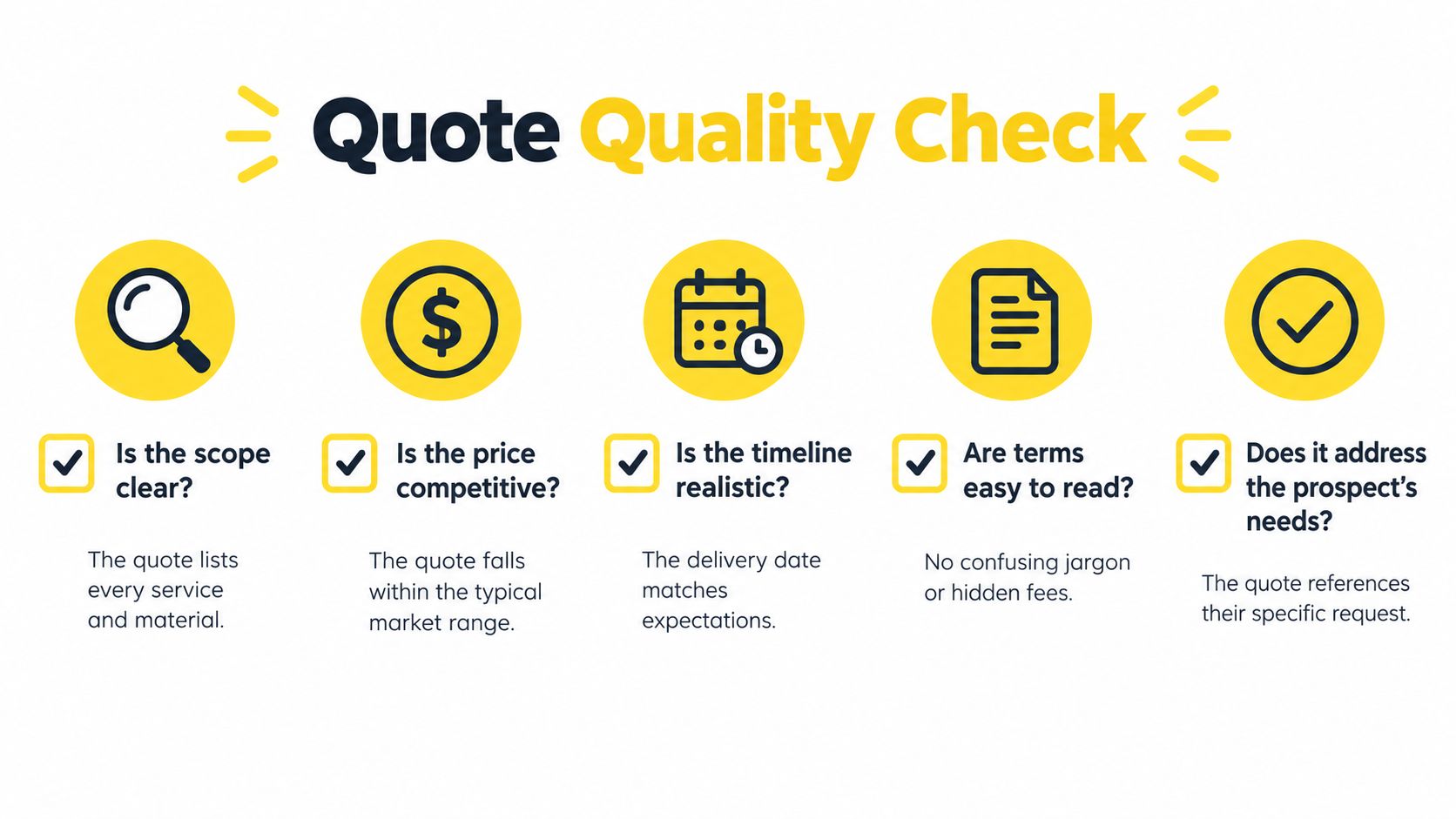
Replace “Have you reviewed it?” with a question the customer can answer without making a buying commitment.
Don't send the entire list as an interrogation. Choose the question most relevant to the inquiry, then discuss the answer.
For example, a prospect may describe a property as needing a standard clean while expecting detailed work after a tenancy. Confirm the condition, explain what changes, and issue an updated estimate with the difference visible. Editing the original amount makes the conversation harder to follow.
Require the details that affect your own pricing and staffing decisions:
Keep the fields relevant. A long form that asks for information you never use creates its own friction.
For the customer's perspective on comparing another home-service purchase, Alex Trend Painters' resource on how to get painting quotes offers a useful adjacent reading. Don't treat painting prices as cleaning benchmarks.
Review your own cleaning service estimate process whenever the same clarification keeps appearing. A repeated question belongs earlier in the intake or service description, not permanently in your follow-up script.
When a prospect finally answers, resist the urge to revise the price immediately. Their first response may describe the symptom rather than the actual obstacle.
“Too expensive” can mean the customer has a lower budget, received a narrower competing estimate, or doesn't understand the work involved. Ask which before making concessions.
A practical email response is: “Thanks for letting me know. Our estimate includes [specific tasks], with [optional work] separated out. Is the concern the total budget, or are you comparing it with a different service scope? I can review the options without removing something you need.”
Use the guidance on handling price objections to prepare consistent responses before someone asks for a discount.
“Not right now” isn't an invitation to keep sending the original sequence. Ask whether the project has moved or whether the customer no longer needs the service.
Try: “Understood. Has the cleaning date changed, or would you prefer to pause? If it's still planned, what date would you like me to contact you?”
“I need to think about it” may reflect hesitation about allowing a new team into the property. Ask what would help them feel comfortable, then provide relevant documentation or explain your actual procedures.
For a specialty-cleaning comparison, Rubber Ducky Rug Cleaning Birmingham's page on what professional rug cleaning looks like is an optional reference, not evidence of your company's results. Use your own authorized project photos when demonstrating your work.
Before changing the estimate, record the concern in the customer's own words.
Finally, keep preliminary pricing distinct from a firm commitment. New Zealand Consumer Protection guidance defines an estimate as a best prediction of cost and a quote as an offer for specified work at a stated price, generally requiring an agreed variation before increasing an accepted price. That's jurisdiction-specific guidance, so check your local obligations.
Automate the handoffs that owners forget, not the judgment calls that require a conversation. A system should remember the next action without pretending every inquiry is identical.
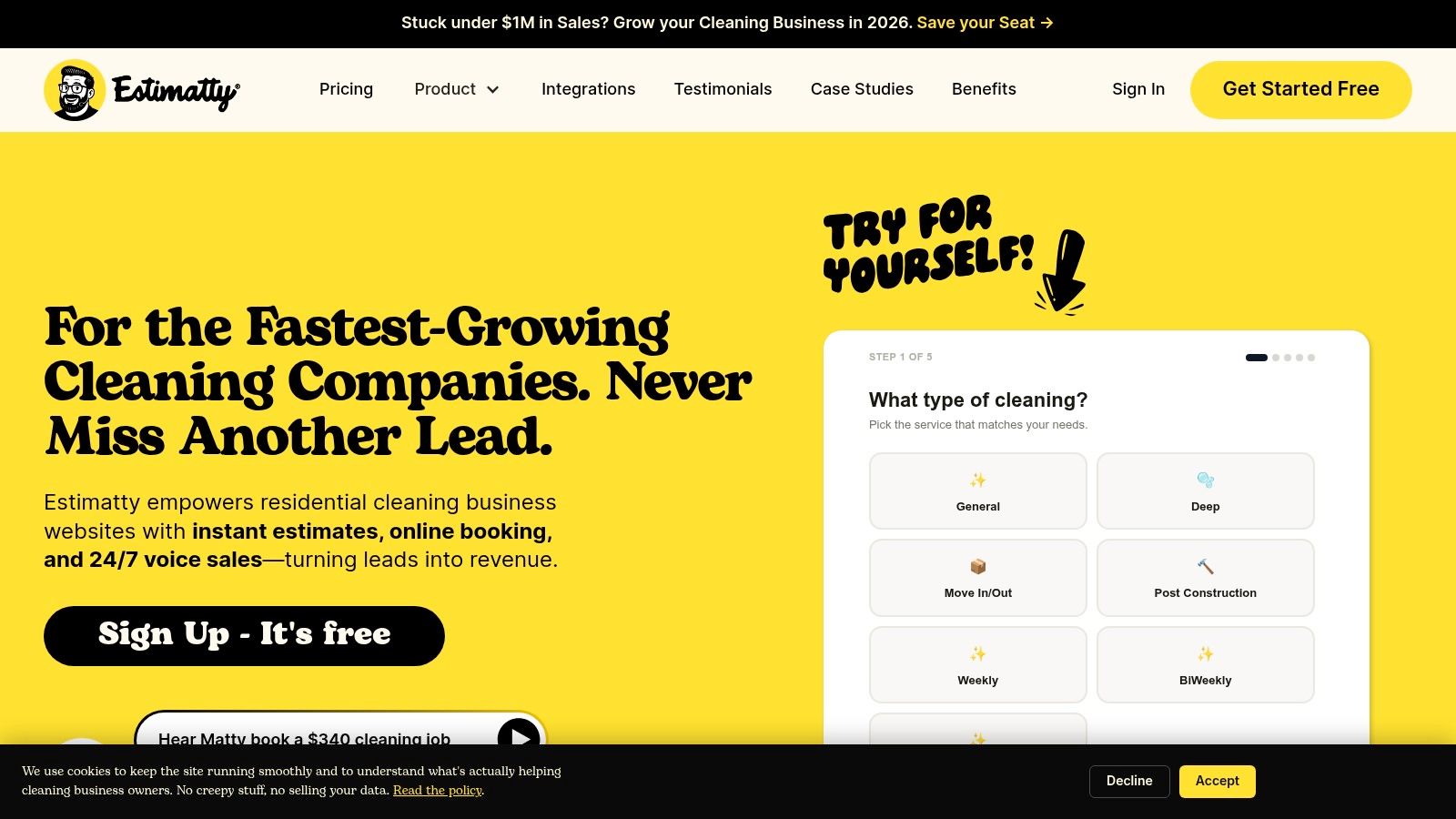
For the intake layer, Estimatty offers web and voice estimate capture with SMS and email delivery. A broader workflow can use Zapier and a CRM such as HubSpot or Jobber, subject to the integrations and actions available in your setup.
Use this process map when planning the connections.

Create the contact record with the service type, deadline, preferred channel, estimate version, and unresolved question. Then assign the relevant reminder path and a named person responsible for exceptions.
Configure your workflow to check the current status before sending anything. A delayed message shouldn't go out merely because it entered a queue earlier.
Test those branches before enabling the workflow. The sales pipeline automation guide can support that planning, but your actual configuration needs its own checks.
Use approved message structures populated with verified inquiry details. Don't let generated text invent appointment availability, insurance coverage, discounts, or cleaning outcomes.
A human call is appropriate when access is complicated, the scope is disputed, or the prospect needs reassurance that a written exchange hasn't provided.
Staffing pressure also makes consistency relevant. A projection attributed to the U.S. Bureau of Labor Statistics indicates approximately 351,300 annual openings for janitors and building cleaners from 2024 through 2034, mostly from occupational transfers or workforce exits rather than net new employment. That projection isn't a turnover rate for your company, but it reinforces the value of processes a replacement team member can understand.
Review outcomes weekly, not just how many messages your software sent. A busy sequence can still leave customers confused or route replies to an unattended inbox.
Use your estimate records alongside the booking schedule.
Track these measures consistently so changes are comparable:
| Measure | What it tells you | What to investigate |
|---|---|---|
| Time to first response | How long customers wait for an acknowledgment | Coverage gaps and failed routing |
| Contact rate | Whether follow-up reaches a real conversation | Delivery, channel preference, and timing |
| Estimate-to-booking rate | Whether issued estimates become scheduled work | Scope clarity and unresolved concerns |
| Attempts per won job | How much follow-up successful bookings require | Unnecessary touches or inefficient handoffs |
| Opt-out rate by channel | Where customers reject further contact | Permission, frequency, and message relevance |
There's no supported universal healthy range for these measures across small cleaning businesses. Establish your own baseline, compare similar service types, and investigate changes rather than borrowing an arbitrary target.
Treat a message sent after a recorded opt-out as a workflow defect, not acceptable statistical noise. Likewise, a customer reply that sits unassigned needs an operational fix, regardless of the overall booking rate.
Choose recent won, lost, and unanswered estimates, then check the actual conversations.
If late replies dominate, fix coverage. If customers repeatedly ask what's included, rewrite the service description. If discounts appear before anyone records an objection, coach the conversation rather than lowering the price list.
Use conversion-rate improvement guidance to choose a focused adjustment, then compare subsequent results. Keep tuning the process around customer decisions, not the satisfaction of completing a reminder schedule.
Estimatty offers web and voice estimate capture, instant SMS and email delivery, and notifications for your team's follow-up. Visit Estimatty to explore how it can support faster initial responses while your team handles scope questions, objections, and booking decisions.