
October 10, 2026
How to Increase Qualified Leads for Cleaners
Learn how to increase qualified leads for your cleaning business. Discover AI estimators, speed-to-lead tactics, and scoring strategies that book more jobs.

Thursday, August 20, 2026
Learn how to improve conversion rates for cleaning businesses with proven tactics for instant estimates, faster follow-up, and smarter quote flows.

Responding within five minutes can make a lead 21 times more likely to qualify than responding after 30 minutes. To improve conversion rates for a cleaning business, fix the operating delay first, then simplify the estimate experience, automate follow-up, clarify pricing, and review the numbers every week.
That speed-to-lead reality changes how owners should think about conversion optimization. The biggest leak usually isn't a button color, headline, or testimonial placement. It happens after the inquiry, when a prospect is waiting for a callback, sending the same request to another cleaner, or losing confidence because nobody can provide a useful estimate.
Cleaning customers often contact several providers while their intent is high. The company that responds first with a clear next step and a credible price range has a practical advantage. The sections below focus on the operational levers that make that response possible, measured in minutes, completed estimates, and booked jobs rather than clicks alone.
Most cleaning businesses don't lose booked jobs at the moment a visitor clicks the estimate button. They lose them in the handoff that follows. A form lands in a shared inbox, an office manager sees it hours later, and the prospect receives a generic message asking when they'd like to talk. By then, another company may already have answered.
The common leaks are familiar:
The MIT and InsideSales lead-response research found that leads contacted within five minutes were about 21 times more likely to qualify than leads contacted after 30 minutes, while other summaries of the same research report a 100 times higher chance of making contact at five minutes versus 30 minutes. The lead response management research supports an operational conclusion: the response layer deserves as much attention as the landing page.
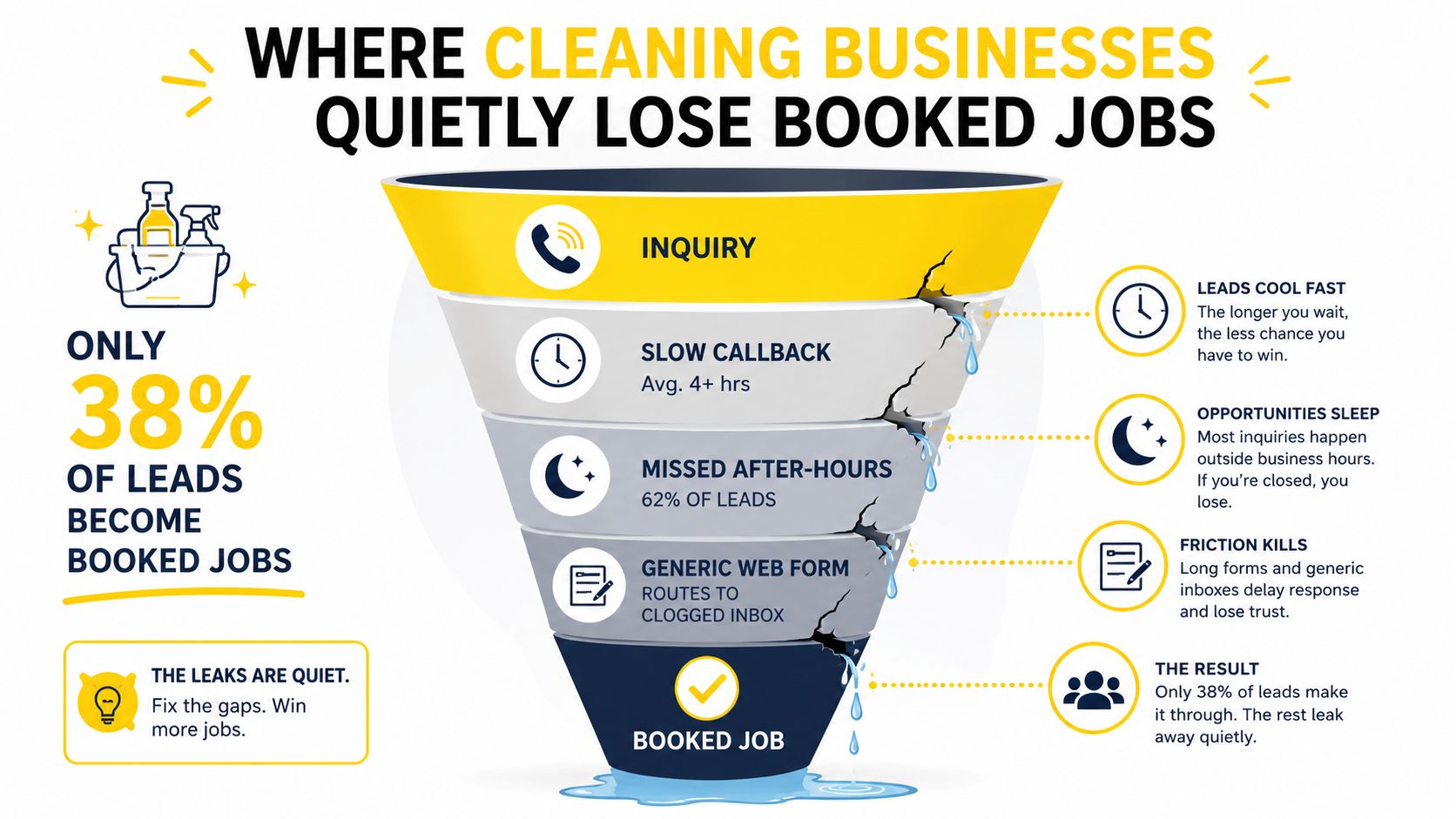
Heatmaps, hero-copy tests, and button experiments can help when visitors aren't taking the first action. They won't solve an inbox that nobody monitors, an unavailable phone line, or a pricing process that takes several days.
That distinction matters for owners evaluating local CRO services Brisbane. A useful engagement should inspect the full path from inquiry to booked job, including routing, response ownership, estimate delivery, and after-hours recovery. Conversion is a marketing outcome, but cleaning operators control many of the causes.
Practical rule: Treat every new inquiry as an operations ticket with an owner, a timestamp, a requested service, and a defined next action.
A prospect doesn't need a lengthy intake interview before receiving useful information. They need a fast path from basic property details to a credible estimate, followed by a clear way to book or speak with someone.
Start with the minimum information required to price the service responsibly. Depending on your model, that may include:
The order matters. Ask easy, objective questions first, then request more detailed information after the prospect sees an estimate. Large form datasets summarized by Neil Patel show conversion falling from 18.2% for one-field forms to 13.0% for two-field forms, 11.5% for three fields, and 8.1% for five fields. Forms with nine or more fields converted at 4.2%, compared with the one-field baseline in the same form-field conversion data.
Qualify first. Identify the service, property, timing, and contact method. Don't ask for information your estimator can't use.
Price second. Present a ballpark estimate or range and explain what could change it. A range is not a promise of a final invoice. Label it clearly, state the assumptions, and tell the prospect how the team confirms the details.
Book third. Offer a booking link, callback option, or live handoff immediately. The estimate shouldn't become another dead end.
A useful estimator can distinguish between an initial price and a final service confirmation. That distinction protects margins while giving the prospect the price anchor they came for. The operational handoff must also be explicit. Assign the lead to a person or queue, trigger a notification, and set a sub-five-minute target for pricing and callback requests.
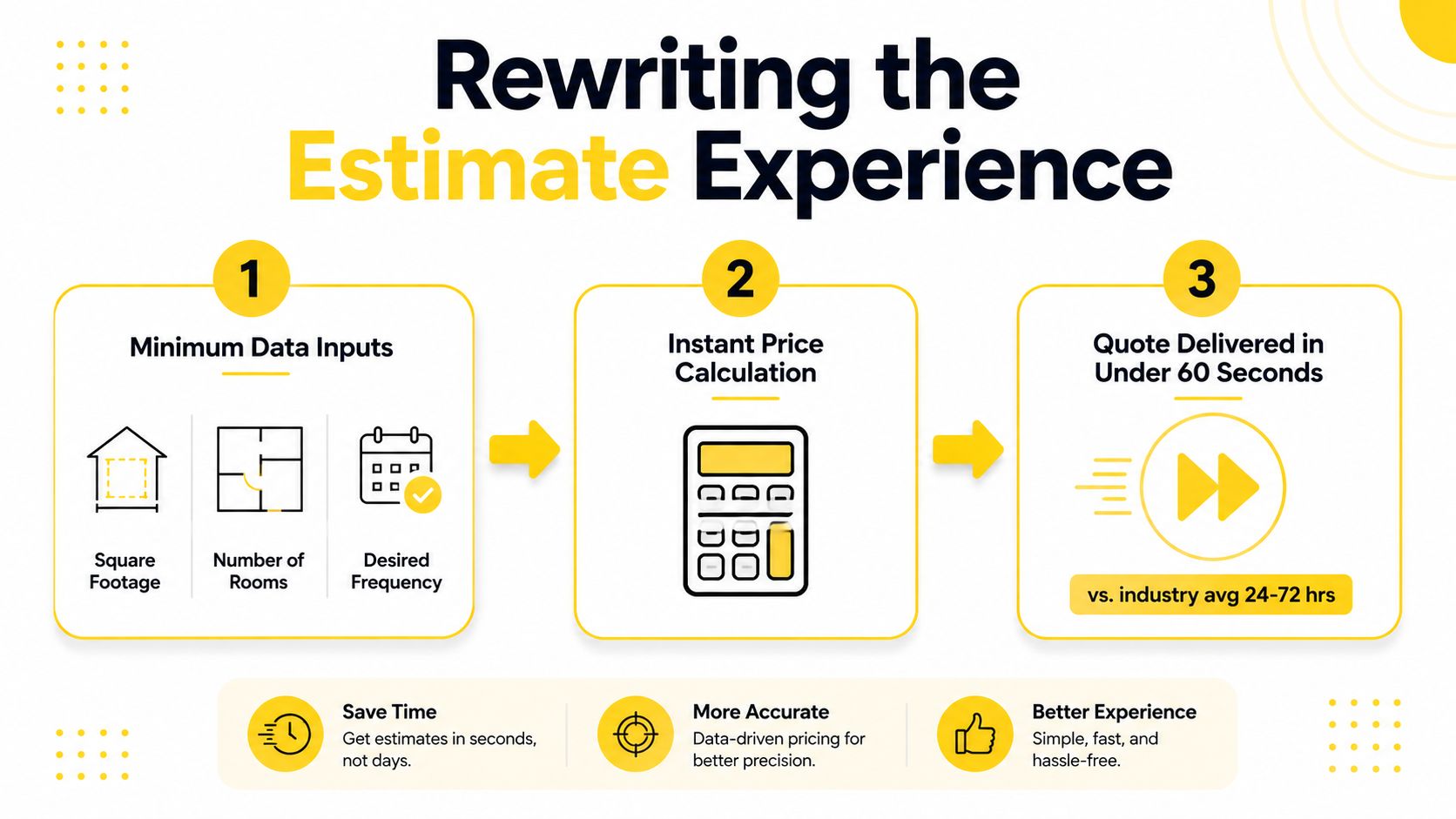
For a deeper look at the mechanics, review this cleaning estimate calculator guide.
The estimate should arrive through the prospect's preferred channel, with the business receiving the same information in a structured record. That prevents the familiar failure where a customer gets a number but the team doesn't know what was promised.
A short form isn't automatically a good form. It must also be easy to understand, quick to complete on a phone, and connected to an estimate process that feels worthwhile.
The first decision is what to ask before pricing. Name, email, phone, property size, service type, and timing may be enough for an initial estimate. Details such as pets, access instructions, heavy buildup, or delicate surfaces can follow when they affect the price or booking plan.
The data supports restraint. A 2026 cross-industry benchmark reported a 17.3% median form conversion rate from interactors to completed submissions, while its form-length research says each field beyond three can reduce completion by about 5% to 10% and abandonment rises sharply at 10 or more fields. See the 2026 form conversion benchmark for the underlying context.
Remove navigation links that pull visitors away from the estimate path. Put one primary action above the fold, such as “Get my instant estimate,” and make the supporting copy explain what happens next. Replace dropdown-heavy layouts with tappable room or service selectors where possible.
A progress indicator helps when the process requires multiple steps, but don't use multiple steps to disguise an unnecessarily long form. The visitor should always know what information is needed and why.
Use this audit before publishing or revising a page:
A focused website for a cleaning business should make the next action obvious without making the visitor search for it. The page earns the inquiry, but the estimate flow earns the opportunity to book.
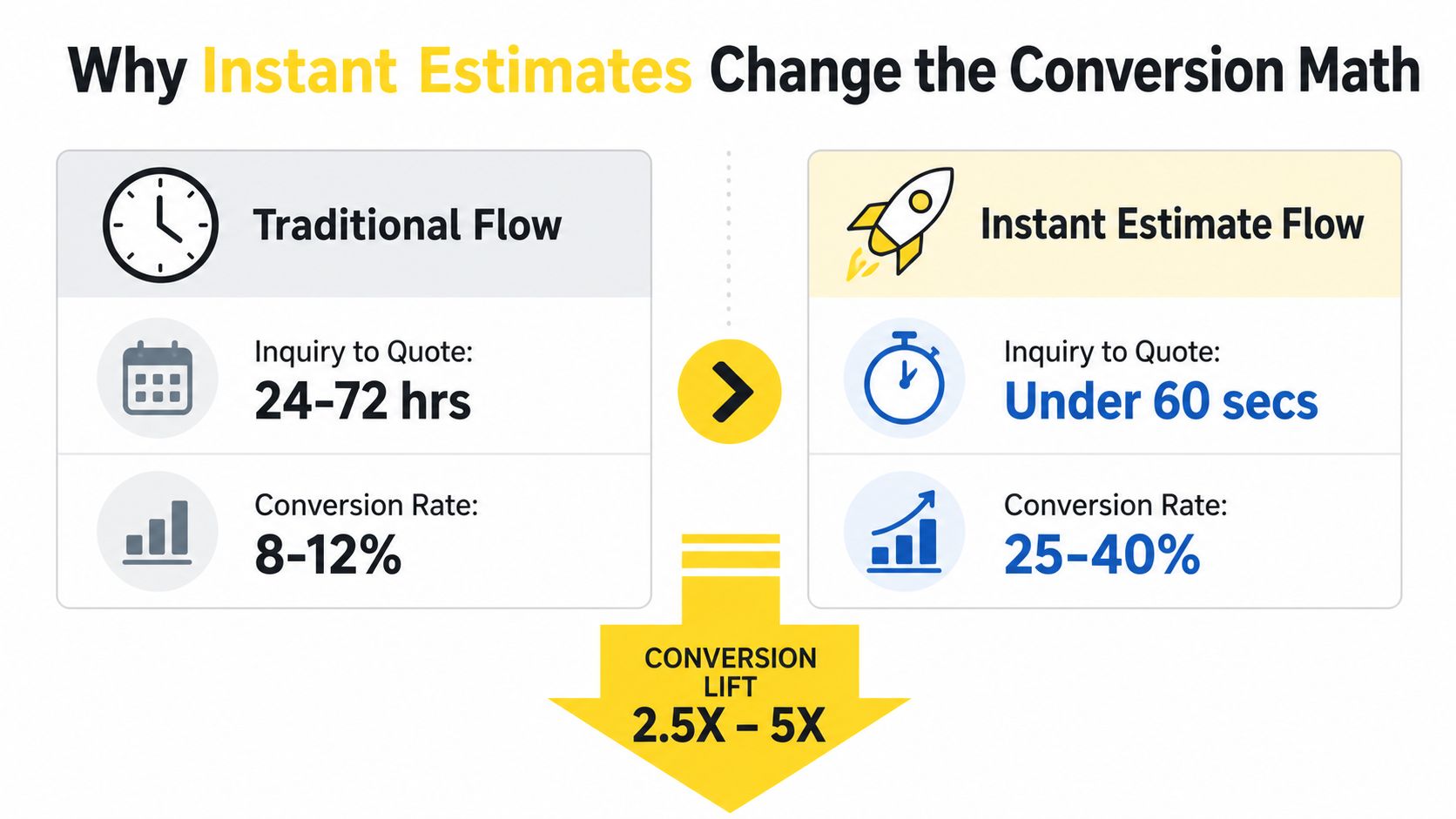
The highest improvement for many cleaning businesses is shortening the distance between inquiry and price. Once a prospect submits a form or calls, silence creates room for comparison shopping, distraction, and doubt.
The practical advantage of an instant AI estimator isn't that it understands a homeowner better than an experienced cleaner. It answers while the prospect is still actively solving a problem. It can ask for property details, apply the business's pricing rules, provide a range, and send the result by SMS or email without waiting for an employee to finish another task.
The response-time evidence is stark. The Sales Cadia benchmark reports that responding within one minute can raise conversions by 391% versus waiting five minutes, and it describes a steep decline after five minutes, with lead quality falling by 80% and conversion at 30 minutes dropping to roughly 17% of peak potential. Those figures appear in its speed-to-lead benchmark, so the relevant operating target is immediate acknowledgment and a human or automated response under five minutes.
A range often communicates honesty better than a falsely precise fixed number. A cleaning business can show the assumptions behind the estimate, identify common add-ons, and explain when a final amount may change after reviewing access, condition, or scope.
The number must still feel actionable. “Prices vary” gives the prospect no reason to continue. A defined estimate range, a short explanation, and a booking option create a usable decision path.
For teams comparing systems, the instant-estimates case study offers a product-specific example to review, but the principle applies beyond any one platform. The workflow must connect pricing, notifications, follow-up, and booking. A fast estimate that disappears into a disconnected inbox only moves the delay to another stage.
A strong after-hours workflow doesn't pretend that automation replaces a relationship. It keeps the conversation alive until a person can help.
Consider a representative scenario. A homeowner submits a request at 9:47 PM after putting the children to bed. An AI estimator delivers an estimate to her inbox in 38 seconds. At 9:48, she receives an SMS confirmation with the estimate and a simple reply option. At 8:15 AM the next morning, the system sends a reminder. At 11:30 AM, after no response, it sends a booking link and offers help with questions. She books at 12:14 PM without speaking to a human.
The details of that scenario illustrate the sequence more clearly than a generic “follow up more” instruction:
The common failure is a single email that says someone will be in touch, followed by silence. That message transfers the work to the prospect and assumes they'll remember to chase the business.
The after-hours answering service guidance for small businesses is useful because it frames coverage as continuity, not call handling. Your automation should capture the request, preserve the details, notify the team, and give the prospect a clear route to booking when the office is closed.
Speed earns attention, but trust earns the booking. Cleaning customers are inviting a crew into a private space, so the page and estimate should reduce the risks they're already considering.
Place proof close to the decision point rather than hiding it on a separate testimonials page. Use recent reviews, real before-and-after photos, license and insurance information where applicable, a re-clean or satisfaction policy, and crew bios that show who will perform the work. Each signal should answer a concern, not decorate the page.
| Trust Element | Where to Place It | Why It Converts |
|---|---|---|
| Recent customer reviews | Near the estimate action | Shows that comparable customers had a satisfactory experience |
| License and insurance details | Estimate page and footer | Reduces concern about responsibility and professionalism |
| Real before-and-after photos | Beside relevant services | Makes the promised outcome concrete |
| Re-clean guarantee | Near pricing and booking | Lowers perceived risk if expectations aren't met |
| Crew bios | Service or booking page | Humanizes the team entering the property |
Pricing clarity performs the same trust-building role. Starting prices or ranges filter out visitors who were never a fit and help serious prospects decide whether to continue. Don't hide every variable, but don't force someone to submit a long form just to discover that the service is outside their budget.
Qualification questions should improve both accuracy and confidence. Ask about square footage, pets, the last professional clean, access, surfaces, and urgency when those details influence the work. The strongest single qualifying question for many estimate flows is the phone number, because it creates a direct path for clarification and booking. It should be requested clearly, not disguised as an unrelated field.
A practical cleaning service price list can help owners organize starting prices, service categories, and add-ons before those rules are placed into an estimator. The purpose isn't to publish every exception. It's to make the initial decision easier while preserving room for a final review.
Conversion work becomes reliable when the owner treats it like a weekly operating process. Track the full chain, not a single website metric:
Read the numbers together. If inquiries rise but estimates stay flat, the response system is failing. If estimates rise but bookings remain flat, inspect price presentation, trust signals, service fit, and follow-up. If bookings improve while response time worsens, check whether a small group of fast responders is masking a wider queue problem.
Reserve 30 minutes at the start of the week. Use the same order every time:
A small cleaning operation doesn't need a complicated analytics department. Jobber, Housecall Pro, or a spreadsheet can track lead ID, source, service type, inquiry time, estimate time, response channel, booking time, assigned employee, and final status. Keep the definitions consistent so the owner compares the same stages each week.
One useful test is follow-up messaging with different coupon codes. The codes show which message brings more leads back into the conversation, provided the business records the code alongside the booking and doesn't change several other variables at the same time. The lesson is practical: test one meaningful change, preserve the record, and use the result to improve the next version.
For paid traffic, this guide to conversion optimization for Google Ads can help connect ad intent with landing-page action. But the final dashboard still needs to reach booked jobs. Clicks and form starts matter only when the operation responds, estimates, follows up, and closes the work.
Monday standard: Every inquiry should have a timestamp, an owner, a response status, an estimate status, and a booking outcome.
Conversion optimization isn't a quarterly redesign. It's operational hygiene. Owners who review response speed, estimate delivery, follow-up, and bookings every week can find the quiet leaks before they become normal.
Estimatty provides an AI-powered web and voice estimator for cleaning businesses, delivering consistent estimates by SMS and email while capturing details and notifying the team. Visit Estimatty to see how an always-on estimate and follow-up workflow can help you respond faster and turn more inquiries into booked cleaning jobs.