
October 16, 2026
Journeyman Electrician License Requirements Explained
Understand journeyman electrician license requirements, training hours, and reciprocity rules. Learn how jurisdiction impacts scope and hiring decisions.

Saturday, October 17, 2026
Eight house cleaner quotes examples and templates, from flat-rate SMS estimates to add-on line items, that cut callbacks and lift average job value.

A homeowner texts at night: “How much to clean a three-bedroom house?” If you reply with one number and no scope, you've left room for two different ideas of what the job includes. The customer may expect the oven and interior windows; your crew may arrive expecting a routine clean. That mismatch can cost you the booking, trigger an argument at the door, or leave the job unprofitable.
Vague pricing costs jobs before the crew arrives. Strong house cleaner estimates connect the price to the work, make assumptions visible, and give the customer a clear next step. Below are eight estimate formats with practical wording for SMS, email, and on-site conversations, plus the line items that help prevent disputes and offer relevant add-ons without a hard sell.
There isn't one format that fits every home. A flat-rate estimate can make a routine visit easy to book, while a condition-based estimate can protect your crew from underpricing a home that needs extra work. Use the format that matches the job, then state exactly what's included, what's extra, and what could change the final price.
A flat rate works well when the home and service are predictable. A prospect with a three-bedroom, two-bathroom home can see one price for a routine visit instead of trying to calculate labor hours. It also gives your team a consistent starting point across phone, email, and web inquiries.
Define the base clean before publishing a starting price. A practical scope might include dusting reachable surfaces, vacuuming and mopping floors, cleaning kitchen counters and sinks, sanitizing bathrooms, and removing household trash. Name exclusions such as interior appliances, inside cabinets, laundry, or heavy buildup. A customer shouldn't have to guess whether “standard clean” includes a task that materially changes the time on site.
SMS: “Your standard clean estimate is [price] for your three-bedroom, two-bathroom home. It includes dusting, floors, kitchen surfaces, bathroom cleaning, and trash removal. Oven interiors, fridge interiors, and heavy buildup aren't included. Reply BOOK to choose a time.”
Email: “The estimated total is [price] for the scope listed below. The price assumes the home is in maintained condition and covers the standard tasks shown. We'll confirm any requested extras before scheduling.”
On site, say: “This price covers the routine clean we discussed. If you'd like the oven interior or another extra, I'll add it separately before we start.”
Review the rate against actual labor hours and operating costs periodically. A published starter price can attract first-time customers, but only if it reflects the work your crew can reliably complete.
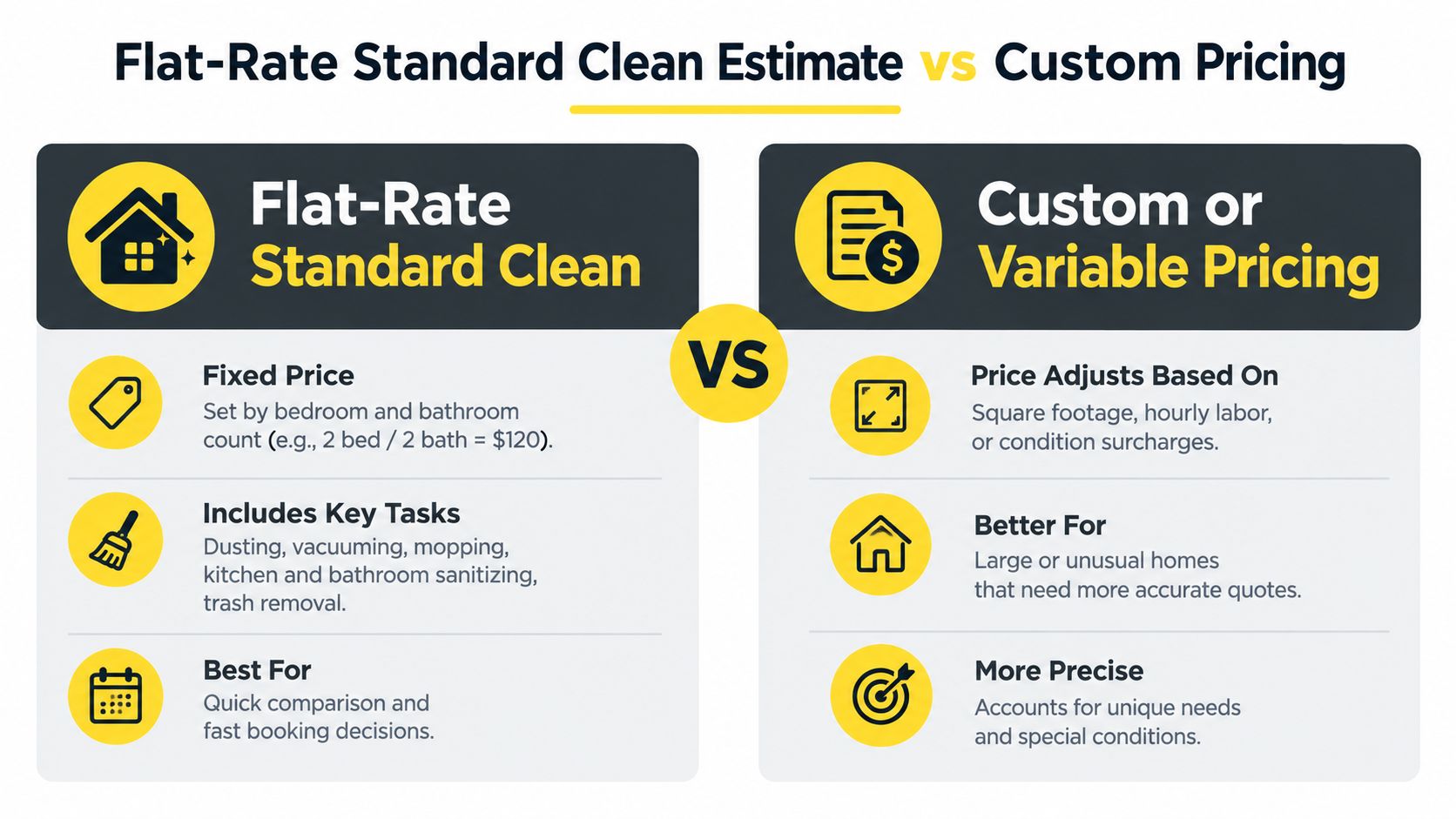
Square footage can be a useful anchor when homes vary widely in size. It helps distinguish a compact apartment from a larger home with the same bedroom count, but it doesn't tell you everything. Layout, bathrooms, condition, and requested tasks still affect the labor required.
Ask for the home's approximate size early, then confirm whether the figure includes finished areas that need cleaning. Set a minimum charge so a small property still covers travel, setup, and the time required to complete the service. If you use tiers, explain which tier applies and what could change the estimate.
SMS: “Thanks. Based on approximately [square footage] square feet, your estimated standard clean is [price]. This assumes a maintained home and includes [scope]. Please tell us if the size excludes a finished area or if you'd like any add-ons.”
Email: “We've estimated your service using the home's approximate living area. The estimate includes [tasks] and excludes [tasks]. If the property's layout or condition differs from the details provided, we'll review the scope with you before confirming.”
For an irregular home, don't rely on the square-foot number alone. A large open-plan space may take less time than a smaller home with several bathrooms and cluttered surfaces. Use the size as a starting input, then ask a brief follow-up about the areas that drive labor.
On site, explain the line items plainly: “The home size sets the base estimate. The additional bathroom and the requested interior glass are separate because they add work beyond the standard scope.”
For setup ideas, see the square-footage pricing guide on Estimatty's blog. The same principle applies to adjacent property services, including exterior house washing for Ventura homes: explain the measured area and scope rather than presenting a number without context.
Hourly estimates suit work with uncertain scope, such as a first visit in a home that needs a reset. They can also work when the customer wants to choose priorities as the team moves through the property. The trade-off is that the final cost depends on how long the crew takes, so unclear minimums or crew size can undermine trust.
Show the hourly rate, number of cleaners, minimum booking, and what the clock covers. State whether travel, supplies, and setup are included. A two-person crew working for three hours is not the same billing basis as one cleaner working for three hours, so spell out the unit rather than saying only “hourly.”
SMS: “We estimate a two-person crew at [rate] per crew-hour, with a [minimum] minimum. The estimate includes [supplies/travel details]. We'll confirm any change in scope with you before continuing.”
Email: “Your estimate uses a two-person team and an expected service window of [time range]. You'll be charged for the hours worked, subject to the stated minimum. The estimate assumes [scope and condition]; requested work beyond that scope will be discussed first.”
Operator's rule: Track time by home type and service, not just by crew. Otherwise, an estimate can look accurate on paper while missing the labor pattern that makes the job profitable.
A small team might use hourly pricing for a first deep clean, then offer a fixed recurring rate once it understands the home. Explain that transition before the first appointment so the customer knows why a later estimate may use a different format.
For a customer-facing explanation of hourly pricing, link to how much housekeepers charge. If volume grows and staffing becomes the constraint, pipehirehrm.com offers resources on hiring cleaning employees. Keep worker classification and payroll obligations in view when building labor assumptions, rather than treating the payment method as a substitute for understanding the working relationship.
A deep clean needs a clearer scope than a standard visit because customers may use “deep clean” to mean different things. Your estimate should name the detail work included, then price optional extras separately. That structure helps customers see what the base service covers and prevents an add-on from appearing as a surprise when the crew arrives.
List the agreed tasks in plain language. Depending on your service, that might include baseboards, cabinet fronts, light fixtures, or grout detail. Inside the oven, inside the refrigerator, and interior windows can remain separate line items if they aren't part of the base package.
SMS: “Your deep-clean estimate is [price]. It includes [agreed detail tasks]. You also asked for the oven interior at [price] and interior windows at [price], bringing the estimated total to [total]. Reply CONFIRM to approve the listed scope.”
Email: “Below is your itemized estimate: deep-clean service, [price]; oven interior, [price]; interior windows, [price]. The total is [total], based on the home details provided. We'll confirm any changes before adding work.”
A first-time deep clean can also give the company a sensible route into recurring service. Offer the follow-up plan after explaining the reset work, not as a condition for receiving a clear estimate. Keep the add-on menu focused on tasks customers request and show each price beside the task.
For examples of how providers present this service, see Estimatty's deep-cleaning price list.
The key is to separate the base service, optional tasks, and assumptions. That makes it easier for the customer to remove an extra, approve it, or ask what the team will do instead.
Move-related cleaning often comes with a deadline and an empty or nearly empty home. Don't estimate it as a routine visit with a different label. Ask about the move date, whether furniture remains, and whether the customer has a landlord, buyer, or property-manager checklist.
The line items should name the areas that drive the work: cabinets and closets, appliance interiors, walls, and any other requested tasks. Make clear whether those items are included in the package or priced separately. A customer asking for a deposit-ready clean may have a different scope in mind from someone who wants the home ready for new occupants.
SMS: “Your move-out estimate is [price] for the scope listed: [included tasks]. Your requested [add-on] is [price]. What date must the home be ready? Send any checklist so we can confirm the estimate matches the handover requirements.”
Email: “This estimate assumes the home will be [empty/nearly empty] when our crew arrives. It includes [scope] and excludes [items]. Please share the move-out date and any written checklist before confirming the appointment.”
If you offer a re-clean guarantee, make sure the crew has a documented checklist and the policy explains what qualifies. A promise that isn't tied to a defined scope can create more disputes than it resolves. Publish the checklist customers can expect your team to follow, and tell them how to flag an issue after service.
When the booking arrives after hours, capture the deadline and property details before sending the estimate. A fast response helps, but speed doesn't replace scope. The move-out house-cleaning cost calculator can help frame the estimate, while a customer may also be comparing a Clean Space SA move-out service.
Recurring estimates should make the per-visit price and schedule easy to compare. Show the customer the selected frequency, what each visit includes, and the applicable price. A discount can encourage a regular schedule, but it should reflect the reduced work your team expects from maintaining the home, not be an arbitrary cut that erodes the margin.
Avoid presenting a discounted price without explaining the starting scope. If a first visit needs a deeper reset before routine maintenance, state that separately. Then show what the recurring service covers once the home is on a regular schedule.
SMS: “Your [weekly/biweekly/monthly] service estimate is [price] per visit for [scope]. The first visit is estimated at [price] because it includes [initial work]. Reply with your preferred schedule and we'll confirm available times.”
Email: “Your recurring plan includes [tasks] at [price] per visit. The estimate assumes the home remains within the agreed condition and scope. Please review our rescheduling and cancellation terms before confirming.”
For a customer deciding between frequencies, explain the practical difference: more frequent visits can mean less buildup between appointments, while less frequent service may require more time per visit. Don't claim one schedule is always cheapest or best. The right choice depends on the household and what the customer expects the crew to maintain.
“A recurring discount only works if the next visit stays close to the scope you priced.”
Show the service frequency and any discount as separate lines, and state the policy for skipped visits or changing the schedule. For planning recurring pricing and hiring needs, see recurring service resources at Pipehire HRM.
Per-room pricing gives customers control when they don't need the whole home cleaned. It can fit a condo with a heavily used kitchen and bathrooms, or a townhome where the customer wants selected areas included. The risk is a long list of tiny charges that makes the estimate harder to understand than the job itself.
Group rooms into sensible categories, then state the included tasks for each. A customer might select a kitchen, two bathrooms, and a living room, with bedrooms left out. Add a minimum charge for small bookings so travel and setup don't disappear from the estimate.
SMS: “Your selected-room estimate is [price]: kitchen [price], two bathrooms [price], and living room [price]. It excludes bedrooms and other areas. Reply CHANGE if you'd like us to add or remove a room.”
Email: “The estimate reflects only the rooms you selected. Each room line includes [scope], and the total is [price]. Please check the list before booking so the crew arrives with the same plan you approved.”
On site, use the room list as the work order. If the customer asks for an extra area, agree on the price and update the estimate before the crew starts. That simple pause prevents the familiar dispute where a customer assumes an unlisted room is included.
For detail-work definitions, use a professional deep-cleaning checklist to align the room-level scope with what the team can deliver. If you add office areas inside a home, label them as separate spaces rather than hiding them under a broad “common areas” line.
A home's condition can change the labor even when its size and room count stay the same. Pet hair, heavy soil, clutter, or a long gap between visits may require extra time or supplies. Ask about these factors before estimating, and use neutral language. The point is to price the work accurately, not to judge how someone keeps their home.
Use simple condition categories with written definitions your team can apply consistently. A light-condition home may need routine maintenance; a heavy-condition home may need extra attention to buildup or surfaces beyond the base scope. Explain what each surcharge covers, and give the customer a chance to revise the scope.
SMS: “Your estimate includes a [light/moderate/heavy] condition adjustment of [price] for additional [pet hair/soil/detail work]. The rest of the estimate covers [base scope]. Let us know if you'd like to review the details before booking.”
Email: “We've included a condition line because the details provided indicate additional labor beyond a standard visit. The adjustment covers [specific work], not an unspecified fee. If the home's condition or requested scope differs, we'll confirm any change with you before service.”
Make the reason visible: “Pet-hair removal requires additional vacuuming and detail work, so it's listed separately.”
A household with dogs, for example, may need an added pet-hair line if hair is embedded in rugs or concentrated on upholstery. Don't assume every pet home needs a surcharge. Ask about the actual work and distinguish routine shedding from a job that requires extra attention.
For a broader view of the variables that influence estimates, see Estimatty's guide to house-cleaning costs. The arrival conversation should confirm the disclosed scope, not introduce a new fee without explanation.
| Estimate Type | Pricing Basis and Inputs | Complexity / Resource Needs | Expected Outcome / Key Advantage | Ideal Use Case |
|---|---|---|---|---|
| Flat-Rate Standard Clean | Fixed price based on bedrooms and bathrooms; defined routine-clean checklist | Low; requires consistent task scope and periodic rate reviews | Fast, easy-to-compare quotes and standardized pricing | Routine residential cleaning and recurring service entry plans |
| Square-Footage Based | Total living area, per-square-foot rate, and possibly a minimum charge | Low to moderate; needs accurate area and clear pricing tiers | Scales with home size and improves accuracy for larger homes | Large or open-plan homes and standardized pricing across properties |
| Hourly Rate with Crew Size | Hourly rate per cleaner, crew size, and minimum booking time | Moderate; requires labor tracking and reliable time estimates | Transparent labor pricing and flexibility for changing scopes | Unusual homes, one-time jobs, or work that is difficult to scope |
| Deep Clean with Itemized Add-Ons | Higher base rate plus individually priced detailed tasks | Moderate; requires defined inclusions and time estimates for add-ons | Clear cost breakdown and opportunities to increase job value | First-time or detailed cleaning, often before recurring service |
| Move-In / Move-Out | Price based on square footage, rooms, or package; may include a guarantee | Moderate to high; requires detailed checklists and deadline planning | High-value, thorough service with clearer turnover expectations | Empty homes, tenant turnover, and time-sensitive moves |
| Recurring Service Discount | Per-visit price based on weekly, biweekly, or monthly frequency | Moderate; requires reliable scheduling and margin planning | Encourages commitment and supports predictable repeat revenue | Customers seeking regular cleaning and businesses building a stable client base |
| Per-Room Itemized | Individual prices for selected rooms and common areas | Moderate; requires room-level pricing and detailed intake | Flexible scope and precise control over included areas | Partial cleaning, unusual layouts, condos, and targeted requests |
| Condition Surcharge | Base price plus disclosed charges for pet hair, heavy soil, clutter, or similar factors | Moderate; requires consistent condition definitions and customer questions | Accounts for extra labor and supplies while reducing arrival-day disputes | Homes with pets, heavy buildup, clutter, or long gaps between cleanings |
Start with the job your team handles most often. Write its estimate wording, inclusions, exclusions, and optional line items into a template. Then use that version on your next inquiries and record where customers ask for clarification or where the crew finds the scope was incomplete.
Keep the language consistent across SMS, email, and phone. A text can be short, but it should still identify the service, total, key inclusions, and any important exclusion. An email can show the line items in more detail. On site, the cleaner or supervisor should be able to explain the same scope without inventing a new interpretation.
Use actual job experience to refine the template. If a common home type regularly takes longer than your estimate allows, review the assumptions behind the price. If customers repeatedly ask whether a specific task is included, name it in the estimate. Comparing service scope matters in adjacent categories too, such as this window-cleaning price comparison.
A useful estimating system should also preserve the details that produced the price. Capture home size, rooms, condition, service type, frequency, requested extras, and timing. When a prospect changes an answer, update the estimate rather than relying on a note that may not reach the crew.
Make the first version simple enough that staff will use it. A template with too many choices slows the conversation and makes the customer do the pricing work. A short, relevant set of options can provide clarity while leaving unusual jobs for human review.
Once the first format is holding up, add another for a different common job, such as deep cleans or move-outs. Estimatty can send estimates by SMS and email and capture the home details that inform them, helping teams respond when an inquiry arrives outside business hours. Whether you use an automated tool or a shared template, keep the same rule: show what the customer is paying for before the crew arrives.
Estimatty helps cleaning businesses collect home details, build consistent estimates, and send them by SMS and email. Set up an estimate format around your services and visit Estimatty to see whether it fits your quoting workflow.