October 13, 2026
Squeaky Clean Window Cleaning: The Pro Technique
Master squeaky clean window cleaning with this step-by-step guide. Learn the tools, techniques, and safety tips pros use for streak-free windows every time.

Wednesday, October 14, 2026
Discover average commercial cleaning rates by facility type and size. Learn pricing models, hidden cost drivers, and how to quote with Estimatty in minutes.

A prospect calls about a 10,000-square-foot office. You know the local market, you've cleaned similar buildings, and the temptation is strong to multiply the area by a familiar rate and send an estimate before the next call arrives. The problem appears later, when the building has several restrooms, dense furniture, difficult access, and a neglected floor that takes far longer than expected. The account may look large on paper while steadily eroding the margin from every visit.
That is why average commercial cleaning rates should be treated as benchmarks, not promises. A sustainable estimate translates square footage, facility type, labor productivity, frequency, and service conditions into a price that accounts for the actual work.
A national benchmark places routine office cleaning at approximately $0.08–$0.18 per square foot per visit. In higher-cost markets such as New York, San Francisco, and Boston, the range can reach roughly $0.12–$0.22 per square foot. For a 10,000-square-foot office, that implies approximately $800–$1,800 per service before adjustments for frequency, access difficulty, supplies, or specialty requirements, according to current commercial cleaning industry benchmarks.
Use that range to frame a quote, not to produce one automatically. An open office with light occupancy, few restrooms, and easy evening access will require less labor than a segmented workplace with private rooms, heavy soil, multiple kitchens, and security procedures.
Square footage measures floor area. It does not measure fixtures, waste points, sinks, partitions, floor transitions, or touchpoints. Those work units determine the labor required for each visit.
Before setting a price, record:
A practical estimator can enter these variables into a tool such as Estimatty, then compare the resulting labor requirement with the market range. That process turns a static rate into a price band tied to the building's actual workload.
Practical rule: Use the market range to test whether an estimate is plausible, then use production hours to decide whether it's profitable.
Published pricing guidance also places standard commercial service broadly at $0.10–$0.20 per square foot, while one-time deep cleaning may reach $0.10–$0.30, depending on scope and condition. Treat both ranges as reference points, then adjust for restrooms, soil load, occupancy, access, and the work required to restore neglected areas.
The owner who wins long-term is not always the one presenting the lowest number. It is the owner who explains what the estimate includes, identifies conditions that could change it, and protects the contract from work that was never priced.
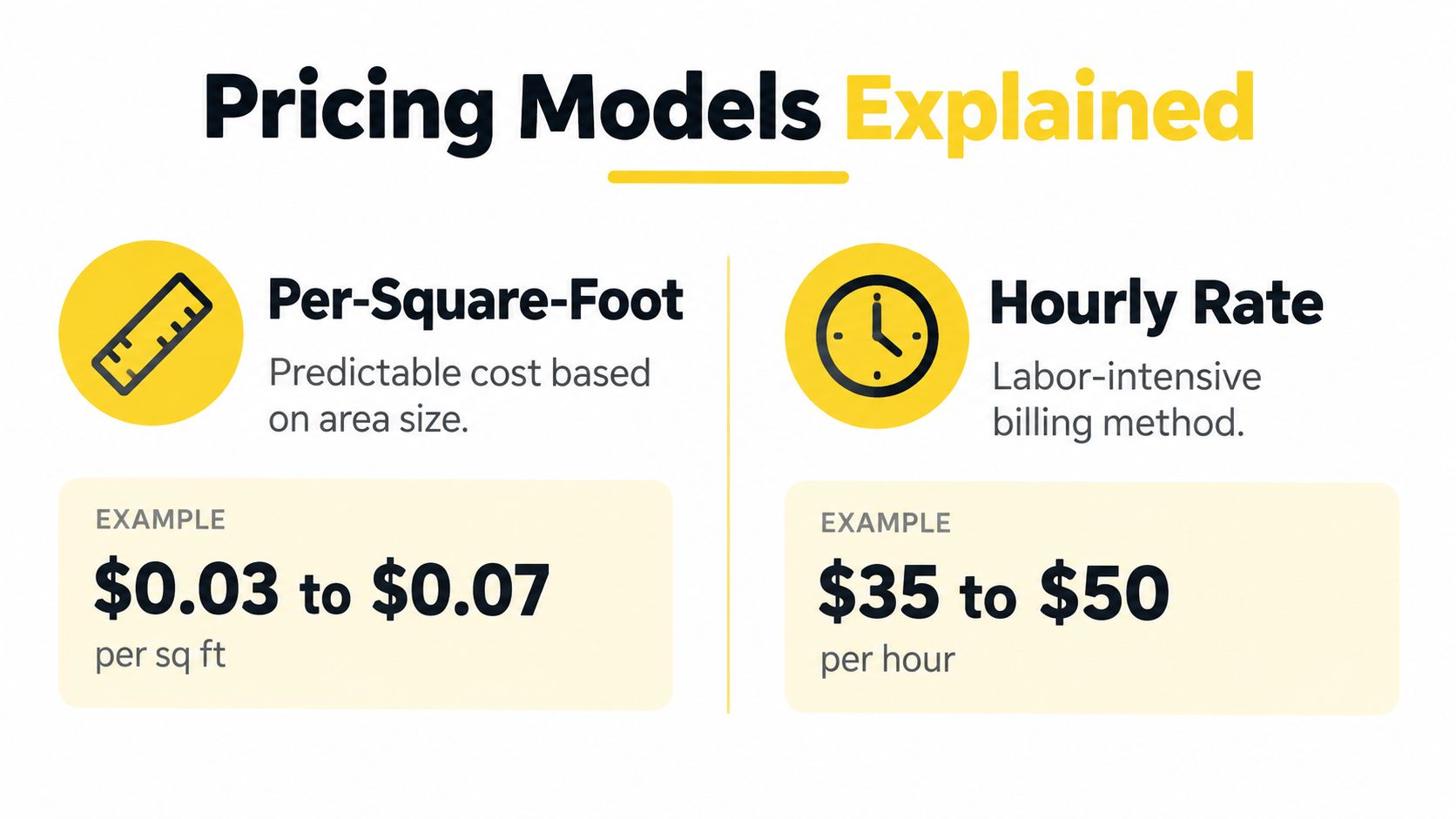
Per-square-foot pricing is easy to communicate. A prospect provides the building area, the estimator applies a rate, and both sides get a number that appears objective. That simplicity works for recurring facilities with a stable scope, but it can hide the most important question: how many labor hours will the building require?
Hourly pricing exposes that question immediately. If a team expects a visit to take a certain number of labor hours, the estimate can start with a fully burdened labor rate and then add supplies, overhead, and margin. The trade-off is that the customer may see a variable bill, while the provider carries more responsibility for documenting time and controlling production.
| Model | Works well for | Main risk |
|---|---|---|
| Per square foot | Recurring work with a defined scope and predictable conditions | Underpricing complex layouts or high-touch facilities |
| Labor hour | Deep cleaning, emergency work, restoration, and uncertain conditions | Cost variability and weaker budget predictability |
| Fixed recurring amount | Established contracts with measured production time | Margin erosion when scope expands without repricing |
The strongest approach often combines them. Use square footage to establish a market band, calculate labor from productivity, and present a recurring fixed amount once the scope is clear. Use hourly or time-and-materials pricing when the starting condition is unknown, such as a neglected facility or a one-time restoration.
Productivity data shows why area alone isn't enough. An ISSA 612-derived productivity benchmark places office production around 3,500–4,500 square feet per labor hour, while medical facilities fall to approximately 1,500–2,500 square feet per labor hour. A 15,000-square-foot office therefore requires approximately 3.3–4.3 labor hours per clean, while the same area in a medical facility could require approximately 6–10 labor hours.
That difference changes the economics of the job even when the floor area is identical. Disinfection protocols, high-touch surfaces, personal protective equipment, dwell times, and documentation reduce attainable production in medical environments.
For a deeper calculation framework, use this guide to commercial cleaning cost per square foot, but don't stop at the area. Add the labor-hour check before finalizing the estimate.
A 10,000-square-foot building can produce two very different quotes. Restroom count, fixture density, surface condition, occupancy, and travel between work areas often matter more than the floor area itself. Treating every facility as a rectangle is one of the fastest ways to underquote.
Facility type helps establish the starting risk, but it should not determine the final rate by itself. Medical offices may require infection-control procedures and high-touch disinfection. Retail sites can bring heavier public traffic, visible entryway soil, and frequent touchpoints. Industrial facilities may have large footprints while adding equipment, difficult access, or specialized soil removal.
Restroom density directly affects labor. Two buildings with the same square footage can require different visit times when one has more toilets, sinks, partitions, dispensers, and replenishment points. Count these work units during the walkthrough instead of relying on area alone.
Floor surfaces change both the task sequence and equipment requirements. Carpet may require vacuuming and periodic extraction. Resilient flooring can require machine work, edge attention, or finish maintenance. Strip-and-wax work should be priced separately from routine cleaning because it involves preparation, multiple treatment stages, drying time, and equipment.
Occupancy and soil load indicate how quickly a maintained space becomes a recovery job. Frequent visitors, food service, and heavy traffic can increase soil, waste, and touchpoint work compared with a similar office used by fewer people.
Frequency also changes the production assumption. Recurring service maintains acceptable conditions. Infrequent visits often require more restoration around restrooms, entrances, floors, and neglected edges.
A reliable walkthrough records more than cleanable square footage. Capture restroom count, fixture density, floor types, trash points, occupancy patterns, access restrictions, supply responsibilities, and specialty tasks. These details let you convert facility conditions into a realistic labor-hour range rather than copying a generic square-foot rate.
A 6,000-square-foot medical suite with four restrooms can require more labor hours than a 12,000-square-foot open office. The smaller site has less area, but denser fixtures, tighter procedures, and more frequent touchpoints can drive the visit.
Local labor markets affect the margin as well. A provider paying more to recruit and retain cleaners cannot safely copy a rate from a lower-cost market without checking production, wages, and burden. Use this cleaning service cost framework to connect those operating inputs instead of treating a generic average as the answer.
Supplies and equipment belong in the same calculation. Medical work may require additional consumables and controlled procedures. Floor treatments may require machines and setup time. Difficult access can turn a short cleaning assignment into a longer paid shift because transport, security, and setup reduce productive minutes.
Build the proposal around a recurring base scope, clearly priced add-ons, and a repricing condition. If the client adds restrooms, expands occupied areas, reduces service frequency, or introduces specialized requirements, the original production assumption no longer applies. Recalculate the work units before accepting the change.
A 10,000-square-foot office can look profitable until the quote ignores restrooms, traffic, and service frequency. Facility type provides a better starting point than square footage alone, because medical sites, offices, factories, retailers, and schools place different demands on production.
The table shows monthly cost divided by cleanable square footage. It does not automatically represent the price of one visit. Apply the requested frequency, occupancy, local labor conditions, and included tasks before presenting an estimate.
| Facility Type | Rate per Sq Ft (Monthly) |
|---|---|
| General offices | $0.09–$0.17 |
| Medical and healthcare facilities | $0.14–$0.29 |
| Industrial or manufacturing sites | $0.08–$0.20 |
| Retail spaces | $0.07–$0.15 |
| Schools | $0.07–$0.14 |
These U.S. reference bands come from ISSA's commercial cleaning rate guidance. Use them to test an estimate, not to copy a monthly figure into every proposal. A rate band becomes useful only after you translate it into the client's schedule and scope.
A general office near the lower end may have open areas, moderate occupancy, few restrooms, and a consistent recurring schedule. The upper end may fit a site with more rooms, heavier traffic, additional touchpoints, or a narrow service window.
Healthcare facilities sit higher because cleaners may need stricter disinfection procedures, protective equipment, dwell-time controls, high-touch surface work, and completion records. Those requirements reduce productive output and can change the labor hours behind the quote.
Apply the table to a real estimate. A 10,000-square-foot office at $0.09–$0.17 per cleanable square foot monthly produces approximately $900–$1,700 in monthly service before adjustments for frequency, specialty work, supplies, or taxes. This is a diagnostic band, not a recommended final price. Compare it with the labor hours required by the actual scope.
Estimate before you average: If labor, burden, supplies, and overhead fall outside the benchmark band, review the scope and production assumptions before cutting the price.
For healthcare operators, this medical office cleaning rates guide helps organize the variables that make the category different. Name the included tasks and frequency in the proposal so the monthly number does not conceal the assumptions behind it.
A cleaner's wage is not your billable labor rate. Confusing the two is one of the quickest ways to accept contracts that look busy but lose money.
The Bureau of Labor Statistics reports a median hourly wage of $17.71 for janitors and building cleaners in May 2025. A customer-facing estimate must recover more than that wage because the operating rate also covers payroll-related costs, supervision, supplies, insurance, transportation, equipment, and business overhead, as explained by the Bureau of Labor Statistics occupation data.
Start with the wage your business pays for the role. Then add the employer costs attached to having that person available and deployable. Include payroll taxes, workers' compensation, paid leave, insurance, supervision, training, equipment, transportation, administration, and other nonproductive time.
The resulting figure is your fully loaded labor rate. It represents what one productive labor hour costs the company before profit. Your customer-facing rate must then recover operating overhead and provide an acceptable margin.
Regional variation makes a copied national number unreliable. Published hourly estimates in the provided pricing framework range from approximately $21–$45 in Boise to $50–$75 in Los Angeles, as discussed in this commercial cleaning pricing guide. Those figures illustrate why local wages and operating conditions belong in the calculation.
For owners comparing labor markets beyond the United States, LATAM salary benchmarks offer useful context for administrative, support, or remote operations roles. They shouldn't replace a local field-labor calculation, but they can help when evaluating distributed scheduling, customer support, or back-office hiring.
Here is the practical sequence:
A labor cost per hour calculation guide can help organize the arithmetic. The important discipline is to avoid treating the wage as the cost base.
A short visual explanation can make this distinction easier for new estimators:
The model also needs a change mechanism. Review contracts when occupancy, access, scope, supply responsibility, or cleaning frequency changes. Annual escalation language, minimum visit charges, emergency surcharges, and defined repricing triggers protect the estimate from conditions that invalidate the original labor assumption.
Manual estimating fails in predictable ways. A prospect reaches voicemail after business hours, waits for a callback, receives a number based on incomplete details, and compares it with a competitor who responded immediately. Your team may spend time chasing information that should have been captured during the first interaction.
The operational problem isn't only speed. It's inconsistency. One estimator remembers to ask about restrooms and floor surfaces, while another asks only for square footage. One includes consumables, while another assumes the customer will provide them. The business then sells similar work at different margins.
A reliable estimating system should collect the details that drive production:
AI-powered tools can apply those rules consistently while a prospect is still engaged. Estimatty is one option built for residential and commercial cleaning businesses. Its web and voice estimator captures details such as square footage, surfaces, and urgency, then sends estimates by SMS and email while notifying the team.
The system doesn't remove the need for operational judgment. Owners still need to validate production assumptions, inspect unusual facilities, and define what the estimate includes. Automation handles the repeatable intake and pricing logic so the team can spend more time on qualified opportunities and less time reconstructing basic facts from calls and emails.
A tool such as the commercial cleaning estimate calculator becomes valuable when its rules reflect your actual costs. Configure facility categories, productivity assumptions, add-ons, minimums, and escalation conditions. Then review completed jobs against estimated labor hours and update the rules when the field data shows a persistent gap.
The growth benefit comes from control. Faster responses reduce avoidable delays, standardized inputs reduce pricing variance, and clearer scope reduces disputes after service begins. The objective isn't to produce a number that looks attractive. It's to produce an estimate your crews can deliver profitably and your customer can understand.
Estimatty helps cleaning businesses collect facility details, apply customizable pricing rules, and send consistent web or voice estimates by SMS and email, including outside normal office hours. Visit Estimatty to see how a structured estimating workflow can help you stop underquoting commercial work and build more sustainable margins.