
October 11, 2026
Cleaning Contracts for Small Business: 2026 Guide
Discover essential cleaning contracts for small business owners. Learn key clauses, avoid common pitfalls, and secure reliable service agreements in 2026.

Monday, October 12, 2026
Learn how cleaning office prices really work in 2026. Compare per square foot, hourly, and monthly models, plus tips to estimate and present winning quotes.

Typical U.S. office-cleaning prices run roughly $0.05 to $0.20 per square foot per visit, $35 to $75 per labor hour, or $715 to $2,800 per month on contract. Those numbers are useful benchmarks, but they don't explain what a client is paying for, or why two estimates for the same office can differ by hundreds of dollars.
A property manager may call three cleaning companies about a 6,000-square-foot office and receive three very different estimates. That gap usually isn't a scam or a mystery. It reflects different assumptions about labor hours, restrooms, frequency, access, floor care, and what the provider left out.
The winning operator doesn't defend a number with vague language. They show how the number was built.
A prospect calls about a 6,000-square-foot office and receives three monthly estimates. One is low, one is high, and yours sits between them. If each proposal shows only a total, the prospect can compare price but cannot compare the labor, scope, or assumptions behind it.
That is how profitable bids get rejected, while underpriced contracts get accepted. The winning estimate makes production time visible and gives the client a reason for every line.
Office cleaning is commonly priced through three structures:
Market benchmarks place routine office cleaning at approximately $0.05 to $0.15 per square foot per visit, hourly janitorial pricing at $35 to $75, and monthly commercial-cleaning contracts at roughly $715 to $2,800, according to commercial cleaning rate statistics.
Per-square-foot pricing suits recurring offices with a stable layout. It gives buyers a fast comparison, but the proposal must connect the rate to production hours and a defined scope.
Hourly pricing fits one-time projects, uncertain conditions, and small offices where each visit may differ. The trade-off is predictability. Clients may worry that inefficient work will increase the invoice, so state the expected hours and the conditions that could change them.
A monthly contract supports steady budgeting and recurring revenue. It also exposes the cleaner to scope creep. Added restrooms, higher occupancy, interior glass, or carpet work can erase margin when the contract does not address them.
Operator's rule: Never present a monthly number without stating the cleanable area, visit schedule, included tasks, exclusions, and conditions that trigger a change.
Your estimate should show those assumptions before the prospect compares totals. Use a production-hours line, then connect labor, travel, supplies, overhead, and profit to the selling price. For broader guidance on building profitable service pricing, see this practical guide to pricing plumbing jobs for profit. Cleaning and plumbing differ operationally, but both businesses lose money when the work behind the price stays hidden.
Each pricing model uses a different billing unit. The estimate still has one job: show how much labor, overhead, and profit the site requires.
For a standard office, a practical U.S. benchmark is $0.08 to $0.15 per square foot per visit. A 10,000-square-foot office serviced five times weekly works out to approximately $1,700 to $3,200 per month, based on commercial cleaning cost-per-square-foot benchmarks.
Area starts the calculation, but it does not finish it. Frequency and scope determine the production hours behind the rate. A 10,000-square-foot office is not equivalent to a warehouse or clinic. Restrooms, kitchens, private rooms, stairs, glass, and floor condition can all increase labor time.
Hourly pricing starts with expected labor time. If a site requires 20 labor-hours per week, direct wages at the 2025 national median of $17.71 per hour equal approximately $354.20 weekly, before benefits, payroll taxes, insurance, equipment, supplies, supervision, travel, administration, and profit. The wage and occupation data come from the Bureau of Labor Statistics janitors and building cleaners profile.
That direct wage is a cost floor, not a selling price. Billing close to employee pay leaves no room for training, supervision, replacement equipment, or service recovery. State the expected hours and define what could increase them, especially for one-time work or changing sites.
A per-visit price gives the buyer a fixed invoice for a defined task list. It works when the scope stays stable and the client values predictable billing. A monthly flat fee follows the same logic across a recurring schedule, but the contract must identify included work and exclusions.
Scope drift destroys this model. “Clean the office” can expand to interior glass, appliance cleaning, supply restocking, carpet extraction, and high-dusting. Put those tasks in the estimate, with a separate charge or clear exclusion.
| Pricing Model | Unit of Measure | Best Fit Scenario | Hidden Risk | Worked Example |
|---|---|---|---|---|
| Per square foot | Area per visit | Stable recurring offices | Scope gets treated as interchangeable floor area | 10,000 square feet multiplied by a per-visit benchmark |
| Per labor hour | Labor time | Variable or one-time work | Slow production increases invoice uncertainty | 20 labor-hours weekly plus fully loaded costs |
| Per visit or monthly | Fixed service amount | Predictable recurring schedules | Unlisted tasks become “included” | One monthly amount for a defined task list |
For broader service-pricing guidance, see pricing plumbing jobs for profit. Cleaning and plumbing differ operationally, but both businesses lose margin when the labor behind a price stays hidden. The commercial cleaning pricing guide offers a practical reference for organizing the calculation. Choose the model that makes assumptions easiest to inspect, not the one with the prettiest headline rate.
A square-foot number doesn't move by itself. Five inputs determine whether an office sits near the low end of a benchmark or requires a much higher estimate.
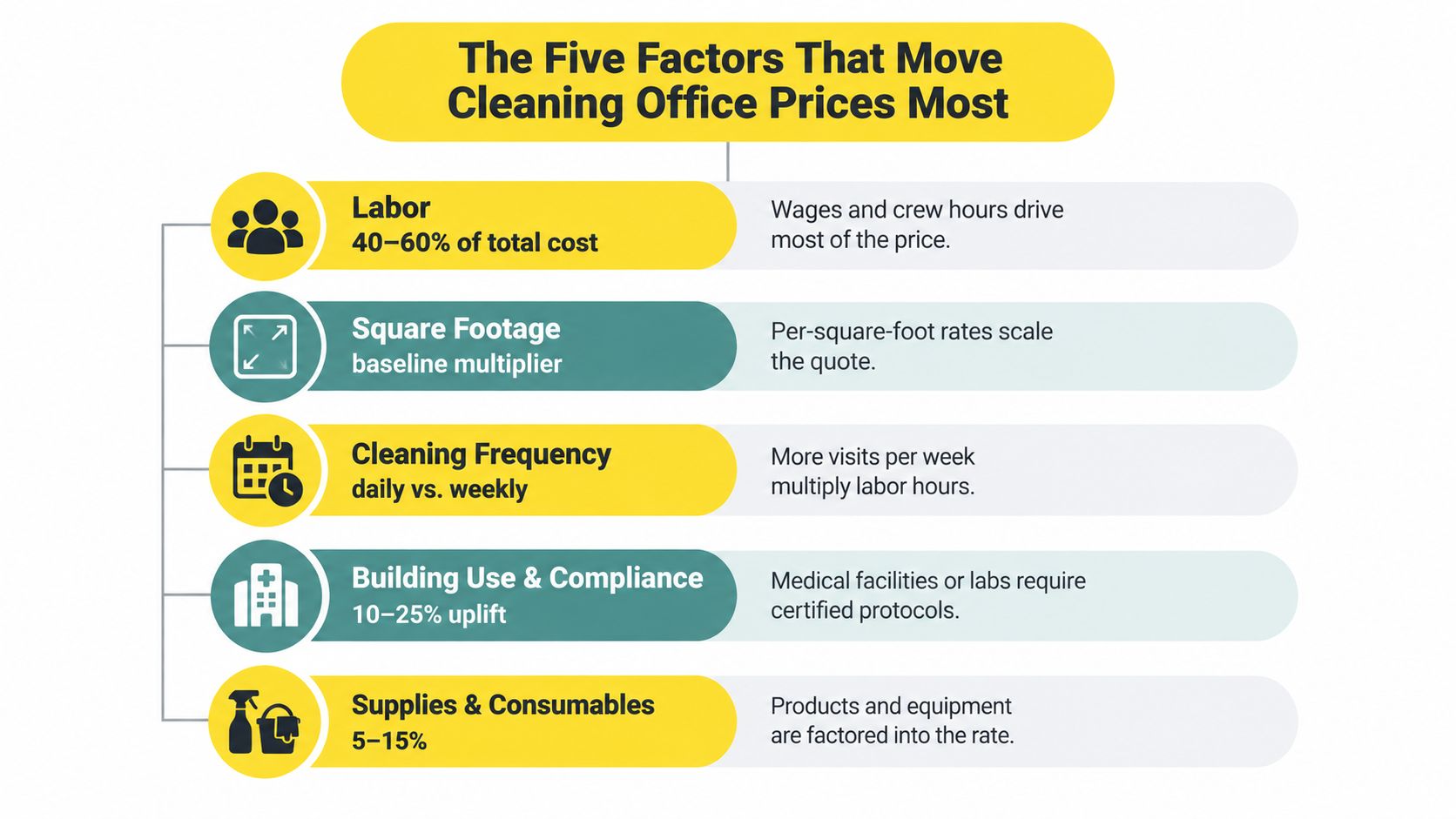
The BLS reported 2025 median pay of $36,840 per year, or $17.71 per hour, for janitors and building cleaners. Industry cost data commonly places labor at 40% to 60% of outsourced commercial-cleaning contract costs, as summarized in the BLS occupational data and commercial-cleaning labor analysis.
That labor share explains why high-wage markets, difficult access windows, and complex sites require higher estimates. The client isn't only paying for the cleaner's wage. They're paying for the entire delivery system around that employee.
Area establishes the baseline. Frequency determines how often you deploy labor, supplies, supervision, and travel. A 5,000-square-foot office cleaned three times weekly needs a different monthly estimate from the same office cleaned once weekly, even if the floor plan never changes.
Open office space is usually faster than restrooms and kitchens. High-touch disinfection, consumable replenishment, interior glass, carpet extraction, stairs, and floor finishing add work without necessarily adding square footage.
Cited hourly averages include approximately $60 in New York City, $55 in Los Angeles, $42 in Dallas, and $38 in Orlando, according to the commercial cleaning rate data linked above. Those regional differences affect the minimum viable estimate before you add supplies or margin.
A locked building, slow elevator, security desk, restricted loading area, or narrow after-hours window can consume labor that never appears on a floor plan. Capture those details during intake. If you don't, the estimate will assume ideal access and the crew will absorb the difference.
For a deeper breakdown of how area-based pricing should be calculated, see commercial cleaning cost per square foot. Don't assign a percentage uplift to every factor without evidence. Build the number from the actual time, burdened cost, and scope.
The cleanest way to defend an estimate is to work backward from the price into labor hours. Square footage is a useful starting point, but production time is what the crew actually sells.
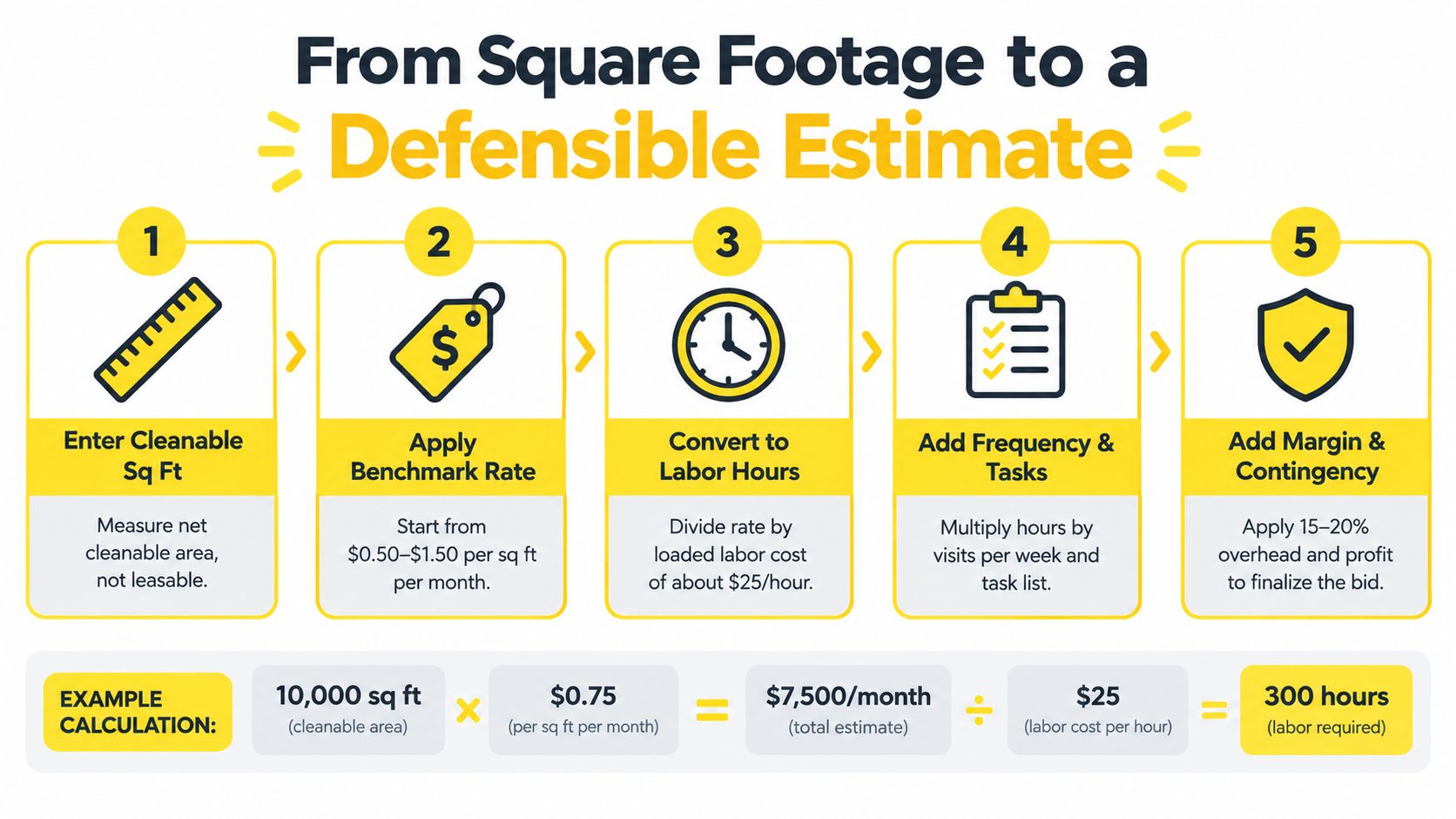
Use this operating formula:
Monthly price = cleanable area × per-visit rate × visits per month + fixed mobilization + periodic-task allowances
The area must be cleanable area, not leased area. Then validate the result against the work mix. Production commonly falls around 2,500 to 4,000 square feet per worker-hour, while restrooms and kitchens are substantially slower, according to the benchmark source above.
Start with the open office, private offices, reception, corridors, restrooms, kitchens, and other zones. Assign the recurring tasks to each zone instead of treating the entire building as one surface.
Then apply visit frequency. A daily schedule may reduce buildup between visits, but it still requires repeated deployment. Add fixed mobilization when travel, setup, access procedures, or supervision won't scale neatly with square footage.
Finally, separate periodic tasks. Carpet extraction, high-dusting, interior glass, and floor-care projects shouldn't disappear inside a flat recurring rate. Give each task its own frequency and allowance.
The 10,000-square-foot, five-times-weekly benchmark of approximately $1,700 to $3,200 per month is useful as a reasonableness check. It isn't permission to ignore the implied labor hours. If your proposed rate requires an impossible production speed, the estimate is wrong even if it resembles the market.
Practical rule: Every estimate should answer three questions: what gets cleaned, how often it gets cleaned, and how many labor hours the scope should require.
A client who adds another restroom isn't asking for a minor favor. They're adding recurring labor. Interior glass, increased occupancy, extra kitchen service, and a new floor type should each have a visible adjustment.
This change-order mindset prevents the common argument where the client says, “That was always part of cleaning.” Your written scope settles the question before the crew arrives.
For a structured way to turn these inputs into a repeatable calculation, see the commercial cleaning estimate calculator guide. The objective isn't mathematical theatre. It's an estimate a skeptical buyer can understand and your operations team can deliver.
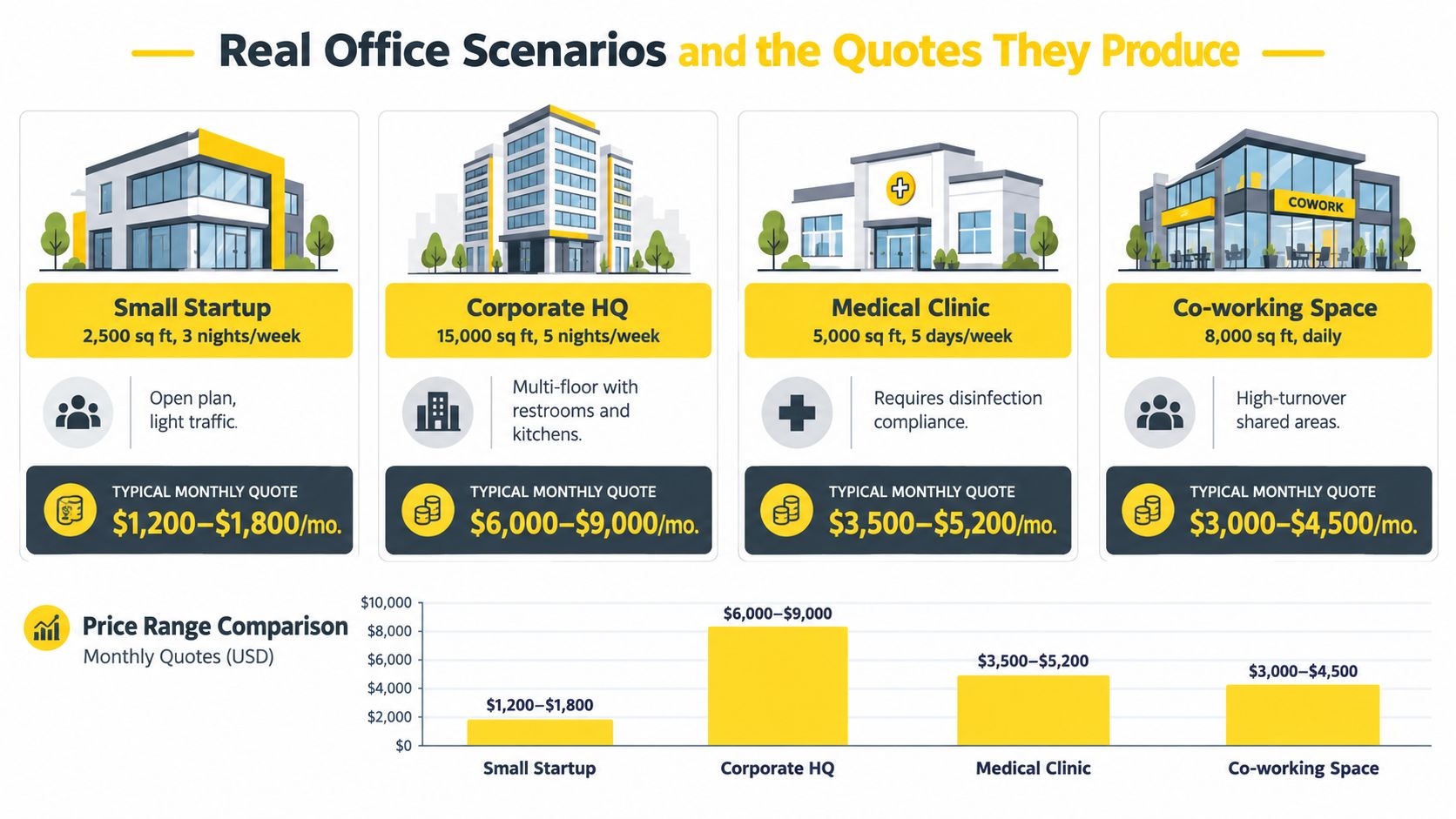
A 2,000-square-foot law office can produce a higher cleaning estimate than a 3,500-square-foot open studio. Room density, restroom count, security procedures, and after-hours access create production hours that square footage alone cannot show. These scenarios make those hidden hours visible.
| Office profile | Inputs to collect | Suitable model | Estimate logic |
|---|---|---|---|
| Small single-tenant suite | 1,500 square feet, twice weekly, one restroom, basic floors | Per visit or monthly | Keep the recurring scope narrow. Price periodic work separately. |
| Law office | 2,000 square feet, three private restrooms, kitchen, after-hours access | Monthly with labor check | Private rooms and restricted access can outweigh the area advantage. |
| Creative studio | 3,500 square feet, open layout, one shared bathroom, moderate traffic | Per square foot or monthly | Open space may require fewer labor hours than a smaller segmented office. |
| Multi-floor headquarters | 25,000 square feet, nightly service, multiple restrooms and kitchens | Monthly contract with line items | Separate zones, crew hours, access time, and periodic tasks. |
For the law office, count rooms rather than trusting the floor-area comparison. Three private restrooms, kitchen details, security procedures, and an after-hours service window add minutes to every visit. Room density and access can outweigh the area advantage, as covered in our breakdown of medical office cleaning rates.
A hybrid-work office creates a different pricing trap. Lower occupancy may reduce trash volume, while restroom service, kitchen cleaning, access procedures, and travel still require scheduled labor. Fewer desks do not automatically mean proportionally fewer hours.
Use production hours to defend each estimate. A client who sees only a monthly total can compare prices without understanding the service. A client who sees visit frequency, zones, task time, and periodic allowances can judge whether two bids actually cover the same work.
For external market context, HomeAdvisor's commercial cleaning rate examples report a typical $0.10 to $0.20 per square foot range. Its examples include $70 to $250 for spaces up to 1,000 square feet, $150 to $600 for 1,000 to 5,000 square feet, $400 to $2,000 for 5,000 to 20,000 square feet, and $1,000 to $2,500 or more above 20,000 square feet. Use those figures as outside context, then verify the labor calculation against the actual building.
A defensible estimate shows the visit schedule, zones, task list, labor assumptions, travel treatment, and periodic work. That detail turns a higher price into a clear difference in service design.
A reliable estimating process doesn't depend on whoever happens to answer the phone. It captures the same inputs, applies the same rules, and flags exceptions before the number reaches the prospect.
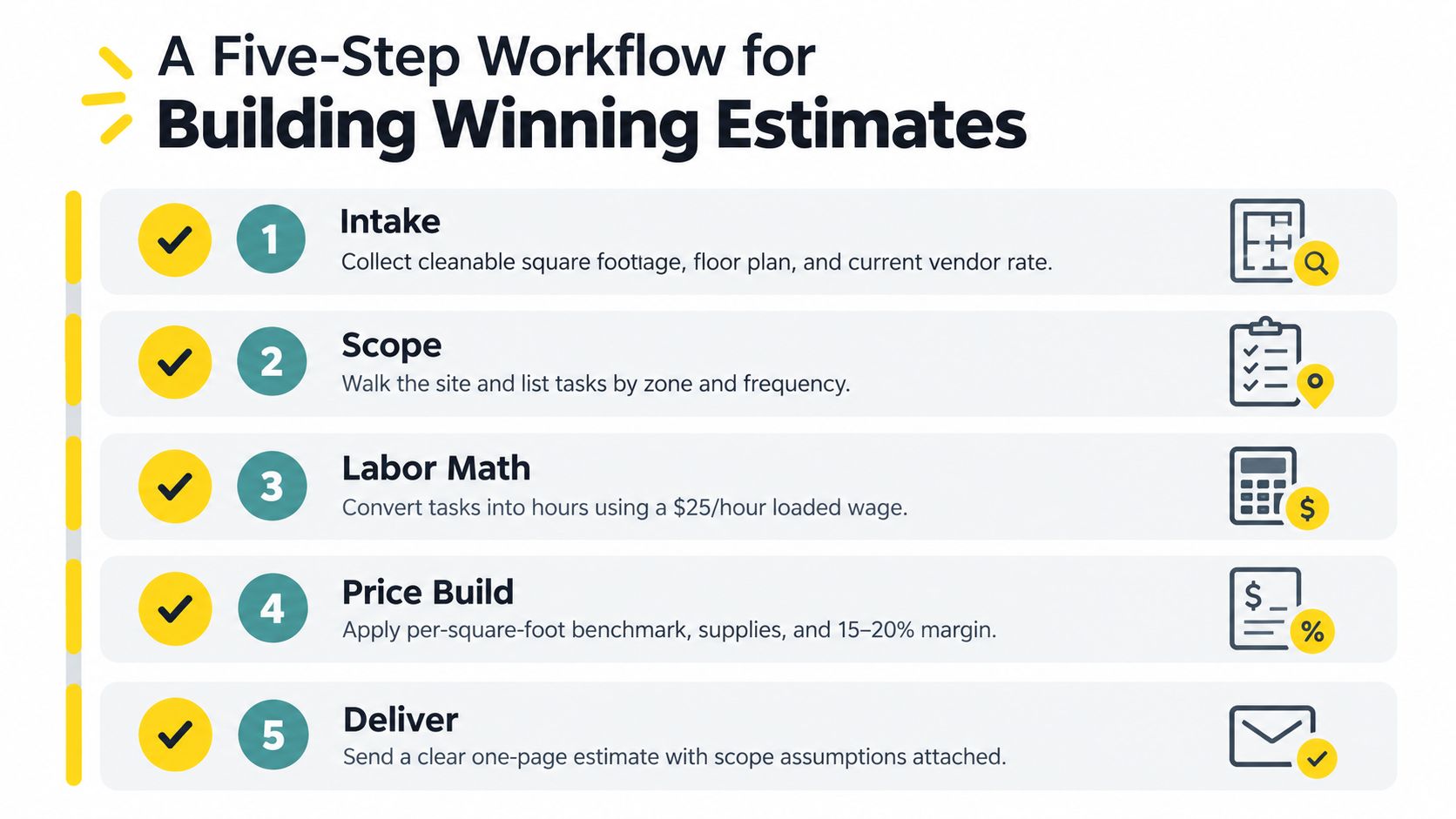
Collect cleanable square footage, floor plan or room mix, restrooms, kitchens, floor surfaces, occupancy, frequency, urgency, service window, access restrictions, and add-ons. Ask what the client expects after every visit, not merely what they call the space.
Map tasks by zone and frequency. Decide whether per-square-foot, hourly, per-visit, or a hybrid structure gives the client the clearest explanation. Don't force every facility into the same rate card.
Convert the scope into expected labor hours. Compare those hours with your production assumptions, then apply fully loaded labor cost. A low area rate is useless if the implied crew speed cannot happen in the building.
The IRS set the U.S. business standard mileage rate at 72.5 cents per mile beginning January 1, 2026. A cleaner traveling 30 business miles round trip would record a travel component of $21.75 before labor time or other expenses, according to the IRS 2026 business mileage rate notice.
Set margin before taxes, add-ons, and client negotiations. Then deliver a readable document with a summary, included work, exclusions, schedule, assumptions, periodic tasks, and change conditions.
Estimatty can collect building type, square footage, frequency, urgency, and add-on scope through a website or voice estimator, then send the resulting estimate by SMS or email. Whether you use that tool, a spreadsheet, or a CRM workflow, the process should produce the same answer from the same inputs.
Use estimate when site conditions or scope can change. Reserve quote for a tightly defined price with clear boundaries. That wording won't fix weak math, but it prevents a flexible estimate from being mistaken for an unconditional promise.
Most cleaning businesses don't lose money on jobs they never win. They lose it on jobs they win at the wrong price.
The fix is straightforward. Build from rooms and tasks, validate labor hours, price travel, and attach a written scope. Don't discount a number you haven't proven.
Lead with a plain-English summary: area, frequency, included work, monthly estimate, and the conditions that can change it. Then show the line items. A client asking for a lower price should get a scope conversation, not an unexplained discount. Remove frequency, interior glass, or periodic floor work if the budget requires it, and show the operational consequence.
Use the guide to handling price objections to keep the discussion focused on labor and deliverables. Follow up while the prospect still remembers the walkthrough, and make the estimate easy to approve by email or SMS.
For the next seven days, audit your last estimates, compare implied labor hours with actual delivery time, separate periodic tasks, and rewrite your scope assumptions. Then use a consistent intake process for every new office instead of relying on memory.
Estimatty helps cleaning businesses collect office details, apply customizable pricing rules, and send consistent estimates by SMS or email at any hour. Visit Estimatty to replace slow forms and guesswork with a repeatable estimating workflow that protects margin and responds while prospects are ready to buy.