October 20, 2026
How to Follow Up on a Quote and Close More Cleaning Sales
Learn how to follow up on a quote with timing, templates, and tactics that turn estimates into booked cleaning jobs. Practical advice for cleaning businesses.

Friday, July 17, 2026
Build a commercial cleaning estimate calculator that wins jobs. Our guide covers formulas, inputs, common mistakes, and automation tools for accurate estimates.
.png)
A lot of cleaning owners are still pricing commercial work the same way they priced their first few jobs. A lead comes in after hours. You open an old spreadsheet, change a few cells, guess at labor, and send an estimate that feels reasonable.
That approach works right up until it doesn't. You either respond too slowly, price too low, or send numbers that you can't defend when the client asks what they're paying for. A proper Commercial Cleaning Estimate Calculator fixes all three problems. It gives you a repeatable way to price the scope, protect margin, and respond like a serious operator instead of someone winging it.
It usually happens at the worst time. You're wrapping up the day, a property manager asks for pricing on a multi-room office, and you know the lead is hot. If your process depends on you being available, focused, and willing to recheck formulas late at night, your sales process is fragile.
A spreadsheet is better than guessing, but it still leaves holes. Different team members may use different assumptions. One estimator may include restroom labor, another may bury it inside a flat rate. One person may price frequency correctly, while another copies the weekly number into a monthly estimate and hopes it holds.
Clients notice when your estimates feel vague. They may not know your labor model, but they can tell when pricing looks rushed or generic.
The bigger problem is internal. Manual estimating creates drift.
Practical rule: If two people in your company can produce two different prices for the same scope, you don't have a pricing system yet.
Commercial buyers often compare responsiveness before they compare cleaning details. The company that answers clearly and quickly looks more organized. That matters even before a walkthrough.
A systematic calculator changes the experience. It asks the same core questions every time, applies the same logic every time, and gives your team a cleaner starting point for follow-up. That's what turns estimating from admin work into part of your sales process.
If you're building a business that needs faster response and less manual back-and-forth, it's worth studying how AI-based sales systems are changing service companies through tools like AI growth platforms for service businesses.
Good estimating isn't about making a spreadsheet prettier. It's about forcing the right decisions before a number ever reaches the client. You need a method that ties scope to labor, labor to cost, and cost to profit.
That discipline protects you in two situations that hurt most cleaning companies:
A real commercial cleaning estimate calculator gives structure to both. That's how you stop pricing by instinct and start pricing with intent.
A 12,000 square foot office can be easy money or a margin trap. The difference usually shows up before the first cleaning. It shows up in the questions asked during intake.
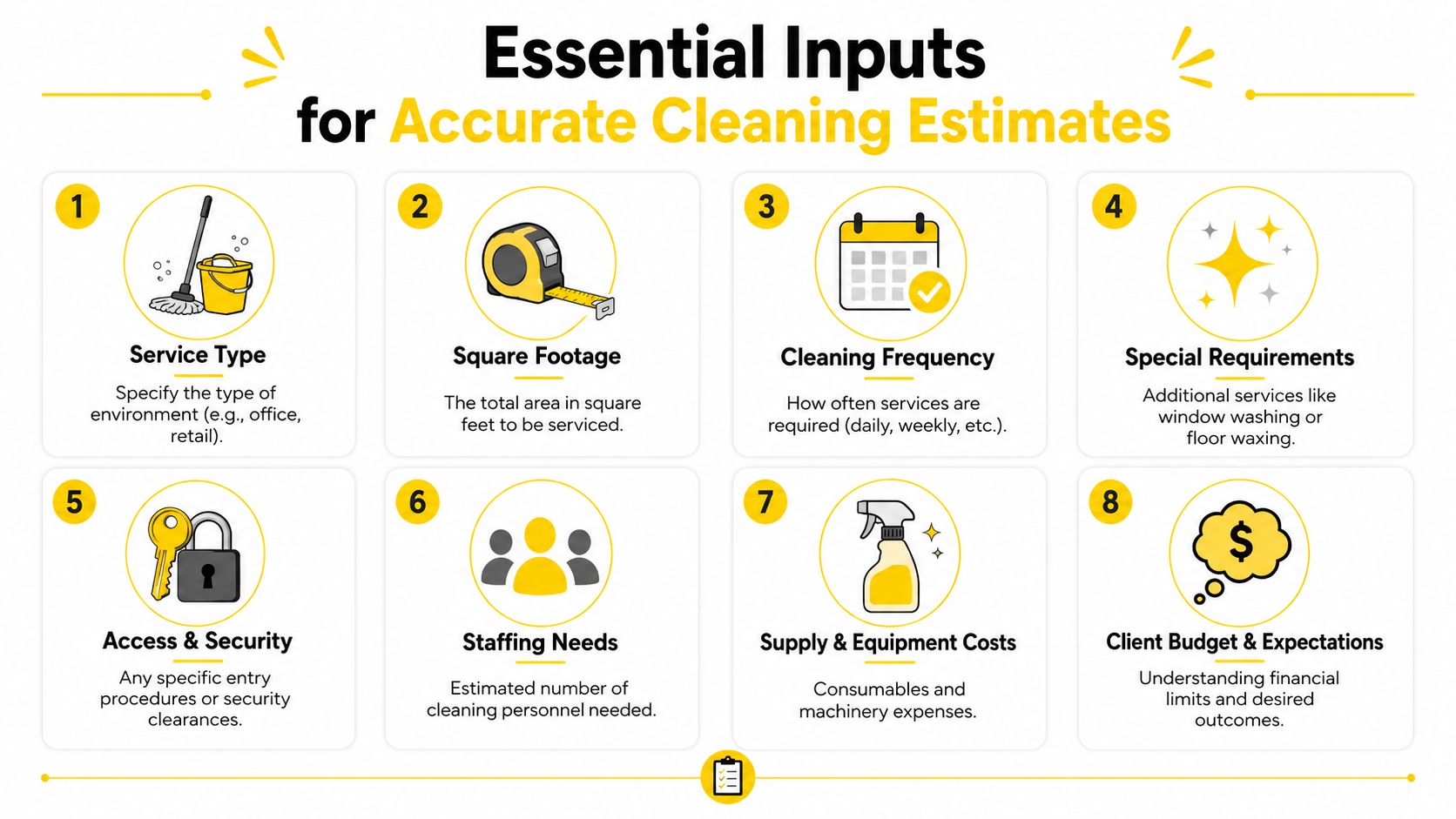
Square footage matters, but it is only a container. Labor comes from what is inside that container and how often your crew has to reset it.
Start by collecting four inputs every time:
If the prospect cannot define those four clearly, the estimate is a range, not a price.
Cleaning companies underbid when they price floors and forget fixtures. Restrooms, breakrooms, glass, entryways, and touchpoints often drive more labor than open office space.
That is why intake forms need operational detail, not just sales detail. Ask for:
A building with modest square footage and eight restrooms will often cost more to service than a larger building with open cubicle space and two restrooms.
Many free calculators miss one ugly detail. Not all square footage produces billable labor at the same rate.
According to LeadDuo's commercial cleaning price calculator discussion, commercial estimates often fail because owners treat non-cleanable areas, fixture-heavy zones, and labor-intensive rooms as if they behave like open floor space. LeadDuo also notes in that same discussion that many free calculators ignore those exclusions, which is why early bids often look profitable until the route starts.
That problem gets worse when the estimator never visited the site.
A practical fix is to break the building into zones. Open office, restrooms, breakrooms, medical exam rooms, warehouse aisles, and front-of-house areas should each have their own production assumption. That is the difference between a spreadsheet that stores numbers and a calculator that helps your team price jobs correctly. It is also the first step toward automation, because software can only produce fast estimates if the intake fields reflect how labor is really consumed.
Weak estimates usually fail in predictable places. Consumables were assumed but not listed. Day porter tasks were mentioned casually during a walkthrough. Interior glass got added after the proposal. Floor burnishing was expected because the last vendor did it "once in a while."
Get specific before you send a number.
Use intake questions that force clear answers on:
If you are tightening your questionnaire, it helps to understand commercial sanitation needs before you standardize your scope categories.
The final check is simple. Can the information collected support a believable labor hour target and a profitable bill rate?
If not, the intake is incomplete.
That is why I treat labor inputs as the backbone of the calculator, not an afterthought. Estimatty's guide on how to calculate labor cost per hour for cleaning services is a solid reference here, because profitable estimates depend on taxes, burden, travel, supervision, and overhead, not just hourly wage. Once those inputs are captured cleanly, a spreadsheet can calculate a number. A system can do more. It can pre-qualify leads, standardize scope, trigger follow-up, and turn estimating into a 24/7 sales process instead of a manual quoting chore.
Once the inputs are solid, pricing gets much simpler. Not easy. Simple. You stop asking, "What should I charge?" and start asking, "What does this scope require, and what price preserves margin?"
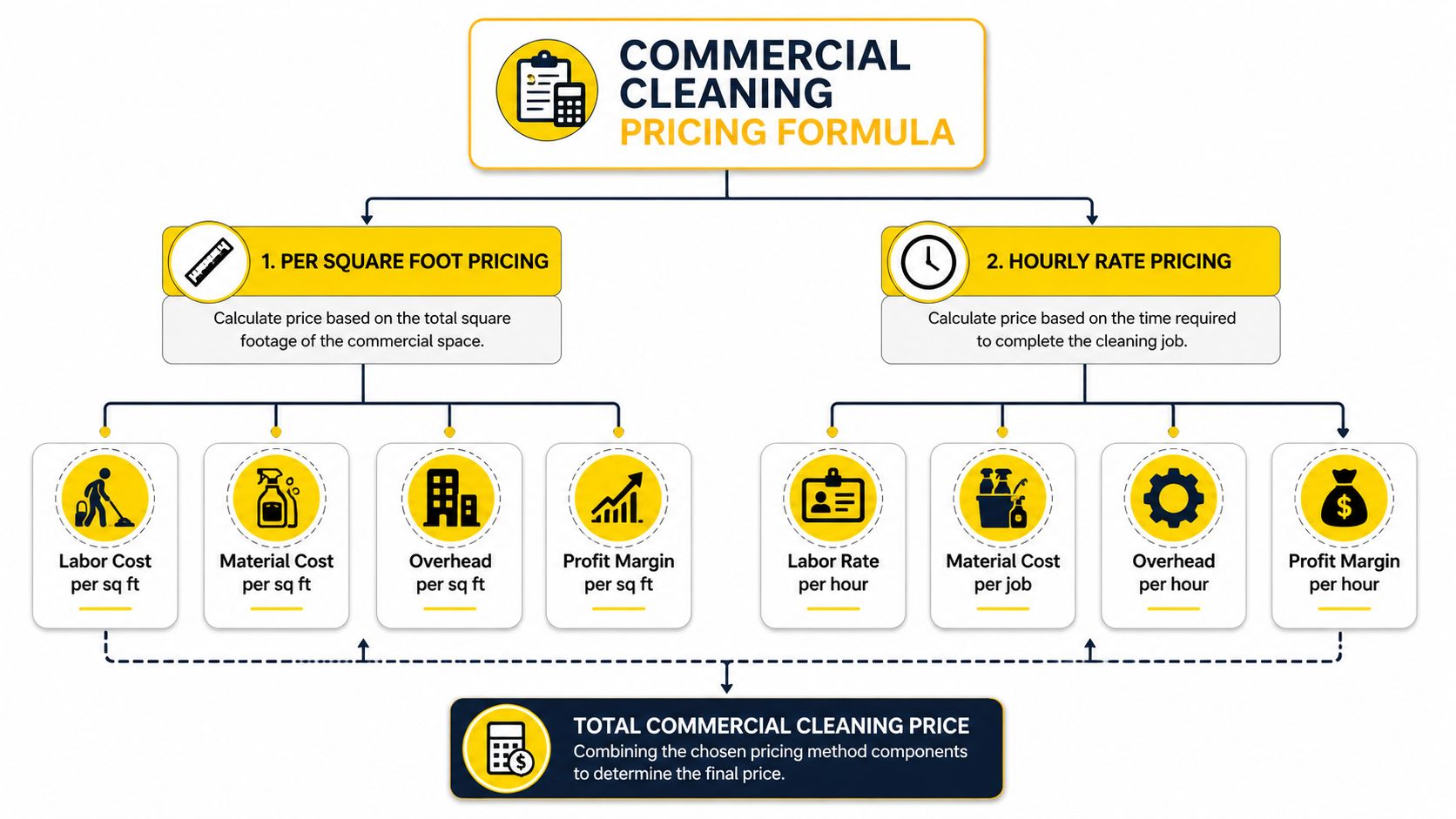
Most commercial estimates start from one of two methods.
| Pricing model | Best use | Risk |
|---|---|---|
| Per square foot | Faster benchmarking and simpler recurring work | Can hide fixture-heavy or access-heavy labor |
| Per hour | Better for irregular scope or labor-driven work | Can feel less predictable to the client |
Across the United States, average commercial cleaning pricing ranges from $0.10 to $0.25 per square foot or $30 to $60 per hour per cleaner, according to Nilfisk's commercial cleaning rate guide. The same guide notes that small office spaces under 5,000 sq. ft. often run $600–$1,000 monthly, mid-sized facilities of 5,000–10,000 sq. ft. often run $1,000–$1,500, and larger spaces of 20,000+ sq. ft. can reach $3,000–$5,500+, depending on scope and daily requirements.
Those numbers are benchmarks, not your final answer. They help you sanity-check your estimate, not replace your model.
The strongest commercial cleaning estimate calculator doesn't choose one method and ignore the other. It combines them.
A practical hybrid formula usually works like this:
This approach keeps the estimate understandable for the client and accurate for your business.
Operator's view: Square footage is the shell. Labor is the truth.
If you're copying what another company charges, you're borrowing a number without borrowing their payroll, overhead, routing, equipment, or standards. That's how owners win the wrong jobs and lose money on the right ones.
Your formula should include:
If you're hiring and trying to understand labor structure more clearly, tools and hiring content from pipehirehrm.com can help you think through staffing costs and recruiting trade-offs before you lock pricing assumptions into estimates.
One of the fastest ways to wreck margin is bundling high-effort services into a general monthly number. Window work, hard floor restoration, interior glass, and specialty sanitation should stand on their own.
If you offer glass or facade work, reviewing a dedicated window cleaning cost calculator can be useful because it reinforces the same principle: specialty services need their own pricing logic.
For a broader framework on structuring job pricing, Estimatty's article on how to price cleaning jobs is a strong companion resource.
The formula isn't usually what breaks. Execution does. Most bad commercial estimates come from a handful of repeat mistakes, and every one of them feels harmless in the moment.
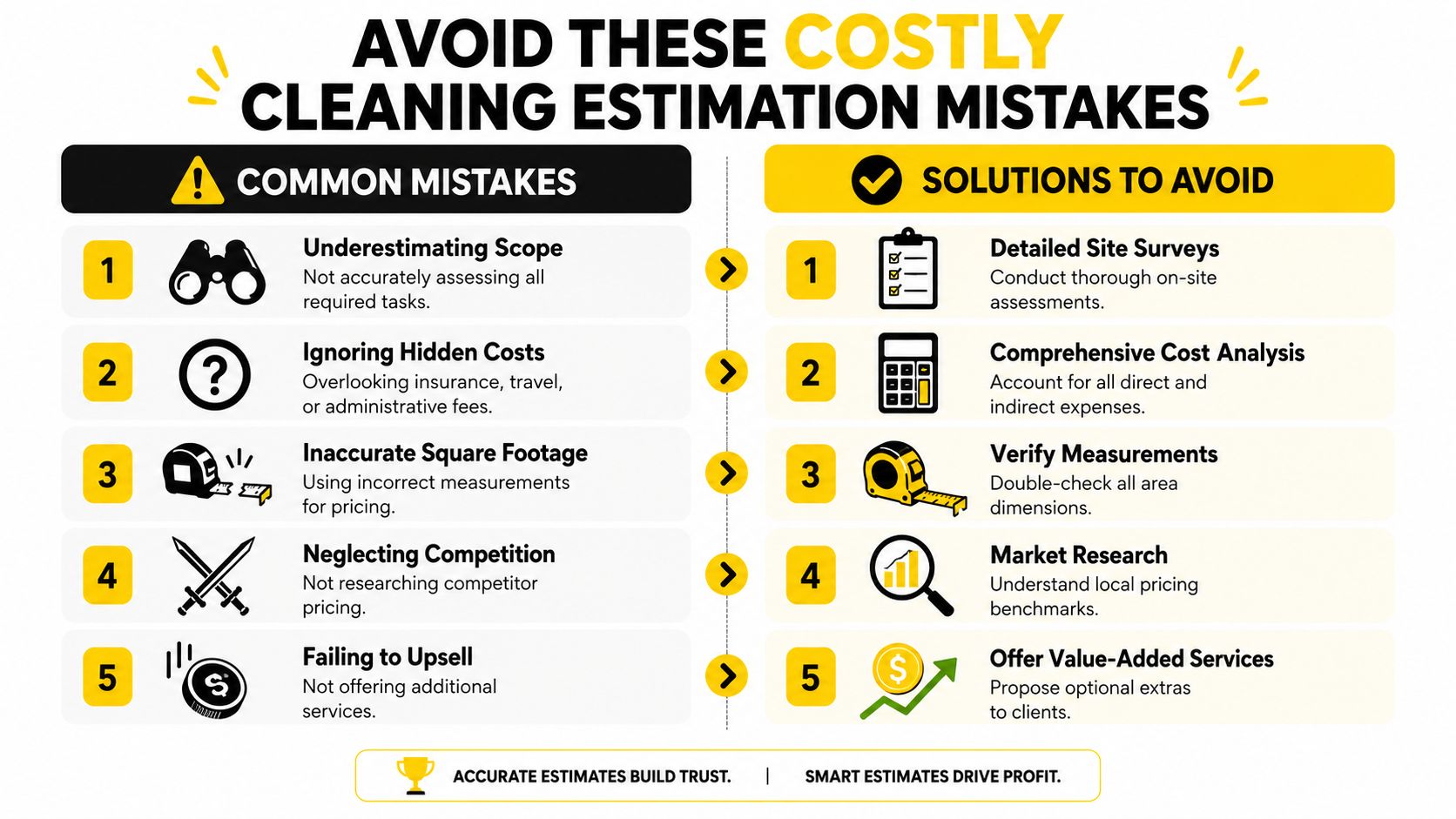
The first mistake is treating all facilities like standard office space. A robust calculator should use a six-step methodology where productivity changes by environment. According to Janitorial Appointment's calculator guide, Step 2 applies industry-specific productivity rates, including 2,500–3,500 sq ft/hour for standard offices, while medical and food facilities run significantly lower. The same guide says Step 4 multiplies those hours by the fully burdened labor rate, Step 5 adds supplies at 3–5% of labor cost and overhead at 15–20%, and Step 6 applies profit margin.
The second mistake is pricing from gut feel. That same source warns that 40% of new bidders lose contracts or underprice because they don't account for facility-type variances when converting square footage into labor.
That failure looks like confidence from the outside. It's usually just speed without structure.
Owners also miss hidden cost layers. They remember wages and forget taxes, insurance, benefits, equipment wear, admin time, and field supervision. Once that estimate turns into a contract, the margin disappears.
Another common error is inaccurate measurement. Not every square foot belongs in the cleaning production count, and not every room has equal labor demand. If your site survey is rushed, the estimate won't be recoverable later.
Here's a practical refresher before pricing the next walkthrough:
The last mistake is burying add-ons inside the base estimate. Owners do this because they want the proposal to feel simple. The client sees one neat number. The cleaner sees extra labor every visit.
Use a short pre-flight check before sending any estimate:
If the estimate only works when everything goes perfectly, it isn't a profitable estimate.
A prospect lands on your site at 9:40 p.m., needs pricing for a 22,000 square foot medical office, and wants an answer before sending the same request to three competitors. If your calculator lives in a spreadsheet on one manager's laptop, you are closed for business.

Implementation decides whether your pricing logic stays an internal tool or starts producing leads around the clock. Plenty of owners build a usable spreadsheet and stop there. The spreadsheet helps with internal consistency, but it still depends on staff availability, manual follow-up, and someone translating raw numbers into a proposal the client can understand.
The jump usually happens in three stages.
| Feature | DIY Spreadsheet | Website Widget | AI Agent (Estimatty) |
|---|---|---|---|
| Availability | Only when staff is working | Available on-site | Available on-site and during calls |
| Consistency | Depends on the user | More standardized | Highly standardized |
| Lead capture | Manual follow-up | Form-based | Conversational and immediate |
| Client experience | Slow and internal | Better, but static | Fast, guided, and interactive |
| Upsell handling | Manual | Limited | Can ask follow-up questions in real time |
| Operational handoff | Requires copying notes | Better than email chains | Structured data for follow-up |
A spreadsheet is still the right first build for many companies. I recommend it when an owner is still testing production rates, restroom pricing, floor care add-ons, and frequency discounts. It is cheap, fast to adjust, and good for spotting bad assumptions.
It also breaks down quickly.
A basic website widget is the next step. It lets prospects enter square footage, frequency, and contact details without waiting for office staff. That improves response time, but most widgets still behave like a static intake form. They collect fields. They do not ask clarifying questions about day porter needs, hard floor square footage, restricted access hours, or whether the "office" includes exam rooms, breakrooms, and heavy restroom traffic.
Good implementation starts with the workflow, not the screen design. The calculator needs to collect the same details your best estimator asks on a walkthrough, then turn those answers into pricing that matches how your crews work.
At minimum, the system should handle scope inputs, pricing logic, lead capture, and follow-up. If it only spits out a rough number based on square footage, it will create cleanup work for your sales team and pricing problems for operations.
A useful setup usually includes:
That last part gets overlooked. Owners spend time on formulas and ignore the handoff. If the calculator captures a lead but your team still has to retype details into email, call the client back for missing information, and rebuild the quote manually, you did not automate estimating. You moved the bottleneck.
AI matters because it can ask follow-up questions in real time and adjust the estimate path based on the answers. A standard form cannot do that well. A trained estimator does it naturally, and software should get as close to that behavior as possible.
For example, if a prospect selects "medical office," the system should ask different questions than it would for a standard general office. If they mention strip and wax, post-construction cleanup, or multiple tenant suites, the calculator should branch into the right pricing path instead of forcing a generic quote.
That is the difference between a calculator that looks modern and one that sells. For a closer look at how this works in practice, see Estimatty's guide to AI estimates software for cleaning.
The advantage is speed with structure. Prospects get a fast answer. Your team gets organized job data. Operations gets cleaner handoff notes. And you stop relying on whoever happens to be available to read an inquiry and "figure out a number."
Most cleaning companies don't lose jobs because they can't clean. They lose jobs because their estimating process feels slow, uncertain, or inconsistent. A prospect asks for pricing and gets one of three bad outcomes: a delayed response, a vague number, or an estimate that has to be corrected later.
A disciplined commercial cleaning estimate calculator fixes that by making your business easier to trust. The client sees a company that asks the right questions. Your team sees cleaner handoffs. You see numbers that hold up after startup instead of collapsing under labor reality.
According to Aspire's pricing guidance for commercial cleaning, successful bids commonly target a 10–28% net profit margin of gross sales, and a standard markup formula is Break-even cost ÷ (1 − target margin) = target price. The same source warns that pricing purely by square footage without adjusting for restroom count or facility type creates revenue leaks, which is why office estimates often need a separate [Restrooms × Restroom Rate] component.
That point is bigger than math. It shapes how you compete. You stop trying to be the cheapest number in the inbox and start being the most reliable estimate in the process.
If you're still building estimates from memory, old files, and call notes, growth gets messy fast. Every new estimator introduces variation. Every rushed proposal adds risk. Every underpriced contract steals time from better clients.
A repeatable estimating system gives you an advantage:
For owners who want to tighten their process, Estimatty's commercial cleaning estimate template is a practical next read. It's also worth spending time on both estimatty.com/blog and get.pipehirehrm.com/blog if you're working on sales systems and hiring at the same time.
If you want more profitable contracts, don't just send faster estimates. Build a system that makes every estimate more consistent, more defensible, and easier for the client to say yes to.
If you're ready to stop guessing and turn after-hours inquiries into real opportunities, Estimatty gives cleaning companies a practical way to automate estimates, standardize pricing, and respond instantly across web and phone. It's built for operators who want a real sales system, not another spreadsheet.