
October 10, 2026
How to Increase Qualified Leads for Cleaners
Learn how to increase qualified leads for your cleaning business. Discover AI estimators, speed-to-lead tactics, and scoring strategies that book more jobs.

Wednesday, August 26, 2026
Learn what commercial cleaning cost per square foot really means, the 2026 benchmarks by facility type, how to calculate your own rates, and how
A property manager calls late in the afternoon. She needs a ballpark estimate for a 12,000-square-foot office by tomorrow, and she wants one number she can put in front of ownership. The temptation is to multiply the building size by a familiar rate and send it over.
That approach is fast, but it can also turn a profitable account into a recurring loss. Commercial cleaning cost per square foot isn't a universal price. It reflects the labor required to clean a particular building, the frequency of service, the supplies and equipment involved, and the business costs that sit behind every visit.
The practical formula is simple:
Total monthly cleaning cost ÷ total cleanable square footage = monthly cost per square foot.
The estimating work happens before the division. You need to define what gets cleaned, how often it gets cleaned, and what conditions make the work easy or difficult. The following benchmarks and workflows are designed to help you turn that information into a repeatable estimate instead of relying on gut feel.
A prospect asking for a square-foot rate usually isn't asking for a mathematical lesson. They want to know whether your service fits their budget. Still, giving a flat number before you understand the facility creates risk for both sides.
A per-square-foot rate is really a productivity assumption. It represents the labor hours, supplies, equipment, overhead, and margin required to service each unit of cleanable space. If the number is low because you overlooked restrooms, a break room, or a public lobby, the square footage won't protect your margin.
Before offering a preliminary estimate, capture the details that change the work:
A drive-by estimate fails because it treats visible square footage as the whole job. It doesn't account for fixture density, surface type, or the time needed to move through the building.
Practical rule: Give a preliminary range only after you label the assumptions behind it. A rate without scope is an invitation to argue about what was included.
A defensible estimate must absorb direct labor and payroll burden, cleaning products, equipment, insurance, vehicles, administration, and profit. That doesn't mean every early conversation requires a full site audit. It does mean your first response should sound like, “I can give you a starting range once I confirm the facility type, cleanable square footage, frequency, and core scope.”
Presentation matters too. Businesses evaluating providers often judge the clarity of the estimate before they judge the cleaning method. A resource on house cleaning website design can help owners think through how service information, forms, and calls to action should be presented online, even when the underlying service is commercial.
A 20,000-square-foot office and a 20,000-square-foot medical suite can produce very different bids. Facility type, service frequency, labor market, and operating requirements shape the rate, so a national average has limited value on its own. Published references place standard office cleaning in major U.S. markets at $0.09 to $0.17 per square foot. Broader commercial-cleaning guides use $0.10 to $0.20 per square foot for recurring work and visits, depending on scope and market conditions. The commercial cleaning service price list helps organize those inputs before building a facility-specific estimate.
The table keeps each facility type in its own row, with the ranges visible for comparison. Treat the figures as estimating benchmarks, not promises. Monthly conversions assume five service visits per week, or approximately four weeks of service in a month. They support planning, but they do not establish a universal contract rate.
| Facility Type | Per-Visit Cost / Sq Ft | Monthly Cost / Sq Ft (5x/wk) | Why It Differs |
|---|---|---|---|
| Standard office | $0.09 to $0.17 per ISSA pricing guidance | About $1.80 to $3.40 | Routine surfaces, offices, corridors, restrooms, and common areas |
| Office, broader guide range | $0.10 to $0.20 per Angi commercial cleaning guide | About $2.00 to $4.00 | Scope, local labor, building condition, and service level |
| Medical and healthcare | $0.14 to $0.29 per square foot | About $2.80 to $5.80 | Disinfection, infection-control procedures, and stricter operating requirements |
| Industrial or manufacturing | $0.08 to $0.20 per square foot | About $1.60 to $4.00 | Open spans can reduce fixture density, while soil and floor work can increase effort |
| Retail | $0.07 to $0.15 per square foot | About $1.40 to $3.00 | Customer traffic, trash, entry glass, and presentation standards |
| Schools | $0.07 to $0.14 per square foot | About $1.40 to $2.80 | Large areas can offset classroom and restroom demands |
| Recurring commercial cleaning, broad range | $0.04 to $0.32 per month per CleanQuote's 2026 guide | Already expressed monthly | Facility type and compliance requirements create a wide spread |
The broader monthly office range clusters around $0.07 to $0.18 per square foot per month. Medical and healthcare can reach $0.14 to $0.32 per square foot per month because infection-control protocols, restroom turnover, and specialized procedures add labor minutes.
A medical suite generally has more rooms, sinks, touchpoints, hard flooring, and procedure-specific requirements than an open-plan office. Dedicated chemicals, documented processes, and additional training can increase the labor allowance. Retail may carry a lower base rate, yet customer traffic, entry glass, displays, and frequent trash handling can move the estimate toward the upper end of its range.
Regional labor markets also affect the final bid. Use these values as a sanity check, then adjust for the confirmed scope, access conditions, and expected productivity. Estimatty can help turn those facility details and benchmark ranges into a repeatable estimating workflow, so the square-foot figure remains tied to the actual building rather than copied from a national average.
Three variables explain many disagreements between an owner's expected rate and a cleaner's estimate: size, frequency, and building type. They don't operate independently, but separating them makes the pricing conversation easier.
| Variable | Low-End Scenario | High-End Scenario | Rate / Sq Ft |
|---|---|---|---|
| Size | Large office with repeated zones and efficient supply movement | Small office with fixed setup and travel burden | Larger sites often support a lower rate |
| Frequency | Frequent routine service that prevents heavy soil | Infrequent service requiring more restoration work | Higher frequency can reduce cost per visit |
| Building type | Open-plan office with limited fixture density | Medical suite with exam rooms and stricter procedures | Higher-complexity sites command higher rates |
A larger building doesn't automatically cost less in total. It often costs less per square foot because setup, equipment movement, travel inside the facility, and supply mobilization spread across more cleanable area. Nilfisk places medium facilities of 5,000 to 10,000 square feet around $0.12 to $0.20 per square foot, while large buildings of 10,000 to 50,000 square feet are listed around $0.10 to $0.16 per square foot in its commercial cleaning rate guide.
That pattern isn't permission to reduce every large estimate. A sprawling building with multiple entrances, separated wings, or difficult access can erase the efficiency advantage.
Nightly routine service prevents soil from becoming a restoration project. Weekly service may look cheaper because there are fewer visits, but each visit can require more time for floors, restrooms, trash, and touchpoints. Price the actual labor minutes, not just the number of scheduled visits.
The labor cost per hour calculation guide helps connect production time to the rate you need to charge. That connection is critical when a client asks for fewer visits without reducing scope.
A medical suite and an open office can have the same footprint while requiring very different procedures. Treating them as equivalent is one of the fastest ways to underbid.
Square footage is only the denominator. Your estimate works when the numerator covers every cost required to deliver the scope.
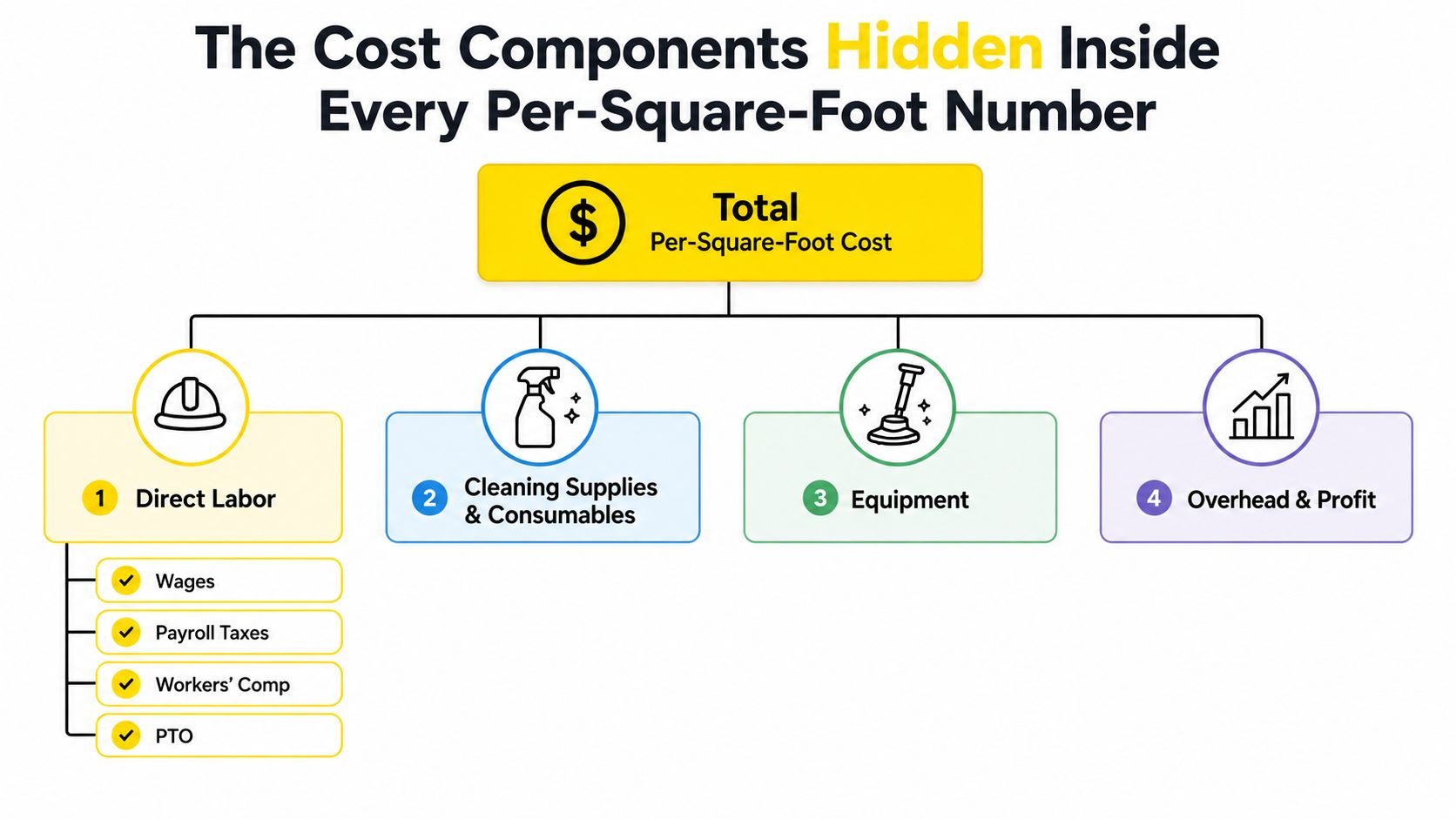
A practical worksheet separates four groups:
Planning assumptions for a typical commercial cleaning estimate place direct labor at 55% to 65%, supplies at 5% to 8%, equipment at 3% to 5%, and overhead at 10% to 15%, with margin filling the remainder. Use these shares as a starting structure, not fixed accounting rules. Adjust them to match your payroll, equipment cycle, service model, and market.
A crew spending four hours inside a facility may consume more than four labor hours on the account. Include loading and unloading, security procedures, supply staging, supervisor checks, training, rework, travel between accounts, and inspection walks.
Hourly references can test whether your labor burden is reasonable, even when you sell a square-foot estimate. Housecall Pro reports commercial cleaning rates of $30 to $75 per hour per cleaner, depending on scope, facility type, and local labor costs. Nilfisk cites $30 to $60 per hour per cleaner in its national commercial cleaning guide. Use those references to test whether your calculated labor burden makes sense, but avoid substituting an hourly guess for a defined scope.
Assigning every dollar to cleaner time leaves insurance renewals, vehicle repairs, software subscriptions, recruiting, and administrative work unfunded. The commercial cleaning overhead cost guide offers a framework for assigning those expenses before you set the final rate.
Linking production time to your rate is critical when a client asks for fewer visits without reducing scope. Recalculate labor, supplies, and supervision against the revised schedule before changing the per-square-foot price.
Estimator's test: If your rate covers the visit but not the business supporting it, you haven't priced the account. You've only priced the visible task.
The core calculation remains straightforward:
Square footage × rate per square foot = cost per visit.
For recurring work, multiply the per-visit amount by the scheduled visits in the billing period. The following examples use the specified planning assumptions and published benchmark context. They show the arithmetic, but the labor hours, supply allocations, overhead, and margin must still be replaced with your own operating figures.
| Facility | Square Footage | Frequency | Rate per Sq Ft | Cost per Visit | Monthly Total |
|---|---|---|---|---|---|
| Office | 5,000 sq. ft. | Five nights per week | $0.15 | $750 | About $16,200 |
| Medical clinic | 25,000 sq. ft. | Three nights per week | $0.22 | $5,500 | Depends on scheduled visits |
| Boutique retail | 1,200 sq. ft. | Twice per week | $0.12 | $144 | Depends on scheduled visits |
The office example produces $750 per night at the selected rate. Its approximate monthly total of $16,200 follows the supplied planning example. Because the monthly figure doesn't reconcile neatly with a simple four-week, five-visit conversion, treat it as a stated example rather than a substitute for counting the exact billing schedule.
Start with the stated $750 per visit. Build a worksheet beneath it that lists labor hours, loaded labor cost, supply cost, equipment allocation, overhead allocation, and intended margin. If the total of those lines exceeds $750, the rate isn't viable even if it sits inside a familiar office benchmark.
At 25,000 square feet and $0.22 per square foot, the visit amount is $5,500. A clinic estimate should separately identify disinfecting procedures, exam-room cleaning, restroom work, waste handling, floor care, documentation, and exclusions. Don't hide specialized work inside a generic “standard cleaning” line.
At 1,200 square feet and $0.12 per square foot, the result is $144 per visit. A small retail space may have a low total ticket but a high operational burden if access is limited, the site is far from other accounts, or the client expects display-area detailing and frequent glass cleaning.
Use the commercial cleaning estimate calculator guide to structure the worksheet, then validate it against actual labor and supply consumption after service begins.
The pricing model should match the predictability of the work. A clean square-foot calculation can support all three structures, but each one places risk in a different location.
| Pricing Model | Best For | Risk Carrier | Typical Range |
|---|---|---|---|
| Hourly | Post-construction, one-time deep cleans, uncertain scope | Client carries more risk because time determines the bill | $30 to $75 per hour per cleaner, according to Housecall Pro |
| Per-visit | Small retail, recurring service with seasonal variation | Cleaner carries scope and productivity risk | Calculated from the agreed square-foot rate |
| Monthly recurring | Offices, medical facilities, and schools with defined scope | Cleaner carries delivery risk, client gains budget stability | Calculated from the agreed recurring scope and frequency |
Post-construction cleaning can change once dust, adhesive, debris, and unfinished areas become visible. A one-time deep clean also creates uncertainty when the starting condition varies. Hourly billing protects the cleaner from promising a fixed outcome before the labor requirement is known.
The downside is behavioral. Hourly rates can tempt a slow crew to spend more time than necessary, while clients may focus on the clock instead of the completed scope.
A per-visit amount works well when the client wants a predictable invoice for each service night. It also suits smaller retail accounts that experience seasonal swings, provided the scope states what happens when traffic, events, or floor conditions change.
Monthly recurring pricing supports budgeting for the client and revenue planning for the contractor. It works best when the scope, frequency, exclusions, supply responsibilities, and periodic services are written in plain language.
Under-scoped monthly contracts erode margin quickly. If the client adds restocking, extra restrooms, event cleanup, or floor care without a corresponding change order, the cleaner absorbs the labor.
For broader service-pricing principles outside cleaning, the Solo AI Website Creator pricing guide offers useful context on aligning the pricing model with scope and perceived value.
Inconsistent estimating language leaks revenue before the crew ever enters the building. One estimator may use $0.12 per square foot for a facility while another uses $0.18 per square foot because she included restocking and floor care. The difference isn't necessarily a pricing error. It may be a scope-definition error, and clients won't understand the distinction if both estimates use the same vague “standard cleaning” label.
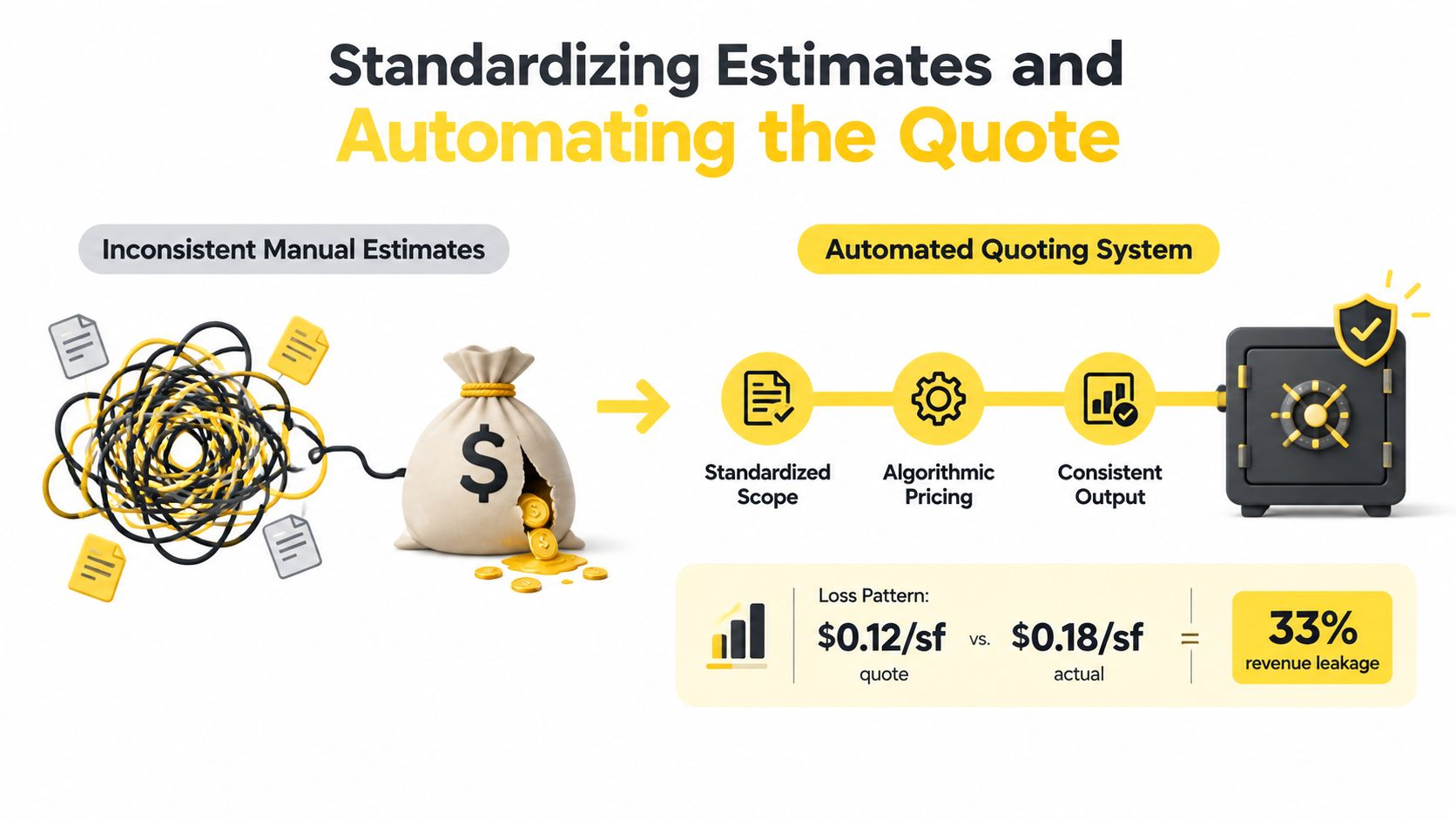
A standardized commercial estimate should include:
This template turns pricing logic into something a new estimator can follow. It also makes client conversations more productive because the cleaner can point to the exact scope difference rather than defend an unexplained rate.
Estimatty can turn that structure into a reusable form, apply a stored rate library, layer add-ons, and produce a branded PDF estimate. Its web and voice sales estimator can also capture details such as square footage, surfaces, and urgency, then send an estimate by SMS or email. The AI estimates software for cleaning businesses page provides additional product context.
Software won't fix a bad rate library or an incomplete checklist. Set the facility categories, define the base scope, document exclusions, and review actual labor after the account starts. Then automation can improve turnaround, reduce forgotten line items, and give you cleaner data for comparing estimate outcomes.
The workflow should make the rate visible, not hide it behind a form. A client should understand what the square-foot number covers and what would trigger a revised estimate.
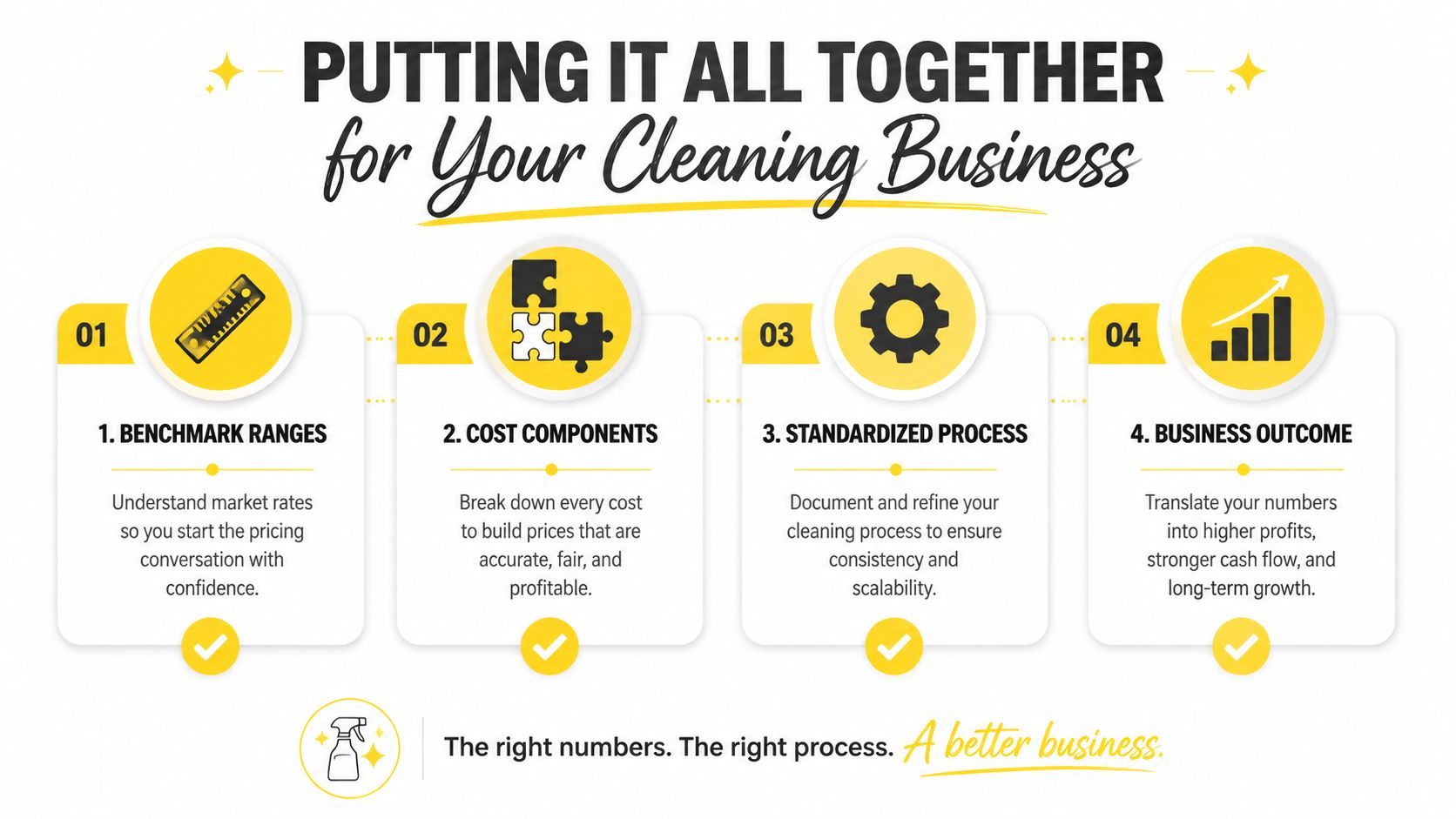
Commercial cleaning cost per square foot is useful when it anchors a system. Benchmark ranges start the conversation. Cost components justify the number. Contract structure protects the margin. Standardized estimates make the process repeatable.
Run this checklist over the next week:
The objective isn't to make every account fit one number. It's to make every number traceable to the building, the labor, the scope, and the margin your business needs. That gives you an estimate you can defend to a client, a banker, or a new hire.
Estimatty helps commercial cleaning businesses capture prospect details, apply consistent pricing logic, and send branded estimates by SMS or email without waiting for office hours. Visit Estimatty to see how you can turn square-foot pricing into a faster, more consistent estimating workflow.