
October 12, 2026
Cleaning Office Prices: A Practical Pricing Guide for 2026
Learn how cleaning office prices really work in 2026. Compare per square foot, hourly, and monthly models, plus tips to estimate and present winning quotes.

Tuesday, October 13, 2026
Master squeaky clean window cleaning with this step-by-step guide. Learn the tools, techniques, and safety tips pros use for streak-free windows every time.

You've spent an afternoon washing the glass, the sun moves around the house, and suddenly every window shows a web of streaks. The harder you scrub, the worse the result seems. That familiar frustration usually comes from a poor process, not a lack of effort.
Professional squeaky clean window cleaning combines controlled technique with a careful assessment of the glass, access, and service scope. The same discipline that prevents streaks also helps a cleaning business produce accurate estimates instead of guessing at a price and discovering too late that screens, tracks, height, or mineral deposits were never accounted for.
Most streaks come from leaving something behind. Household sprays can contain ingredients that dry into a film, while paper towels shed lint and break down when they become wet. A cloth that was used on frames, counters, or oily surfaces can transfer residue back onto otherwise clean glass.
The timing matters, too. Direct sun heats the pane and dries the solution before the squeegee can remove it. That creates overlapping edges, partial drying, and hazy trails. Work in shade where possible, or clean the cooler side of the building first. You're trying to keep the glass wet long enough to complete the pass, not race against a hot surface.
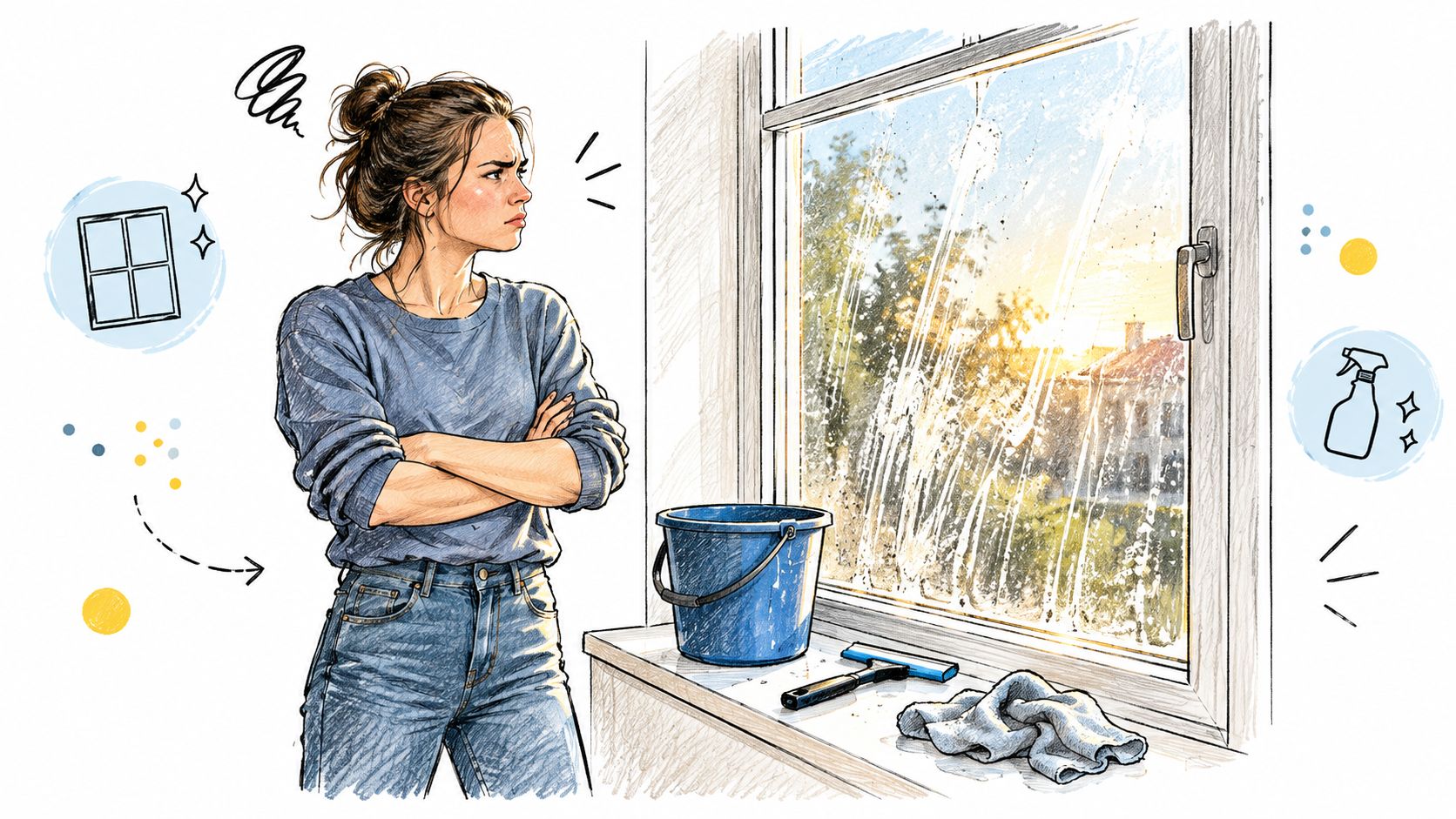
Start by removing dry grit and loose dust. If you drag that material across wet glass, you can create fine scratches, especially on coated surfaces or panes exposed to construction debris. Then apply enough solution to suspend the dirt, agitate methodically, and remove the liquid with a clean blade.
The same principle applies to mineral residue elsewhere in the home. A useful explanation of the difference between ordinary grime and mineral buildup appears in this guide to hard-water stains on faucets. Hard deposits need diagnosis and an appropriate treatment, not just more pressure.
Use a clean microfiber for the edges, but don't polish the whole pane with a damp, dirty towel. That spreads moisture and soil. Detail the corners and perimeter after the main water has been removed, then inspect the glass from different angles. A pane can look perfect head-on and reveal missed lines when afternoon light hits it.
Practical rule: If the solution dries before you finish the stroke, change the timing, amount of water, or section size before changing chemicals.
The professional mindset is simple. Clean glass comes from clean tools, controlled moisture, and repeatable movement. Scrubbing harder is rarely the answer.
A workable kit doesn't need every gadget on the market. It needs a few tools that perform consistently and fit the job. A cheap squeegee with a warped channel may cost less at the register, but it can leave water trails that force you to redo the pane. Professional equipment earns its place by making the result more predictable.
| Tool | Best For | Pros | Cons |
|---|---|---|---|
| Professional squeegee | Routine interior and exterior glass | Precise control, replaceable rubber, fast water removal | Requires practice and regular rubber changes |
| Microfiber washer | Dusty or heavily soiled panes | Holds solution, lifts soil, reduces hand contact with glass | Can become overloaded with dirt and leave residue |
| Extension pole | Elevated exterior windows | Improves reach and reduces climbing | Less tactile control at greater distance |
| Pure water system | Exterior maintenance and high-access work | Leaves minimal residue when used correctly, supports ground-based work | Initial equipment cost and water-quality management |
| Scraper with compatible blade | Stuck paint or isolated debris | Removes bonded material when used carefully | Can scratch glass if the surface or blade is unsuitable |
For a practical review of choosing squeegees and pure water systems, compare tool design with the work you perform. A small residential operator may need a reliable washer, squeegee, microfiber detailing cloths, and a pole before investing in a full water-fed setup.
Your washer should be clean enough that it lifts soil instead of redistributing it. Your squeegee rubber should have a sharp, continuous edge. A bucket that carries dirty solution from pane to pane can undermine otherwise good technique, so change the water when it becomes visibly contaminated.
A basic operating kit usually includes:
A cleaning supplies list can help organize purchasing, but field judgment still determines which tools belong in the vehicle. Don't carry specialized restoration products to every maintenance appointment, and don't arrive at a high-access property without a safe reach plan.
The best equipment is the equipment you maintain. Rinse sleeves, clean channels, store rubber away from damage, and keep cloths separated by use. A professional finish starts before the first pane.
Start with the job site, not the bucket. Check the glass, frames, screens, nearby surfaces, and access route. Look for loose grit, paint, sealant, sprinkler residue, and fragile landscaping. Remove or protect screens before cleaning, and don't assume every pane has the same soil or access conditions.
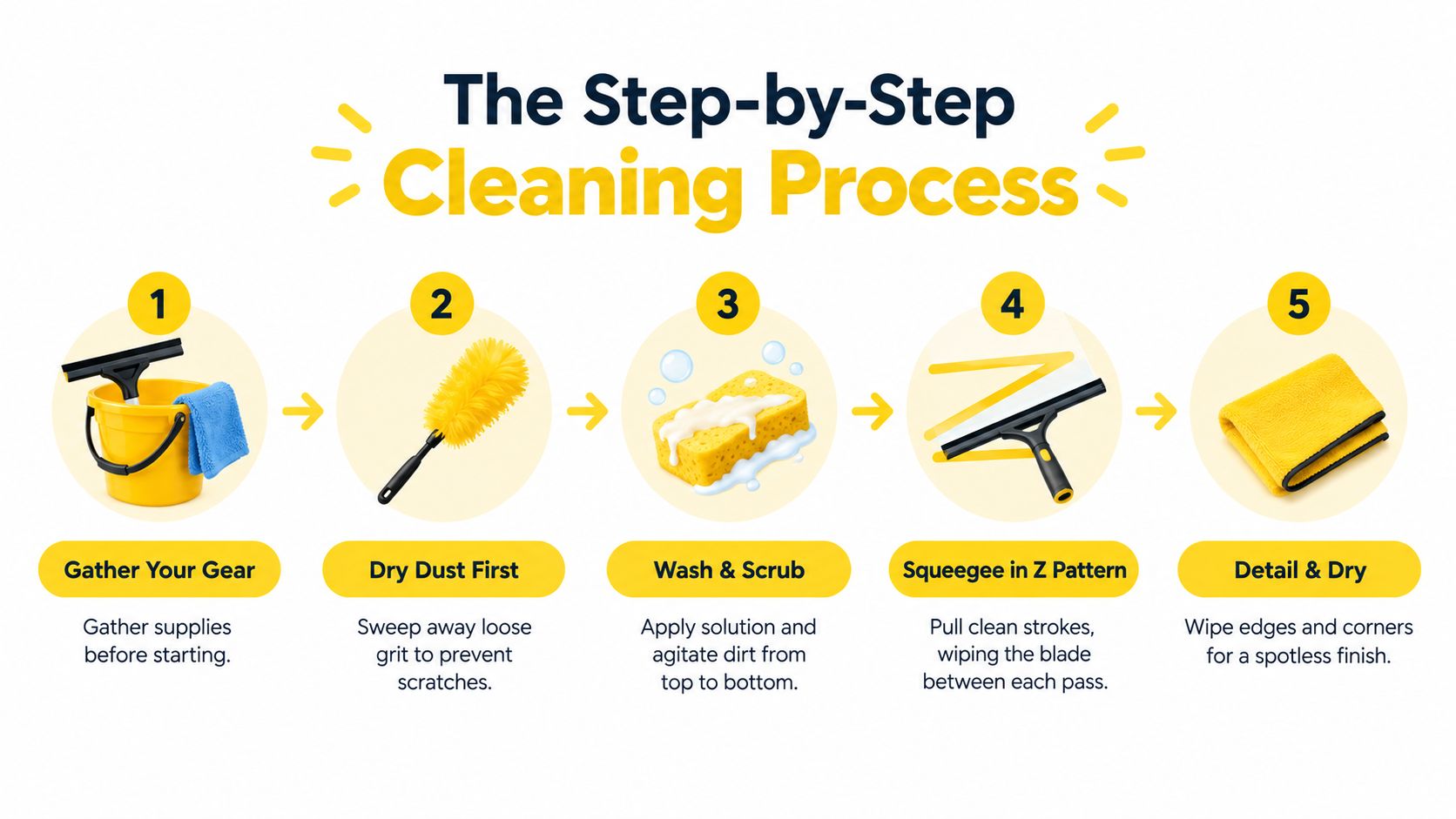
Gather your gear. Set out the washer, squeegee, solution, clean microfiber cloths, scraper if appropriate, and waste container. Searching for tools with a wet pane waiting wastes time and encourages shortcuts.
Dust dry surfaces first. Sweep loose grit from the frame, sill, and glass. Don't press dry debris into the pane with a cloth. That first pass protects the surface and makes the wet cleaning stage more effective.
Wash and agitate. Apply solution from the top down. Work the washer across the glass with overlapping movements, concentrating on edges and contaminated areas. Heavy soil may need a pre-soak, followed by another controlled scrub rather than aggressive pressure.
Squeegee in an S or Z pattern. Start with a clean edge and keep the blade at a steady angle. Pull connected strokes so each pass overlaps the previous one. Wipe the blade after every pass, especially along the bottom edge where dirty water collects.
Detail and dry. Use a dry, lint-free microfiber around the perimeter, corners, and sill. Inspect the pane from inside and outside when possible. If you see a line, re-wet and correct it instead of rubbing a dry mark across the glass.
The pattern matters because it controls where water travels. Random strokes leave isolated pockets of solution, while a consistent sequence gives you a clear starting point and a predictable finish. On larger panes, divide the glass into manageable sections rather than allowing the solution to dry while you work.
For high-level work, technique can't compensate for unsafe access. Ground-based poles and water-fed systems often reduce climbing demand, while ladder use should follow a documented risk assessment covering footing, weather, electrical hazards, surface condition, and overreaching. A written procedure can be formalized through resources on how to build a compliant SWMS.
Watch the process in motion before trying unfamiliar movements, then practice on accessible glass. A professional deep cleaning checklist can also help keep screens, sills, tracks, and finishing checks from disappearing under time pressure.
A hard-water mark isn't automatically a cleaning problem. Some deposits sit on top of the glass and can be removed with a compatible mineral treatment. Others have fused to the surface or etched the glass, which means repeated scrubbing won't restore the original clarity and may create additional damage.
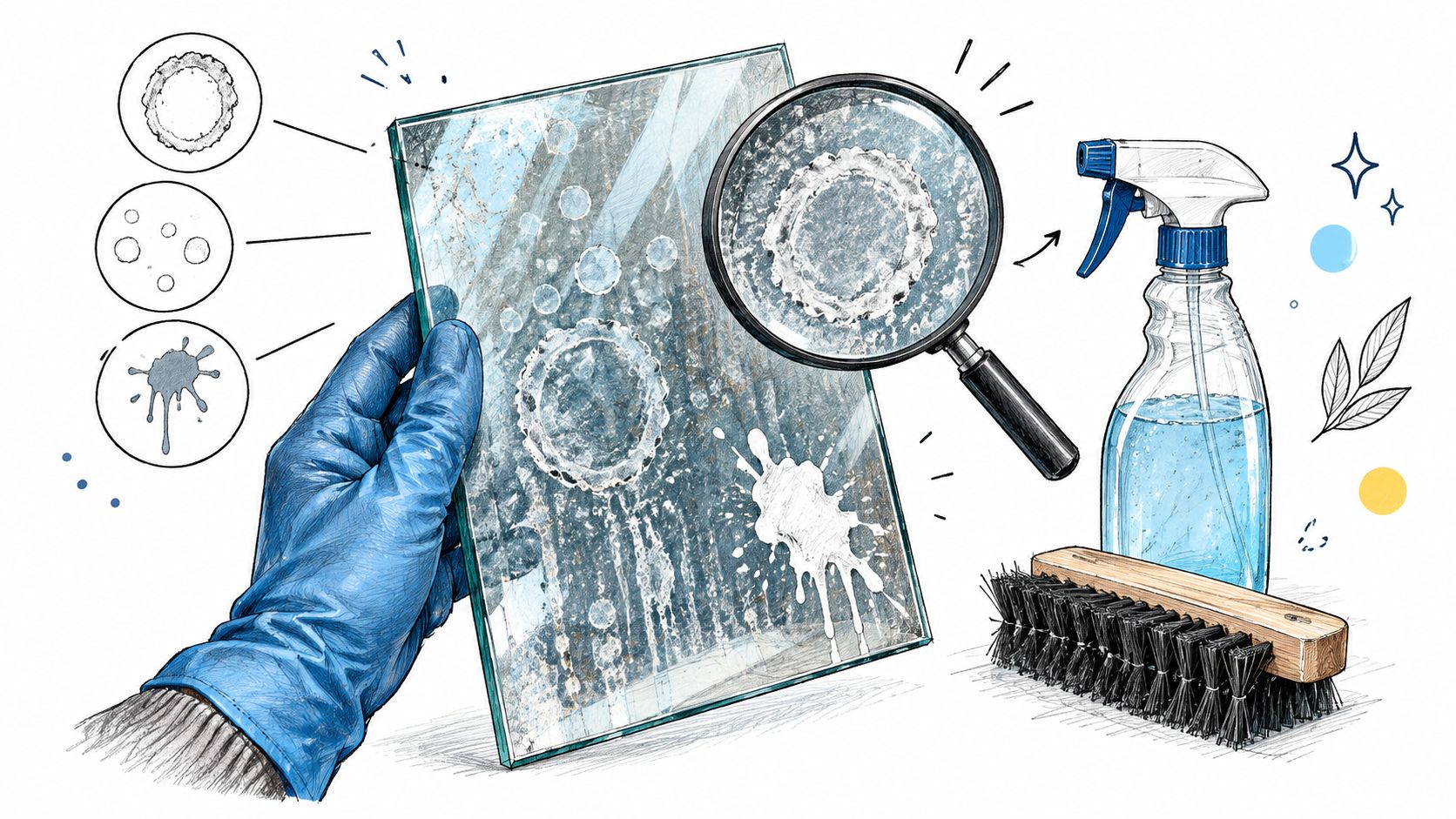
Inspect the pane under useful light and identify the likely cause. Sprinkler exposure, mineral-rich water, construction debris, paint, and coating limitations require different decisions. Clean away loose grit first, then test a small hidden area before treating the full pane.
A controlled restoration workflow looks like this:
One documented polishing procedure specifies 2 to 4 pounds of working pressure and emphasizes rinsing before the compound dries, as described in the hard-water stain guidance from Professional Window Cleaning. For calcium deposits, a pH-controlled dissolver, white nylon pad, and deionized-water rinse may be appropriate. Steel wool and improvised abrasives can scratch the pane.
Pine Country Window Cleaning's advice on removing hard-water stains from windows is useful for understanding why treatment should be deliberate rather than forceful. The critical decision is knowing when to stop. Stage-three deposits may require controlled cerium-oxide polishing, and some panes won't be fully restorable.
A cleanable deposit and an etched pane can look similar from across the room. Test first, explain the limitation, and get approval before restoration work.
Keep chemical choices tied to the surface and the result you're promising. A professional cleaning chemicals guide can support product planning, but no product list replaces a test patch and a realistic expectation.
A careful cleaner sees more than dirty glass. During assessment, record pane count, window type, interior and exterior access, screen removal, track and sill condition, skylights, height, landscaping, roof or balcony conditions, and signs of mineral residue or construction debris. Those details determine labor, tools, risk, and whether the work belongs under routine cleaning or restoration.
An estimate should make assumptions visible. If upper panes can be reached from the ground with a pole, say so. If interior access is required, note that the customer needs to provide it. If tracks, screens, skylights, gutters, or solar panels are separate services, list them as distinct components instead of hiding them inside a low headline price.
A technician may discover a failed seal, overspray, damaged screen, fragile coating, or glass that has been permanently etched. Cleaning can improve removable soil, but it won't repair a failed seal or reverse every surface defect. Explain the finding, photograph it when appropriate, and offer restoration or referral only when the scope and risk are clear.
This distinction protects both sides. The customer understands what the service includes, and the operator avoids promising a replacement result from a cleaning process. Reviews associated with Squeaky Clean operators show why customers value technicians who explain defects and difficult conditions rather than just wiping around them.
The name also needs geographic care. Squeaky Clean Window Cleaning refers to multiple independent businesses, not one globally unified company. A Southern California operator identifies itself as family-owned and operating since 1991, reports more than 30 years of experience, and claims over 2,000 satisfied customers in its own company information. A separate operator serving Jeffersonville, Louisville, and nearby areas says Chris Martin founded it in 2017. In the United Kingdom, Squeeky Clean Window Cleaning Ltd was incorporated on August 11, 2021, under SIC 81221, window-cleaning services. Another central Illinois operator says it was created in 2014, while a Madison-area listing gives 2005 as its founding year. These separate histories are documented in this Squeaky Clean Window Wash company overview.
One Chico, California business traces its origins to a local labor shortage more than four decades ago. Its historical account says founder Floyd Jones developed time-saving methods, later transferred the business, and that successors expanded into power washing and solar-panel cleaning. The company also describes an in-house screen-washing machine and a later family-operated phase involving Colby and Alex Perry. That history shows how documented methods and adjacent services can help a small operator grow beyond one founder's individual skill. Read the account in Squeaky Clean Window Washing's company history.
For labor planning, cleaning businesses face an ongoing recruitment task. The U.S. Bureau of Labor Statistics projects 350,300 annual job openings for janitors and cleaners, excluding maids and housekeeping cleaners, in its 2024 occupational projections. The figure reflects replacement demand and employment growth, which is why repeatable hiring workflows matter. Businesses evaluating hiring support can also review pipehirehrm.com and its cleaning-industry resources.
Build estimates from observable conditions, then apply consistent pricing rules for labor, travel, supplies, access, and add-ons. Estimatty can collect window count, pane size, access notes, service frequency, and screen requirements, then apply configured pricing rules and send estimates by email or SMS. For a practical framework, review how to estimate window cleaning, keeping the language centered on estimates rather than fixed quotes when site conditions still need confirmation.
If you want fewer missed details and faster responses, visit Estimatty. It helps window-cleaning businesses collect job information, apply consistent pricing rules, and send estimates by SMS or email while your team focuses on safe, high-quality work.