
October 23, 2026
How to Start Commercial Cleaning in 2026
Learn how to start commercial cleaning in 2026 with proven steps for pricing, staffing, licensing, and automation that win recurring contracts.

Wednesday, September 2, 2026
Learn how to quote window cleaning with practical formulas for labor, materials, access, extras, proposals, automation, and more accurate estimates.

A homeowner calls with a simple request: clean the windows on a two-story house. You count the openings, glance at a competitor's public rate, and send an attractive estimate before the lead cools off. The trouble starts on arrival. The crew finds difficult ladder access, screens packed with debris, dirty tracks, and a long drive. The number looked competitive, but it never reflected the work.
Learning how to quote window cleaning profitably means replacing guesswork with measured inputs. Count the panes, document access, calculate your real operating cost, and present optional work clearly. Then turn those rules into a consistent estimating process so every lead receives a defensible estimate, not a rushed number that damages your schedule.
A two-person crew accepts a 30-window residential job at a competitor's low posted rate. The team expects a straightforward visit, but travel takes longer than planned, ladder setup slows production, screens need removal and cleaning, and solution costs add up. The work runs past seven hours. By the time the crew packs the equipment away, the business has delivered a demanding job without preserving meaningful profit.
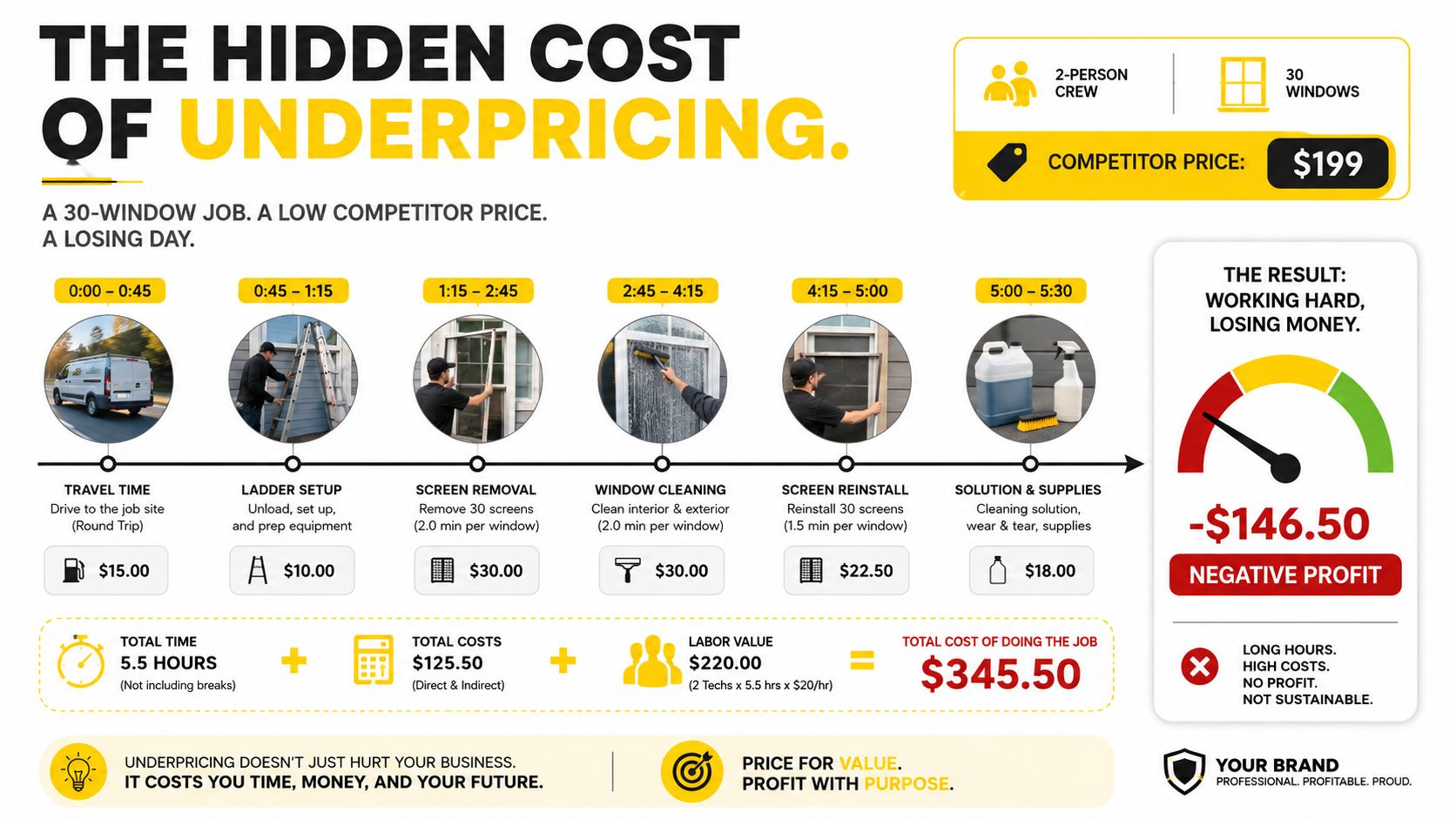
Matching a competitor's number doesn't prove that the job works for your company. It only proves that another operator has published a number. That operator may have different labor costs, route density, equipment, insurance, service scope, or tolerance for thin margins.
A weak estimate hurts more than one job's profit. It also consumes capacity that could have gone to a better opportunity. If the crew spends most of a day on a job that barely covers direct costs, the owner faces a chain reaction:
Use the word estimate in every customer conversation. An estimate can be precise while still acknowledging that access, condition, and final scope may change after inspection. That language protects both sides and makes variability part of the process from the beginning.
Your estimate should answer a practical question: can this job pay for the labor, materials, travel, overhead, and profit it demands? A market reference can help you sense-check the result. Residential visits are often reported around $221 on average, with a typical range of $150 to $302, and common pricing may be around $10 per window or $45 to $75 per hour, as summarized by recent residential window-cleaning pricing data. Those figures are context, not permission to copy a competitor's number.
Operator's rule: If you can't explain what each part of the estimate pays for, you're not pricing the job. You're guessing.
A defensible estimate gives you cleaner scheduling and a stronger sales conversation. It also gives you permission to decline work that can't clear your minimum, instead of allowing an unprofitable booking to dictate your crew's day. For a practical framework on presenting service pricing clearly, review cleaning service estimate practices.
Don't decide the price before you know what the crew will touch. A reliable estimate begins with a property survey, whether that survey happens through a phone intake, photos, video, or an on-site visit.
Start by counting every pane, not just every window opening. Record the count by floor and distinguish fixed glass from operable units. A large picture window, a divided-light French pane, and a small bathroom slider may each be one opening, but they don't represent the same labor.
Count screens separately and record whether they're removable, damaged, heavily soiled, or blocked by furniture. Note tracks and sills as their own scope items. Then document the glass type, approximate size, story count, and whether the crew can work from the ground, a ladder, a water-fed pole, or another access method.
Access details often decide whether an estimate is viable. Check for retaining walls, steep landscaping, roof-pitch surfaces, narrow side yards, locked gates, and parking restrictions. Ask where the nearest water spigot and electrical outlet are located. For planned work, confirm HOA rules, restricted work hours, alarm requirements, pets, and interior access.
Use this checklist in your phone form or field app:
Missing inputs cause predictable underpricing. A second-story slider that needs special access or a five-foot retaining wall can add substantial labor and setup. Treat any claimed adjustment such as 20 to 40 percent as a warning threshold only when you have a verified internal basis, not as a universal rule. Your own time records should determine the adjustment.
| Measurement Input | How to Capture It | Why It Changes the Estimate |
|---|---|---|
| Pane count | Count each pane by floor and opening | Sets the base labor volume |
| Story count | Record ground, second, and higher levels | Changes equipment, setup, and safety needs |
| Window type | Note sliders, double-hung units, French panes, skylights, and storm windows | Different designs require different handling time |
| Screen count | Count removable screens and note condition | Adds removal, cleaning, drying, and replacement work |
| Tracks and sills | Mark included areas and soil level | Detailed work can extend interior service time |
| Access points | Photograph ladders, walls, landscaping, gates, and roof surfaces | Determines setup, movement, and risk |
| Condition | Record dust, paint, cobwebs, minerals, and renovation residue | May require additional tools, dwell time, or restoration work |
| Site logistics | Confirm parking, water, power, pets, alarms, and HOA limits | Prevents delays that aren't visible in a pane count |
For phone-based intake, ask prospects to send exterior photos and a short video of difficult sides of the property. A structured estimate-by-phone workflow can collect the same decision-making inputs before you commit to a service window.
A profitable estimate has separate buckets. Keep labor, materials, overhead, travel, profit, and the job minimum visible in your internal calculation, even if the homeowner receives a simpler presentation.
Begin with a fully loaded labor rate. Don't use wage alone. Include payroll taxes, workers' compensation, training, paid drive time, and the fact that employees aren't producing billable window work during every paid hour. For employees, the federal minimum wage under the Fair Labor Standards Act is $7.25 per hour, and overtime generally applies at 1.5 times the regular rate after more than 40 hours in a workweek, according to this window-cleaning labor pricing guidance. Your actual cost can be higher once the full employment burden is included.
Materials look inexpensive when viewed one item at a time. Concentrate, mop heads, squeegee rubber, towels, scraper blades, ladder pads, and protective materials still belong in the estimate. A practical allocation method is:
Monthly material spend ÷ completed jobs = average material cost per job
Overhead needs the same discipline. Allocate vehicle wear, fuel, insurance, software, equipment replacement, administration, and other recurring expenses across completed work. Then add your target profit margin. A small operator may choose a target such as 20 to 30 percent, but that target must be applied consistently to your own cost structure, not borrowed from another company.
Use this internal formula:
Estimate price = labor cost + materials + travel + overhead allocation + target profit
Then apply the job minimum. Setup and travel don't disappear because a customer has only a few panes. A minimum trip charge protects the time required to drive, unload, inspect, set up, clean, pack, and process payment.
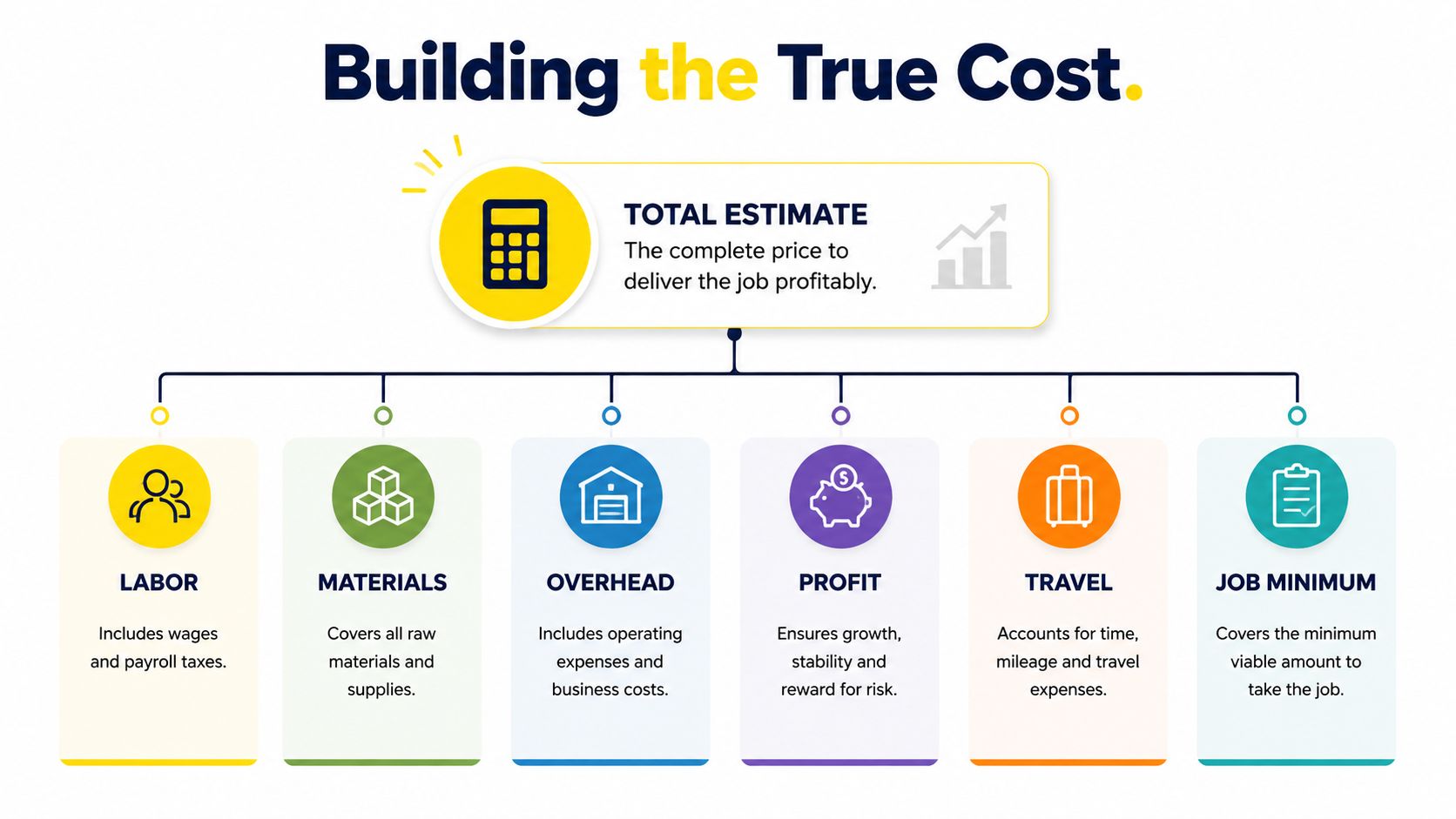
Cost-control check: Cutting labor out of the math doesn't make a job efficient. It makes the business subsidize the customer.
If labor productivity is weak, fix the process before lowering the estimate. Review equipment layout, route planning, training, and supply usage. A resource such as Value Tools Co cost reduction can help owners think through labor efficiency without pretending that lower pricing solves an operational problem.
Build the model in a spreadsheet first. A dedicated labor cost calculator for cleaning businesses can then make the calculation easier to repeat, audit, and hand off to a salesperson.
No single pricing model fits every window-cleaning job. Per-pane pricing works well when the operator can count openings accurately. Per-job pricing suits properties where square footage, linear feet, or a defined service package better represents the workload. Recurring-contract pricing works when regular maintenance reduces buildup and creates predictable scheduling.
| Model | Best For | Formula | Example Result |
|---|---|---|---|
| Per pane | Detached residential homes | Pane count × base pane rate + access and service additions | A defensible total after screens, tracks, access, labor, and overhead |
| Per job | Storefronts or larger properties | Base service scope + measured labor and site adjustments | One estimate for the defined property or route |
| Recurring contract | Quarterly maintenance accounts | Regular service price less a documented recurring discount | A lower per-visit estimate with agreed frequency and scope |
For a 24-pane, two-story home with interior and exterior glass, screens, and tracks, start with measured production time. Suppose your field test shows 30 labor minutes per pane, including the defined screen and track scope. That is 720 labor minutes, or 12 labor hours. Do not invent a labor rate for the customer-facing estimate. Insert your fully loaded hourly labor cost from the cost model.
The calculation becomes:
12 labor hours × loaded labor rate + materials + overhead + travel + target profit = residential estimate
If the first cleaning requires heavier soil removal or unusual setup, price it separately. Industry pricing guidance commonly recommends first cleans at 1.5 to 2 times the regular rate because initial visits often require more preparation and detailed work, as explained in this window-cleaning cost guide. Your estimate should state why the first visit differs.
Residential estimate = (measured labor hours × loaded labor rate) + per-job materials + travel + overhead allocation, then add target profit and check the minimum
For a small commercial storefront, count each service opening and record interior, exterior, frame, and access requirements. If a storefront has six openings and your production test assigns 15 minutes per opening, the measured labor is 90 minutes before travel, setup, materials, overhead, and profit. The final estimate should use your loaded labor rate, not a generic hourly figure.
A minimum service fee remains necessary for small commercial and residential calls. If the calculated amount falls below your minimum, charge the minimum or decline the route. Don't let a tiny job consume a prime appointment window.
For a broader perspective on selecting and testing pricing structures, use these business pricing strategies as a planning reference.
Access and condition deserve their own line items because they create work the basic pane count can't see. A second-story window isn't automatically difficult, but a second-story window above a retaining wall, behind landscaping, or over a slippery roof surface is a different job.
Price adjustments should connect to added time, equipment, or risk. Use a base rate for standard work, then add a documented surcharge for ladder setup, higher stories, roof-pitch surfaces, French panes, storm windows, security bars, or blocked openings. You can use a percentage multiplier when your time records support it, or a fixed add-on when the task is easy to isolate.
Condition changes the estimate as much as height. Cobwebs, paint specks, construction debris, mineral deposits, and post-renovation dust may require scrapers, brushes, chemical dwell time, or careful testing. Hard-water treatment should never be included without disclosure, especially when deposits may have etched the glass or when restoration results can't be guaranteed.
Present the adjustment before approval:
The visual guide may show examples such as ladder work at +15 percent, second-story work at +10 percent, third-story work at +20 percent, roof-pitch surfaces at +25 percent, and exterior screen removal at +$3 per window. Treat those figures as menu examples, not universal prices. Your own estimate should use tested adjustments that reflect actual labor and risk in your market.
A homeowner shouldn't discover at the end that screen cleaning, track detailing, mirror wiping, skylights, gutter clearing, or interior window work was assumed. Put each upgrade in the proposal as included, excluded, or optional.
Recurring maintenance can support a different adjustment because regular service usually involves less buildup. One pricing guide reports that monthly, quarterly, or semi-annual contracts commonly receive 10 to 25 percent off compared with one-time cleaning, as described in this recurring window-cleaning pricing guide. Apply a discount only after confirming that the recurring route and scope remain profitable.
A good proposal turns internal math into a customer decision. It should identify your business, include license information where applicable, define the scope in plain language, and show the exact pane count and access assumptions behind the estimate.
Place the customer's property details near the top. Then list interior and exterior glass, screens, tracks, sills, access notes, scheduling window, expected duration, payment terms, cancellation policy, exclusions, and signature lines. A homeowner should know what happens if weather interrupts the visit or if the crew finds damage that existed before service.
Here's a realistic structure for a two-story home:
Window Cleaning Estimate
Don't promise restoration when you're only providing cleaning. State that mineral deposits, paint specks, or construction residue may require a separate assessment and that results depend on the glass condition. This language is direct, fair, and much safer than burying exclusions in fine print.
A branded PDF should stay within one or two pages. Use headings, bullets, photographs from the site visit, itemized scope, and a clear approval button or signature area. Send it promptly, then follow up while the property details are still fresh for the homeowner.
This short video can help owners think through the presentation and customer experience of a service estimate.
Once your estimating rules work on paper, put them into a repeatable workflow. Estimatty can capture window count, pane size, access notes, service frequency, screen requirements, and other intake details, then use configured pricing rules to send a customer estimate by email or SMS.
Set conditional logic for height surcharges, add-on toggles for screens and sills, and automatic job minimums for visits below 30 panes. Connect the workflow to your CRM so every inquiry receives a status, follow-up task, and record of the assumptions used. For owners comparing automated tools, AI estimate software for cleaning businesses provides a useful reference point.
Automation doesn't replace judgment on unusual properties. It makes the standard work consistent, exposes missing inputs, and gives prospects a faster response. Treat software setup like any other business investment, and check your training investment before committing resources to a process your team won't maintain.
Estimatty helps cleaning businesses turn measured service inputs into consistent estimates, capture leads after hours, and send pricing through SMS or email without relying on gut feel. Visit Estimatty to build a faster window-cleaning estimate workflow that protects your minimums and keeps follow-up moving.