October 12, 2026
Cleaning Office Prices: A Practical Pricing Guide for 2026
Learn how cleaning office prices really work in 2026. Compare per square foot, hourly, and monthly models, plus tips to estimate and present winning quotes.

Saturday, February 28, 2026
Discover how to use a move-out house cleaning cost calculator to generate accurate quotes that convert estimates into bookings for your cleaning business.
.png)
Still relying on a "gut-feel" to price a move-out clean? It's a high-risk gamble that leaves you guessing how much to charge, and frankly, it’s costing you more than you think. A move-out house cleaning cost calculator takes the guesswork out of the equation, giving you instant, data-driven estimates that protect your profits and actually win more jobs.
Let's be real. In the high-stakes world of move-out cleaning—where security deposits and landlord inspections are on the line—imprecise estimates are silent profit killers. Every single time you price a job based on a "feeling," you're either underbidding and working for free or overbidding and scaring away a perfect lead.
I’ve seen this exact scenario play out countless times. One business owner I know was consistently underpricing large homes by just $50, figuring it wasn't a huge deal. But over a year, that tiny "miss" snowballed into thousands of dollars in lost revenue—money that could have gone toward new equipment or hiring great cleaning employees through a service like pipehirehrm.com. This isn't just about a few bucks; it's about building a sustainable, profitable business.
Relying on manual, gut-feel estimates does more than just chip away at your profit margins; it slowly erodes your reputation. Imagine a client finds out their neighbor paid a different price for a nearly identical apartment clean. Right away, it feels unprofessional and arbitrary. That kind of inconsistency kills trust and makes it impossible to scale your business with any kind of predictability.
An inconsistent estimate process is like trying to build a house on a shaky foundation. Without standardized pricing, every new lead becomes a new risk, and your business can never achieve predictable growth.
A reliable move-out house cleaning cost calculator isn't some fancy add-on anymore—it's the core engine for profitability. When you can fire back an accurate, instant estimate, you look like a pro and lock in the lead before your competition can even pick up the phone.
The demand for these services is exploding. Just look at the numbers:
When we talk about the financial impact, the difference between old-school estimating and a modern calculator is stark.
Here's a breakdown of the real-world costs of sticking with manual estimates versus the gains you'll see with an automated tool like Estimatty.
The numbers don't lie. Sticking with manual estimates is like choosing to walk when your competitors are driving a sports car. You're simply getting left behind.
Automating your estimating process with a move-out house cleaning cost calculator completely changes the game. Instead of you spending hours on the phone or stuck in email chains just to gather basic info, you empower clients to get their own instant estimate, whenever they want. This not only frees you from administrative hell but also gives modern customers the immediate answers they expect.
Once you formalize your pricing strategy, you can confidently figure out how much to charge for cleaning services in any situation. This shift from guesswork to a data-driven system is the single most powerful step you can take to secure your company's financial health and grab a bigger piece of this booming market. It’s how you turn casual website visitors into confirmed, profitable jobs on your calendar.
Let's get down to the engine of your move-out house cleaning cost calculator: the pricing formula. A powerful formula isn't static; it's a dynamic tool that adapts to the unique details of every single job. This is how you produce estimates that are consistently fair to the customer and, just as importantly, profitable for you. It's time to move past rigid, one-size-fits-all pricing and build a system that truly reflects the work involved.
The foundation of a great formula rests on three key inputs from the client: the home's square footage, the number of bedrooms and bathrooms, and the condition of the property. These variables work together to give you a surprisingly accurate picture of the labor required before your team even grabs their supplies.
First things first, you need to establish a base rate for your local market. Think of this as the minimum price for any move-out job, covering your travel, setup, and other basic overhead. It's often helpful to see how other service industries handle this. For example, looking at a comprehensive moving cost calculator can spark some great ideas on how to structure your own variable inputs.
With your base rate in mind, you'll need to decide on the core of your pricing model:
The smartest calculators find a way to blend both. You can offer a flat-rate price to the customer that is internally calculated based on your estimated hours. This gives the client a fixed price they can budget for, while you’ve already made sure your labor costs are covered.
This is the difference between just guessing on your prices and using an automated, data-driven system to protect your bottom line.
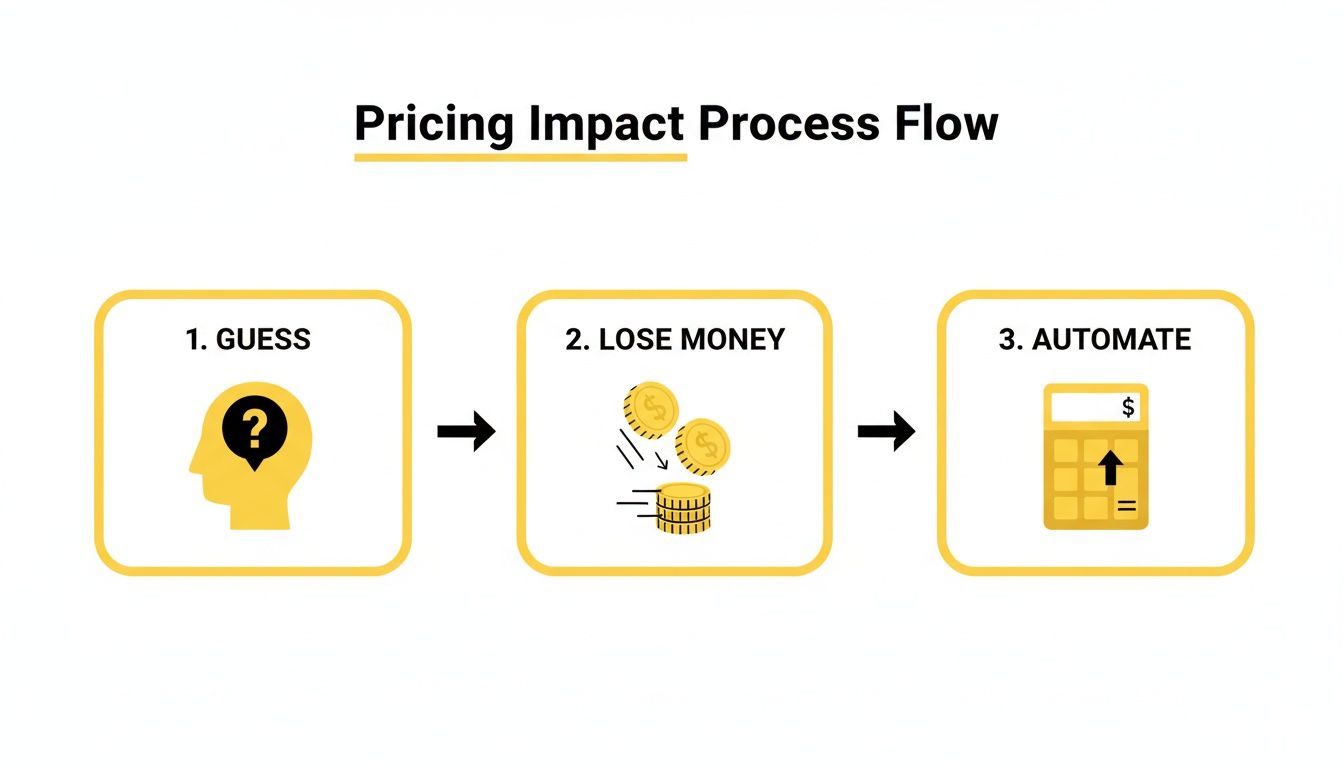
Automating your estimates is what moves your business from financial guesswork to calculated profitability.
So, how does this look in practice? Let's walk through a common scenario: a 1,200 sq ft, 2-bed/2-bath apartment.
A simple but effective formula might look something like this:
Base Price + (Square Footage * Rate) + (Per Bathroom Fee) + (Condition Multiplier)
Now, let's plug in some realistic numbers. We'll use a $50 base rate, a $0.15 per sq ft charge, and a $30 fee per bathroom.
Example 1: The 'Light' Condition Job
Imagine a tenant who kept their apartment pretty tidy. They select 'light condition' on your calculator. The math is simple:
$50 (Base) + $180 (1200 sq ft * $0.15) + $60 (2 baths * $30) = $290 estimate
This approach makes sure you're paid for both the overall space and the extra-detailed work that bathrooms always demand. If you want to dive deeper into structuring your prices, our guide on creating estimates for house cleaning is a great resource.
This is where your calculator really starts to shine. The "condition multiplier" is your secret weapon, protecting you from those nightmare jobs where tenants have left a complete disaster behind.
Example 2: The 'Heavy' Condition Job
Now, picture a tenant in an identical apartment who admits the place needs some serious TLC. They select 'heavy condition'. You can automatically apply a 1.3x multiplier to the parts of the job that require the most labor.
$50 (Base) + ($180 + $60) * 1.3 = $362 estimate
That's an instant adjustment of $72, covering the extra hours, supplies, and elbow grease your team will need. This data-driven approach is absolutely critical. From experience, I can tell you that manual estimating often leads to 15-25% underpricing, and the subsequent back-and-forth can eat up 2-3 hours of admin time every single day.
In major US cities, a move-out clean can easily range from $250-$600. This often breaks down to $0.20-$0.40/sq ft or $25-$40/hour per cleaner. It's a global trend, too, with the UK cleaning industry projected to hit an incredible $24.53 billion by 2026.
By building these smart formulas directly into an Estimatty booking widget, every potential client gets an intelligent, profitable, and instant estimate. This is how you stop losing money on bad estimates and start building a more resilient cleaning business.
A standard move-out clean gets your foot in the door, but let's be honest—the real money is in the add-ons. These optional services are your secret weapon for turning a basic job into a highly profitable one. When you build them into your move-out house cleaning cost calculator, it transforms from a simple pricing tool into a persuasive sales machine.
The key is making it dead simple for clients to see the value and add what they need. When a customer can click a button, select a service, and watch their estimate update instantly, you’ve removed all the friction. This interactive experience naturally guides them toward a more comprehensive package, which means a bigger ticket for you and a sparkling clean home for them. It’s a genuine win-win.
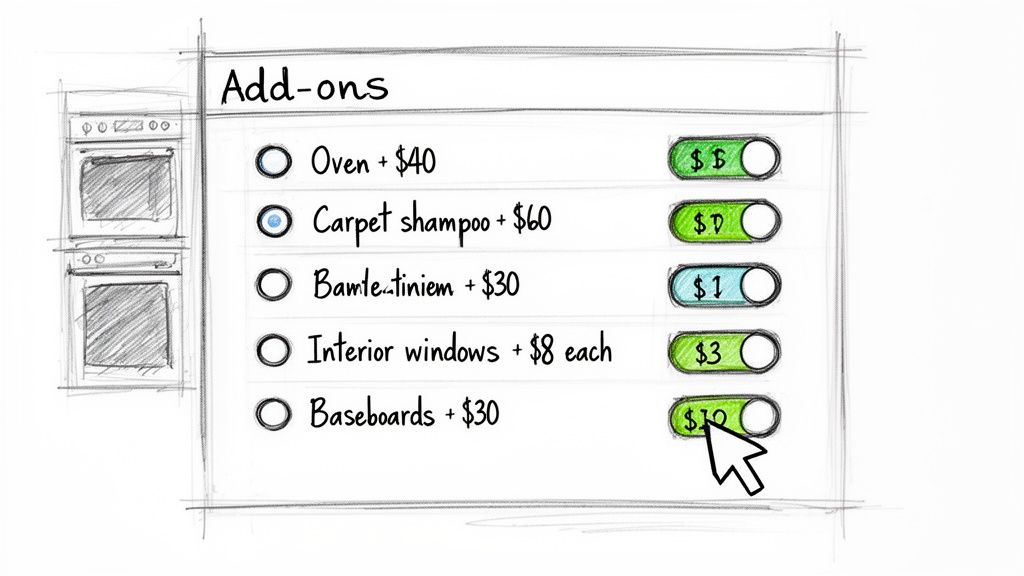
Look, everyone and their brother offers "inside the fridge" and "inside the oven" cleaning. While those are absolutely essential, you have to think bigger to really maximize your revenue. You want to offer services that solve the biggest headaches for tenants fighting to get their full security deposit back.
I've found these are some of the most profitable options to build into a calculator:
The magic happens when your calculator seamlessly presents these choices. A customer can build their own custom cleaning in a few clicks, which empowers them and quietly boosts your average job value.
A well-designed add-on menu does more than just list extra services. It shows the client what a truly move-in-ready property looks like, positioning you as the expert and making them far more likely to invest in a complete, top-to-bottom clean.
When it comes to pricing your add-ons, you’ve got two main approaches. From my experience, using a mix of both is the most effective strategy. It keeps your pricing logical and easy for customers to grasp—a confusing menu is the fastest way to get an abandoned booking.
This is your go-to model for tasks that take a predictable amount of time and effort, no matter the size of the house. The price is fixed, which gives the client total transparency.
For services where the workload scales directly with quantity, this model ensures you're paid fairly. It just makes sense.
By offering a mix, your estimates stay profitable for you and crystal clear for your customers. For a deeper dive into all the variables that go into your pricing, you can check out our comprehensive guide on the average house cleaning cost.
To pull this all together, here’s a sample pricing menu you could build right into your Estimatty calculator. This structure is designed to be clear, profitable, and incredibly easy for a customer to navigate.
Integrating these kinds of add-ons into your move-out house cleaning cost calculator is one of the quickest ways to increase your revenue per job. You aren't just selling cleaning; you're selling a complete, stress-free solution that gives tenants peace of mind and helps them get their deposit back. That’s a powerful promise.
A brilliantly designed move-out cleaning calculator is a waste if it’s not working for you around the clock. This is where you connect the dots, turning your website from a static brochure into a sales machine that never sleeps. It's not enough to just have the tool; you have to put it right where your clients will see it and hook it into a system that captures every single lead.
The real goal here is to build a seamless bridge from the moment a potential customer lands on your site to the second a hot lead hits your inbox. This is how you stop trading your time for tedious admin work and start generating revenue, even when you're off the clock.
I can't stress this enough: where you put your calculator is just as important as the formulas running it. You need to make finding it ridiculously easy for visitors, no matter how they found your site. Hiding it on some back page is a recipe for missed opportunities.
Your calculator needs to be in these non-negotiable spots:
Think like your customer for a second. When someone needs a move-out clean, they're usually stressed and in a hurry. Making them hunt for your pricing is the fastest way to lose them to a competitor who makes it easy.
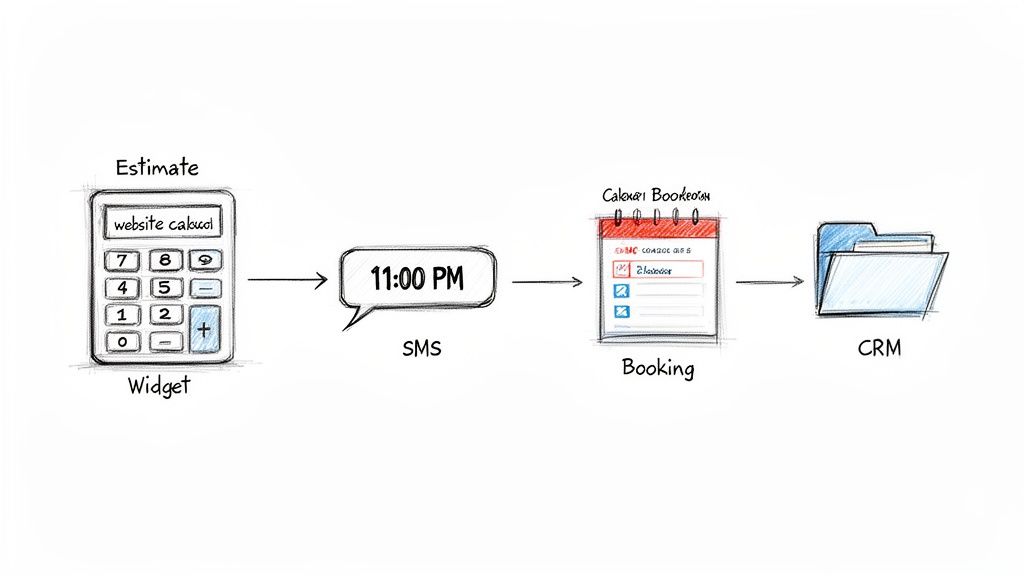
This is where modern tools completely change the game for cleaning businesses. A simple "contact us" form is passive; an automated system is an active sales partner. Platforms like Estimatty do more than just give you a calculator widget—they automate the entire workflow that comes after the click.
Picture this common scenario: It's 11 PM on a Friday. A tenant who just got their landlord's move-out checklist starts frantically searching for cleaners. They find your site, use your move-out house cleaning cost calculator, and instantly get a professional-looking estimate sent to their phone via SMS and email.
You wake up Saturday morning not to a cold voicemail, but to a hot lead notification in your inbox. It has all the job details, their contact info, and the exact estimate they received. The system did all the heavy lifting for you while you slept.
This isn't some luxury reserved for massive corporations anymore. It's a crucial, accessible tool for solo cleaners and growing teams alike. The data is clear: for multi-location brands, inconsistent manual estimating can cost them up to 25% of bookings, and old-school contact forms see a staggering 70% abandonment rate. An instant estimator fixes this by engaging clients immediately, delivering a precise estimate (like €350 for a 100 sq m property with an oven add-on), and cutting down on endless phone tag by 50%.
The final piece of the puzzle is integrating your estimate tool with the other software that runs your business, like your CRM or scheduling calendar. This creates a powerful, hands-free pipeline from the first click all the way to a confirmed job on your schedule.
Maximizing the revenue from this automated system comes down to applying solid conversion rate optimization best practices. Once a lead is captured, you can use integrations to:
This creates an efficient system that nurtures leads and turns them into paying customers, all without adding to your daily workload. As you start landing more of these jobs, finding reliable staff becomes the next challenge. A specialized hiring platform like pipehirehrm.com is an excellent resource for sourcing vetted cleaning pros. To see another angle on this, our article on building a general cleaning estimate calculator provides some extra helpful context.
So, your move-out house cleaning cost calculator is officially live on your website. That's a huge win! But don't pop the champagne just yet—getting it online is just the beginning. The real magic happens now, in the fine-tuning. This is where you transform a neat tool into a powerhouse asset that builds rock-solid client trust and keeps your business profitable.
The moment your calculator starts spitting out its first few automated prices is a golden opportunity. This isn't a "set it and forget it" gadget. You have to get your hands dirty and actively test its accuracy against real-world jobs. This is how you make sure the numbers work for you and for your clients.
Think of your first handful of calculator-booked jobs as live case studies. Once the work is done, pull up the automated estimate and compare it directly with the actual time and resources your team spent on-site.
Did that 'heavy condition' fee really cover the extra elbow grease? Was your per-window charge enough to justify the labor involved? These initial jobs will give you immediate, unfiltered feedback.
By comparing your numbers to reality, you'll spot where you need to make small, but crucial, adjustments. Maybe your base rate needs a tiny bump, or perhaps a specific add-on is underpriced. These data-backed tweaks are what separate a decent calculator from a truly great one.
The goal isn't just to generate a number; it's to generate the right number. Constant refinement based on actual job data is what protects your profit margins and turns your estimates into a reliable foundation for your entire operation.
For instance, if a move-out clean for a 1,500 sq. ft. house consistently takes an hour longer than your calculator predicted, that's a red flag. It’s a clear signal to dive back into your formula. Maybe your per-square-foot rate is a touch too low, or you need a new variable for homes that require more than two cleaners, which you can find using a tool like pipehirehrm.com.
The words you choose are just as important as the numbers you calculate. This is a simple but profound shift that can prevent countless headaches and misunderstandings down the road.
Here's a non-negotiable rule: always, always use the word "estimates" instead of "quotes."
This simple vocabulary change manages expectations from the very first click. It tells clients you're being transparent and fair based on what you know, but you reserve the right to adjust if the job is bigger than described. It's professional, and it's just good business.
Transparency is everything. Your calculator needs a clear, easy-to-read disclaimer that explains exactly what the estimate covers and, just as importantly, what it doesn't. This isn't about burying sneaky fine print; it's about being upfront and professional.
A client might not have any idea that a move-out clean can range from $90 for a tidy studio to $500 for a neglected larger home. Your disclaimer should state that the online estimate is based on the client's input and assumes standard cleaning conditions for the level they chose. You have to clarify that extreme conditions (think hoarders, biohazards, or years of grime) will require a revised, on-site estimate.
Consider adding simple, direct language like this right below your calculator:
This protects your bottom line from those nightmare jobs while showing clients you run an honest ship. For more ideas on how to phrase your terms and conditions, checking out a free cleaning estimate template can give you some great starting points.
By constantly testing your calculator, choosing your words carefully, and being totally transparent with disclaimers, you elevate your tool from a simple pricer to a cornerstone of your customer experience. It becomes a system that doesn't just work—it actively builds the trust that turns prospects into loyal, long-term clients.
Alright, let's talk about the real-world headaches and "what-ifs" that come with putting a price calculator on your website. You're smart to be cautious. You want to make sure this new tool protects your time, your profits, and the great reputation you've worked so hard to build. I get it.
So, let's dive into some of the most common questions I hear from cleaning business owners when they're on the verge of automating their estimates. These are the things that keep you up at night, and I've got some practical, battle-tested advice for you.
This isn't a "what if"—it's a "when." This is probably the number one fear I hear, and it's completely valid. A homeowner's idea of "a bit messy" and our professional reality are often two different planets.
The key is building flexibility and clear communication into your entire system, right from the first click.
Your terms of service, which absolutely must be displayed next to the calculator, need to be crystal clear. State that the estimate is based on the client's own description and assumes a "standard" level of grime. Most importantly, your policy must give your team the power to do a quick walkthrough the moment they arrive.
If the house is a disaster zone far beyond what was described, the process should be simple: pause, snap a few photos to document the situation, and immediately call the client. You'll explain the discrepancy and provide a revised, fair price for approval before a single surface is cleaned. A tool like Estimatty is a lifesaver here, as it automatically bakes these disclaimers into the initial estimate it sends out. This creates a professional paper trail from the get-go.
Why choose? The most profitable and accurate move-out cleanings are priced using a hybrid model. Relying on just one metric is a classic rookie mistake that either leaves money on the table or leads to wildly inaccurate estimates that scare customers away.
Here’s how to think about it:
The winning formula is to use square footage for the base price, then add a flat-rate upcharge for each bedroom and a more significant upcharge for each bathroom. This way, you're paid for both the overall space and the detailed, high-effort areas. A smart move-out house cleaning cost calculator can handle this kind of multi-variable formula without breaking a sweat, giving you the best of both worlds.
The most bulletproof pricing model I've seen in my years in this business is one that blends square footage with room counts. It’s the only way to truly account for the scale of the job and the pockets of intense labor that define a move-out clean.
Ah, the sweet problem of success. Automating your booking is amazing, but it shines a harsh light on your next bottleneck: staffing. When your calculator starts booking jobs at 2 a.m., you'd better have a plan for finding great cleaners.
Stop wasting time with generic job boards. It’s like fishing in the ocean for one specific type of fish. Instead, go where the pros are. Using a specialized platform built for the cleaning industry is far more efficient. For example, a resource like PipeHire connects you directly with vetted cleaning pros who are actually looking for work in our industry. It cuts through the noise and saves you a ton of time.
By leaning on a dedicated hiring tool, you can get back to managing your booming sales pipeline. You'll have the confidence that comes from knowing you have a reliable source of qualified team members ready to tackle all the new work. If you want more tips on this, check out the specialized insights over at the PipeHire blog.
You can't build a fortress around your prices, and honestly, you shouldn't try. The goal isn't to be secretive; it's to be smart. You want to make it a little inconvenient for your competitors while making it dead simple for your actual customers.
First, require an email address and phone number to see the final price. This is a small but powerful hurdle. A nosy competitor might think twice, but a serious customer will see it as a normal step. The best part? You just turned a curious visitor into a warm lead that you now have permission to follow up with. That's a win.
Second, and this is the real game-changer, shift your focus from the price tag to the total experience. A competitor can copy your numbers, but they can't easily replicate your seamless, professional service. When a system like Estimatty delivers an instant SMS and email estimate, sends automated follow-ups, and offers one-click booking, you're not just selling a clean—you're selling confidence and convenience. That exceptional service is your true moat, your real competitive advantage.
Ready to stop the guesswork and start scaling your business? Estimatty gives you the AI-powered calculator and automated booking system that turns your website into a sales machine that never sleeps. Get instant, profitable estimates, capture more leads, and build the professional, in-demand cleaning business you've always dreamed of.