
October 15, 2026
7 Anchorage House Cleaners: Pricing and Booking Tips
Compare seven Anchorage house cleaners by service type, estimate process, and booking ease, with tips for choosing a local team.

Friday, October 16, 2026
Understand journeyman electrician license requirements, training hours, and reciprocity rules. Learn how jurisdiction impacts scope and hiring decisions.

The most popular advice about a journeyman electrician license is also the most dangerous: complete the hours, pass the exam, and assume the credential follows you wherever the work is. It doesn't. A journeyman credential is a jurisdiction-specific permission to perform defined electrical work, and the same title can carry different scope, renewal, supervision, and portability rules from one location to the next.
That distinction matters to apprentices planning a career, contractors assigning crews, clients reviewing estimates, and estimators costing projects across borders. A license card can demonstrate meaningful training while still failing to authorize the exact installation, location, or contract arrangement in front of you.
A journeyman electrician license isn't a universal national or international qualification. In the United States, a journeyman electrician typically reaches that level after completing a structured apprenticeship lasting 4 or 5 years, representing approximately 8,000–10,000 hours of practical training, yet licensing remains decentralized with substantial variation in exam structure and permitted scope by jurisdiction. The U.S. Bureau of Labor Statistics overview of electrician requirements also distinguishes apprenticeship completion from unrestricted practice, because state and local rules determine whether the worker may operate independently.

One jurisdiction may treat the credential as permission for independent field work under defined conditions. Another may require a local registration, a separate contractor license, or additional proof that the applicant passed a qualifying examination. Some locations recognize a journeyman classification at the state level, while others leave individual electrician licensing mainly to cities, counties, or provinces.
Canada shows the same problem in a different form. Federal Job Bank guidance describes a 4- or 5-year apprenticeship as the usual route for industrial electrician trade certification, but whether certification is compulsory depends on the province, territory, and specialization. Construction-electrician certification is compulsory in some jurisdictions and voluntary in others, so the word “certified” doesn't answer the practical question by itself.
Practical rule: Treat “journeyman” as the beginning of your verification process, not the end.
For a business, the risk appears during hiring and estimating. A worker who is properly credentialed in one place may need a new application, exam, or local authorization before legally starting work elsewhere. The license's issuing authority, classification, restrictions, and permitted scope can affect staffing, scheduling, insurance, and whether an estimate can legally be fulfilled. Contractors comparing broader licensing obligations can also review requirements for a contractor's license, but the issuing authority remains the final source for current rules.
“Four years of experience” sounds precise until you ask what the applicant did during those years. Regulators may count supervised hours, classroom instruction, commercial or industrial work, approved education, military service, or documented experience in a particular category. Two applicants can each present 8,000 hours and still receive different answers because the composition of those hours isn't equivalent.
Colorado illustrates the point clearly. Applicants must document four years or 8,000 hours of apprenticeship or practical wiring experience, including at least two years or 4,000 hours in commercial, industrial, or substantially similar work, according to the cited licensing requirements. Total time alone doesn't establish eligibility.
| Jurisdiction | Total Hours Required | Specific Composition Rules | Education/Military Credit |
|---|---|---|---|
| United States apprenticeship pathway | Approximately 8,000–10,000 practical hours | Usually paired with structured supervised training and technical instruction | Credit depends on the applicable authority |
| Nebraska | 8,000 hours for the standard experience threshold | Verifiable electrical-trade experience; fewer than 4,000 in-state hours can lead to a restricted, nonreciprocal classification | Approved two-year electrical technology education can provide one year of experience credit; qualified military experience may count |
| Colorado | 8,000 hours over four years | At least 4,000 hours in commercial, industrial, or substantially similar work | The relevant experience category matters more than total hours alone |
| Texas | 7,000 hours to take the examination, 8,000 hours for final licensure | Hours must be completed under a Texas-licensed master electrician | The examination milestone doesn't replace the final experience requirement |
The Nebraska experience and reciprocity requirements are detailed by the Nebraska State Electrical Board. Texas makes another important distinction. An applicant may qualify to take the examination after documenting 7,000 hours of supervised on-the-job electrical training, but must ultimately document 8,000 hours to qualify for the license, as explained by the Texas Department of Licensing and Regulation.
Strong demand doesn't automatically create an easy route into licensure. In the United Kingdom, the electrical workforce grew only marginally in 2025, from 160,200 to 161,300, remained about 25% below its 2018 level, and JTL estimated that roughly 12,500 apprenticeship starts are needed annually compared with fewer than 7,000 expected in 2025/26, according to Professional Electrician's coverage of the electrical skills gap. Australia's National Centre for Vocational Education Research reported that trade apprenticeship commencements fell 4.2% in the 12 months to December 2025, in the same verified source material.
The practical lesson is blunt. A job opening isn't the same thing as a compliant training position. New entrants should compare paid apprenticeships, recognition of prior experience, military or overseas documentation, and classroom requirements before choosing a route. Employers should maintain hour records by work type, supervisor, location, and date, rather than relying on a résumé summary. For a clearer look at available top electrician training paths, compare the program's documentation standards with the authority where you intend to work. Budgeting for applications and credentials also belongs in project planning, alongside resources such as contractor license cost guidance.
An apprentice, journeyman, and master electrician aren't interchangeable labor categories. They represent different combinations of training, supervision, examination, responsibility, and legal authority. Treating them as simple seniority labels creates problems when a contractor assigns work, pulls permits, or represents qualifications to a client.
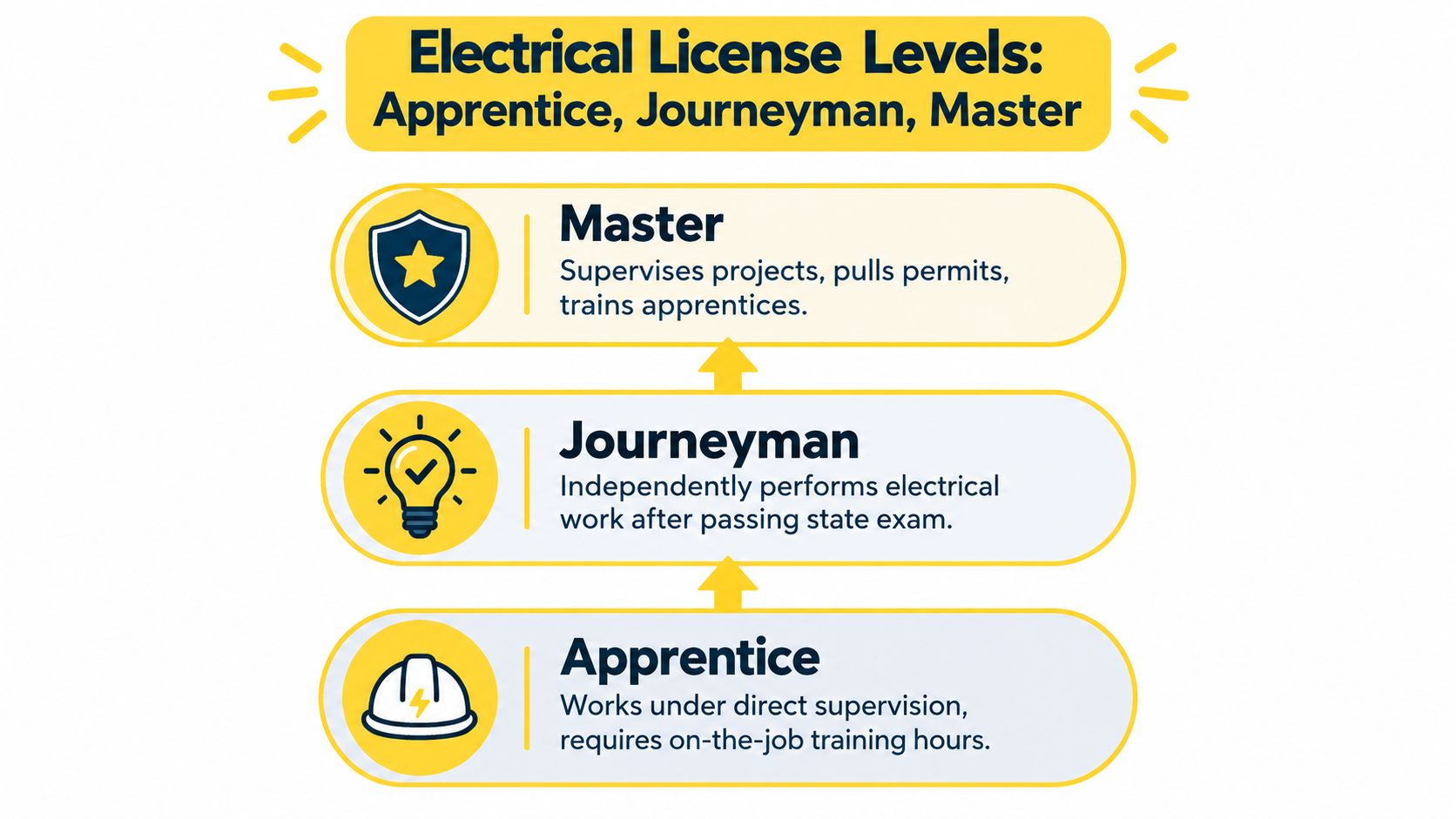
An apprentice develops practical skill through supervised field work and technical instruction. The apprentice's work must follow the applicable supervision and registration rules, and the employer needs records showing who provided oversight and how the hours were earned.
An apprentice isn't a lower-paid journeyman. Assigning independent work outside the permitted supervision arrangement can expose the employer to compliance action and create questions about whether the work was performed lawfully.
A journeyman has generally completed the required training pathway and passed the applicable examination, but the credential doesn't automatically grant every authority associated with electrical contracting. Depending on the jurisdiction, the journeyman may perform work independently within a defined scope while lacking authority to design all systems, pull every type of permit, supervise every worker, or operate a contracting business.
A master classification commonly carries broader responsibilities involving supervision, planning, permits, technical oversight, or responsibility for a contracting business. The exact legal meaning still varies, so a master title from one jurisdiction shouldn't be treated as a complete substitute for local contractor registration.
A useful analogy is medical training. A resident may perform important clinical work under a defined structure, while an attending physician carries broader responsibility. The analogy isn't perfect, but it makes the operational point: competence in one task doesn't automatically confer authority over the entire project.
Assign the worker to the scope the credential permits, not the scope the title seems to imply.
Before placing a role in a hiring plan, write down the expected tasks, supervision arrangement, permit responsibility, and required license class. A precise sample job posting can distinguish apprentice duties from journeyman field execution and master-level oversight, reducing ambiguity before the first shift.
“Reciprocity” rarely means automatic permission to work. It usually means a jurisdiction may recognize an out-of-state credential if the applicant satisfies conditions involving the issuing authority, exam history, license tenure, experience composition, good standing, or similarity of standards.
Oregon demonstrates the conditional model. Reciprocal applicants must come from jurisdictions with substantially similar criteria, including four years of apprenticeship education, at least 576 classroom hours, and 8,000 supervised trade hours, according to the Oregon Building Codes Division reciprocity rules. Colorado requires a current license in good standing, a state-administered examination, and at least one year holding the credential. A license obtained through grandfathering doesn't qualify under that stated pathway.
Nebraska adds another filter. Reciprocity requires a score of at least 75% on the state examination for the license being reciprocated, alongside documented registration and experience requirements. The transferred license must have been held in good standing for at least one year, and the applicant must have passed a state examination before the credential can qualify.
Before accepting a project or relocating a worker, ask these questions in order:
Maryland is a particularly important counterexample because it generally doesn't reciprocate out-of-state journeyperson licenses, except under limited conditions involving local-jurisdiction credentials and currently Virginia reciprocity. That single example should stop any estimator from building a national labor pool on the assumption that neighboring credentials transfer.
Portability affects more than paperwork. A failed reciprocity application can force re-testing, delay mobilization, alter labor availability, and invalidate assumptions in an estimate. It can also create insurance and permit questions if the assigned worker lacks the exact authority required for the project. Businesses operating in cleaning, maintenance, or facility services should apply the same discipline to subcontracted electrical work as they would to other regulated vendors, including the license considerations discussed in cleaning business license guidance.
A license check should answer more than “Does this person have a card?” The useful question is whether the credential is active, authentic, unrestricted where necessary, and legally matched to the work being estimated.
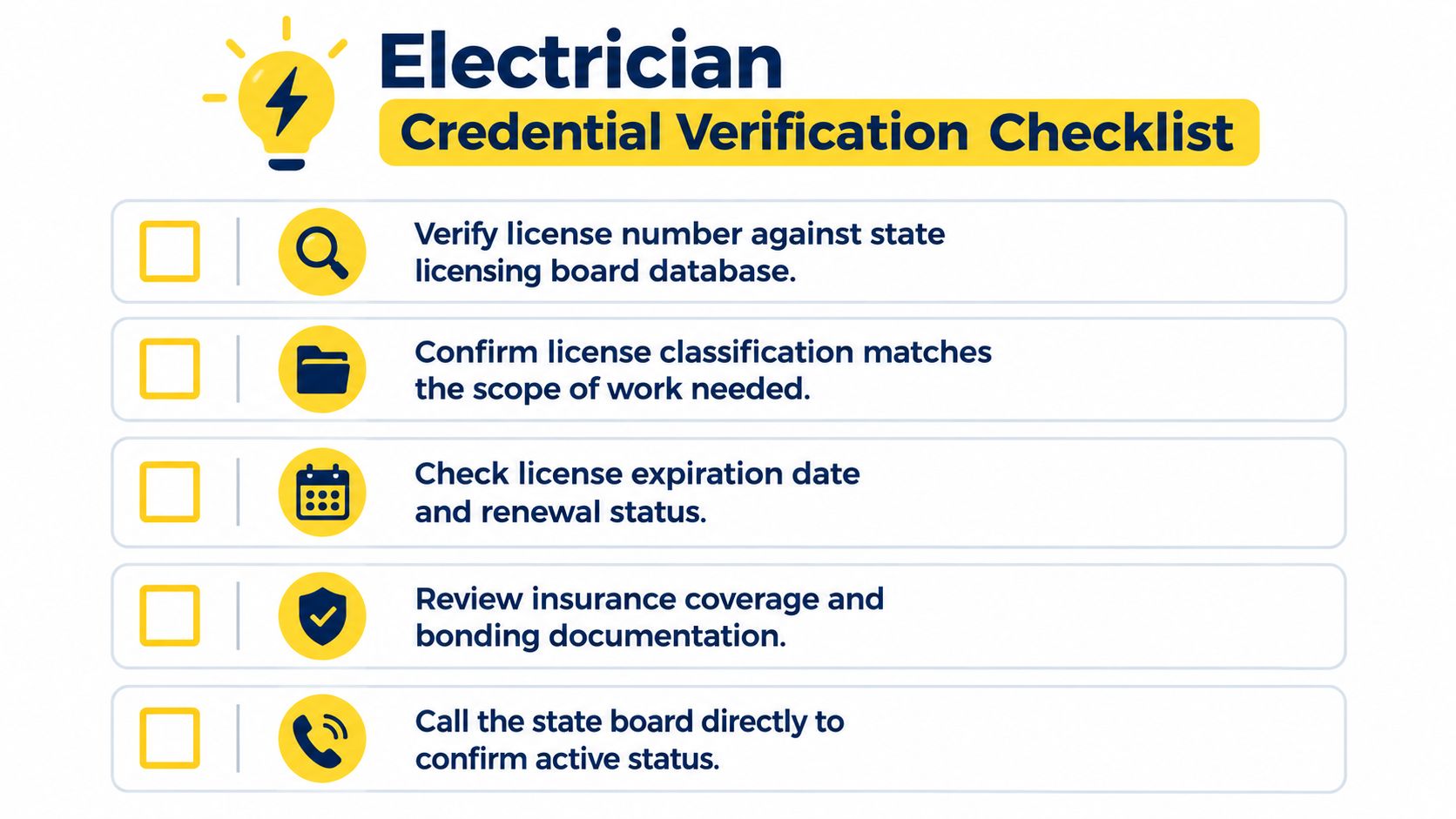
Use a repeatable workflow:
Nebraska's distinction between unrestricted eligibility and restricted, nonreciprocal classifications shows why a simple active-status check can be insufficient. An active license may still limit mobility or permitted work. Keep the verification record with the bid file, purchase order, or employee onboarding documents, alongside broader operating controls such as a policies and procedures manual.
A journeyman credential is a maintained authorization, not a permanent achievement. Renewal dates, continuing education, fees, late penalties, and reinstatement rules can affect whether a worker remains deployable on an active project.
Texas provides a clear example. A Texas journeyman electrician license is valid for one year, and renewal requires four hours of continuing education during each license cycle. The standard non-refundable renewal fee is $30. For an expired credential, the listed fee is $45 when expired 90 days or less, and $60 when expired 91 days through 18 months or more than 18 months but less than 36 months. A license expired 36 months or longer isn't eligible for the listed renewal process, according to the Texas renewal requirements.
Individual electricians should save completion certificates, renewal receipts, and board correspondence in one controlled record. Employers should track each worker's issuing authority, renewal date, education status, restrictions, and project assignments. A calendar reminder alone is weak protection because it doesn't prove that the required education was completed or that the renewal was accepted.
Some education systems use different terminology for continuing education units and professional development hours. Teams responsible for multiple credentials can use resources explaining how to track PDH for renewal, but they still need to confirm which units the relevant authority accepts.
An expired license can remove a worker from a project at the worst possible moment. The direct cost includes administrative work and possible late fees, while the operational cost can include reassignment, schedule disruption, permit complications, and a revised labor plan. Treat renewal as a recurring business control, not a personal reminder left to the last week.
License validation belongs inside estimating, hiring, scheduling, and subcontractor management. The credential affects whether the proposed labor can legally perform the scope, whether a permit can be pulled, whether supervision is adequate, and whether the work aligns with insurance requirements.
For facility managers, property-service firms, and businesses that coordinate cleaning or maintenance teams, electrical work should trigger a specific credential review rather than an informal referral. Resources such as Paradigm International Inc. compliance advice reinforce the broader need for documented compliance processes, but electrical licensing still requires confirmation from the relevant board or authority.
A sound operational record connects the worker to the project, license classification, jurisdiction, supervision arrangement, insurance documents, and renewal status. Estimators should flag uncertain credentials before labor is priced, because a cheaper or faster worker isn't cheaper if the assignment causes a failed inspection or a delayed start.
The central point is simple: “journeyman” is a variable legal status, not a fixed skill set. Use the title as one input, then verify the authority behind it, the work it permits, and the conditions attached to it.
Estimatty helps cleaning businesses standardize service estimates, answer prospects through web and voice channels, and keep pricing consistent while your team focuses on qualified work. Visit Estimatty to see how its AI estimator can support faster lead response and more controlled operations.