November 13, 2026
Deep Cleaning vs Regular Cleaning: What Changes and When
Deep Cleaning vs Regular Cleaning compared on scope, time, frequency and cost, with a checklist of included tasks and guidance on when to quote each.

Saturday, November 14, 2026
Commercial cleaning cost per hour in 2026: typical U.S. rates, what drives them, and how to price every bid to win work and keep margin.
A commercial cleaning cost per hour runs roughly $30 to $75 per labor hour in published U.S. pricing benchmarks, and a recent trade source puts general janitorial billing at $28 to $50 per hour. Where your building lands inside that band depends on the building itself: square footage, layout, surfaces, frequency, access hours, and how far the crew drives to reach it.
That spread is information, not sloppiness. An hourly rate is a construction. It's built from productive labor hours, the wage those hours carry, the burden stacked on that wage, the overhead that keeps the truck on the road, and the margin that carries the business through a slow month. Skip a layer and the number you send out looks competitive while it loses money on every visit.
Underpriced bids rarely come from careless owners. They come from careful owners who multiplied a wage by hours and called the result a price.
Published benchmarks put general commercial cleaning at $30 to $75 per hour, according to Rapid Eye Inspections' commercial cleaning rate research. That range offers context, not a price to copy. Your bid still has to reflect the building's scope and the labor it takes to clean it.
| Benchmark | Published range | Pricing basis | How to use it |
|---|---|---|---|
| General commercial cleaning pricing summary | $30 to $75 per hour | Hourly labor billing | Starting point for hourly bids |
| Recurring commercial cleaning | $0.05 to $0.25 per sq ft | Per square foot | Converting square footage to a monthly figure |
| Office cleaning example | $0.09 to $0.17 per sq ft | Per square foot | Benchmark for office estimates |
Treat the figures as reference points, not answers. A standard office on a recurring schedule with day-shift access may sit toward the lower end. Healthcare-grade disinfection, overnight access, heavy floor care, or specialty surfaces can add labor and push the bid higher.
No single rate fits every building. Set the price from the scope, not the other way around.
The same research places recurring commercial work broadly around $0.05 to $0.25 per square foot, with office examples near $0.09 to $0.17 per square foot. For a 10,000-square-foot office, that office range works out to roughly $900 to $1,700 per service, before accounting for frequency or special requirements.
Hourly and square-foot pricing measure different things. An hourly figure depends on crew size, travel, minimum charges, productivity, and the labor hours a visit requires. A square-foot figure depends on layout, occupancy, soil level, restroom density, surface mix, frequency, and scope. Convert both to a per-visit comparison before choosing a benchmark.
Use the closest match in the table to set an initial assumption for your estimate. Then build the bid from the actual work required.
The gap between what a cleaner earns and what a client pays isn't padding. It's the business. The U.S. Bureau of Labor Statistics occupational outlook for janitors and building cleaners reports a median wage of $17.71 per hour in May 2025, equal to $36,840 a year for full-time work. Compare that to the $30 to $50 band a client sees on the invoice.
| Percentile | Hourly wage |
|---|---|
| 10th percentile | $13.29 |
| 25th percentile | $14.59 |
| Median | $17.71 |
| 75th percentile | $19.03 |
| 90th percentile | $23.35 |
The distribution is tight at the bottom and top. Even the 90th percentile earns $23.35 per hour, well under any billable rate that keeps a company solvent.
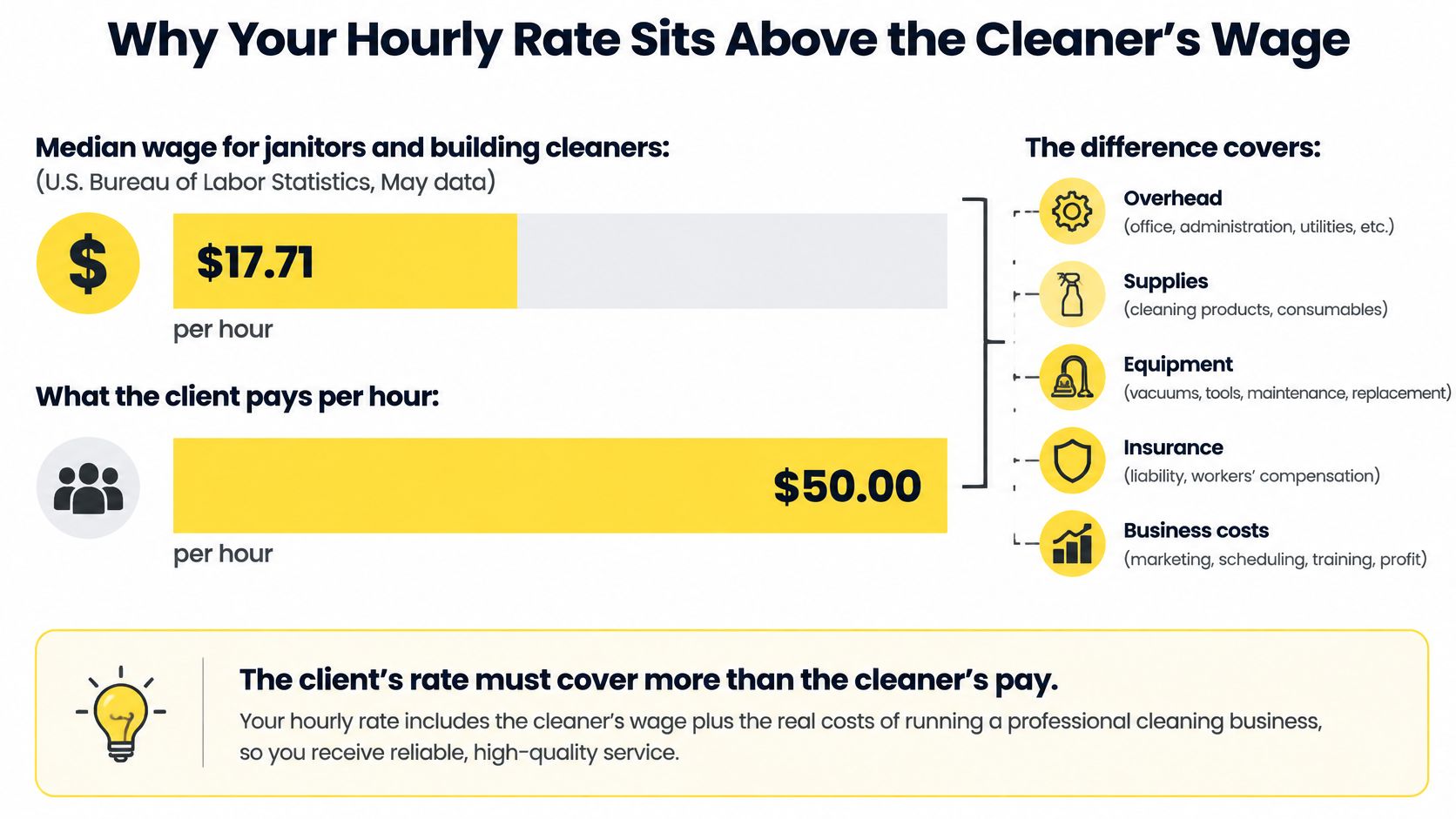
A provider must also cover everything between the pay stub and the client:
Add profit on top of all of it. A cleaner at $17.71 costs the company noticeably more than $17.71 once taxes and insurance land, which is exactly why a billable rate of $30 to $50 is plausible while the wage stays under $20. Build that burden into every estimate using a labor and burden model you can repeat instead of an educated guess.
A higher rate is often the cheaper option for the client too. It buys steadier productivity, fewer callbacks, and a scope that doesn't drift in month three. If you're hiring the crew behind that rate, pipehirehrm.com has hiring guidance for cleaning operations.
Two buildings with the same square footage can require different bids. Crew size, shift timing, surface type, travel, contract terms, and local wages all change what the work costs.
Data covering 120 U.S. metropolitan areas puts median janitorial wages between $13.79 per hour in Baton Rouge and $22.38 in Boston, an $8.59 hourly spread, according to commercial cleaning cost data by metro area. Build the local wage into the estimate rather than applying a national figure to every market.
Travel can widen the gap between two bids. A crew driving 45 minutes between Boston sites spends an hour and a half on the road per loop. Include service area, local wage, building type, shift timing, and staffing among your pricing inputs. Define the area your estimates cover before the first walkthrough.
Score each job against all five drivers before pricing it. The highest-cost factor may be the one that turns a profitable account into a loss.
Square footage means nothing until it becomes hours. The method published by ISSA divides the square footage to be cleaned by the applicable production rate per hour, then multiplies by 60 to express the result in minutes. On a 10,000-square-foot facility at 2,500 square feet per hour, that's 4 labor hours before restrooms, kitchens, travel, setup, interruptions, or specialty work get added.
| Facility type | Production rate (sq ft per hour) |
|---|---|
| Open commercial office | 2,500 to 4,200 (2.4 to 4.0 hours for 10,000 sq ft) |
| Congested cubicle layout | 2,000 to 2,800 (3.6 to 5.0 hours) |
| Classroom | 3,000 to 4,500 (2.2 to 3.3 hours) |
| Medical or dental clinic | 1,000 to 2,200 (4.5 to 10.0 hours) |
Those ranges come from a cleaning-time estimator built on ISSA 612 benchmarks, and the clinic figure is the one that should stop you. Disinfection dwell time means a medical suite takes two to four times the hours of an open office at the same square footage.
Pick the production rate before you look at the price. The rate chooses the price. Reverse those two steps and you'll spend the next year explaining why the clinic costs more.
A flat per-square-foot price is where healthcare work gets mispriced. The clinic at 1,000 square feet per hour carries ten labor hours where the open office carries four, so a single blended rate subsidizes the clinic and overcharges the office. When you need the per-foot view for a client conversation, the commercial cleaning cost per square foot benchmarks give you the conversion.
Never send an estimate built on square footage alone. Square footage is a quantity. A production rate turns it into a cost.
Here's a full build-up for a 10,000-square-foot office. It's illustrative, so swap in your own wage, burden and production rate rather than copying the totals.
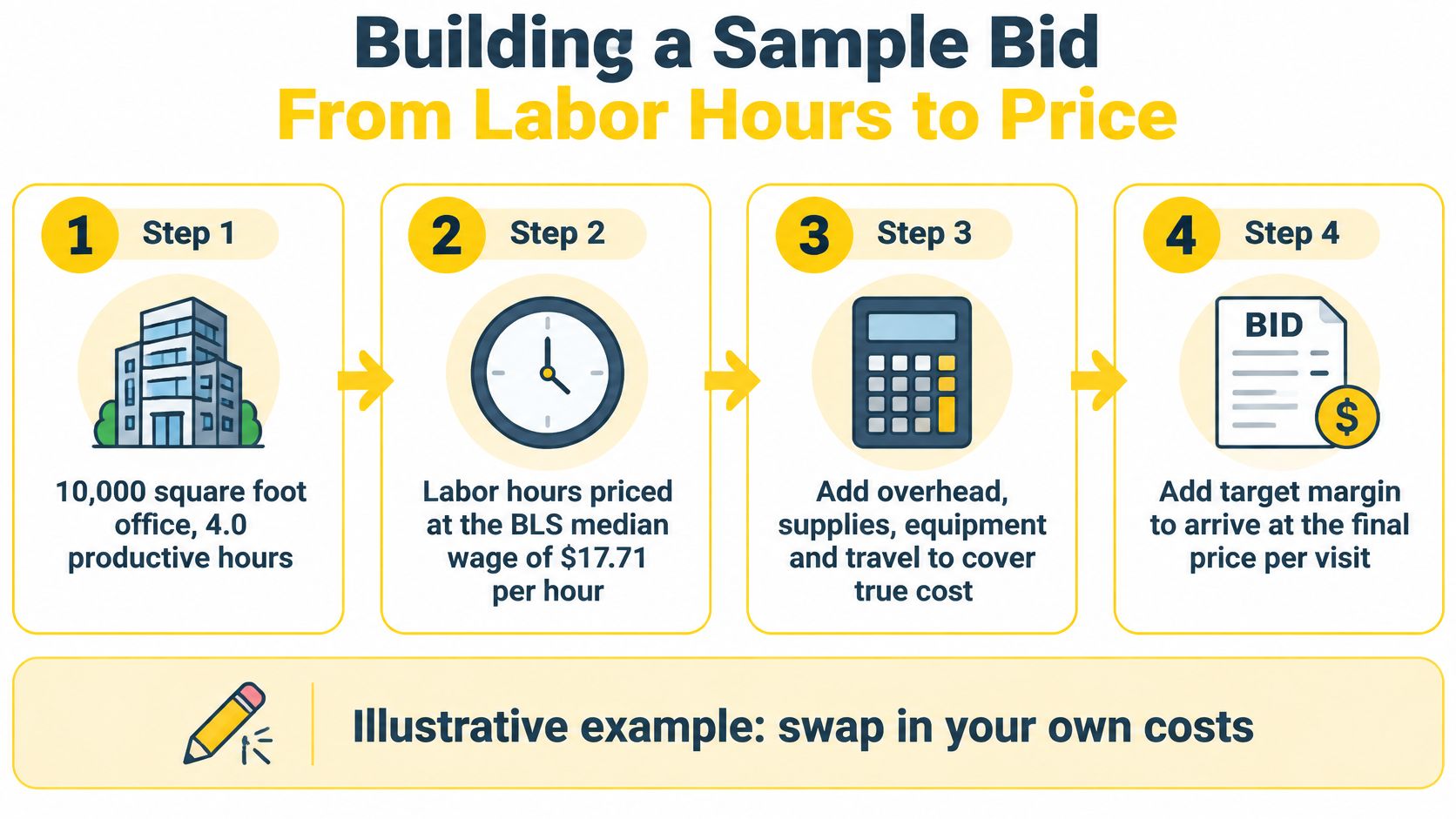
Run the flow in this order and the arithmetic takes care of itself:
| Line item | Basis |
|---|---|
| Productive labor | 4.0 hours at $17.71 = $70.84 |
| Payroll taxes and insurance | 25% of labor (assumed) = $17.71 |
| Supplies and equipment | Per-visit allowance (assumed) = $8.00 |
| Travel and setup | 0.5 hours at $17.71 = $8.86 |
| Supervision and admin | 10% of direct costs (assumed) = $10.54 |
| Total cost | Sum of all lines = $115.95 |
| Price at 25% target margin | $115.95 ÷ 0.75 = $154.60 |
| Effective hourly rate | $154.60 ÷ 4.5 billed hours = $34.36 |
$34.36 per hour sits inside the market band and inside the trade range. That's the check that matters: the build-up produced a rate the market recognizes, rather than a rate you reverse-engineered to match a competitor.
Here's the walkthrough of the same logic if you want the reasoning in video form.
Drop the production rate to 2,000 square feet per hour, which is realistic for a dense cubicle floor, and the office now needs 5.0 productive hours. Labor rises to $88.55, burden to $22.14, travel stays at $8.86, and supervision lands at $12.76. Total cost becomes $140.31, and at the same 25% margin the price is $187.08 across 5.5 billed hours, or about $34.01 per hour.
Read that result carefully. The effective hourly rate barely moved while the per-visit price climbed 21%. An hourly comparison between two bidders hides that difference completely. A line-by-line comparison exposes it.
Insurance certificates, subcontractor documentation and crew compliance checks belong in the same build-up, because a lapsed certificate is a cost line waiting to happen. If you're tracking that paperwork across crews and sites, managing contractor compliance gives you a system for it instead of a folder.
Write the bid as a structured cleaning contract bid with each assumption named, and you can defend any line in it when a client pushes back. That's the whole advantage. The number isn't magic, it's arithmetic, and arithmetic survives a negotiation.
Most commercial-cleaning pricing coverage stops at the customer-facing hourly rate. The Cleaning & Maintenance Management trade article on commercial cleaning bidding makes the missing point plainly: a recent trade source places general janitorial billing at roughly $28 to $50 per hour against a $17.71 median wage, and that gap has to absorb payroll taxes, workers' compensation, insurance, supervision, equipment, chemicals, travel, administrative labor, rework and sales costs. It is not profit wearing a disguise.
The article also names the trap small operators fall into. Multiplying the wage by hours produces bids that look competitive and lose money, because nonproductive setup and travel never appear in the multiplication.
Name a target margin first, then build to it. If you decide the margin after the arithmetic, you'll rationalize whatever number the math produced, and that number is usually too thin.
Set a minimum charge per visit that covers travel and setup even when the building is small. A 2,000-square-foot suite still costs a drive, a check-in, and a staging sequence. Confirm the effective hourly rate clears the cost build-up before the estimate goes to the client, and check it against the band from the first table. If your build-up lands at $24 per hour and the trade floor for that work is $28, your assumptions are wrong somewhere, and the client is about to find out for you.
Before the estimate goes out: write down the production rate, the wage, the burden percentage, the supply allowance, the travel hours, and the target margin. Six numbers. If you can't name all six, you don't have an estimate yet.
Recurring service with fixed frequency can carry a lower hourly rate because it buys predictable hours you can staff and route. A one-off deep clean or a post-construction scope cannot, because setup, rework, and the risk of a job running long aren't recovered anywhere else. Price project work higher and price it as a project.
The contrarian case is worth making to clients who push on rate. A higher hourly figure can be cheaper for them when it reflects better productivity, fewer callbacks, and a scope they can hold you to. What looks expensive per hour often costs less per year.
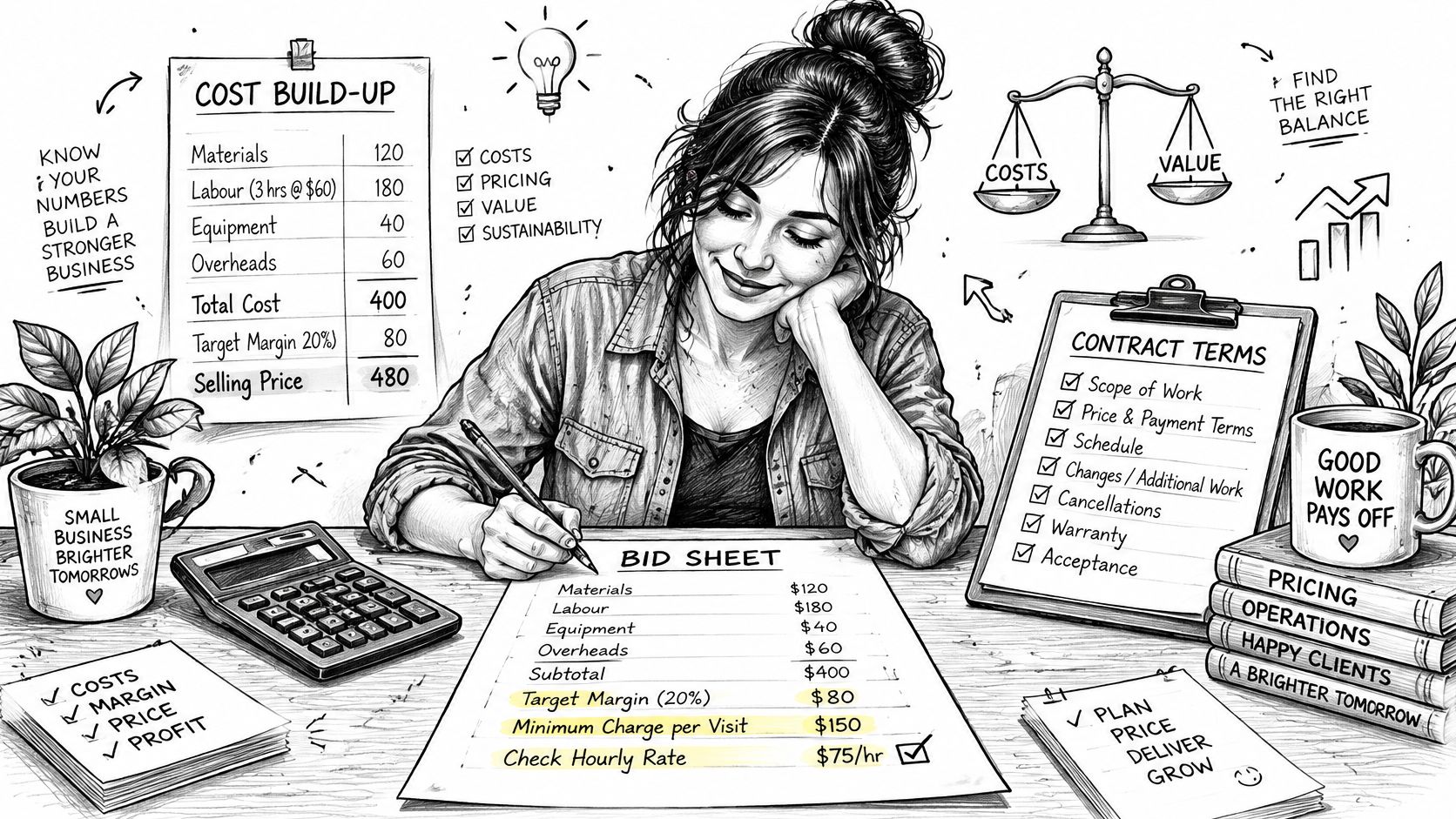
Keep the two terms apart and use them consistently with clients. An estimate is the standardized figure built from those seven inputs, produced consistently for every inquiry. A quote is the priced commitment you make after a site check confirms the assumptions. Mixing them lets a client treat a phone estimate as a binding price on a building you've never walked.
Write the assumptions down. Travel, supplies, production rate, margin, and what happens when the scope changes. Recheck the rate once a year as labor costs move, because the wage floor under your bid is not fixed. The cleaning industry standards that anchor those assumptions are worth having in front of you when you set them.
Estimatty was built specifically for cleaning businesses, so the estimate you send carries your production rates, your burden and your margin instead of a guess. Most cleaning company owners are up and running the same day they sign up, and it starts at $25 per week. There's more pricing guidance on the Estimatty blog and hiring guidance on the PipeHire blog.
The rate you can explain line by line is the rate you can win on. Pick the band that matches the job, run the build-up with your own numbers, and put an estimate in front of the client that you're prepared to defend.
Every number in your estimate should come from six inputs you can name: production rate, wage, burden, supply allowance, travel hours, and target margin. Estimatty runs that calculation on every inquiry for cleaning businesses, turning square footage and production rates into a consistent estimate in under a minute, around the clock. Visit Estimatty to see it working on your own site.