October 25, 2026
Pressure Cleaning Prices in 2026: Rates by Job and Size
Compare pressure cleaning prices for homes and commercial jobs in 2026, with size bands, per-square-foot rates and sample estimates you can use.

Thursday, March 5, 2026
Learn how to estimate house cleaning jobs like a pro. Ditch guesswork for our proven system to create profitable, consistent estimates that win more clients.
.png)
If you want to price your house cleaning jobs right, you have to look at the whole picture. It’s not just about square footage, the number of rooms, or how messy the place is. It's about combining all those details with a solid pricing model that actually works. This is how you stop underbidding and start protecting your profits.
Simply put, you need to move from random guessing to a smart, data-backed system for every estimate you send.
Let's be honest: just "winging it" on your prices is a recipe for disaster. Relying on a gut feeling is one of the fastest ways to kill your profits. It feels easy in the moment, but it leads to lost income, unhappy clients, and a business that’s constantly struggling to stay afloat.
The secret to a scalable, successful cleaning business isn't a secret at all—it's consistency. When every estimate you produce is built on a repeatable, logical system, you build trust from the very first conversation. More importantly, you guarantee that every job you take on is actually making you money. It's time to stop gambling and start calculating.
Getting your pricing right isn't some mystical art. It’s a clear, straightforward process. You start by ditching the guesswork, move to a system of real calculation, and land on reliable profitability.
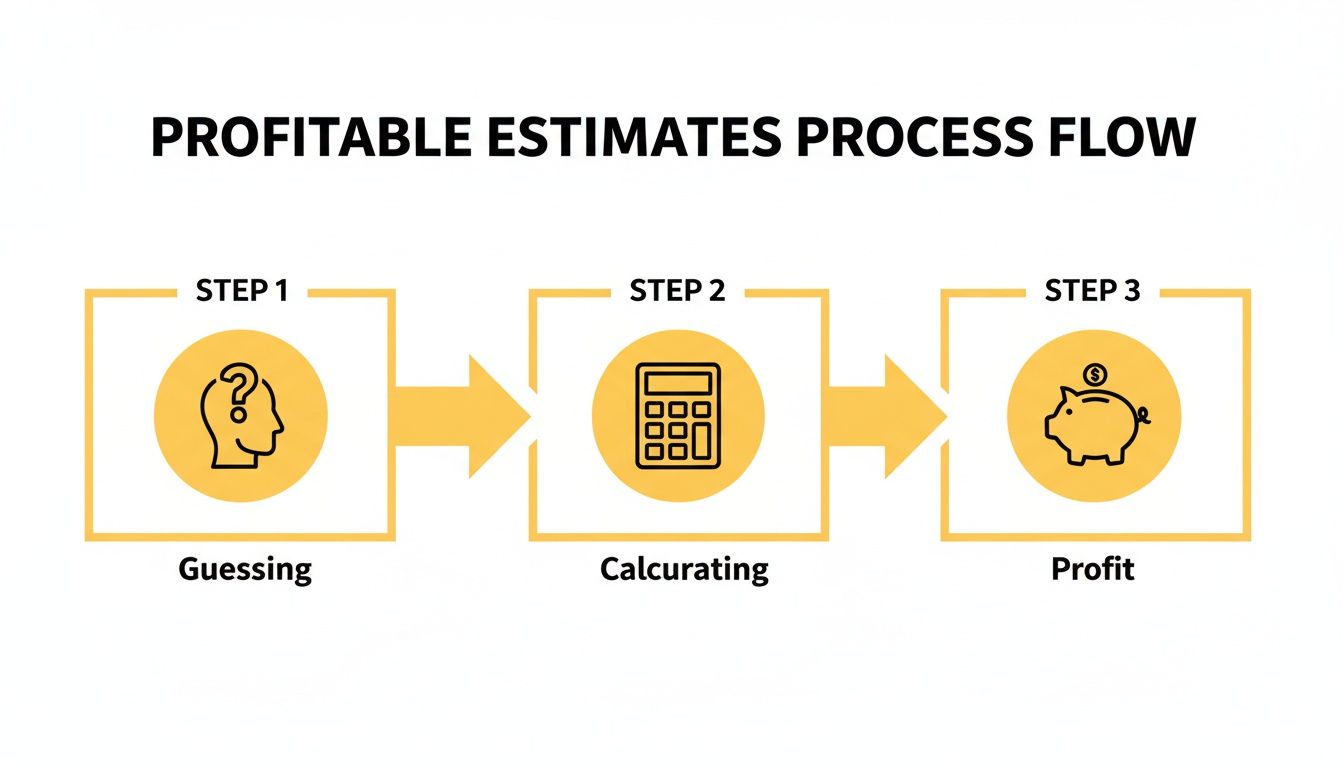
This journey from uncertainty to stability is the most important step you can take. A methodical approach is what turns a side-hustle into a serious business.
The house cleaning industry is massive—we're talking about a market projected to hit $411,431 million USD by 2026. In a field this big, leaving money on the table is a critical mistake. And that's exactly what happens with sloppy, manual estimates.
Believe it or not, studies show that nearly 30% of cleaning businesses end up underpricing their services by 15-20%. Why? Usually, it's because they misjudged the square footage or, more commonly, forgot to account for all the little add-ons that take up time. Every dollar really does count.
To get started, you need to know your numbers. These are the core metrics that form the backbone of any good estimate.
These numbers give you a solid framework, but they're just the beginning. The real magic happens when you use them to build a detailed, customized estimate for each client.
The core difference between a thriving cleaning business and one that just gets by is how it values its time and labor. A solid estimate protects both. It's your primary tool for communicating value and setting clear expectations from the start.
This commitment to detail is what separates the pros from the amateurs. A solo cleaner might get away with a quick verbal estimate, but that often leads to misunderstandings, callbacks, and arguments—wasting up to 25% of your sales time. A real system ensures you’ve covered everything, from the number of bathrooms to whether they have a long-haired dog shedding everywhere. You can learn more about how all these factors play into the final price in our detailed guide on house cleaning costs.
At the end of the day, knowing how to estimate house cleaning jobs correctly is everything. It’s not just about winning this one job; it’s about building a sustainable business that can actually grow. Whether you're working on your own or managing a team you've hired through a platform like pipehirehrm.com, a standardized estimation process is your most powerful tool for long-term success.

Alright, let's talk about money. Once you know what a job entails, you have to decide how you're actually going to charge for it. This isn't just about picking a number; it’s about choosing a pricing model that works for your business and makes sense to your clients. Get this right, and you’ll build trust while protecting your profits.
In my experience, most successful cleaning businesses lean on one of three core models: charging by the hour, offering a flat rate, or billing per square foot. There’s no single “best” way—the right choice really depends on the specific job, your local market, and where you want to take your business.
The most straightforward way to price a job is by the hour. You track your time, bill for it, and you're always paid for the work you do. Simple as that. Depending on where you operate and the kind of cleaning, you’ll see rates anywhere from $25 to $90 per hour for each cleaner on the job.
This method is your best friend for unpredictable jobs. Think first-time cleans, post-construction messes, or homes with a lot of clutter. In these situations, giving a flat rate is a huge gamble. Charging hourly protects you from getting stuck in a job that takes twice as long as you expected.
The only catch? Some clients get nervous about hourly billing, worrying that a cleaner might drag their feet to run up the clock. I always head this off by giving a clear, upfront estimated time range for the job. It manages expectations and shows you’re a professional.
Clients absolutely love flat-rate pricing. It’s clean, simple, and gives them total certainty. They know the exact cost before you even unload your supplies, which gets rid of any budget anxiety. A standard clean for a family home might be a flat $150, while a serious deep clean could be $300.
To make flat-rate pricing profitable, you have to get really good at estimating your time. This means your initial walkthrough and questions are critical. You need to nail down the square footage, room and bathroom counts, the presence of pets, and the general condition of the home to build an estimate that covers your costs and then some.
This model is a home run for your recurring clients. Once you've cleaned a house a few times, you know exactly what to expect. It makes your services easy to package and even easier for customers to buy. For a closer look at the numbers, our guide on how much to charge for cleaning services breaks it down even further.
Basing your price on square footage is a fantastic way to generate a quick, data-driven starting point, especially for bigger homes or when you're first talking to a client. It gives you a baseline number to work from. For example, your initial math might look something like this:
The big limitation here is that square footage doesn't tell the whole story. A 2,000-square-foot minimalist loft with one bathroom is a world away from a cluttered 2,000-square-foot house with four kids and three well-used bathrooms. That’s why you should treat this method as a starting point, not the final word.
The real secret sauce is a hybrid approach. I always start my estimates with a quick per-square-foot calculation to get a baseline number. Then, I use the specific details from my walkthrough—the number of bathrooms, the condition of the kitchen, any special requests—to adjust that number into a final, custom flat-rate price.
This combination gives you the speed of a formula with the accuracy of a personalized assessment. Mastering your pricing is what separates the pros from the amateurs. Exploring effective pricing strategies will help you find that sweet spot between competitive bidding and strong profit margins.
As you scale your business and bring on more staff using resources like pipehirehrm.com, having a consistent pricing system becomes non-negotiable. You can even test different models to see what resonates in your area, a topic often covered on blogs like estimatty.com/blog. Whether you land on $50/hour for a small apartment or a $250 flat fee for a 3-bed, 2-bath house, the right model will make or break your profitability.
Your estimate is only as good as the information you gather. This is where the client walkthrough comes in, and frankly, it's the most critical part of building a profitable house cleaning estimate. Whether you're there in person or doing it virtually, this is your chance to get past the basic numbers and see the reality of the job.
Think of yourself as a cleaning detective. You’re not just looking at a house; you're sizing up a unique project. Every home tells a story, and your job is to read it right so there are no nasty surprises waiting for you—or your client. This is how you build real trust and, more importantly, protect your profit margins.
Anyone can ask for the number of bedrooms and bathrooms. But that’s amateur hour. Seasoned pros know the real difference between a profitable job and a money-loser is hidden in plain sight.
You have to train your eyes to spot the high-effort zones and hidden complexities. A home might look tidy at a glance, but a closer inspection can reveal some serious time sinks.
Here’s what I always look for:
Paying attention to these details is what turns your estimate from a wild guess into a solid business decision. Learning how to properly estimate a cleaning job really comes down to seeing what others miss.
A walkthrough shouldn't feel like an interrogation. It's a conversation. Your goal is to understand what the client truly wants and to spot potential challenges, all while being friendly and collaborative.
I like to start with open-ended questions to get them talking:
A walkthrough is your best opportunity to set expectations. If you see heavy soap scum, point it out gently. "I notice we have some buildup on the shower glass. We have a great process for that, but it will take some extra time to get it sparkling." This frames an add-on or a higher price as a solution to their problem, not a penalty.
At the end of the day, the condition of the home is the great equalizer. A tidy, well-kept 3,000-square-foot house can be far easier to clean than a cluttered 1,500-square-foot apartment. You have to be direct but tactful when assessing clutter.
A simple way I phrase it is: "To give you the most accurate price, it helps me understand the general tidiness we'll be starting with. On a scale of 1 to 5, where 1 is minimalist and 5 is very lived-in, where would you say your home usually is?" This gives you a clear picture and opens the door to a helpful conversation about decluttering.
This level of detail is exactly why having a standardized estimating system is so powerful. Our own data shows that using a consistent method can stop you from underbidding by over 20%. In an industry projected to be worth $442.09 billion by 2025, those margins are everything. Details like pets, which are a factor in about 45% of jobs, can add 15% or more to your cleaning time but are often completely missed in rushed estimates. You can read more analysis about the growth and metrics of the cleaning services market to see the bigger picture.
For those ready to streamline this even further, you can absolutely transition from in-home to online estimates with the right tools. The secret is to keep asking these same critical questions. This rich data feeds into a much more accurate final price, which leads to a happier customer. And as you grow, having reliable cleaning employees hired from sources like pipehirehrm.com to execute these detailed cleanings becomes essential.

Your base estimate gets your foot in the door. But let's be honest—the real money is in the details. Smartly priced add-ons and well-defined surcharges are what separate a barely-scraping-by business from a truly profitable one. This is where you go from just creating an estimate for a job to building a high-value service package.
And this isn't about nickel-and-diming your clients. It's about giving them options. When you offer "deep oven cleaning" or "detailed baseboard washing," you’re solving a specific pain point. You’re not just tacking on a fee; you’re selling them back their Saturday afternoon.
Think of your services like a restaurant menu. Your standard cleaning is the main course, but the à la carte sides are where you can really shine. These are the specific, high-effort tasks that most people are absolutely thrilled to hand off to a professional. Pricing them individually keeps your base rate looking competitive while opening the door for easy upsells.
Here are a few of the most popular (and profitable) add-ons I've seen, along with typical pricing:
The trick is to frame these as valuable upgrades that create a truly finished feel. When you put it that way, clients feel like they're customizing their clean, not just getting hit with extra fees. If you want to see how these numbers stack up, playing with a house cleaning cost calculator can give you a better feel for how different services impact a final estimate.
Let’s face it: not every house is "standard." You will inevitably walk into jobs that are far more demanding than the initial phone call suggested. This is where having pre-defined surcharges is non-negotiable for protecting your time and profit.
The key is to be completely transparent about these potential charges in your initial estimate. No one likes surprises on their invoice.
Your time is your inventory. Surcharges aren't penalties; they are the price for handling exceptional circumstances that require significantly more time, product, and physical effort. Don't be afraid to charge for them.
You’ll want to have policies in place for common challenges. Consider adding surcharges for situations like these:
While add-ons and surcharges boost the value of a single job, smart discounts are your best tool for building long-term, predictable revenue. The goal here is to reward loyalty without giving away the farm.
By far, the most powerful strategy is the recurring service discount.
Offering a 10-15% discount for clients who sign up for weekly or bi-weekly cleanings is an incredible incentive. They get a consistently clean home for a better price, and you get a locked-in, reliable customer on your schedule. That kind of stability is the bedrock of a scalable cleaning business, allowing you to plan your weeks and manage your income with confidence.

In the cleaning business, speed isn't just a nice-to-have—it's your secret weapon. Think about it. When a potential client fills out a form on your website, the clock starts ticking. If they have to wait hours for you to get back to them, they're already looking elsewhere. That job just went to a competitor who was faster on the draw.
This is the hard truth of our industry today. A slow, manual estimating process is like a hole in your pocket, leaking potential revenue every single day. Shifting to an automated system that works for you 24/7 isn't just an upgrade; it’s essential for survival and growth.
The numbers don't lie. A shocking 40% of leads simply give up and walk away because of slow responses. This gets even worse after 5 PM, which is exactly when 60% of cleaning inquiries actually happen. With the global cleaning market set to explode to $859.20 billion by 2034, ignoring those after-hours leads is like leaving cash on the table. You can dig into the market growth details in the Fortune Business Insights report.
This is exactly where an AI-powered estimator like Estimatty completely changes the game. It becomes your best salesperson, working tirelessly to engage visitors the moment they arrive on your website.
Picture this: it's 10 PM, and a homeowner is on your site. Instead of hitting a dead end with a "contact us" form, they're greeted by a smart, friendly chat agent. This isn't just a glorified answering machine; it's a lead-converting powerhouse.
In seconds, an AI estimator can:
This instant, professional touch turns a casual browser into a booked job. Your website is no longer just a digital brochure; it’s a 24/7 sales engine that captures leads you would have otherwise lost forever.
The real goal is to make it incredibly easy for a customer to say "yes." An automated estimator removes every bit of friction, giving clients the instant gratification they expect and booking jobs for you while you sleep.
You can find more great insights from top pros on driving business growth on blogs like the one from Pipehire.
Speed is only half the battle. Automation also brings something just as valuable: consistency. Let's be honest—manual estimates are full of potential mistakes. One team member forgets to ask about pets, another guesstimates the time for a deep clean and underbids. These small errors kill your profit margins and create a rocky customer experience.
By automating your estimating process, you solve this problem for good. You program your exact pricing formulas, service options, and surcharges into the system one time. From that point on, every single estimate is 100% accurate and consistent. No more underbidding, and no more leaving money on the table.
This table breaks down just how big of a leap this is for a cleaning business.
Switching to an automated estimator is less about new technology and more about a fundamental shift in how you run your business—from reactive and busy to proactive and profitable.
Ultimately, remember that instant estimates work best when you have a steady stream of visitors. To make the most of your new system, you'll need to deploy effective strategies for website lead generation.
When you’re ready to see how this works in practice, check out our guide on the Estimatty cleaning estimate calculator. It shows you how to put these principles to work so you can scale your business, add more teams—perhaps finding great staff through resources like PipehireHRM—and maintain perfect control over your pricing without getting buried in admin work.
Even with the best system in place, you’re going to run into some tricky situations. Over the years, I've heard the same questions pop up time and time again from other cleaning business owners. Let's tackle them head-on so you can protect your profits, win better clients, and handle these conversations like a pro.
This is a big one. A first-time deep clean is a whole different animal than a recurring maintenance clean. My rule of thumb, which has served me well for years, is to plan for it to take 1.5x to 2x the time of a standard visit.
You're not just wiping down surfaces; you're tackling months or even years of buildup in every nook and cranny. That extra time and elbow grease have to be reflected in your price.
For example, if you estimate a standard bi-weekly clean for a 2,000 sq. ft. house at 3 hours for $150, that initial deep clean should be estimated at 4.5 to 6 hours, landing somewhere between $225 and $300. I always make a point to explain this to the client—we’re setting a new standard of clean that makes all future visits faster and more effective.
For almost every residential job, a firm, flat-rate price is your best bet. It gives the client a sense of security and makes saying "yes" a lot easier. People hate budget surprises.
Now, there are times when a range is necessary. If you’re walking into a total wild card—like a post-construction cleanup where the amount of dust and debris is a complete unknown—giving a tight price range (like "$350-$450") is the safer play. Just be crystal clear about what factors will push the price to the higher end of that range.
The real trick to offering firm prices without getting burned is to get all the details you need right from the start. This is where an online estimator tool like Estimatty is a game-changer. It guides the customer through the questions, so you have the data to give a solid, accurate price instantly.
No matter what, always label your document as an "estimate," which gives you a bit of legal wiggle room. But your goal should always be to hit the number you gave in the estimate.
I’ve seen so many new owners make this mistake, and it’s painful to watch: they completely undervalue their own service. In a desperate scramble to land those first few clients, they set their prices way too low. This race to the bottom is a one-way ticket to burnout.
They forget about all the hidden costs that eat into their revenue: gas, travel time between jobs, cleaning supplies, insurance, software, and taxes. Before they know it, they’re working for next to nothing.
You have to avoid this trap. The solution is a simple formula: Figure out your total hourly overhead costs, then add your desired hourly profit. That’s your non-negotiable minimum rate. For instance, if your overhead is $15/hour and you want to make a $35/hour profit, your absolute minimum charge is $50/hour. All of your estimates must be built on that foundation.
When a potential client pushes back on price, resist the urge to immediately offer a discount. Doing so tells them your service isn't really worth what you asked for. Instead, see this as your chance to reinforce your value.
Try saying something calm and professional, like: "I definitely understand you're working with a budget. We calculate our prices very carefully to make sure our insured, professional team can deliver a truly thorough cleaning. In my experience, lower prices often mean something has to be cut—whether it's time spent in the home or attention to detail—and that’s a compromise we’re just not willing to make."
Then, pivot to becoming a problem-solver. You could offer to adjust the scope of the job to meet their budget. For example: "To help get the price into a more comfortable range, we could customize the service to focus only on the kitchen and bathrooms. Would you like me to work up an estimate for that?" You hold firm on your value while still working to win the business. This is a hot topic on a lot of industry blogs, including the one over at estimatty.com/blog.
Ready to stop the endless back-and-forth and turn leads into booked jobs while you sleep? Estimatty scraps the slow, manual estimating process for an AI-powered system that gives your clients a professional, accurate estimate in under 60 seconds, 24/7.
Book a demo and see how Estimatty can transform your sales process today!