
November 16, 2026
Standard Cleaning Prices in 2026: What to Charge and Why
Compare standard cleaning prices by home size, service type and region, and learn how to build consistent estimates that win more bookings.

Tuesday, November 17, 2026
Learn how area rug steam cleaning works, which fibers tolerate heat, safe temperatures, costs and when to choose a specialist wash instead.
The most popular advice about area rug steam cleaning is also the most dangerous. Pick the hottest machine, run it over any rug, and let the heat do the work. That's backwards. Fiber, backing, and dye stability decide the method, not square footage or advertised temperature. A synthetic rug that shrugs off standard extraction shares almost nothing with a wool flokati or a silk handwoven piece, except the floor it sits on.
I treat steam cleaning as a conditional service. It's usually hot-water extraction, not true vapor, and it's appropriate only when the rug can tolerate the water, heat, chemistry, and drying time involved. Get that match right and you get a deep rinse. Get it wrong and you can felt wool, bleed dyes, distort backing, or leave moisture trapped where you can't see it. The estimate should follow the method, because the method drives the labor, risk, and drying plan.
Most rugs can be wet cleaned within limits, but only some belong under standard hot-water extraction. Nylon and polypropylene rugs are the easy case. They're synthetic, they don't hold water like wool, and they tolerate normal extraction when the label, backing, and dyes check out. Even then, the working temperature is set by the rug and the technician's inspection, not by whatever number is printed on the machine.
Wool is where the margin shrinks. Its fibers can felt and shrink under heat and agitation, so the safe ceiling sits well below what a synthetic rug accepts. Wool flokati is stricter still, because its long pile traps water and distorts under aggressive brushing. I'd treat every natural-fiber rug the same way: the right temperature is the lowest one that still rinses soil out, confirmed by a dye test and a technician's inspection rather than a universal figure.
That distinction matters at booking. "Steam cleaning" quoted for a flokati or a silk piece often means a different service entirely, and the price should reflect that.
| Rug type | Temperature guidance | Method to ask for |
|---|---|---|
| Nylon or polypropylene (synthetic) | Standard extraction heat is usually tolerated | Standard hot-water extraction |
| Wool cut-pile | Reduced heat, set by dye test and inspection | Trained technician with controlled moisture and drying |
| Natural fibers in general | Lowest heat that still cleans | Reduced temperature with wool-safe chemistry |
| Wool flokati | Minimal heat, gentle drying | Low pressure, no reciprocating brushes, careful air drying |
| Silk, viscose, jute, sisal, antique or handwoven | No safe default temperature | Inspection and testing first, then low-moisture or off-site washing |
Rugs also behave differently from wall-to-wall carpet. Many area rugs sit over finished flooring with nothing sealed underneath, so wash water can soak through the backing and reach the floor below. The cleaner has to limit how much liquid goes down, extract hard, and dry both faces, not just make the pile look clean from above.
Do this self-check before you book anything. Read the fiber label on the back. Find your row in the table and ask for the method it names, not just a price. Stop if the rug is unlabeled, antique, or handwoven and nobody can identify it with confidence.
Practical rule: If you can't name the fiber, you can't pick a temperature.
Run four checks before any water touches the rug, then book only the method the results support. Fiber comes first because Bissell guidance on cleaning wool carpet is clear that fiber composition determines whether a rug can safely receive conventional high-temperature extraction. Heat, excess moisture, and aggressive agitation can cause wool to felt, shrink, bleed, or distort, so "it looks sturdy" isn't evidence.
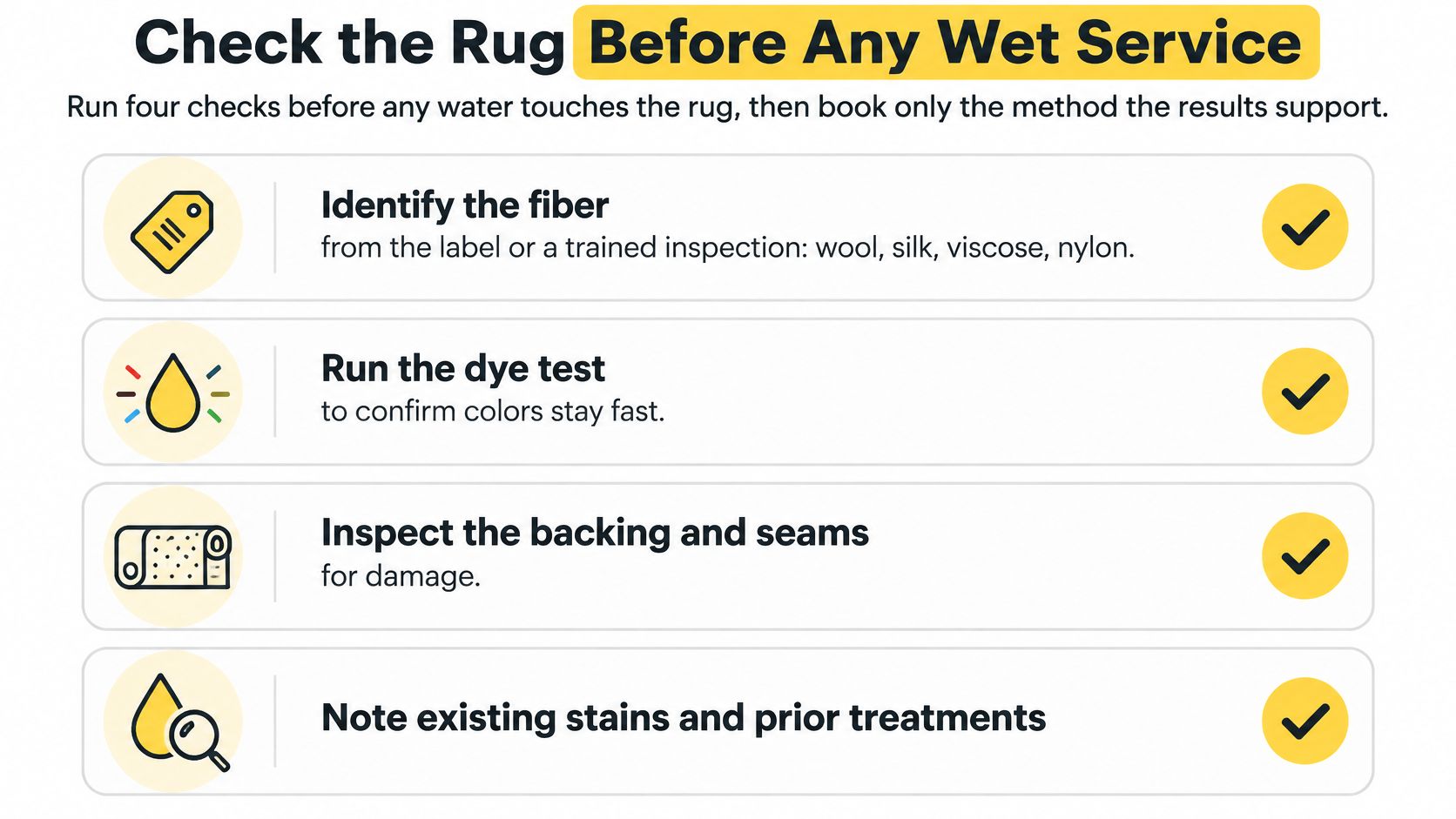
Those details belong in the estimate, not in a hurried hallway conversation. Our instant price tool asks for service type, when the last clean was done, home size in square feet, beds, baths, pets and add-ons, and add-ons such as inside oven, steam cleaning, AC vents and blinds appear automatically during the booking flow. A rug checklist with photos gives that kind of intake the fiber and condition detail an area rug needs. It's also the kind of record our overview of cleaning industry standards points businesses toward when they want consistent service decisions.
Now apply the booking rule. If the label says synthetic and the dye test passes, book standard extraction with the temperature and drying plan in writing. If it's wool, confirm surface temperature, chemistry, and drying before you accept a time slot. If fiber, age, or construction is unknown, or the dye test bleeds, book an inspection or specialist method instead.
No fiber check, no wet service.
Truck mounts and portables sold for this work rarely blast a rug with pure steam. They precondition the pile with detergent, agitate or allow dwell time, spray heated water in, and extract the loosened soil and liquid in the same pass. A dirty sponge shows why that order wins: soaking it in soapy water and wringing it out removes far more than warming it and hoping the dirt lets go.
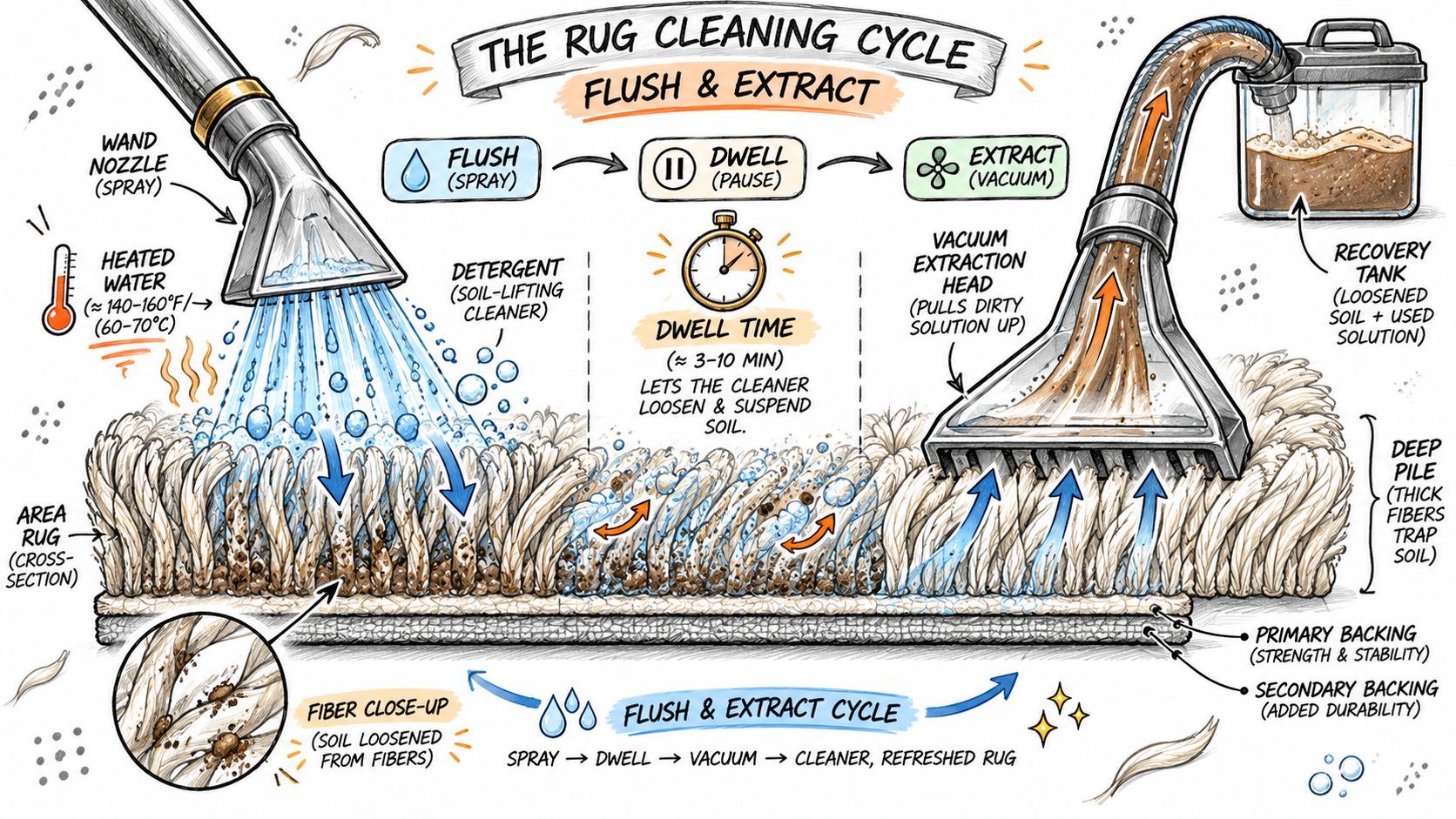
The test results back up that sequence. In controlled Carpet and Rug Institute testing reported in this summary of carpet cleaning machine effectiveness, hot-water extraction alone removed an average 57% of deposited test material, and extraction followed by vacuuming with a CRI-approved vacuum raised removal to 67%. The wet pass does the heavy lifting. The dry pass after it captures what the water loosened but didn't carry out.
Chemistry carries part of that load, too. Detergent applied during extraction releases soil that plain hot water only shifts around the pile, which is why the precondition and dwell stages exist at all. Skip them and you're rinsing dirt, not removing it.
That's why a quote built on advertised machine heat misleads you. Two operators can run similar equipment and get different results because one preconditions, dwells, rinses, and vacuums properly while the other rushes. And before any of that matters, the rug itself has to qualify: fiber, backing, and dye stability decide whether wet extraction is even on the table, so the method follows the rug and the price follows the method, not the thermostat rating on the box. The same sequencing discipline shows up in our guide to professionally cleaning a house, where order of work matters as much as product choice.
Success looks simple. The pile looks evenly clean, the rinse runs clear without soapiness, and the base of the rug isn't left wet.
Heat gets the attention, but chemistry ruins rugs as well. Under the Carpet and Rug Institute Seal of Approval program for deep-cleaning extractors and systems, cleaning formulas are tested at the manufacturer's recommended dilution and approved products must fall within a pH range of 4 to 10. Extremely acidic or alkaline chemicals can damage dyes, treatments, and fibers. A product closer to neutral is the safer default for rugs, especially wool and anything with unstable color.
Dilution isn't a place to improvise. Doubling detergent doesn't double cleaning. It leaves residue in the pile, and residue attracts new soil, makes fibers feel stiff, and can interfere with dyes. Log the product and dilution for every job so you can repeat what worked and correct what didn't. If you're comparing products, our guide to professional cleaning chemicals is a useful place to check how product categories and pH should be matched to the surface.
The same CRI program measures moisture left in carpet after simulated extraction as ounces of residual moisture per square yard. That gives you a way to compare extractors on drying performance, not just spray pressure or tank size. Ask what a machine leaves behind. A rug that looks clean but stays saturated at the backing is a problem you have postponed.
Wool raises the stakes because it can hold a surprising amount of moisture before the surface feels obviously wet. Prolonged saturation slows drying and invites dye migration, browning, odor, shrinkage, and felting. Natural-fiber rugs need controlled solution, strong extraction, and air movement over both faces until the backing is dry.
A technician should be able to sign off four things before leaving: pH in range, dilution logged, residual moisture checked, and both faces dry or drying under airflow.
Start with a rug that has passed identification and dye testing. The sequence below suits a rug approved for hot-water extraction, and each step has a common slip that undoes otherwise good work.
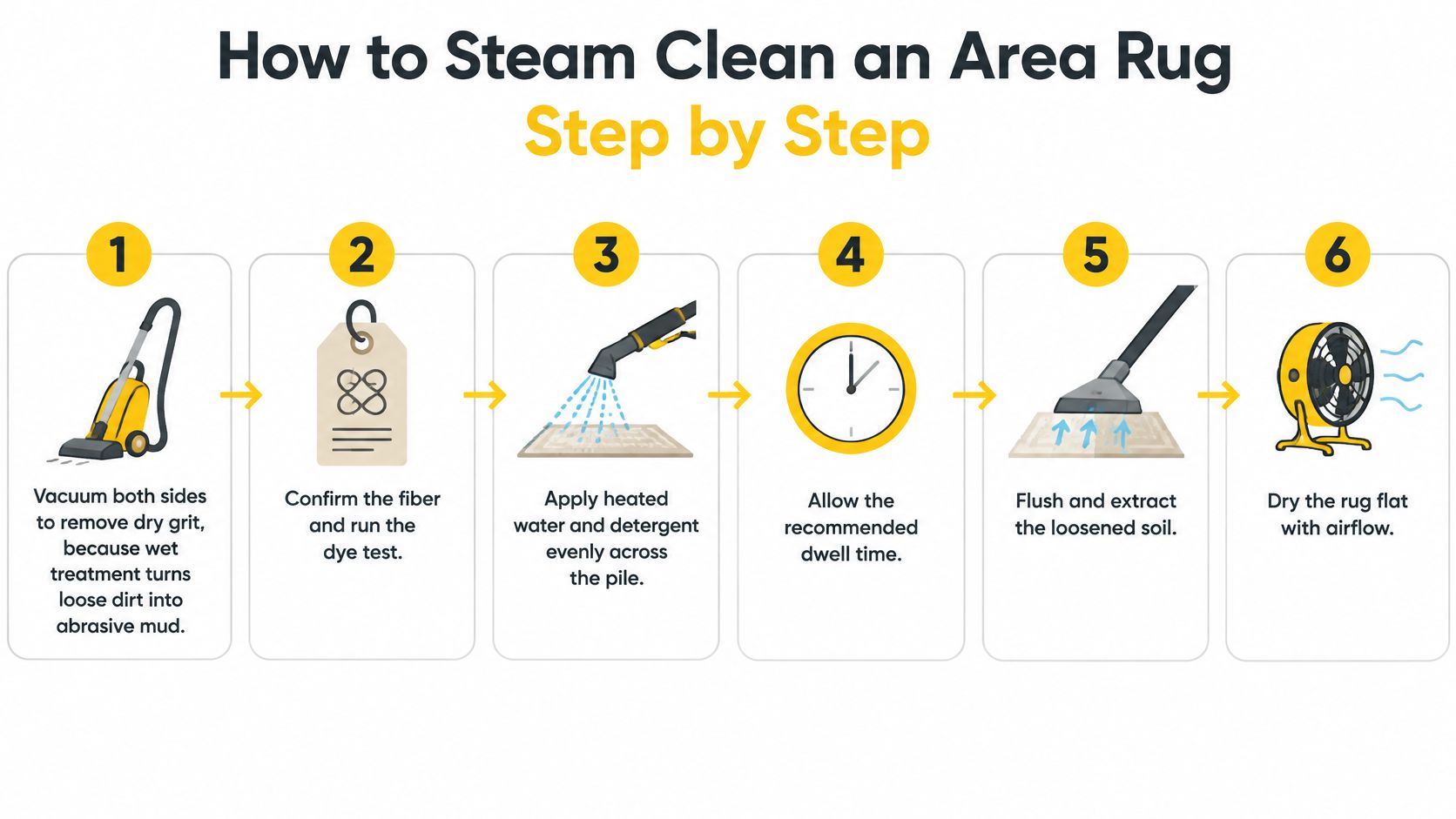
Watch the wet pass and extraction technique in this demonstration before you judge whether an operator is rinsing or merely wetting the surface.
A finished job shows even color, no soapy feel when you rub the pile, no sour smell, and a dry backing. If the surface looks bright but the base still feels cool and damp, the job isn't finished.
Steam cleaning isn't one universally safe method, and that's where cheap estimates get expensive. Natural fibers respond to water and heat in ways synthetics don't: wool holds moisture deep in the pile, and plant fibers like jute and sisal swell and weaken when saturated. Add excess water or heat to viscose, silk, antique, or handwoven construction and you can get shrinkage, bleeding, browning, distortion, or loss of structural strength.
Extraction done correctly on the right rug removes contamination well. The failure mode is uncontrolled extraction on a fiber that can't take it. Square footage and machine heat ratings don't decide this. Fiber, backing, and dye stability do.
| Method | Best for | Trade-off |
|---|---|---|
| Controlled low-moisture extraction | Water-sensitive natural fibers with dye risk | Less water in the pile, but needs a trained operator and a written method |
| Off-site full washing | Antique, handwoven or unstable rugs | Rug leaves the home until washing and complete drying are finished |
| Decline in-home steam until tested | Silk, viscose or unknown construction with no test results | No wet cleaning until evidence supports a method |
Low-moisture work suits a rug that needs soil removal but can't tolerate saturation. Off-site washing gives a specialist control over immersion, rinsing, blocking, and drying that you can't reproduce in a living room. Declining in-home steam isn't a failure to clean. It's the correct service when nobody has proven the rug can take it.
When fiber, dye, or construction is unknown, an inspection comes before any steam pass.
For cleaning businesses, intake has to capture photos, age, origin, backing, fringe, and prior treatments before anyone promises an in-home method. Because the rug picks the method, the price follows it. A higher-priced specialist wash can be the safer buy because you're paying for control, not just hot water.
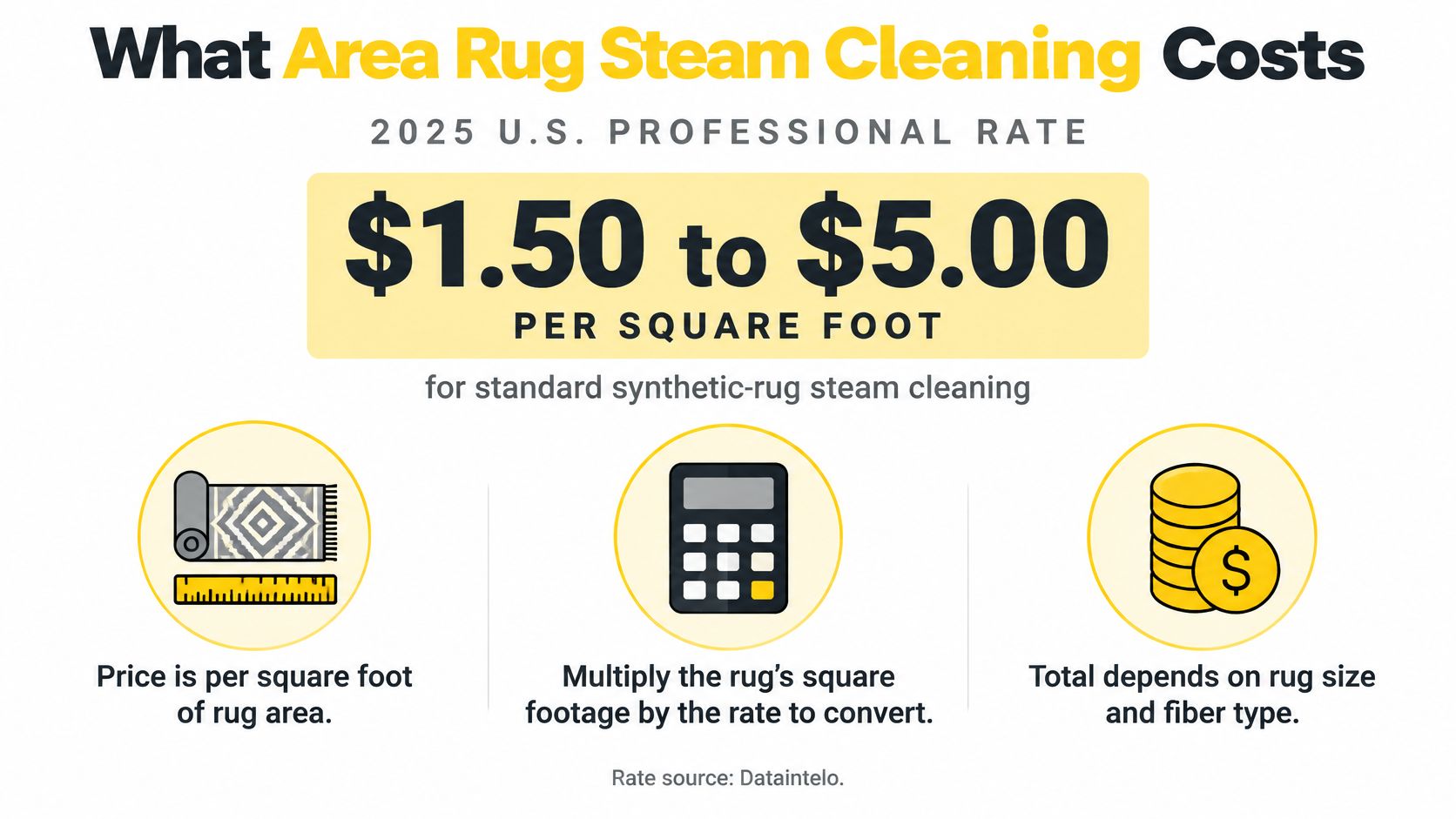
For a standard synthetic rug, start with square footage. In 2025, professional area rug cleaning in the United States typically cost $1.50–$5.00 per square foot for standard synthetic-rug steam cleaning, according to Dataintelo's area rug cleaning services market report. Multiply length by width, then multiply that area by the rate.
| Rug size | Area (sq ft) | Estimated range |
|---|---|---|
| 5 x 7 ft | 35 | $52.50–$175.00 |
| 8 x 10 ft | 80 | $120–$400 |
A 9 x 12 rug at 108 square feet works out to $162–$540 on the same rate. That range covers standard synthetic work only. Wool, handmade, silk, viscose, and antique rugs should be priced after inspection because method, chemistry, extraction passes, fringe care, and drying time change the labor. Heavy soil, pet contamination, stains, prior treatments, edge work, and off-site washing also move the estimate.
Ask for the written method, fiber assessment, temperature limit, and drying plan before you compare numbers. If you're building that paperwork for clients, a residential cleaning quote template from AurenWell can help you itemize the service clearly, and our page on getting a carpet cleaning estimate online shows how that detail fits a faster booking flow. You'll find more estimating guidance for cleaning businesses on the Estimatty blog.
If you run a cleaning business, use Estimatty to collect rug size, fiber photos, pet issues, and add-on details before your team promises steam cleaning, then send a consistent estimate by SMS and email while the lead is still warm. Estimatty gives residential cleaning websites instant estimates, online booking, and 24/7 voice sales, so conditional services like area rug cleaning start with the right questions instead of a risky guess.