
September 29, 2026
Commercial and Residential Cleaning in 2026
Compare commercial and residential cleaning markets in 2026. Explore pricing, staffing, compliance, and how AI estimators streamline operations.

Wednesday, July 1, 2026
Stop revenue leaks from last-minute changes. Our guide to cancellation of service covers policies, fees, and automation to protect your cleaning business.
Your phone buzzes at 6:12 a.m. A client cancels a deep clean. Your team is already clocking in. The route is built. Supplies are loaded. That one message just punched a hole in your day.
Most cleaning owners treat cancellation of service like a customer service headache. That's too small a view. It's an operations failure point. If you don't engineer around it, cancellations chew up payroll, wreck routes, create admin drag, and train customers to treat your schedule like a suggestion.
Some cancellations are unavoidable. Sick kids happen. Access problems happen. Budget cuts happen. But the financial damage is not some mystery force. You can reduce it with better estimates, tighter agreements, cleaner policies, and systems that don't leave your office team improvising.
A cancelled cleaning job doesn't only remove one line of revenue. It knocks over everything attached to that line. Your cleaner may still be on the clock. Your office still has to reshuffle the board. Your next job might start late because the route changed badly. Then your team spends the afternoon trying to refill a hole that should never have existed.
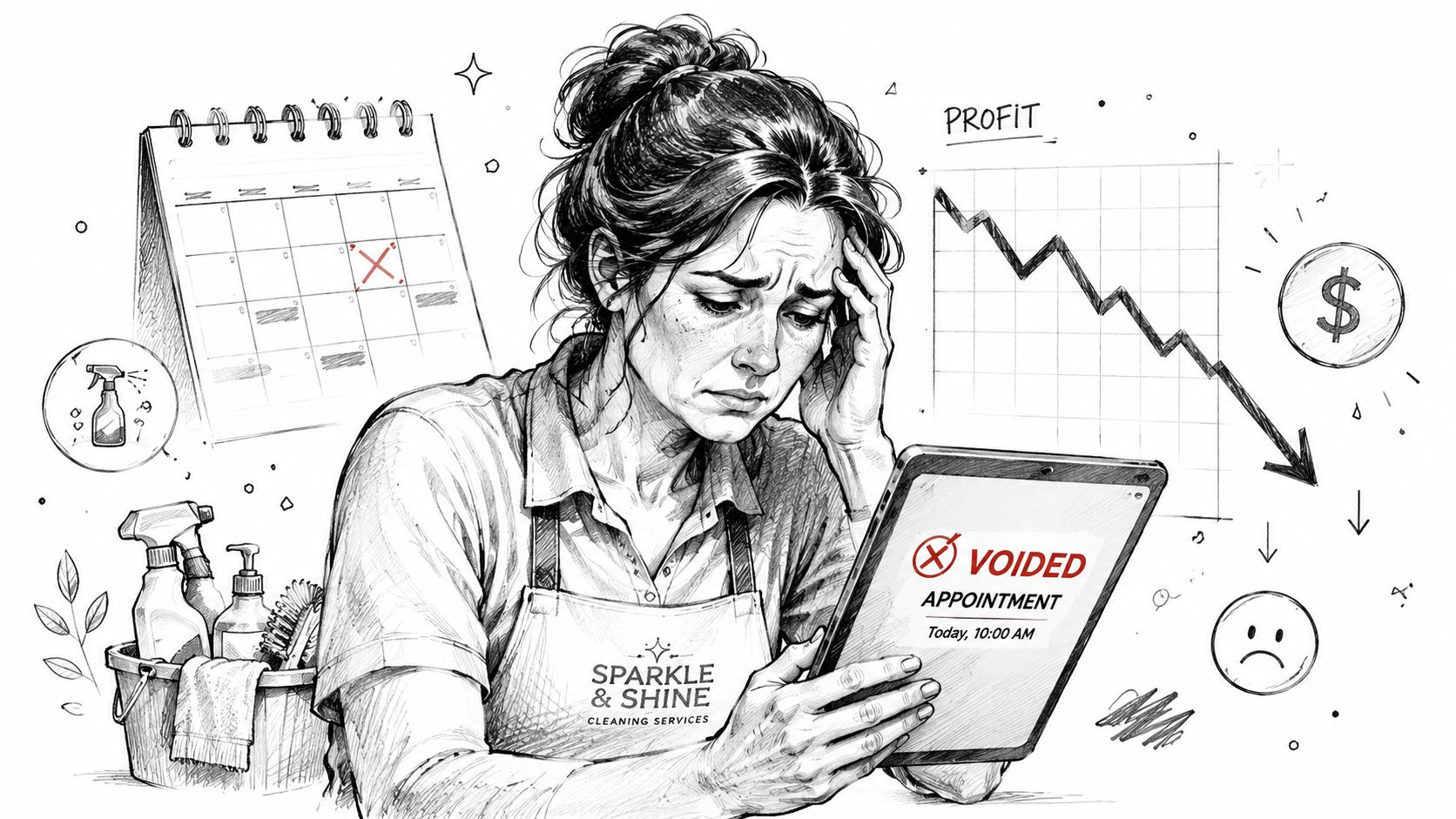
This is why I tell owners to stop calling cancellations “part of the business” in a casual way. Theft is part of retail. Chargebacks are part of e-commerce. Neither gets a free pass. Cleaning companies need the same attitude toward preventable schedule loss, especially if you're already watching margins through your cleaning business accounting system.
Customers are reviewing recurring expenses harder than they used to. Nearly 47% of consumers are projected to cancel at least one service in 2026 to save money, according to subscription fatigue data compiled here. That matters to cleaning companies because recurring clients now compare your service against every other monthly charge hitting their card.
If your value isn't obvious, your schedule becomes optional in their mind.
Owners usually react in one of two bad ways:
Both approaches fail. Soft policies invite abuse. Harsh policies create resentment and charge disputes.
Practical rule: Treat cancellation of service as a design problem. Build the process so the client knows the rules early, the team follows the same script every time, and the money impact is controlled before the first appointment is booked.
The businesses that handle this well don't rely on charisma at the front desk. They rely on process.
Not every cancellation is the same, and that's where most policies fall apart. If you use one blunt rule for every situation, you'll either lose money or create conflict you didn't need.
Start by splitting cancellations into the categories that matter operationally.
Customer-initiated cancellations happen when the client calls off the service. Maybe they forgot, can't afford it, have guests in town, or just changed their mind. These need policies around notice windows, rescheduling, and fees.
Business-initiated cancellations happen when your company can't perform. A cleaner calls out, you overbooked, the job was quoted badly, or access requirements were never confirmed. These are worse because they hurt trust fast. When your company cancels, your process should focus on recovery, not defense.
If you're canceling on clients more than occasionally, don't blame “bad luck.” Check staffing, scheduling discipline, and hiring quality. That's also where resources like estimatty.com/blog and get.pipehirehrm.com/blog can help you think more operationally about booking flow and team reliability.
Timing changes the damage.
A policy that charges the same response for all three is lazy policy writing.
These two reasons sound similar in the office. They are not the same.
Financial hardship means the client may like your service but can't justify the spend right now. Dissatisfaction means your delivery, communication, or pricing no longer feels worth it. One may be recoverable later. The other usually requires you to fix a real business problem before trying to retain them.
If you don't tag cancellation reasons consistently, you won't know whether you have a pricing problem, a service problem, or a communication problem.
Use simple internal labels. Keep them practical:
Those labels will tell you more than a generic “cancelled” status ever will.
Most cleaning businesses don't have a cancellation problem. They have a documentation problem. They try to enforce rules that were never clearly accepted.
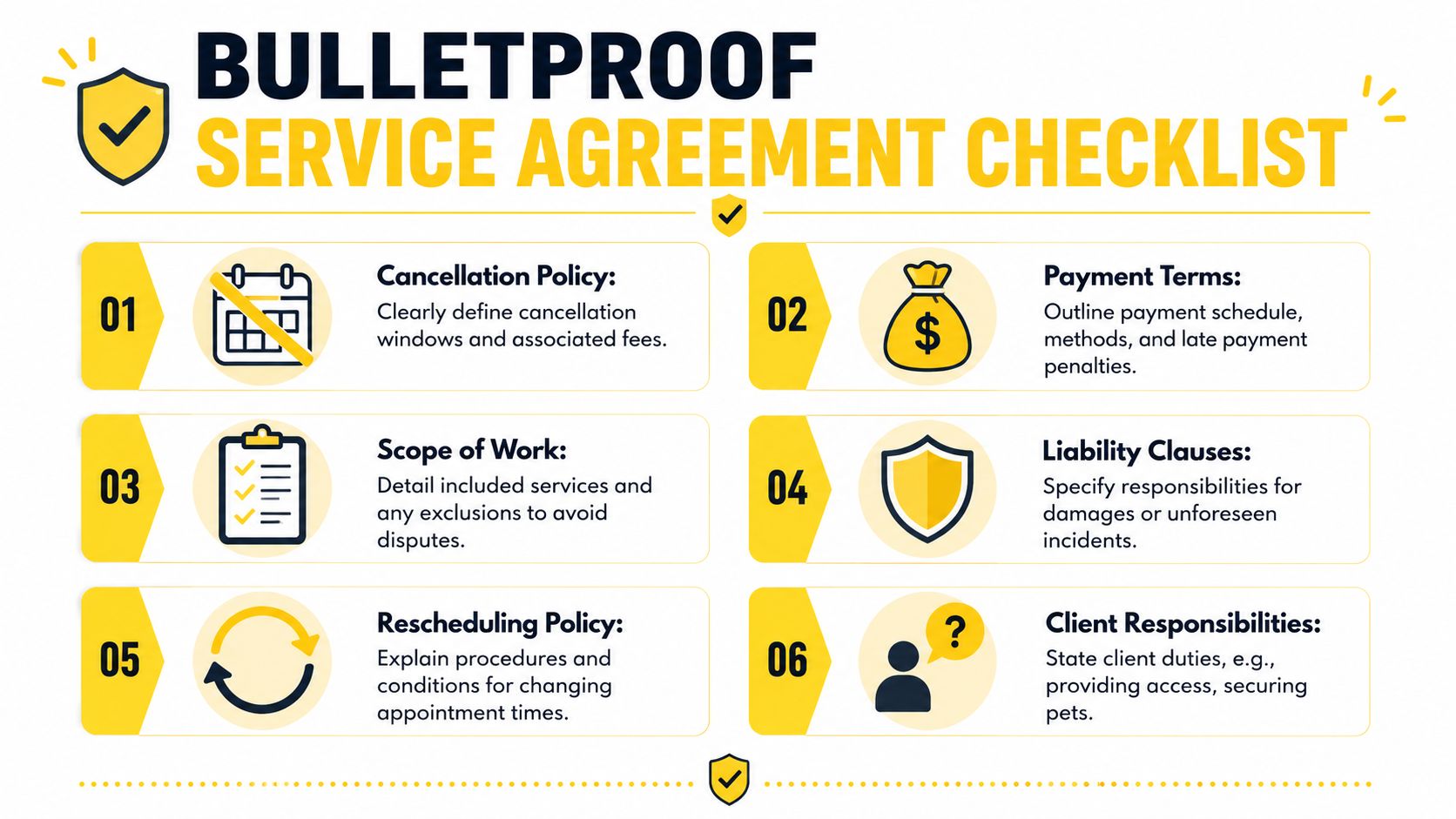
If you want a cancellation fee to hold up, the client needs to know what they agreed to before the conflict starts. That means your paperwork has to be clean, readable, and specific.
Let's clear up a mistake I see constantly. An estimate is a non-binding price guide. A quote is binding only when costs are certain, as explained in this breakdown of estimates versus quotes. For Estimatty content, use estimates versus quotes correctly every time, because mislabeling them creates avoidable legal and customer friction.
If your website or office sends a rough price based on square footage, frequency, or client answers, that's usually an estimate. It should say so. It should also say the final price can change if the condition, scope, access, or requested extras differ from what the client disclosed.
Then you move to the actual service agreement.
For cleaning businesses, that agreement matters more than the initial price message. If you need a solid starting point, review these cleaning services contract essentials.
Your cancellation clause should answer the practical questions before the client asks them.
Don't bury this in legal fluff. Plain English wins. If a customer can't understand your policy in one read, your staff won't enforce it consistently either.
Property managers already understand this logic. When rules aren't written clearly, disputes drag on and everybody wastes time. That's one reason a structured resource like Edinhart's tenant eviction process is useful as a comparison. Different industry, same lesson. Clear procedure reduces chaos.
Owner advice: If your office team has to “explain what we usually do,” your agreement is too vague.
Good agreements don't make you look rigid. They make you look organized.
Your crew is loaded for the day. Routes are built. Payroll is committed. Then a client cancels a four-hour job an hour before arrival.
That is not a customer service hiccup. It is a scheduling system failure, and it costs more than the invoice you just lost.
Owners who only count cancelled jobs miss the operational damage. A 45-minute recurring clean and a full-day move-out both count as one cancellation on a report, but they do not hit your business the same way. Track cancelled scheduled time, not just cancelled appointments.
Calculating cancellation rates by job count hides the true loss. Measuring by scheduled minutes gives you a far clearer picture, as shown in this scheduled-minutes approach.
That method came from healthcare operations, but the logic fits cleaning perfectly. A long booking that falls off the board creates a larger payroll, routing, and capacity problem than a short visit. If your team reports "three cancellations today," that number is too vague to manage.
For practical ways to tighten your schedule and cut avoidable gaps, review this guide on how to reduce no-show appointments.
The missed invoice is the obvious loss. The harder hit shows up in the rest of the system.
This is why weak cancellation handling eats margin. The loss spreads across labor, admin time, fuel, and schedule quality.
Rising cancellations usually point to a broken process upstream. Start by checking the basics.
Then go one step further. Track the reason code for every cancelled minute. Late notice, access problem, price objection, scope confusion, duplicate booking, frequency change. Those patterns tell you where your system is weak.
Owner advice: A cancellation trend is rarely random. It usually points to a policy, scheduling, pricing, or communication problem you failed to engineer upfront.
Strong operators do not wait for cancellations and then improvise. They design the business to absorb fewer of them in the first place. That means measuring lost time, tagging the cause, and fixing the system that keeps creating the same hole.
A good cancellation fee does two jobs. It protects your revenue, and it tells clients your schedule has value. A bad fee policy does the opposite. It either gets ignored because it's too weak, or it starts arguments because it's sloppy and unfair.
You don't need a complicated formula. You need a fee structure that matches how your business operates.
| Fee Structure | How It Works | Pros | Cons |
|---|---|---|---|
| Flat fee | Client pays the same fee whenever the policy is triggered | Simple to explain, easy for office staff to apply, predictable | Can undercharge large jobs and feel excessive on small ones |
| Percentage of service price | Fee is tied to the scheduled service value | Scales better across job sizes, fairer on mixed service types | Requires accurate pricing records and can trigger more client pushback |
| Tiered fee | Fee changes based on how close to the appointment the cancellation happens | Best match for actual operational damage, rewards early notice | More moving parts, staff must apply it carefully and consistently |
Residential recurring cleaning often works well with a flat fee or a tiered fee. The service is repeatable, and clients understand routine rules if you explain them upfront.
Commercial and larger one-time jobs usually justify a percentage-based approach because the labor block, prep, and staffing impact can vary more. If you're pricing from labor planning, keep that same logic in your policy. In commercial cleaning, operators often use the formula Monthly Hours = (Square Footage ÷ Production Rate) × Visits per Month, as shown in this guide to quoting commercial cleaning work. If labor hours drive your estimate, cancellation fees should respect that reality too.
Don't write like a lawyer trying to impress another lawyer. Write like an operator.
Try wording like this:
Appointments cancelled without the required notice may be subject to a cancellation fee. Rescheduling requests are treated the same as cancellations when they fall inside the notice window. If our team arrives and cannot access the property, the appointment may be treated as a same-day cancellation.
That language is firm without sounding hostile.
If your internal playbook still lives in scattered notes, fix that. Build the policy into your policies and procedures manual so every office employee and field manager handles it the same way.
If you're small and still cleaning up operational inconsistency, start simple. Choose one fee rule, one notice window, one script, and one exception process. Complexity doesn't make a policy smarter. Consistency does.
Tomorrow's schedule is full. Then at 7:10 p.m., two clients cancel, one stops replying, and another forgot to leave the gate code. Your crews are still on payroll, your route is already built, and the day is now less profitable before it even starts.
That is not a customer service problem. It is a system design failure.
Owners who keep no-shows low do not rely on reminders alone. They build a booking process that forces commitment, collects the right details early, and removes avoidable confusion before a job hits the board.
No-shows usually start upstream. The estimate was vague. The client did not read the appointment details. Nobody confirmed access. The office assumed the customer would reply later.
Fix the process, and the no-show rate drops.
Use this standard:
If your current workflow leaves any of that to memory, tighten it with online booking tools for cleaning businesses.
A spike in no-shows usually points to a broken step in your process. Start with the blunt questions.
Are you attracting poor-fit jobs with unclear pricing?
Are clients confused about arrival windows or service scope?
Is your team arriving late, rescheduling too often, or missing details the customer already provided?
Those problems create cancellations long before the client cancels. Owners waste money when they treat each missed appointment as a one-off headache instead of a repeatable process failure.
Good automation helps here. PIA Southern Alliance's automation insights make the same point from another service industry angle. Repetitive admin work should be standardized, tracked, and handled the same way every time. Cleaning companies need that discipline too.
Client cancellations get all the attention. Company-caused cancellations do just as much damage.
If a technician quits, calls out, shows up late, or cannot handle the account, the customer sees one thing: your company is unreliable. That is how recurring service gets lost.
Reliable staffing, cleaner job matching, and tighter route planning reduce cancellations from your side. So does confirming tomorrow's schedule before the office closes, instead of waiting to discover problems at dawn.
Fast reminders help.
A stronger system helps more.
The practical playbook is simple. Book with clear scope, collect access details before dispatch, confirm early, remind consistently, and review failure patterns every week. Owners who do that stop reacting to cancellations and start engineering them out of the business.
Manual enforcement is where good policies go to die. One office admin waives the fee. Another applies it differently. A third forgets to mention it at booking. Then the client says, “Nobody told me,” and now you're debating policy from memory.
Automation fixes that.

The right place for a cancellation policy isn't buried in a PDF after the fact. It belongs inside the booking path. The client should see service terms when they're getting the estimate, confirming scope, and selecting a time.
That matters because one of the most common disputes in cancellation of service is whether the client was fully informed. A frequent version of that question is when a customer can cancel without penalty because terms were unclear. That problem usually starts in pre-onboarding communication, as discussed in this consumer-focused explanation of incomplete term disclosure.
If your process leaves room for “I didn't know,” your process is weak.
Owners don't need another policy document that sits untouched. They need workflow enforcement.
A well-built booking setup should do these things automatically:
If you're interested in the broader operational payoff, PIA Southern Alliance's automation insights make a useful point that applies outside insurance too. Repetitive admin work should live in systems, not in employee memory.
For cleaning businesses, that same logic belongs in online scheduling. Your booking process should be fast, consistent, and documented, which is why owners should care about tools built for online bookings that standardize client intake.
Automation doesn't just save staff time. It removes emotion from enforcement. Clients get the same terms. Staff use the same language. Exceptions become intentional management decisions instead of random front-desk improvisation.
That is how you protect revenue without sounding combative.
Cleaning owners usually don't struggle with the obvious situations. They struggle with edge cases. That's where weak process gets exposed.
Sometimes, yes. That's why transparent pre-onboarding matters so much. A common unresolved issue is whether a customer can exit without penalty when they were not fully informed, and that usually traces back to poor communication during the estimate and booking phase, as noted in the earlier section.
If your team rushed the client, buried the policy, or never got clear acknowledgment, don't expect a hardline fee to hold up cleanly. Fix the intake process first.
If the reschedule request falls inside your notice window and leaves you with dead time, treat it the same operationally. Call it out in writing. Clients will otherwise treat “reschedule” as a loophole word.
Use judgment, but don't use chaos. Create an exception category and define who can approve it. If everyone in the office can waive fees on instinct, your policy is decoration.
Own it fast. Apologize clearly. Offer the first recovery option before the client asks. If business-initiated cancellations keep happening, the issue is staffing, scheduling, or bad estimates. It is not a communication script problem.
Yes. Put the short version where clients can see it before booking, then include the full version in your service agreement. Hidden rules create ugly conversations.
Use a simple internal review grid.
| Cancellation reason | Tells you whether the issue is price, service, schedule, or access |
| Lost scheduled time | Shows the real operational hit better than raw job count |
| Fee enforcement consistency | Reveals whether your office follows policy or improvises |
| Business-initiated cancellations | Exposes hiring, staffing, and planning failures |
| Repeat offenders | Helps you decide who needs stricter terms or prepayment |
If you review those items consistently, cancellation of service stops being a recurring surprise and starts becoming a manageable metric.
If you're tired of loose booking workflows, inconsistent estimates, and preventable revenue leaks, Estimatty gives cleaning businesses a faster way to standardize intake, deliver estimates, and tighten the process before cancellations hit your schedule.