September 29, 2026
Commercial and Residential Cleaning in 2026
Compare commercial and residential cleaning markets in 2026. Explore pricing, staffing, compliance, and how AI estimators streamline operations.

Sunday, August 16, 2026
Maid Central vs Jobber compared on pricing, features, and ideal user. Find out which cleaning software fits your business size and operational needs.
Most Maid Central vs Jobber comparisons give you the wrong buying advice. They line up features, count checkmarks, and imply that the platform with the longer list wins. That approach ignores the decision that affects your margin most: does your cleaning business need a specialized operating system, or does it need a polished general field-service workflow?
MaidCentral is built around recurring cleaning operations, crew consistency, quality control, and job-level profitability. Jobber is built around quoting, scheduling, invoicing, payments, and client management across several home-service categories. Neither platform is automatically better. The wrong choice creates unnecessary cost, workarounds, and staff frustration.
The practical question is whether your service volume and operational complexity justify paying for deeper automation. Use the same discipline you'd apply when selecting accounting tools, including this useful accounting software guide by Bookkeeping and Accounting of Florida Inc.. Your software should fit the way money, labor, customers, and work move through the business. For a broader look at that decision, see this guide to service business software.
More features do not automatically create more value. They matter only when they solve an expensive operational problem.
A solo cleaner may not need detailed quality scorecards, room-level logs, or complex payroll rules. Those tools can slow adoption without improving the customer experience. A multi-crew maid service has the opposite problem. If teams interpret client instructions differently, the owner pays through callbacks, complaints, rework, lost recurring customers, and margin hidden inside poorly measured jobs.
That divide defines Maid Central vs Jobber. MaidCentral builds cleaning-specific standards into daily workflows. Jobber provides a broader quote-to-invoice system for cleaning, landscaping, plumbing, and other home services. Its public positioning emphasizes scheduling jobs, sending invoices, and getting paid faster, with workflows for quoting, dispatching, invoicing, and payments as described in independent cleaning-software coverage.
Ask what your office team must control every day:
MaidCentral fits businesses whose revenue depends on repeatable cleaning delivery. Jobber fits companies that need flexible service administration without adopting a cleaning-specific operating model. Use the same discipline as when choosing accounting tools, including this accounting software guide by Bookkeeping and Accounting. A service business software guide can also help frame the wider workflow decision.
Consultant's rule: Buy software for the operational problem already costing you time and money, not for the operation you hope to have.
Total cost matters as much as the feature list. MaidCentral's published base price is substantially higher than Jobber's entry plans, and its pricing rises with completed jobs and physical locations according to MaidCentral's pricing structure. That premium makes sense when recurring revenue and crew complexity create enough rework, oversight, and lost margin for deeper automation to pay for itself. For a small business focused mainly on scheduling and invoicing, the added cost is difficult to justify.
MaidCentral earns its higher price by treating each cleaning visit as an operating unit, not merely a calendar entry. Its published capability set includes quality management, customer preferences and warnings, scheduling consistency tools, worksheet instructions with images and room logs, dispatch tools that measure each job for profitability, and sales tools that encourage higher service frequency and add-ons as outlined in its demo materials.
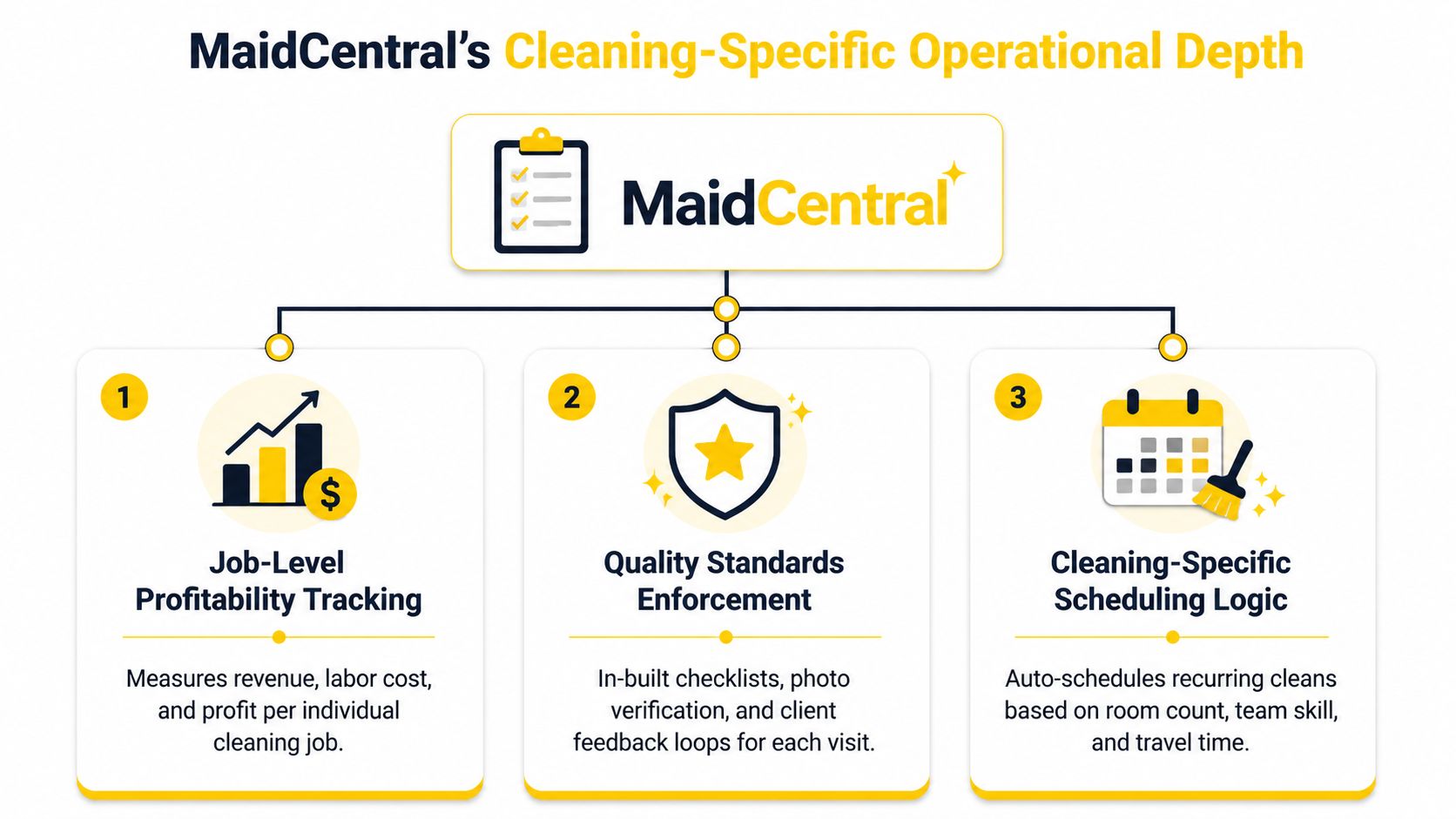
That structure matches recurring-cleaning economics. Clients judge whether crews remember access instructions, follow room preferences, use the expected sequence, and deliver the same standard on every visit. MaidCentral puts those details in the workflow instead of leaving them across messages, scattered notes, or employee memory.
Job-level profitability is the clearest operational distinction. MaidCentral's dispatch tools measure each visit for profitability, allowing owners to compare expected revenue with the labor and execution required. Margin leakage becomes visible at the individual job level rather than disappearing inside a monthly revenue total.
Quality enforcement becomes more valuable as crew count rises. Built-in quality management and scorecards give managers a consistent method for reviewing service standards. Customer preferences, warnings, images, and room logs help crews complete the work as sold, even when the original cleaner is absent.
Recurring-service management supports retention and customer-value decisions. MaidCentral's customer reporting tracks all-time revenue, revenue in the last 12 months, start date, last cleaning, and next cleaning in its published customer statistics documentation. Owners can review service continuity and customer value over time instead of treating every appointment as a separate transaction.
The sales connection matters too. Tools that encourage higher service frequency and add-ons give the office a structured way to act on recurring-service opportunities. They do not replace disciplined selling, but they reduce the chance that follow-up depends on memory.
This depth carries both financial and organizational costs. Managers must configure standards, train crews, maintain instructions, and review operating data. A company that will not enforce those workflows will pay for capability it does not use.
For a broader comparison of customer-management systems, this CRM guide for cleaning businesses offers useful context. MaidCentral's premium is justified when recurring revenue and multiple crews create enough rework, quality oversight, and margin leakage for this automation to repay its cost. A small operation that mainly needs scheduling, invoicing, and payment collection should choose the simpler system instead.
Jobber fits owners who need a reliable administrative spine, not a cleaning-specific command center. Its lower entry cost can look attractive, but the right comparison is total operating effort, not the subscription alone.
Its core workflow covers quoting, scheduling, dispatching, invoicing, and payment collection. Independent reviews describe Jobber as a broad field-service platform that supports cleaning businesses while also serving general home-service companies in comparative software coverage.
That generalist design is a real advantage for businesses offering organizing, handyman work, lawn care, or other services alongside cleaning. One system can hold varied job types, client records, job notes, online booking, automated follow-ups, GPS tracking, and QuickBooks syncing. The feature ladder matters, because some capabilities appear only on higher plans as noted in independent 2026 cleaning-software reviews.
Jobber's strongest case is front-office coordination. An owner can create an estimate, schedule the work, communicate with the client, invoice the job, and process payment without first building a specialized cleaning operating model.
That makes it practical when administrative coordination is the main bottleneck. Leads can move from inquiry to scheduled work through a workflow that staff can learn quickly. Client-facing tools also help a smaller company present a consistent experience without stitching together several disconnected systems.
Operational fit: Jobber is strongest when the business sells and coordinates service. MaidCentral is strongest when the business must control how recurring cleaning gets delivered.
Recurring cleaning requires more than appointment administration. Preferences, rotations, quality checks, route efficiency, and crew accountability must remain visible and consistent. Jobber can store many of these details through notes, fields, processes, or integrations, but maid-service execution is not its central design.
The gap widens as recurring volume and crew count rise. An owner can create workable procedures in Jobber, then discover that supervisors are maintaining separate checklists, spreadsheets, or manual review routines. The lower subscription price may therefore transfer cost into office labor and management time.
That trade-off defines the practical threshold. A solo cleaner or small mixed-service operation should usually choose Jobber. Once recurring cleaning revenue supports several crews and the office is spending substantial time correcting schedules, checking quality, and maintaining work instructions, MaidCentral's deeper automation can justify a premium price that exceeds Jobber's by more than ten times. Below that point, the premium usually buys unused complexity.
Jobber remains a sensible choice for businesses that value fast onboarding and broad service flexibility. Do not select it solely because the brand is familiar or the headline price is lower. Estimate the labor required to maintain cleaning procedures outside the platform.
For businesses already building estimates around Jobber, an integration workflow for Jobber can connect front-end estimate details with downstream scheduling and client records.
MaidCentral starts at $450 per month, then adjusts pricing through completed jobs per location. Its published model also includes $1.50 per completed job, with billing based on neither labor-hours, users, nor software modules, as stated on its pricing page.
Jobber starts around $29 to $39 per month, depending on billing terms and plan presentation in independent reviews in the 2026 pricing comparison cited earlier. Higher plans add automated follow-ups, QuickBooks syncing, GPS tracking, online booking, and additional users. One review lists Connect at $119 per month for up to five users and Grow at $199 per month for up to 15 users, with extra cleaners at $29 per month each.
These figures are a decision aid, not final invoices. Actual ownership cost depends on completed jobs, locations, billing cadence, payment volume, and the Jobber tier selected.
| Business Size | MaidCentral Cost | Jobber Cost | Cost Difference |
|---|---|---|---|
| Solo cleaner | $450/month base, plus $1.50/job | About $29 to $39/month entry pricing | MaidCentral carries a much higher fixed cost |
| Three-person crew | $450/month base, plus $1.50/job | Entry plan or a higher tier, with user costs depending on plan | MaidCentral remains substantially more expensive before usage |
| Ten-person operation | $450/month base, plus $1.50/job, with location and job-volume scaling | Higher plan, additional-user charges, and payment fees may apply | The gap narrows only if specialized controls replace meaningful admin work |
Jobber's payment fees also belong in the ownership calculation. Independent pricing coverage lists 2.9% plus 30 cents for credit cards, 2.7% plus 30 cents for tap-to-pay, and 1% for bank transfers through Jobber Payments in the same pricing review. Payment collection still has operational value, so treat these charges as part of the service cost rather than an automatic disadvantage.
A cleaning-software comparison identifies the main pricing distinction: MaidCentral can rise with locations and job volume, while Jobber depends heavily on plan level, users, and payment activity in this independent comparison.
Revenue alone does not establish the break-even point. The right test is whether MaidCentral prevents enough rework, administrative labor, route waste, or customer loss to cover its fixed commitment. Its job profitability tools, quality controls, recurring-service workflows, and back-office standardization matter only when those controls replace measurable office work.
For a solo cleaner, the premium case is weak. A small crew should usually stay with Jobber unless cleaning-specific controls already solve a costly operational problem. Once recurring cleaning revenue supports several crews or multiple locations, MaidCentral's deeper automation can justify a premium exceeding Jobber's by more than ten times, especially when supervisors spend substantial time correcting schedules, checking quality, and maintaining work instructions.
Use a proper cleaning business accounting framework before choosing. Track labor, rework, complaints, missed preferences, unpaid administrative time, and customer retention. If those costs remain low, choose Jobber. If they consume office capacity across recurring work, MaidCentral's higher price can be justified.
A feature checklist can make Jobber and MaidCentral look similar. Both schedule jobs, manage clients, and support billing. The operational gap appears in the details: how much cleaning information stays attached to each visit, and how much work the office must perform manually.
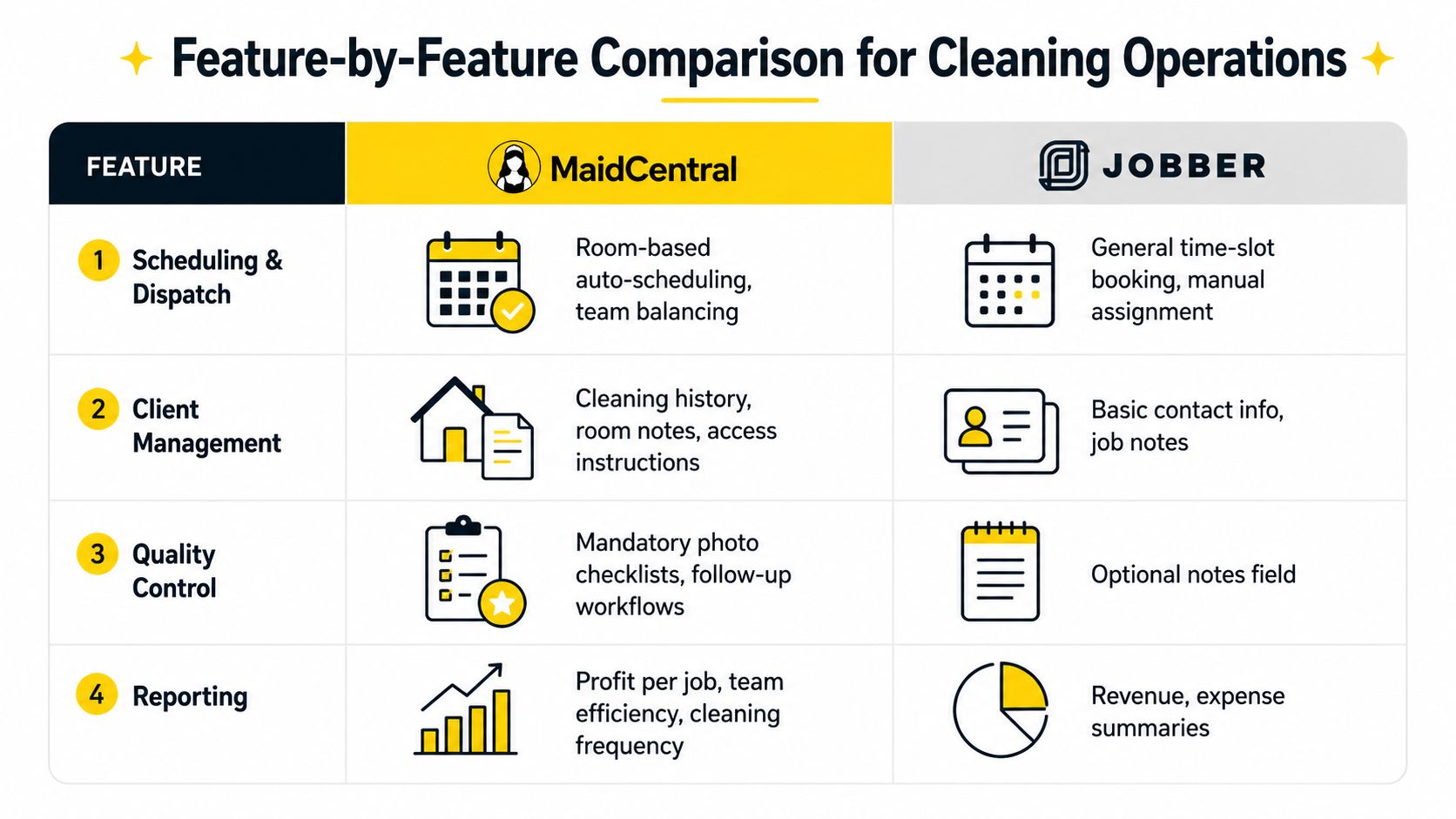
| Workflow | MaidCentral | Jobber |
|---|---|---|
| Scheduling and dispatch | Cleaning-specific scheduling consistency, recurring-service controls, and job-level dispatch measurement | General scheduling and dispatch built for broad field-service use |
| Client management | Preferences, warnings, cleaning history, worksheet instructions, images, and room logs | Client records, job notes, communications, and general service details |
| Quality control | Built-in quality management and scorecard-oriented workflows | General notes and process customization, with less cleaning-specific enforcement |
| Profitability reporting | Job-level profitability and customer performance metrics | Broad revenue and operational reporting, with deeper features tied to higher plans |
| Invoicing and payments | Cleaning-oriented operational data connected to billing and job execution | Strong quote-to-invoice and payment workflow |
| Integrations | Deeper operational focus, with implementation centered on cleaning workflows | Broad field-service ecosystem and common accounting/payment connections |
| Onboarding | More configuration and process discipline required | Generally easier for a general service workflow |
| Best use case | Recurring maid services managing consistency across crews | Smaller or mixed-service businesses prioritizing front-office efficiency |
MaidCentral connects recurring-service scheduling with customer preferences, warnings, room instructions, and service history. If the office changes a crew assignment or sends a different team to a familiar property, those details remain available at the job level. That reduces the need for separate notes, memory, and manual handoffs.
Jobber handles scheduling and dispatch well as general field-service functions. It fits businesses with varied job types, changing services, or a strong preference for a flexible calendar. Cleaning companies can reproduce more detailed instructions and quality checks, but they must build and maintain additional procedures around the platform.
The difference matters most as crew count and recurring volume rise. A general calendar can schedule work. A cleaning-specific system can also preserve the operating standards that make each visit repeatable.
Jobber has the clearer quote-to-invoice workflow. An owner can move from estimate to job, invoice, and payment within one broad process. That structure suits mixed-service companies that need a consistent customer-facing experience across different types of work.
MaidCentral connects completed visits with the operational records behind them. Its customer statistics cover revenue history and cleaning continuity, while its dispatch tools focus on job-level profitability. Managers can therefore examine whether a recurring visit made money and whether the crew delivered the expected standard, rather than reviewing revenue alone.
Implementation is another trade-off. Jobber usually requires less configuration for a general service workflow. MaidCentral demands more process discipline, but that setup supports stronger standardization across recurring cleaning crews.
Use this guide to the best cleaning business software to compare broader system options and workflows. Choose based on the administrative work you need to eliminate, not the interface you prefer.
Choose MaidCentral for a specialized, recurring cleaning company with operational complexity. The strongest case is an established business with multiple crews, demanding residential clients, recurring routes, and a visible quality-control problem. The platform's higher cost is easier to defend when management needs job profitability, standardized instructions, service scorecards, and consistent execution across teams.
A multi-location operator or franchise has an even stronger reason to consider it. Centralized standards become more valuable when owners can't personally inspect every visit. MaidCentral's design gives managers a way to encode service expectations and monitor customer performance instead of relying on informal coaching.
The five-crew recommendation is a practical operating threshold, not a published rule. At that scale, the company should test whether recurring-service inconsistency, route inefficiency, rework, or administrative coordination is already costing more than the software premium. If those problems aren't present, don't buy complexity just to look established.
Jobber is the better choice for solo cleaners, small teams under five people, and mixed-service home businesses. Its lower-cost entry model lets owners create estimates, schedule work, invoice customers, and accept payments without paying for a specialized operational stack they may not use.
It also suits a cleaning company where cleaning is only one part of the service mix. A general-purpose field-service workflow can be easier to maintain when the calendar includes different job types, pricing methods, and service expectations.
The middle ground is real. A growing maid service can start with Jobber, document its procedures, and migrate later when the business outgrows general-purpose controls. But migration still requires data cleanup, staff training, workflow redesign, and customer communication. Don't wait until a quality crisis forces the move. Review the decision when your office team starts maintaining parallel spreadsheets or when managers spend more time correcting service variance than developing the business.
My recommendation is direct:
Start with three questions, then test the answer against actual operating data.
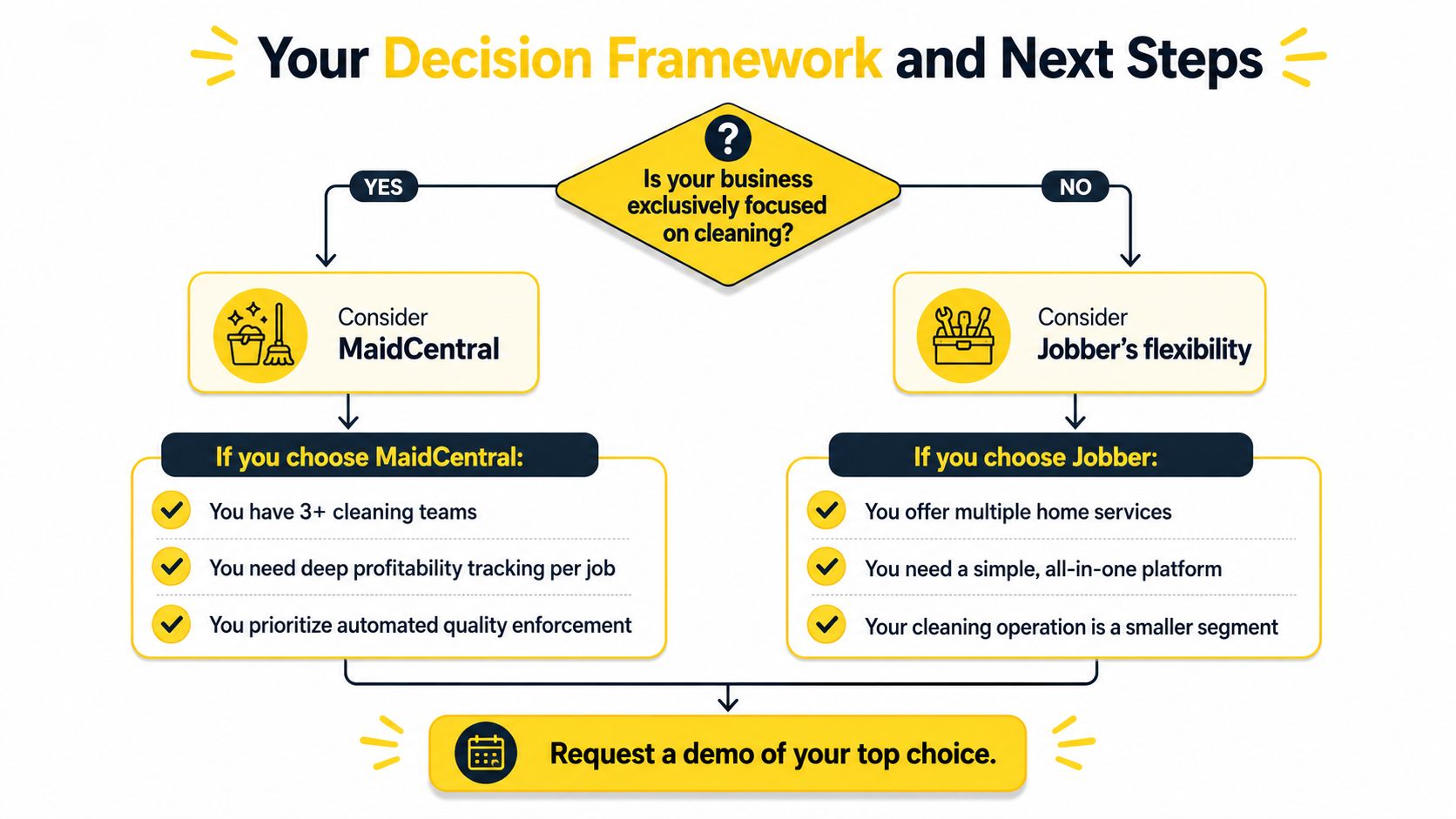
During each demo, use your own recurring clients, crew assignments, room instructions, service changes, and billing rules. Ask the vendor to show how the system handles a late reschedule, a customer warning, a quality complaint, and a job that runs beyond its expected labor time.
For a trial or pilot, track:
Choose Jobber first if your operation is small or mixed-service and your main need is a dependable quote-to-invoice workflow. Choose MaidCentral first if recurring cleaning complexity, quality variance, and job-level margin control already define your management workload. The right platform is the one that removes your most expensive operational constraint, not the one with the most impressive demo.
If you're comparing software because your cleaning business needs faster lead response before scheduling begins, Estimatty provides AI-powered web and voice estimates that capture job details, send pricing by SMS or email, and can pass estimate information into Jobber. Visit Estimatty to see how an always-on estimating layer could fit alongside the platform you choose.