
October 10, 2026
How to Increase Qualified Leads for Cleaners
Learn how to increase qualified leads for your cleaning business. Discover AI estimators, speed-to-lead tactics, and scoring strategies that book more jobs.

Friday, August 21, 2026
Learn how to handle scope creep in cleaning businesses with proven scripts, change-order workflows, and practical contract clauses that protect your margins.

Tuesday morning, a two-bedroom home is booked for a routine clean. Halfway through, the homeowner points at the baseboards, asks for the inside of the oven, and mentions a laundry pile that “should only take a minute.” The crew wants to keep the peace, so they start adding tasks. By the time they leave, the job bears little resemblance to the approved estimate.
That scene is familiar in residential cleaning, and commercial teams see the same pattern in break rooms, offices, restrooms, and storage areas. Scope creep isn't mainly a difficult-customer problem. It's usually an intake, estimating, and approval problem. Once the original boundaries stay vague, every “while you're here” request becomes harder to price and easier to absorb for free.
The first pattern is the undeclared add-on. The customer asks for windows, the inside of a refrigerator, a garage, or an oven that never appeared in the original service description. They may not be trying to avoid payment. They may believe these tasks are part of a general clean because nobody separated standard work from specialty work before the appointment.
The second pattern is an assumed frequency change. A weekly customer suddenly expects deep-clean tasks on every visit, such as detailed baseboards, cabinet interiors, or appliance work. A task that made sense as an occasional add-on becomes a recurring labor commitment.
The third pattern is especially dangerous because it happens inside the crew. A cleaner notices a neglected room and handles it without asking the office. That kindness can create a new customer expectation, and the next crew gets judged against an undocumented promise.
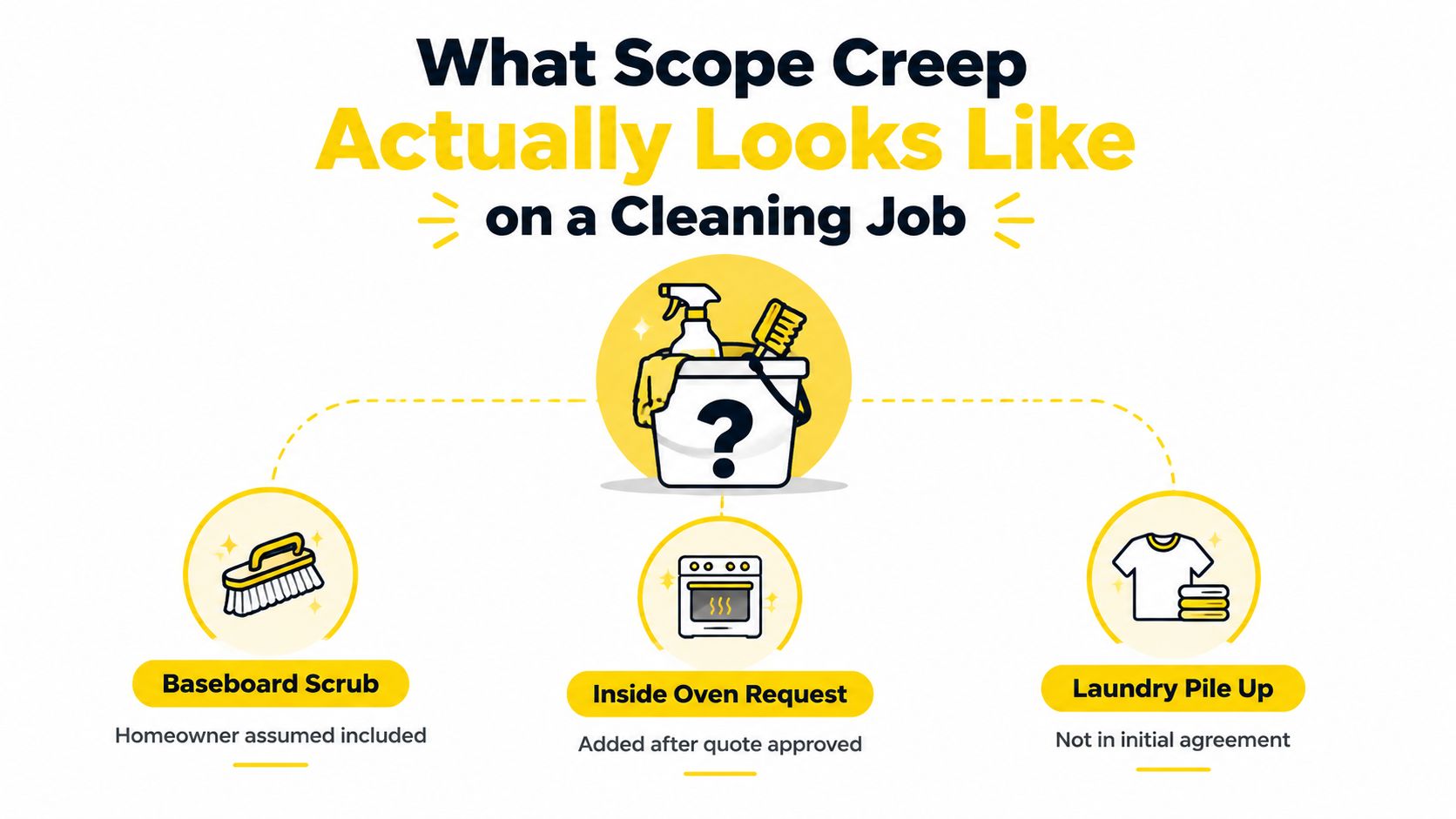
When a customer says, “I assumed that was included,” the useful question is not who's at fault. Ask what the customer saw, what the estimator recorded, and what the crew was told. If the estimate didn't name the rooms, surfaces, exclusions, and add-ons, the business left space for two reasonable interpretations.
Review your last several jobs and mark each request as undeclared add-on, frequency drift, boundary drift, or vague ask. The pattern you find tells you whether to rebuild your estimate template, retrain the crew, or improve confirmation messages.
Cleaning is labor-heavy, so unpriced work consumes the resource that controls most of the visit, crew time. A customer may see an oven, fridge, or extra room as a small addition. The business sees setup, movement, product use, detail work, and a later finish time that can affect the rest of the route.
The risk is widespread across project work. A widely cited Project Management Institute finding reported that 52% of projects completed in the prior 12 months experienced scope creep, up from 43% five years earlier (PMI-backed analysis of scope creep). For a cleaning company, that translates into a familiar operational chain: a crew finishes late, payroll rises, the next appointment gets compressed, and quality complaints appear elsewhere.
A 2026 peer-reviewed study found a strong negative relationship between scope creep and project performance, reporting a path coefficient of -1.076 and a critical ratio of -11.432 (study on scope creep and project performance). The same model reported that strategic best practices improved performance with a coefficient of 0.620, and partially offset scope-creep harm with a coefficient of 0.196. Those findings support what operators see in the field: controls aren't bureaucracy when they protect delivery.
A precise “typical margin hit” can't be stated without knowing your loaded labor cost, crew size, travel time, payroll taxes, supplies, and service price. That's why the right calculation is internal, not borrowed from a generic benchmark:
Uncharged labor cost = extra crew hours × loaded hourly labor cost.
For a small residential clean, even a short addition can consume the profit that was supposed to cover travel, administration, supplies, insurance, and owner compensation. A crew that stays 90 minutes late is also not just completing a longer visit. It may be creating route disruption, overtime exposure, or a customer expectation that every future visit includes the same extras.
| Uncharged Addition | Avg Extra Minutes | Margin Lost per Visit |
|---|---|---|
| Baseboard detail | Record actual time | Extra crew minutes × loaded labor cost |
| Inside oven | Record actual time | Extra crew minutes × loaded labor cost |
| Laundry handling | Record actual time | Extra crew minutes × loaded labor cost |
| Extra room | Record actual time | Extra crew minutes × loaded labor cost |
Don't invent the missing values. Time these tasks in your own operation, then place the figures into the table. Your pricing decision should reflect your crew economics, not an industry guess.
A strong estimate makes the job visible before anyone loads the van. Start with the property type, approximate square footage, number of bedrooms or work areas, bathrooms, kitchen configuration, floor surfaces, pets, access conditions, and requested frequency. For commercial accounts, add operating hours, occupied areas, restroom count, break rooms, entry points, security procedures, and any areas that require special handling.
Build the estimate room by room. A residential template might list bedrooms, bathrooms, kitchen, living areas, stairs, and hallways. A commercial template might list reception, private offices, conference rooms, restrooms, corridors, kitchens, and shared areas. Each item should show what the crew will clean, not a vague label such as “full service.”
Use per-square-foot pricing when property size and surface coverage drive the work. Use hourly pricing when condition varies widely or the customer wants a flexible labor block. Use a flat rate when the service package is standardized and your historical time records support the price.
Separate add-ons from the base service. List inside ovens, inside refrigerators, exterior windows, walls, garages, laundry, and inside cabinets as separate line items or explicit exclusions. The customer should be able to see the difference between “included in this service” and “available for an additional charge.”
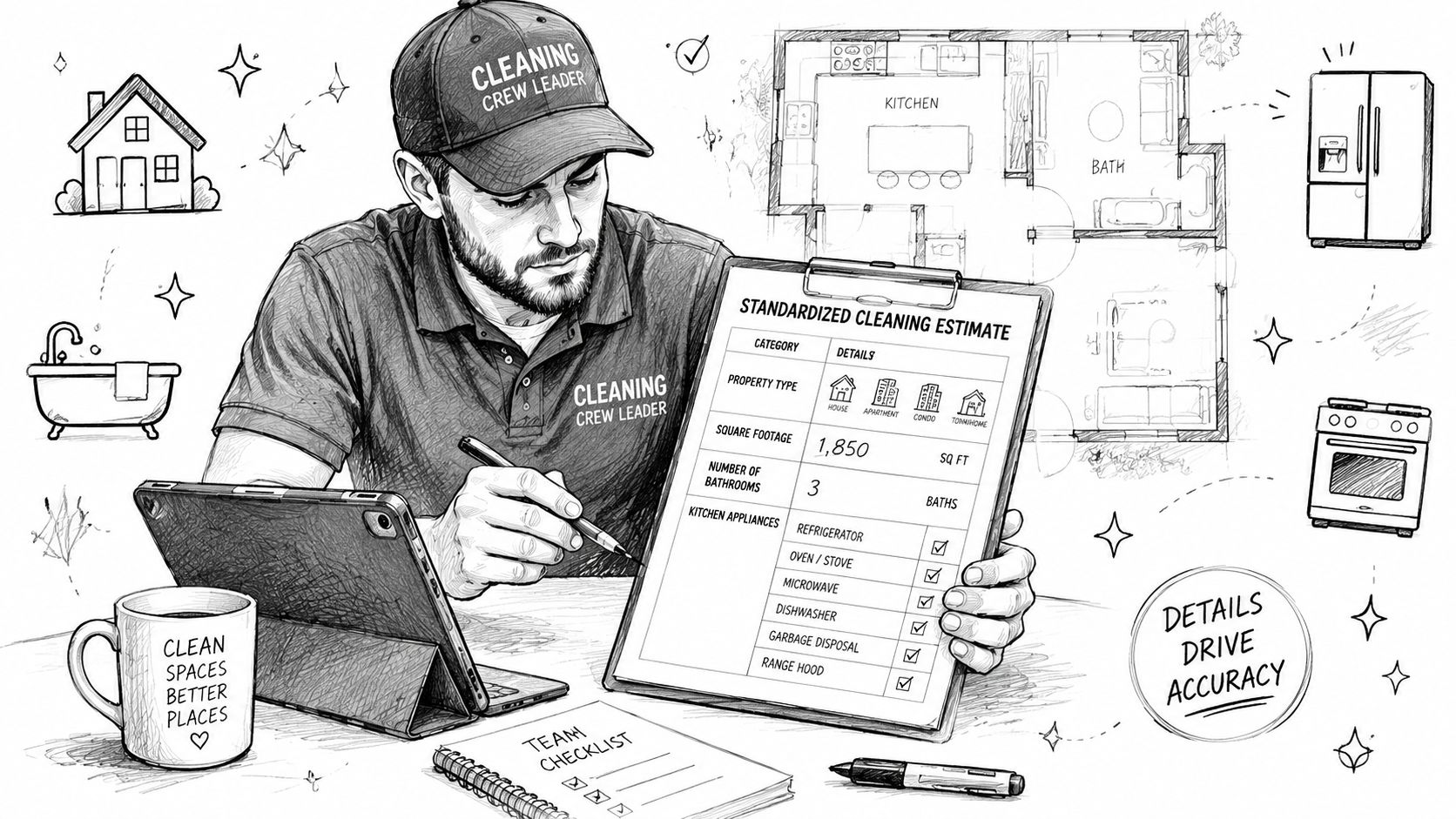
Use this guide to transitioning from in-home estimates to online estimates when you're replacing informal walkthroughs with a repeatable digital process. The important outcome isn't the software screen. It's a consistent record that the customer can review and the crew can follow.
Practical rule: Every assumption a customer might challenge should appear as a confirmation point before service.
Add a notes field for condition, pet hair, clutter, sensitive surfaces, access instructions, and customer priorities. Have the client approve the estimate with the exclusions visible. If they ask for “everything,” turn that phrase into rooms, surfaces, tasks, time, and price before accepting the booking.
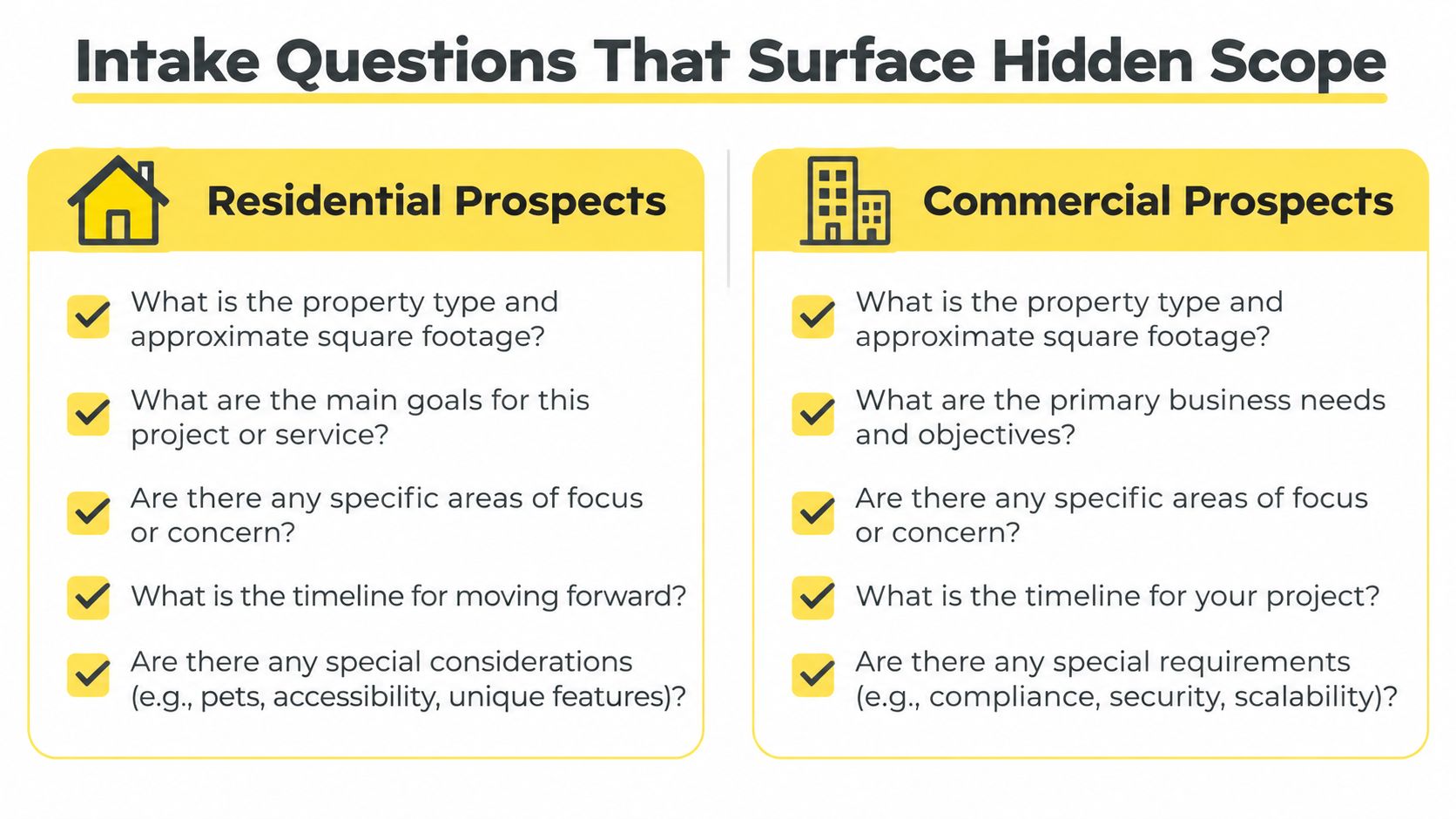
An intake call should uncover the work that customers often forget to mention. Keep the conversation short, but don't skip the questions that change labor, supplies, safety, or scheduling. Record the answers in the customer record so the estimator and crew aren't relying on memory.
Ask:
For commercial prospects, ask about the facility type, approximate size, rooms and restrooms, floor surfaces, window expectations, occupied hours, access, alarms, parking, supplies, waste handling, and any safety restrictions. Ask who can approve added work. A cleaner shouldn't be negotiating with an employee who can't authorize a change.
Subject: Please confirm your cleaning service details
Hi [Client Name],
Your estimate covers [rooms and areas] at [property address], including [specific surfaces and tasks]. It does not include inside ovens, inside refrigerators, exterior windows, walls, garages, laundry, or inside cabinets unless those items appear as approved add-ons.
Your visit window is [time window]. Please confirm parking and access instructions, pets, alarms, valuables, and whether supplies are available or should be provided by our team.
Reply with any corrections before [date]. Requests made after approval may require a separate add-on approval and could be scheduled for the next visit.
Thank you,
[Business Name]
Send the confirmation through the channel the customer monitors. Then attach the reply to the estimate notes and contract. For broader intake and safety considerations, see this guide to protecting cleaning teams through better intake systems.
The day before service, send:
Hi [Client Name], confirming tomorrow's cleaning for [address] during [time window]. We're scheduled for [included rooms and tasks]. Do you have any new requests? Please reply today so we can price and schedule them properly. New work may require approval or a later visit.
A change order shouldn't sound like a refusal. It should sound like a clear service option. The crew or office acknowledges the request, checks the approved scope, prices the addition, captures written approval, briefs the team, and records what changed.
The sequence matters:
Fridge request
We can help with the inside of the fridge. Today's approved scope covers [included areas], and the inside refrigerator wasn't included. The add-on is [price] and will add approximately [time] to the visit. Would you like us to complete it today, subject to the revised finish time, or add it to your next visit? Please reply “Approve” so we can update the work order.
Messier office
We found that the office requires more work than the approved service covers. We can add [specific tasks] for [price], or we can keep today's visit within the approved scope and schedule the additional work next time. Please choose today or next visit, and confirm your approval in writing before the crew continues.
Dog at home
Thanks for letting us know. For safety and access, please confirm that the dog will remain secured away from the cleaning areas and that the crew may enter under the existing access instructions. The pet's presence doesn't automatically add work to today's scope. If there's pet-hair or odor treatment you want, we'll price that separately before starting.
Don't make the cleaner improvise a price at the door. The customer is more likely to accept a charge when the business explains exactly what changed and gives a choice.
| Request | Script Trigger | Add-On Price | Approval Method |
|---|---|---|---|
| Inside refrigerator | “Can you also clean the fridge?” | Approved rate-sheet item | Written approval in estimate |
| Extra office time | “Stay longer, it's messier” | Hourly or time-block rate | Digital change order |
| Pet-related treatment | “The dog is home” plus added cleaning request | Approved pet-treatment item | Written scope confirmation |
| Additional room | “Can you do this room too?” | Per-room rate | Signed or digital approval |
For tone, boundaries, and de-escalation language, use this practical guidance on dealing with difficult cleaning customers. The point isn't to win an argument. It's to give the customer a professional decision instead of an unexpected invoice.
Your contract should turn a hallway conversation into a documented decision. It doesn't need to sound hostile. It needs to state what the business will do, what it won't do, and what happens when the customer asks for something different.
Use a clause such as:
Scope of work: Cleaning services will be provided at [address] for approximately [square footage], covering [rooms or commercial areas] and [surfaces]. Included tasks are listed in the approved estimate attached to this agreement.
Exclusions: Unless separately listed and approved, services exclude inside ovens, inside refrigerators, exterior windows, walls, mold remediation, biohazard cleanup, hoarding cleanup, garages, laundry, and inside cabinets.
Don't include a task in a general “deep clean” label and expect customers to infer the details. Attach a room-level checklist or work breakdown to the agreement.
Change orders: Any request outside the approved scope, or any request that requires more than [X] additional minutes, requires written approval and a price adjustment before work begins. Approved changes may affect the service finish time or be scheduled for a later visit.
Rate sheet: Approved changes will be priced using the attached rate sheet: [hourly rate], [per-room rate], and [per-window rate], plus any listed specialty-service charges.
Set the threshold based on your operation. A threshold doesn't authorize free work below it. It identifies when the office must stop, review, and document the request.
Access and safety: The client will provide safe access, disclose pets and alarms, secure valuables, and identify hazards before service. The team may pause or decline work that presents an unsafe condition or requires a service outside the company's capabilities.
Scope acknowledgment: Client initials each line:
[ ] I reviewed the included rooms and tasks.
[ ] I reviewed the exclusions.
[ ] I understand added work requires written approval.
[ ] I understand added work may change price and finish time.
[ ] I authorize the attached estimate and agreement.
Upload the signed agreement as the document attached to the approved estimate, so the customer record keeps the commercial promise and operational instructions together. This resource on cleaning service contracts can help you organize the agreement language.
| Clause | Scope Creep It Prevents | Where It Lives in Estimatty |
|---|---|---|
| Scope definition | Extra rooms and unclear surfaces | Estimate description |
| Exclusions | Assumed appliance and specialty work | Estimate exclusions |
| Change threshold | Unapproved time expansion | Contract attachment |
| Rate sheet | Inconsistent add-on pricing | Estimate template |
| Access and safety | Unplanned access or hazard demands | Customer notes and agreement |
| Initialed acknowledgment | “I thought it was included” disputes | Signed agreement |
A policy fails when the cleaner can't use it during a busy visit. Train the workflow until the response feels normal: check the approved scope, pause before accepting added work, send the change order, wait for approval, then proceed or schedule the request later.
Run a 15-minute Monday huddle with a tight agenda:
For distributed offices, a practical guide to remote team collaboration can help owners keep office staff and field crews aligned without relying on scattered messages. The same principle applies locally: one current scope record beats several contradictory conversations.
| KPI | How to Calculate | Target Benchmark |
|---|---|---|
| Change-order revenue as a percentage of total invoice | Approved change-order revenue ÷ total invoiced revenue × 100 | Set an internal baseline, then review the trend |
| Silent scope additions per 100 cleans | Unapproved additions recorded ÷ completed cleans × 100 | Move toward zero |
| Request-to-signed-change time | Average time from request receipt to written approval | Shorten without skipping review |
| Repeat-customer retention rate | Returning customers retained ÷ customers eligible to return | Track by service type and account |
Don't assign targets before collecting clean baseline data. A sudden increase in change-order revenue might mean better billing, while a fall might mean crews are absorbing work. Pair the numbers with job notes and customer feedback.
Review the scorecard at 30 days to correct scripts and fields, 60 days to adjust rates and training, and 90 days to decide whether the process is reducing unpaid work without harming retention. Keep service consistency visible through cleaning quality assurance practices, especially when a change affects finish time or crew assignment.
Estimatty gives cleaning businesses a practical way to capture property details, standardize estimates, separate included work from add-ons, and send consistent pricing before the crew arrives. Visit Estimatty to replace informal mid-job promises with documented approvals that protect your margins and your customer relationships.