September 29, 2026
Commercial and Residential Cleaning in 2026
Compare commercial and residential cleaning markets in 2026. Explore pricing, staffing, compliance, and how AI estimators streamline operations.

Monday, August 10, 2026
Discover what is lead qualification for your cleaning business. Get frameworks, scripts, and tips to stop chasing bad leads and win more jobs in 2026.
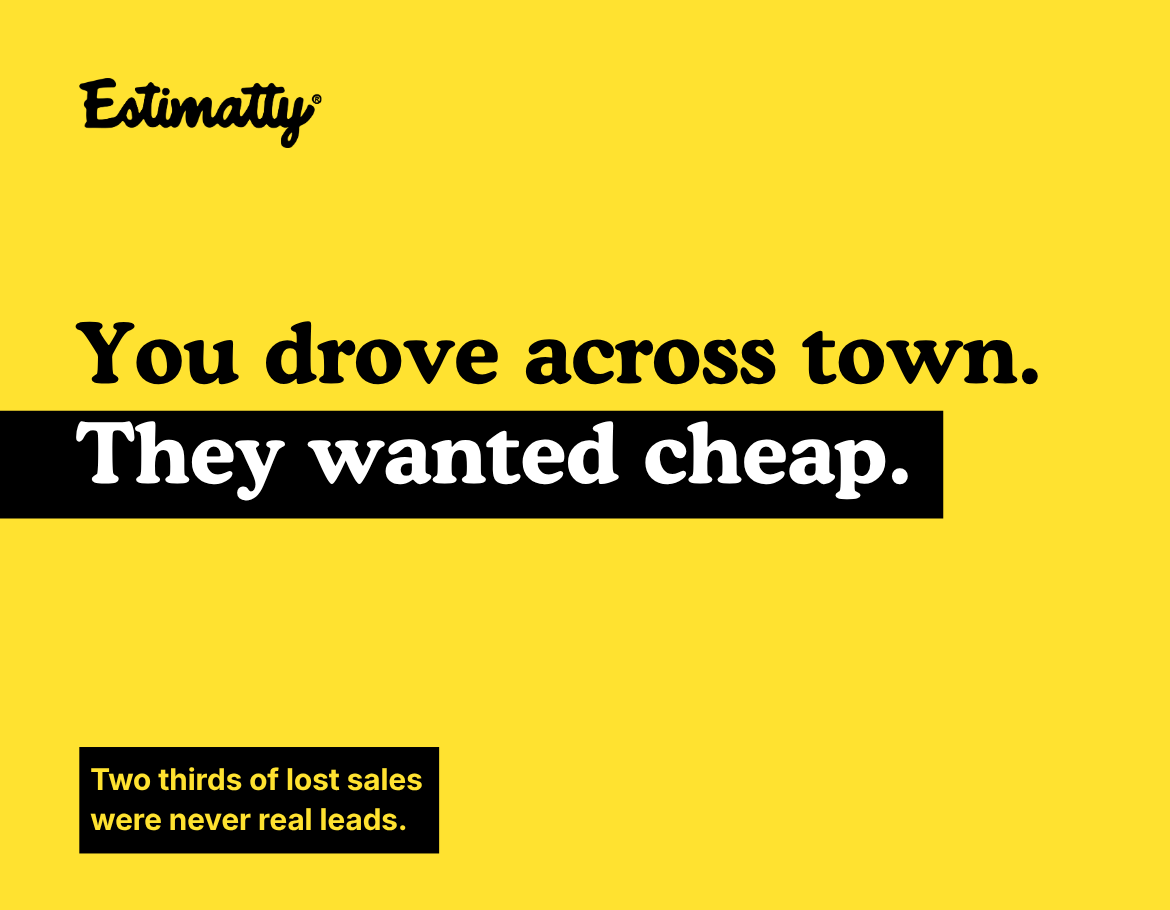
You're probably fielding the same kind of lead over and over. A homeowner asks for an estimate, sounds interested, but then you learn they want a one-time move-out deep clean in a zip code you don't cover, or they're expecting recurring service at a bargain-bin price. Meanwhile, you've already spent the call, the back-and-forth text thread, and maybe a windshield full of driving time.
That's not normal overhead. It's a qualification problem.
In cleaning, lead qualification is the process that separates people who are worth your time from people who are just collecting prices. The sharper your qualification, the fewer tire-kickers you chase, the fewer wasted estimates you deliver, and the faster you get back to profitable work. Poor qualification is a major source of lost revenue, and benchmark data from 2024 to 2026 says 67% of lost sales stem from improper lead qualification, while 79% of marketing leads never convert to sales Landbase benchmark data. If that sounds familiar, your funnel isn't leaking a little, it's bleeding.
If you're tracking where your inquiries come from, this pairs well with lead source tracking because source tells you where the lead entered, while qualification tells you whether it deserves a sales conversation. Lead source tracking for cleaning businesses is useful only when you're filtering the right inquiries, not just counting them.
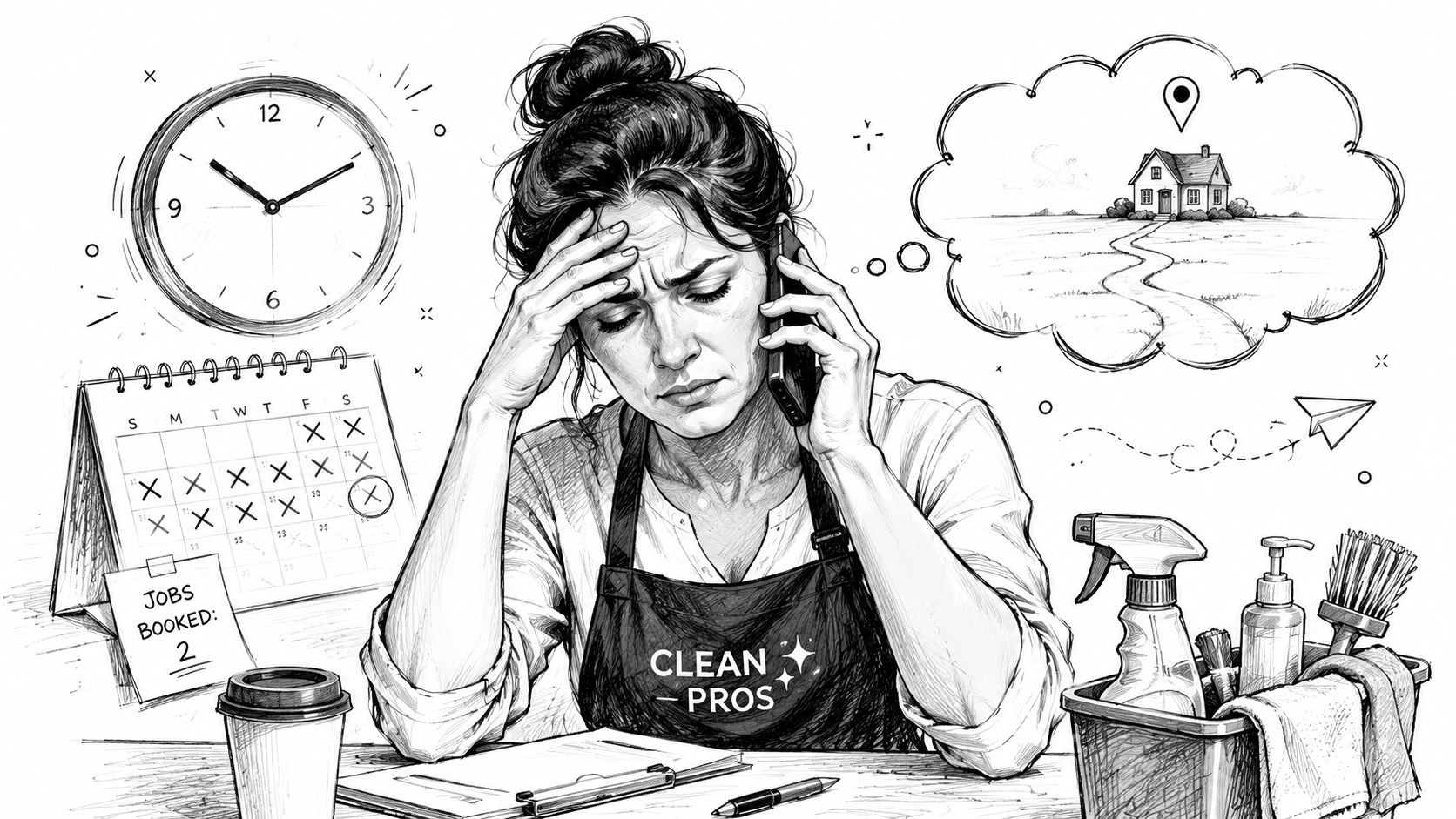
The worst part of bad leads is not the lost job. It is the time drain that follows you all day.
A cleaning business owner does not just “get a lead.” You answer the phone, check the service area, ask about bedrooms or square footage, explain what is included, and maybe even drive out for an in-person estimate. Then the prospect says they were hoping for a price far below your minimum, or they need post-construction cleanup when you only do recurring residential service. This cycle is just avoidable friction.
Practical rule: if a lead cannot clear your basic service, location, and budget filters, do not let it consume a rep, a cleaner, or a drive across town.
The fix is lead qualification, which turns your inquiry flow into a gate instead of a pile of open tabs. A qualified lead is one you would want to schedule, price, and service. An unqualified lead is noise, even if they filled out your form politely.
Sales teams usually qualify by checking whether a lead matches the ICP, has a real need, has the required budget, is a decision-maker, and is buying at the right time PandaDoc lead qualification guide. In cleaning, that translates cleanly. You want service type, location, urgency, and buying power before you commit time.
A simple internal process also helps you see which channels are sending junk. If a referral source keeps sending one-off price shoppers, or a paid ad is attracting leads outside your service area, you need to know that quickly. That is why many owners pair qualification with a sharper intake process, then connect it to website visitors who are ready to become customers instead of letting every inquiry look equal.
The point is blunt. If you are still treating every call as a possible sale, you are choosing chaos. Qualification is how you stop doing free consulting for people who were never a fit.
A cleaning company that treats every inquiry the same wastes time fast. A homeowner wants a move-out deep clean, a property manager wants recurring turnover service, and a bargain hunter wants the lowest possible quote. Lead qualification sorts those calls before your team spends time on the wrong job.
Lead qualification works like a filter. It screens out prospects outside your service area, below your minimum, too expensive to serve, or too vague to deserve immediate attention. That is the point. You want the leads that fit your business model, not every person who filled out a form.
The cleanest definition is simple. A lead is qualified when it matches your Ideal Customer Profile and shows enough buying intent to justify contact now. The question is not, “Did they submit their details?” The question is, “Do they look like a customer who will produce profitable work?”
Qualified cleaning leads usually clear a few practical tests. They are inside your service area. They need the type of work you sell, recurring house cleaning, office cleaning, or another core offer. They understand value instead of chasing the cheapest price. They are ready to move, not browsing five vendors before lunch.
Unqualified leads usually expose themselves quickly. They ask for a one-time garage cleanup you do not offer. They are calling from outside your route. They want a race-to-the-bottom quote, or they have not even decided what they need yet. That is noise, not demand.
A qualified lead should be easy to route, easy to price, and easy to serve.
Lead qualification is a decision gate. It tells you whether a prospect should go to sales now, stay in nurture for later, or get disqualified because the fit and the buying intent are wrong Topo lead qualification glossary. In a cleaning company, that gate protects your calendar. It tells you when to book an estimate, when to keep a prospect warm, and when to end the conversation before it consumes your day.
Qualification also changes over time. A lead can look weak on day one, then become strong later when the move date gets closer or the client's current cleaner fails them. Your system should route leads, not just collect them. If you need a practical example of how that supports scheduling and handoff, see website visitors who are ready to become customers.
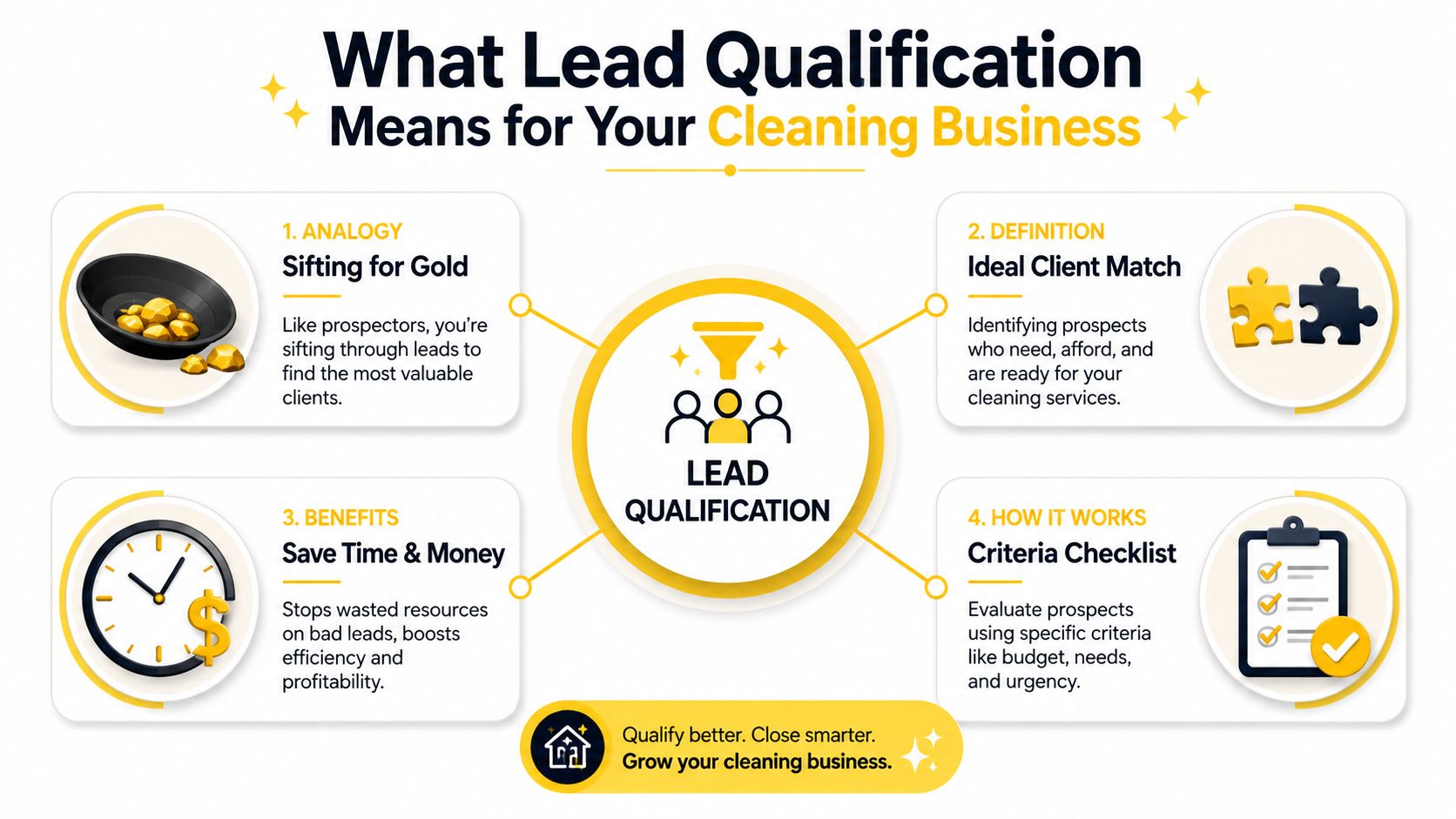
Interest does not pay payroll. A prospect can like your website, ask for a price, and still be a bad fit. Qualification separates curiosity from commercial value.
A cleaning company does not need a heavy sales process. It needs a repeatable filter that keeps tire-kickers out of the schedule and sends real opportunities to quoting or booking. BANT works here, but only after you translate it into cleaning terms instead of office-speak.
| Criteria | BANT Framework (Traditional) | Cleaning Service Model (Simplified) |
|---|---|---|
| Budget | Can they afford the solution? | Does their expected price range fit your minimum service fee? |
| Authority | Are you speaking to the decision-maker? | Are you talking to the homeowner, office manager, or property contact who can approve service? |
| Need | Is there a real business problem? | Do they need recurring cleaning, one-time specialty service, or nothing you offer? |
| Timeline | How soon will they buy? | Are they ready now, or are they months away from booking? |
| Location | Usually implied in B2B fit | Are they inside your service area and route? |
| Service Fit | Usually folded into need | Is this a job you want, and can deliver well? |
Keep the parts that drive decisions and drop the rest. BANT works because it forces a clear check on budget, authority, need, and timeline. For a cleaning business, that means asking whether the lead understands your pricing model, whether the person on the call can approve the work, whether the job fits your service menu, and whether the timing is real enough to schedule around.
A simpler cleaning-specific model is often better. Use Service Fit, Location, and Urgency as your three core checks. If all three line up, move the lead to pricing or booking. If one is weak, keep it in nurture. If two or three fail, disqualify it quickly and move on.
That approach matches the way proven sales teams qualify leads with fixed questions about ICP fit, real need, budget, decision-maker status, and purchase timing, as outlined in the PandaDoc lead qualification guide. Cleaning companies should use the same logic, but apply it to route density, job type, and service capacity instead of enterprise buying committees.
If you want a cleaner way to spot intent before a human call, use the Estimatty product tool for lead intent as a model for what should happen before your team gets involved. The point is simple. Qualification is a rule set, not a gut check.
Good qualification questions don't sound like interrogation. They sound like a professional who respects both sides' time.
Start with the reason they reached out. Ask, “What prompted you to look for a cleaning service today?” That one question tells you a lot. A move-out deadline, a failed cleaner, or a last-minute office issue signals urgency. A vague “just checking prices” usually doesn't.
Then move to fit. “What kind of service are you looking for, recurring, one-time, or specialty?” If they're asking for a service you don't sell, stop there. Don't force a square peg into your schedule.
You can ask about budget in a way that doesn't feel awkward. Try, “To make sure we're a good fit, our recurring services typically start at [your minimum]. Does that fall within the range you had in mind?” That's clearer than asking, “What's your budget?” and getting a dodge in return.
For authority, ask, “Who else needs to approve this before we move forward?” If the answer is “my spouse,” “the property manager,” or “our office director,” you now know who matters. If they can't answer that, the lead may still be early.
Timeline deserves a direct question too. “When would you like service to begin?” If they say “ASAP,” you can prioritize. If they say “sometime this season,” they can go into nurture until the timing changes.
Practical rule: ask one fit question, one budget question, and one timing question before you spend any real estimate time.
Speed changes the entire game. Benchmark data shows 50% of sales go to the vendor that responds first, and contacting a lead within 5 minutes makes them 9 times more likely to convert lead response benchmark data. In cleaning, that means the first clean answer, not the longest follow-up chain, often wins the booking.
If you need a tighter phone flow, use the kind of practical outreach structure covered in quote by phone for cleaning businesses. The key is to qualify while the lead is still warm, not after they've already booked someone else.
A short script is enough:
That's not pushy. That's professional.
Manual qualification breaks down fast. One person asks three questions, another asks seven, a third forgets to ask about service area, and nobody follows the same script after hours. That inconsistency is expensive, and it gets worse the more your team grows.
Modern systems solve this by standardizing the decision. Modern lead qualification is shifting from manual rep judgment to automated systems that use scoring criteria, thresholds, and routing rules to classify leads continuously and standardize the process at scale Highspot lead qualification guide. That's exactly where cleaning businesses need to go. You don't need more gut feel. You need a repeatable intake process that works on the website, by phone, and after hours.
A good automated workflow asks the qualifying questions immediately. Service type. Square footage. Special requirements. Urgency. Location. That means the prospect gets sorted before your team wastes time on a dead lead, and your live staff only steps in when there's real commercial value.
A tool like Estimatty serves this purpose. It acts as a digital front desk for cleaning businesses, asking for the details that matter and turning them into instant estimates and routing signals. That matters because the owner stops being the bottleneck, the office stops guessing, and the pipeline starts filling with leads that are already screened for fit.
If you're comparing systems for building smarter intake forms, the CodeDesign.ai form solution is a useful reference point for how structured form building can support cleaner qualification workflows. The point isn't the form itself, it's the discipline behind it.
The payoff goes beyond intake. When qualified jobs come in more consistently, it becomes easier to hire and schedule staff with support from resources like pipehirehrm.com, because you're staffing against real demand instead of random spikes. That's how a cleaning business moves from reactive quoting to predictable operations.
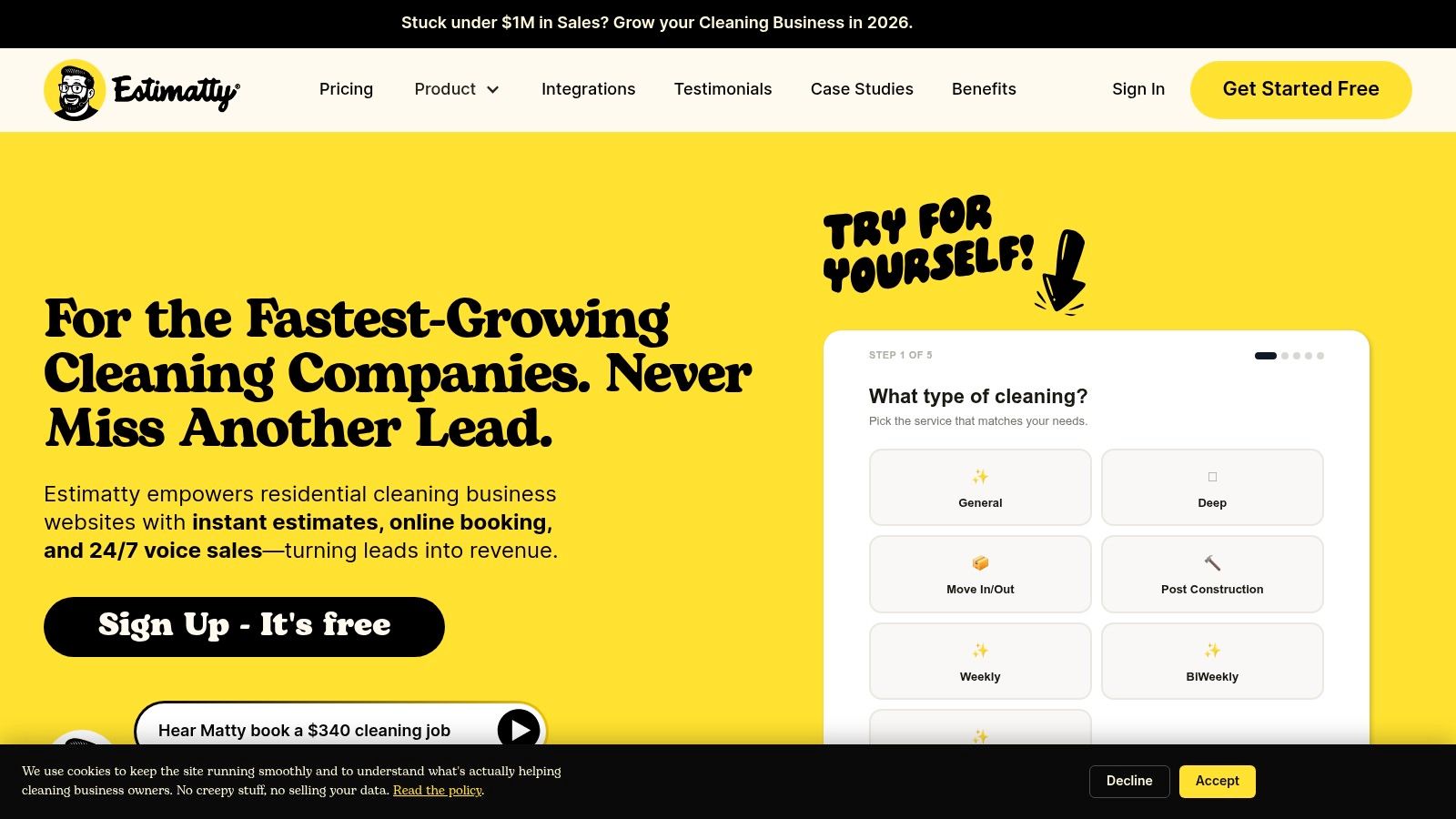
A better process doesn't just speed things up. It makes the whole business calmer. Fewer interruptions. Fewer bad-fit estimates. More time spent on clients who want to buy.
A cleaning business wins or loses money at the inquiry stage. If every phone call, web form, and text message lands on the same pile, your team burns time on bad-fit leads and misses the jobs that pay. Qualification fixes that. It lets you decide which inquiries deserve a quote, which ones need more detail, and which ones should never reach a scheduler.
That process has to stay active. A lead that looks weak today can turn into a booked job later, especially when a homeowner finalizes a move date or a facility manager gets internal approval. Salesforce lead qualification guidance treats qualification as an ongoing process for that reason, and cleaning businesses should do the same.
Commercial work needs the same discipline, just with higher stakes. If you want better results on larger accounts, study mastering cleaning contract bids and connect that thinking to your intake flow. Then use booking software for a cleaning business to keep inquiries, scheduling, and follow-up in one place instead of scattered across voicemail and spreadsheets.
The strongest cleaning companies do not treat every inquiry like a fire drill. They build a filter that screens fast, sends qualified leads straight to booking, and keeps unqualified requests from filling the calendar with low-value work. That protects margins, keeps the office from getting buried in admin, and gives your team more time for jobs worth doing.
If you want the intake process to pull its weight, stop handling it manually. Use a system that asks the right questions up front, routes serious buyers faster, and cuts out the back-and-forth that drains profit.