
October 26, 2026
Professional Commercial Cleaning: Services and Costs
Professional commercial cleaning guide: service types, OSHA rules, staffing, equipment, pricing and how to scope a contract that holds up.

Tuesday, October 27, 2026
Learn what an electrical service contract covers, the clauses that matter, sample language for each, and a checklist to customize it before you sign.

The most common advice about choosing an electrical service contract is to compare the annual fee and look for priority service. That's not enough. A low fee tells you little about who pays when a transfer switch fails after hours, and priority status means nothing unless the provider commits to an attendance window.
Treat the agreement as a risk-allocation document, not a maintenance subscription. Before signing, test every promise against an outage: which equipment failed, who must respond, what they must deliver, and which costs remain yours.
An electrical service contract is a written agreement that sets out which assets a provider will inspect, maintain, or repair, what the work costs, and how long the obligations last. Repair may be limited, priced separately, or excluded. The contract's schedules, not its title, determine what happens when equipment fails.
A project estimate prices a specific job. A service agreement governs ongoing work as equipment ages, tenants change, and owners add electrical loads. Require the agreement to identify covered assets and scheduled work, rather than treating a price document as an operating commitment.
Electrical service contract types compared
| Contract type | Typical term | What it covers | How it is billed |
|---|---|---|---|
| Residential home-warranty electrical plan | Monthly or annual renewal | Wiring, panels, standard fixtures, breakers; meter boxes and generators excluded or add-on | Recurring fee; claim or service fee only as expressly scheduled |
| Residential maintenance agreement | One to three years in the service-contract guidance discussed under payment terms | Scheduled inspections, priority response, discounted repairs | Fixed recurring fee; major repairs billed separately |
| Commercial maintenance agreement | Multi-year term with annual or semiannual scheduled visits | Panels, switchgear, breakers, UPS, transfer switches, generators; scheduled tests | Fixed fee plus pre-negotiated emergency rates |
| Hazardous-area inspection agreement | Inspection interval set by the site's hazardous-area classification and inspection plan | Explosion-protected installations under IEC 60079-17 | Inspection-grade pricing must be stated; equipment repair estimated separately |
| Managed energy service agreement | Program-defined term with stated start, end, and review points | EV chargers, batteries, solar, generators, demand response | Fees or bill credits tied to specified grid services |
The trigger for the provider's obligation matters. A warranty responds to a covered failure; a maintenance agreement requires scheduled work even if nothing has broken. A managed energy agreement also sets terms for how equipment operates.
Electrified HVAC, EV charging, and increasingly complex building equipment are expanding maintenance responsibilities and encouraging contractors to develop recurring service relationships, as ION Analytics' electrical-contractor analysis explains. Property managers coordinating mechanical and electrical vendors can consult Engle Services' guide to routine HVAC care for property managers, while assigning each system's responsibilities separately.
The sorting test: Does the agreement promise inspections alone, or does it define response, restoration, and who pays when something breaks?
For each contract type, demand a scope tied to named equipment and written obligations for failure scenarios. Broad language such as “building electrical systems” leaves the provider's duties and your costs unclear. A clear schedule makes the agreement's coverage checkable against each asset and service commitment.
If a clause can't be checked against a named item, a number, or a date, it isn't ready to sign. Use that rule to distinguish an enforceable operating commitment from reassuring sales language.
The following clause map identifies what must be settled before you compare providers' fees. The final column contains examples of drafting to reject, not language to preserve.
Essential electrical service contract clauses
| Clause | What it must pin down | Vague wording to reject |
|---|---|---|
| Scope of work | Assets covered, tests performed, what counts as repair | Priority service with no asset list |
| Visit frequency | Inspections per year and assets covered at each visit | Regular maintenance |
| Response time | Acknowledgment and on-site attendance windows | We respond promptly |
| Restoration target | Temporary safe state, permanent repair, and parts timeline | Restoration promised without a parts timeline |
| Payment terms | Fixed fee, billing cycle, rate card for extras | Fee schedule without overtime or parts rates |
| Emergency pricing | Callout fee, after-hours premium, approval rules | Discounted emergency rates without figures |
| Liability and insurance | Liability cap, insurance limits, damage carve-outs | Liability left silent or unlimited |
| Warranties | Workmanship period, parts coverage, post-repair test records | Guaranteed work without a term |
| Termination and renewal | Notice period, automatic-renewal rules, unused-visit refunds | Automatic renewal without an exit route |
| Compliance and records | Applicable standards, competent persons, records delivered per visit | Records promised verbally |
| Force majeure and outages | Storm and utility exclusions, regional-event priority | Acts beyond our control without a definition |
Visit frequency, attendance, and restoration are separate commitments. A provider can complete its scheduled inspections yet miss an emergency response obligation. It can also arrive on time without having the parts or authorization needed to restore service.
Don't accept a single sentence that merges these duties into general customer support. Give each obligation its own schedule, trigger, responsible contact, and evidence of completion.
The same drafting discipline applies to other recurring property services. This guide to cleaning contracts for small businesses offers a useful comparison for separating recurring tasks from additional work, though electrical agreements require equipment-specific safety and technical provisions.
Require a document-precedence clause. It should establish which signed schedule controls if the proposal, marketing brochure, and agreement contradict one another.
Assign an owner-side contact with authority to approve work and a provider-side contact responsible for escalation. Include alternates so an unanswered phone doesn't become an excuse for delay.
Finally, require amendments to identify the affected schedule and their effective date. An email offering broader coverage is no substitute for an agreed amendment that states what changed.
Start with an operative scope clause, using wording along these lines:
Provider shall perform the inspections, tests, and preventive maintenance listed in Schedule A against the Asset Register, and no other work without written authorization.
That clause connects the provider's tasks to identifiable equipment. Without both documents, the owner and contractor can reasonably have different expectations about what the fixed fee buys.
The diagram shows how those documents should fit together.
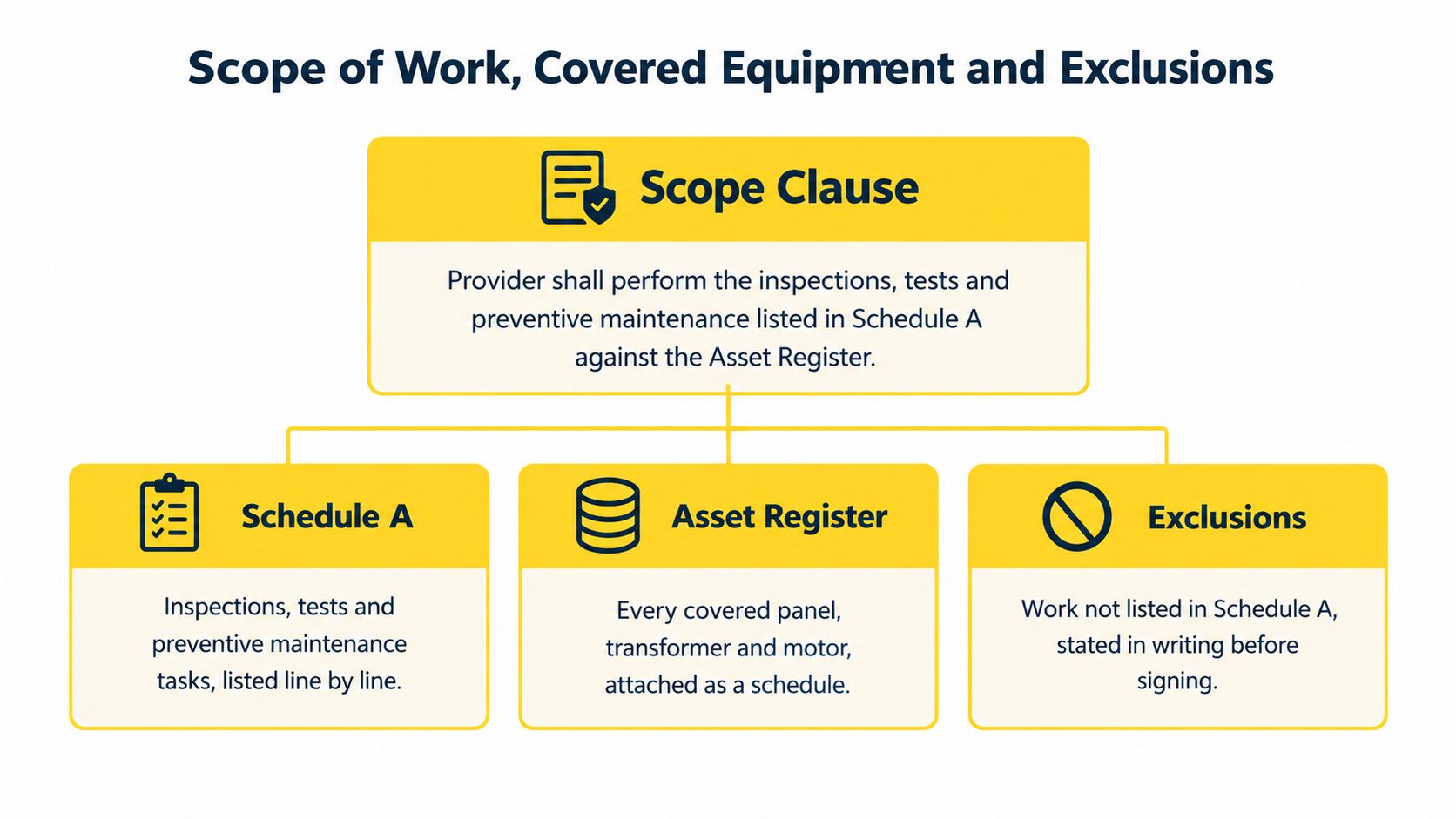
A commercial scope should identify panels, switchgear, circuit breakers, UPS systems, transfer switches, and generators. Sebastian's commercial electrical maintenance guide describes these assets alongside connection checks, GFCI or AFCI testing, thermal imaging, and insulation-resistance testing.
Don't authorize every test indiscriminately. Require the contractor to identify which test applies to each asset, the operating conditions needed, and any shutdown requirement.
For every covered item, record:
List circuit groups where individual circuit identification is necessary to establish the boundary. If transformers or motors appear in a diagram or proposal, put them in the register too. A picture doesn't create coverage.
Contractors preparing equipment-based estimates can evaluate Exayard electrical estimating software alongside their takeoff process. Owners should still insist that the final agreement carries the actual equipment list, not merely an estimate total.
Residential coverage needs a different review. U.S. News' residential service-contract guide describes electrical coverage that may include wiring, panels, standard fixtures, and circuit breakers, while identifying exclusions such as preexisting conditions, cosmetic defects, routine maintenance, commercial-grade equipment, improper installation, neglect, misuse, and damage from fire, lightning, freezing, or pests.
Meter boxes, specialty computer or security wiring, and generators may be excluded or available only as add-ons. Check those boundaries against what's installed, particularly where a home contains backup power or specialized equipment.
For every exclusion, ask a direct question: Would this failure still generate a bill, and who decides whether the exclusion applies? Require the provider to document the condition supporting a denial rather than merely labeling the problem preexisting.
Use a written change process when tenants add equipment or owners replace assets. The principles in this guide to handling scope creep apply: identify the change, establish its price, and obtain authorization before expanding the obligation.
Treat unlisted equipment as excluded unless the agreement expressly says otherwise. Attach the register before signing, and connect every out-of-scope task to the rate card and approval procedure.
Visit frequency and response targets by service tier
| Service tier | Visit frequency | Response target | Emergency work |
|---|---|---|---|
| Standard commercial tier | Annual baseline for this comparison | 48 hours | Premium rate set in advance |
| Business-critical tier | Semiannual | 24 hours | Pre-negotiated emergency rates |
| Commercial priority tier | Quarterly | 24/7 priority response | Included only when the fixed-fee schedule expressly says so |
| Residential plan | Scheduled visits expressly listed in the plan | Written acknowledgment and attendance windows required | May be excluded or available as an add-on |
The 48-hour standard target, 24-hour premium target, semiannual inspection example, and quarterly commercial tier with 24/7 priority response come from Simpro's maintenance-agreement framework. These are comparison examples, not universal service requirements, and round-the-clock availability isn't itself a maximum attendance window.
Use the tier diagram to compare the proposed package against the written service schedule.
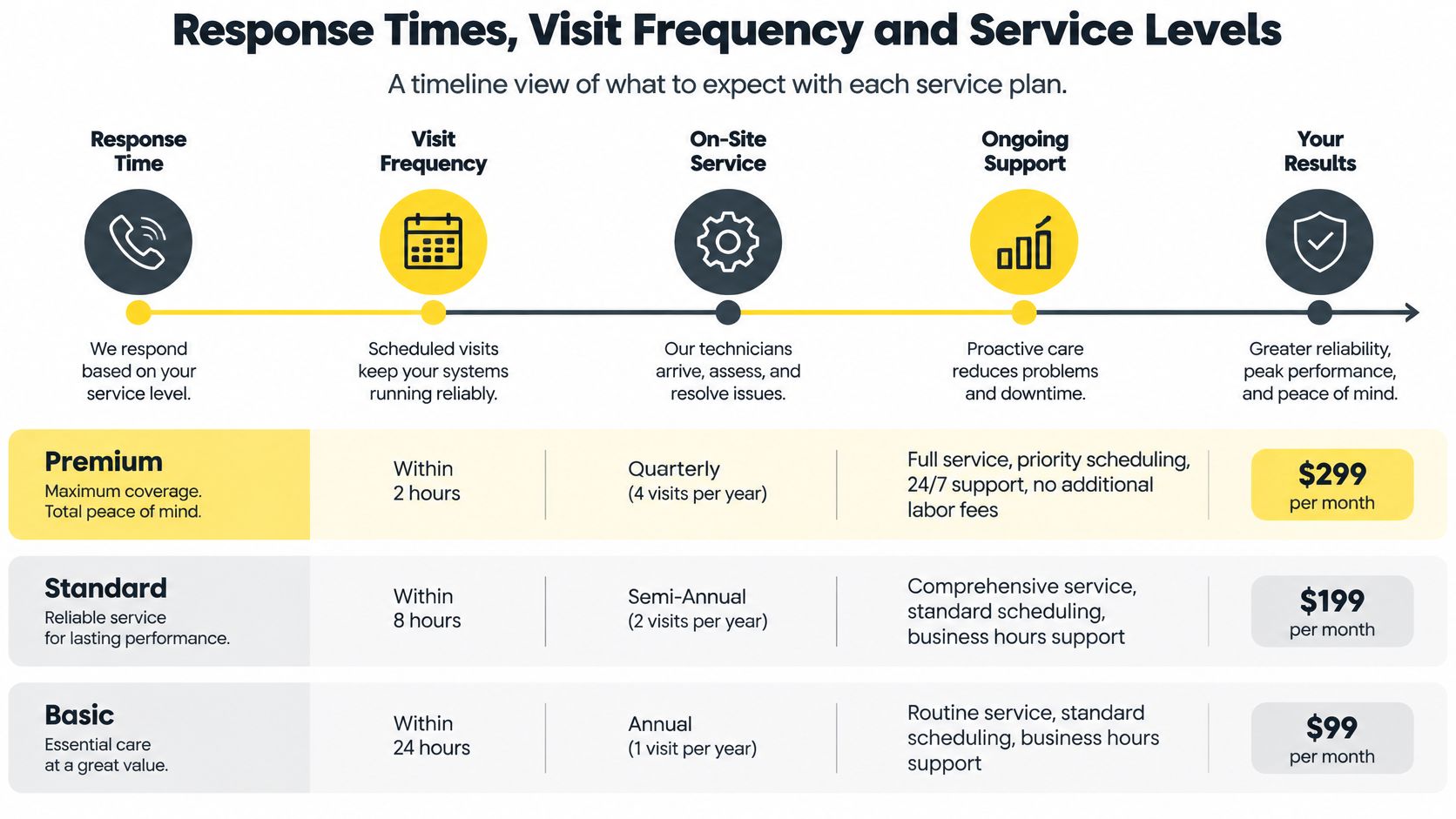
An annual commercial baseline shouldn't override equipment instructions, operating conditions, or applicable requirements. Sites with generators, medical or laboratory loads, or manufacturing equipment need a more demanding assessment than a lightly loaded office.
A quarterly arrangement can be sensible where downtime is costly, but extra visits aren't automatically useful. Require the contractor to explain which tasks the additional visits accomplish.
For a residential plan that publishes no attendance number, don't fill the gap with an assumption. Ask for a written window or acknowledge that the plan offers no measurable emergency commitment.
Acknowledgment means a responsible person has received and classified the incident. An automated receipt shouldn't count unless the agreement explicitly makes that the purchased service.
On-site attendance means an appropriately qualified technician reaches the premises with access arranged. Define when the clock starts, which address it covers, and whether the provider can pause it while waiting for owner access.
Restoration means something different again. Separate isolation or temporary safe-state measures from permanent return to service, and identify who authorizes shutdowns and temporary supplies.
Suggested drafting, with a negotiated acknowledgment period inserted, is:
Provider shall acknowledge each emergency call within the acknowledgment period in Schedule B and attend within the applicable on-site window. Provider shall assess and implement practicable temporary safe-state measures during the first visit, document any barrier, and agree a permanent-restoration timeline in writing.
Parts availability and shutdown authorization can prevent permanent restoration even after timely attendance. Require progress updates and an escalation contact while either issue remains unresolved.
For an additional visual reference, keep the written service schedule beside this video.
Before buying a premium tier, confirm whether emergency attendance is included or merely available at premium rates. Service availability and paid coverage are different purchases.
A fixed recurring fee doesn't purchase protection from every expensive failure. It purchases the obligations expressly listed in the agreement. Calling that peace of mind doesn't expand coverage.
The ELECTRI service-contract guidance describes agreements commonly running one to three years, with fixed recurring fees but potentially separate charges for major repairs, replacement parts, upgrades, emergency callouts, overtime, and out-of-scope equipment. Compare the full cost exposure, not just the subscription.
Cost items a fixed fee may leave out
| Cost item | Usual treatment | Clause to check |
|---|---|---|
| Scheduled inspection and preventive maintenance | Included when listed in the fixed-fee scope | Visit count and asset list in Schedule A |
| Emergency callout | Discounted or included according to the plan | After-hours premium and attendance window |
| Major repair | Billed separately | Approval threshold and not-to-exceed amount |
| Replacement parts | Billed separately | Parts markup, sourcing, and parts warranty |
| Diagnostic labor | Included only if expressly listed; otherwise obtain the applicable charge | Whether diagnosis charges are credited to repair |
| Permits and inspections | Separate unless expressly included | Which party applies and pays |
| Utility-caused failure | Check exclusions before assuming coverage | Definition of utility outage and evidence required |
Ask each bidder to complete the same scenario worksheet. Use the site's equipment, not a generic example detached from the register.
Write an annual total for each scenario. Mark unknown amounts with ? on your working sheet until the contractor supplies the missing rate or exclusion; don't turn an unknown into a zero.
Keep business interruption separate from the contractor's invoice. Lost production, spoiled stock, and unavailable medically important equipment may matter more than the callout charge, but a maintenance agreement doesn't automatically reimburse those losses.
Suggested payment wording is:
The fixed fee stated in Schedule C covers the Schedule A visits. Work outside Schedule A shall be billed under the attached rate card. Any item exceeding the written approval threshold requires owner authorization before work starts, except expressly authorized immediate safety measures.
State the billing cycle, payment deadline, late-payment consequences, and any right to suspend service. Set a cap on annual price escalation and require notice before revised rates take effect.
Also address prepaid fees when the provider misses visits or stops performing. Require a refund mechanism rather than leaving the owner to negotiate after service fails.
The same distinction between recurring scope and separately charged work appears in this commercial cleaning pricing guide. The electrical agreement must go further by assigning emergency spending authority and parts-related costs.
Choose transparent exclusions over broad-looking promises with uncapped extras. A cheaper agreement with a credible attendance commitment can protect you better than a premium plan whose most expensive obligations remain undefined.
Who bears the loss when the work fails or the relationship ends? Answer that before accepting the provider's standard terms.
A liability cap can leave the owner carrying most of an outage loss even when the provider caused it. Don't evaluate that cap without comparing it to the assets, operations, and damage exposure at the site.
A hypothetical provider-proposed clause might read:
Provider's total liability shall not exceed fees paid in the twelve months before the claim, except for death, personal injury, or damage caused by gross negligence or willful misconduct.
That's an example for negotiation, not a recommended universal limit. A fee-based cap can be far below the value of damaged equipment or interrupted operations, and local counsel should assess its enforceability and carve-outs.
Require current certificates for general liability and workers' compensation insurance, with stated limits. Ask your insurance adviser whether the relevant work and potential losses fit the policies; a certificate alone doesn't establish coverage for every claim.
Review any exclusion of consequential loss carefully. If the owner accepts responsibility for business interruption, make that a deliberate insurance decision rather than an unnoticed contract concession.
Set a defined workmanship warranty, using a negotiated period such as twelve months only as a drafting example, not an assumed industry entitlement. Distinguish it from the manufacturer's parts warranty, including who handles claims, removal, shipping, reinstallation, and repeat testing.
NFPA 70 proposal materials address qualified persons trained in servicing and maintaining the equipment. Use that competency principle contractually, without treating proposal language as a substitute for locally adopted requirements.
A repair ticket should close only after delivery of a record identifying the reported fault, isolation status, work performed, replacement parts, applicable protective-device or bonding checks, test-equipment identification, measured results, pass/fail disposition, and remaining limitations.
For negotiation, consider a hypothetical clause allowing thirty days' written notice, a prorated refund for unused prepaid visits, and a renewal reminder sixty days before expiry. These are proposed commercial terms, not statutory notice periods.
Name the dispute path too. A proposed senior-manager meeting within fourteen days, followed by mediation, gives both parties a process without implying a legal deadline.
Specify governing law and the jurisdiction whose licensing requirements apply. Address urgent safety work and unpaid disputed invoices separately so a billing disagreement doesn't leave dangerous equipment unattended.
Finally, control assignment. If the provider is sold or stops trading, require notice, transfer of maintenance records, treatment of prepaid fees, and a clear right to reject an unsuitable successor.
| Reference | Appropriate contractual use |
|---|---|
| IEC 60079-17:2023 | Inspection and maintenance of installations exposed to potentially explosive gas or dust atmospheres |
| IEC 60364-6 | Relevant verification and testing framework for non-hazardous installations |
| IEC 60079-19 | Separate controls for repair, overhaul, and reclamation of explosion-protected equipment |
| Applicable local code and licensing rules | Adopted requirements, authorized personnel, permits, and regulatory oversight |
The IEC's publication page for IEC 60079-17:2023 establishes its hazardous-area inspection and maintenance scope and its relationship to IEC 60364-6. Repair, overhaul, and reclamation of explosion-protected equipment fall outside that inspection standard and need separate treatment under IEC 60079-19.
Don't paste hazardous-area references into an ordinary premises contract to make it appear more rigorous. Cite standards because they apply to the installation and the contracted work.
For a hazardous site, state the installation classification, equipment covered, inspection grades, intervals, and competence requirements. For every site, name the applicable local electrical code, licensing authority, provider's license number, permit applicant, and authority having jurisdiction.
Use this journeyman electrician licensing guide as an orientation resource, then verify the actual credentials through the relevant licensing authority. A job title isn't proof of authorization for the particular task.
The technician's paperwork should be as identifiable as the equipment being maintained.

Suggested wording, using a hypothetical five-business-day delivery period, is:
Provider shall perform work through competent persons with documented equipment-specific training and shall deliver a signed inspection and test record within five business days after each visit.
Require the following records rather than a generic completed-service receipt:
Require the contractor to stop and escalate work beyond its competence or authority. Name the escalation routes, including a licensed engineer, utility, specialist contractor, or authority having jurisdiction.
Auditable records support insurance and compliance reviews. They also establish whether the failed component was covered, what the provider found, and what the owner authorized.
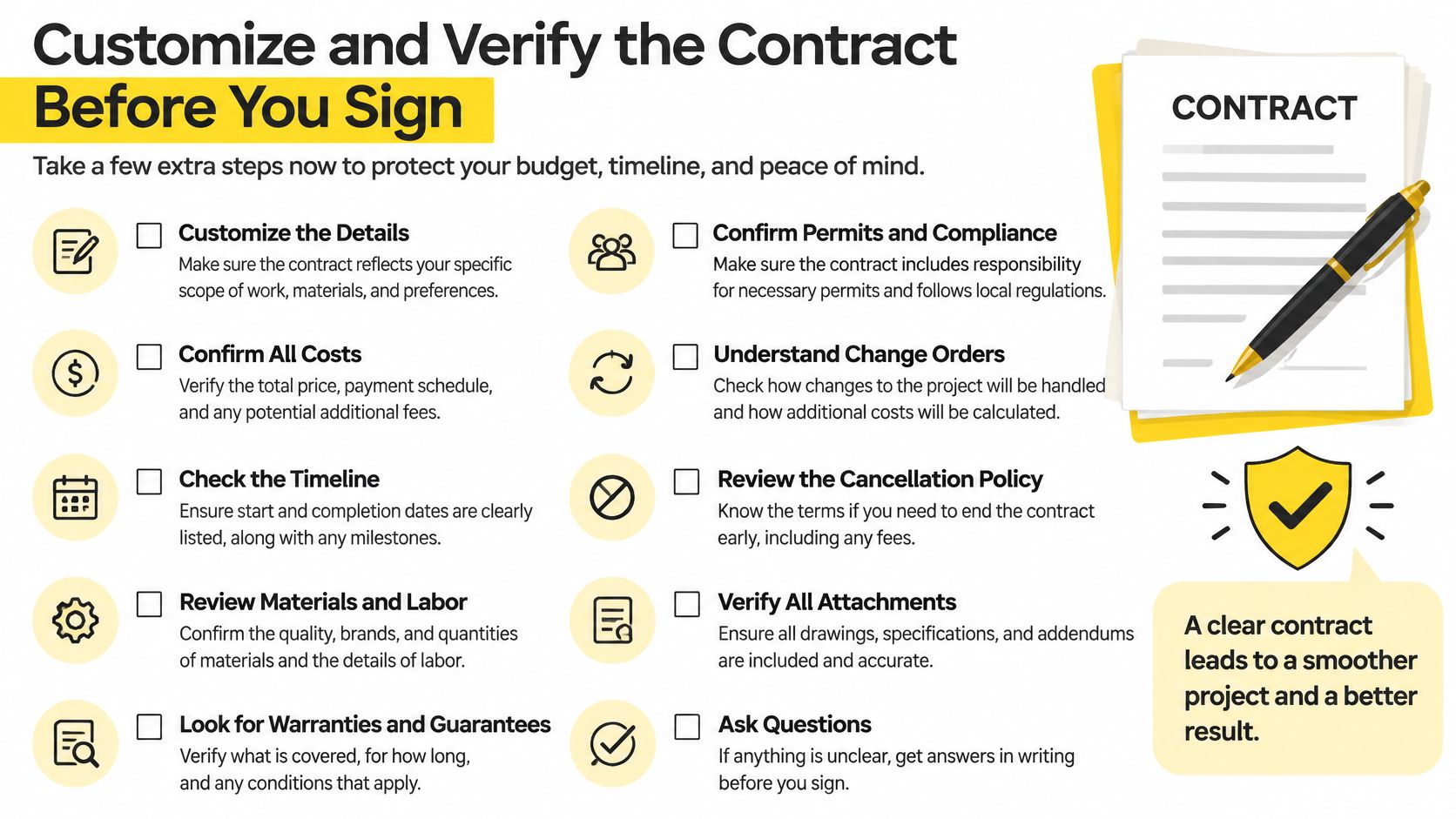
Take the draft, its schedules, and the equipment register through a line-by-line review. Put the relevant schedule reference beside each check so missing information remains visible.
Use this checklist as a document review, not a substitute for inspecting the site.
For batteries, solar, or demand-response participation, add operating priorities, remote-access rights, data ownership, backup reserves, and vendor boundaries. The Department of Energy's distributed-energy service-contract report describes arrangements linking distributed resources with grid services, payments, and bill credits; ordinary maintenance wording won't settle those responsibilities.
Sign only when every check points to a named item, number, or date. Have a licensed engineer review hazardous installations and managed energy arrangements before signing, and use legal counsel for liability and enforceability questions.
For related reading on estimates and contractual commitments, consult this guide to pricing-document terms and conditions.
Estimatty helps residential and commercial cleaning businesses capture inquiries and deliver consistent estimates through web and voice conversations. Bring the same scope discipline to your sales process by defining services and add-ons before pricing them. Visit Estimatty to explore automated estimates for your cleaning business.