October 27, 2026
Electrical Service Contract: Key Clauses and Checklist
Learn what an electrical service contract covers, the clauses that matter, sample language for each, and a checklist to customize it before you sign.

Wednesday, October 28, 2026
Commercial cleaning services price list with 2026 benchmark rates per square foot, per hour and per visit, plus a template to build standardized quotes.

A price list is a set of production rules, not a single rate. Facility type and building size affect the quote, but benchmarks only mean something when cleanable area, service frequency, and labor hours are recorded first.
The industry's scale shows why labor must shape those rules. The 2022 Economic Census figures reported by BSM put janitorial services receipts at about $74.03 billion, with 1.067 million payroll employees and $30.78 billion in annual payroll, roughly 41.6% of receipts before taxes, benefits, supplies, insurance, and profit. 89.0% of firms employ fewer than 20 workers. Smaller operators need to account for travel, setup, and a minimum charge rather than copy a national rate card and risk underpricing the work.
Start with the job's measurable requirements. Record cleanable area, frequency, and labor hours, then use those details to build a rate that covers labor and overhead. Without them, a published benchmark is a weak basis for a quote.
Buyers want a starting band, and that band changes with the building. A defensible commercial cleaning services price list separates facility type, frequency, and scope instead of one universal rate. The 2026 CleanQuote cost guide places recurring monthly pricing at about $0.07–$0.18 per square foot for general offices, $0.14–$0.32 for medical offices, and $0.04–$0.12 for warehouses or industrial facilities. A separate 2026 market guide puts a broad recurring span at $0.05–$0.25 per square foot and hourly work at $25–$60, with offices around $0.09–$0.17, healthcare at $0.14–$0.29, industrial sites at $0.08–$0.20, retail at $0.07–$0.15, and schools at $0.07–$0.14.
| Facility type | Rate per sq ft | Basis and notes |
|---|---|---|
| General office (recurring, monthly) | $0.07–$0.18 | Before specialty work |
| Typical office (market guide) | $0.09–$0.17 | Per visit benchmark, standard scope |
| Medical office (recurring, monthly) | $0.14–$0.32 | Tighter infection control, more frequent service |
| Healthcare facility (market guide) | $0.14–$0.29 | Compliance and disinfection requirements |
| Warehouse or industrial (recurring, monthly) | $0.04–$0.12 | Large floors, fewer fixtures and touch points |
| Industrial site (market guide) | $0.08–$0.20 | Floor type and access set the rate |
| Retail location (market guide) | $0.07–$0.15 | Traffic-driven frequency |
| School (market guide) | $0.07–$0.14 | Scheduled after-hours visits |
These rows come from different benchmark studies with different service assumptions. The notes column is there so you don't treat two studies as one promise.
Medical and healthcare spaces need tighter infection control and more frequent service. Warehouses have big floors and fewer fixtures, so the rate per foot drops even when the monthly invoice is large. A 10,000-square-foot general office inside the monthly office band implies roughly $700–$1,800 per month before specialty work.
Match the row to the building, then collect facility category, visit frequency, restroom count, floor type, and access constraints before you calculate. If you want a local picture of what a staffed crew covers on a recurring visit, see how teams keep your Miami workplace clean. Specialty work such as high dusting, carpet extraction, windows, floor refinishing, or post-construction cleanup belongs on its own line. It changes minutes and equipment, not just area.
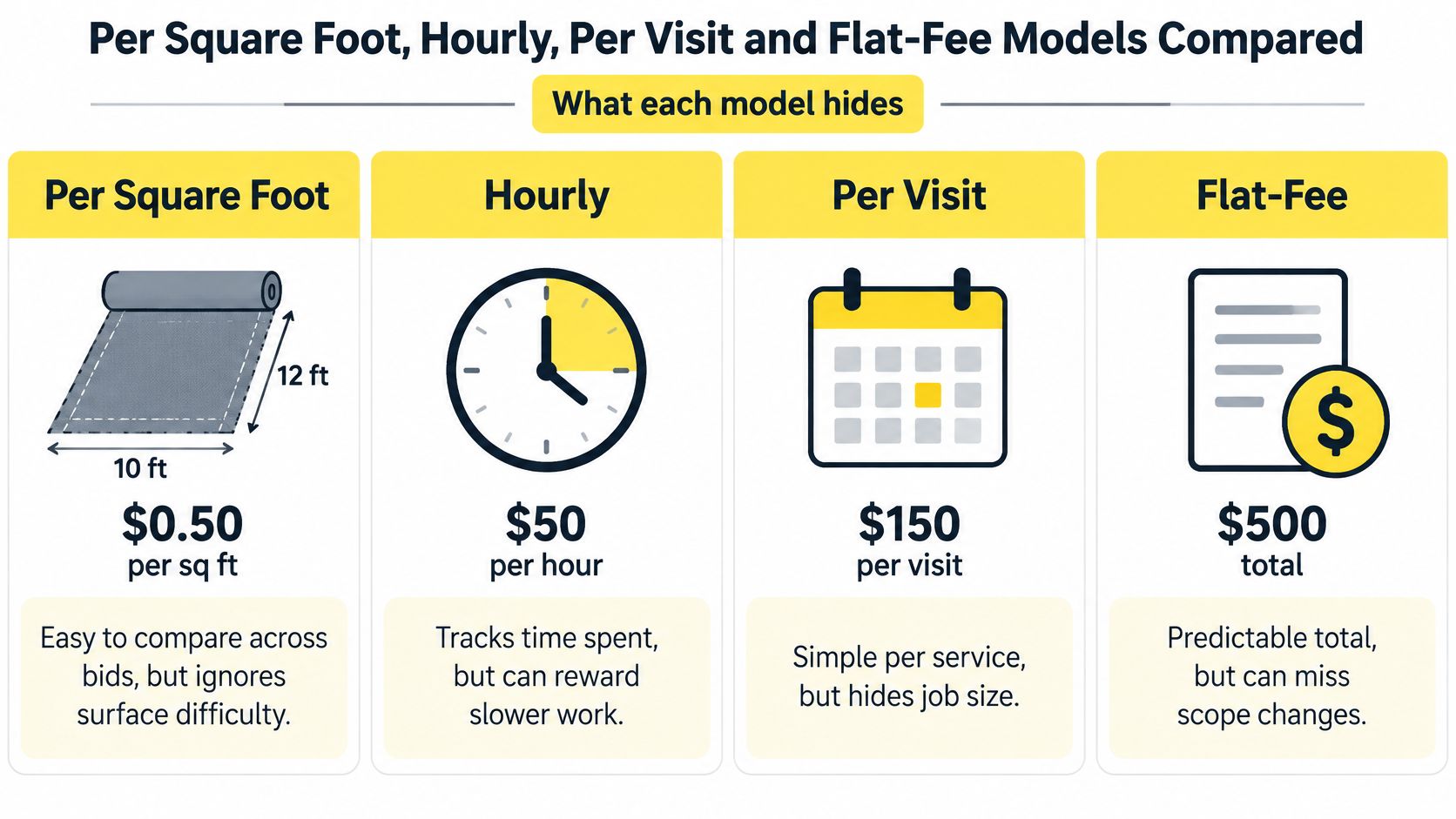
A commercial cleaning price list is a set of production rules, not one universal rate. Each model prices a different part of the work, so record building size, visit frequency, and labor hours before using benchmark ranges to set a quote.
Per square foot makes bids easy to compare, but area alone hides the work required. A glossy lobby and a carpeted cube farm can have the same footprint and need different labor hours.
Hourly billing fits irregular scopes and makes labor visible to the buyer. Housecall Pro's commercial pricing guide puts common cleaner-hour pricing around $20–$80. The trade-off is that slow work can make a simple building look expensive, even when the scope is clear.
Per visit works for recurring office cleaning when the tasks and frequency are defined. A market-guide benchmark of $0.09–$0.17 per square foot puts a 5,000-square-foot office at about $450–$850 per visit. The fixed invoice is straightforward, but without logged labor hours, a job that takes longer than expected can reduce margin.
Per room or per fixture suits restroom-heavy sites. Set the minutes for each restroom or kitchen, then price the labor using a loaded hourly rate. Flat monthly fees suit a stable scope and prevent routine renegotiation, provided the expected labor is known and the agreed tasks remain consistent.
Recurring contracts often work well with a monthly flat fee once production hours are established. One-time deep cleans are easier to price hourly or by task. Keep window washing and similar add-ons on separate lines so extra work does not disappear inside the base price.
A longer rate card can create false precision. One Jobber pricing analysis describes a $30,000 annual school-custodial contract without a usable square-foot denominator, so a precise per-foot rate could not be calculated.
Practical rule: Choose one primary model for the contract. Use other models for add-ons or work that cannot be scoped in advance.
For more on how pricing structure affects a service business, see these business pricing strategies. For recurring work, use a flat monthly fee after confirming the labor hours; reserve hourly billing for uncertain scopes.
Per-square-foot rates usually decline as a building grows: setup, travel, supervision, and the minimum visit take time regardless of floor area. Larger cleanable areas spread those fixed costs across more square feet. Treat any published benchmark as a starting point, not a universal tier.
Record the cleanable area, visit frequency, and labor hours before comparing rates. The general office range elsewhere in this price list is $0.07–$0.18 per square foot, while the per-visit example uses $0.10–$0.20. Those benchmarks overlap, but they describe different pricing contexts. A per-foot figure only makes sense alongside its scope and billing model.
A 2,000-square-foot office can cost more per square foot than a 5,000-square-foot office when a fixed minimum charge applies. The smaller job still requires setup, travel, and a minimum shift. Put the minimum-charge rule in the price list so the quote covers that work instead of relying on a rate designed for a larger site.
Lease area can also overstate the work. Storage rooms, server rooms, or empty floors may be outside the cleaning scope. Measure the area the crew will clean, then apply the relevant benchmark and check the minimum charge. Track size, frequency, and labor hours together; without those production details, a per-square-foot rate can look precise while failing to protect the job's margin.
Labor is usually the largest expense in commercial cleaning, so a price list built from wages alone will underprice the work. A cleaner's pay is only one input. The selling price also has to cover supervision, travel, supplies, equipment, insurance, administration, and profit.
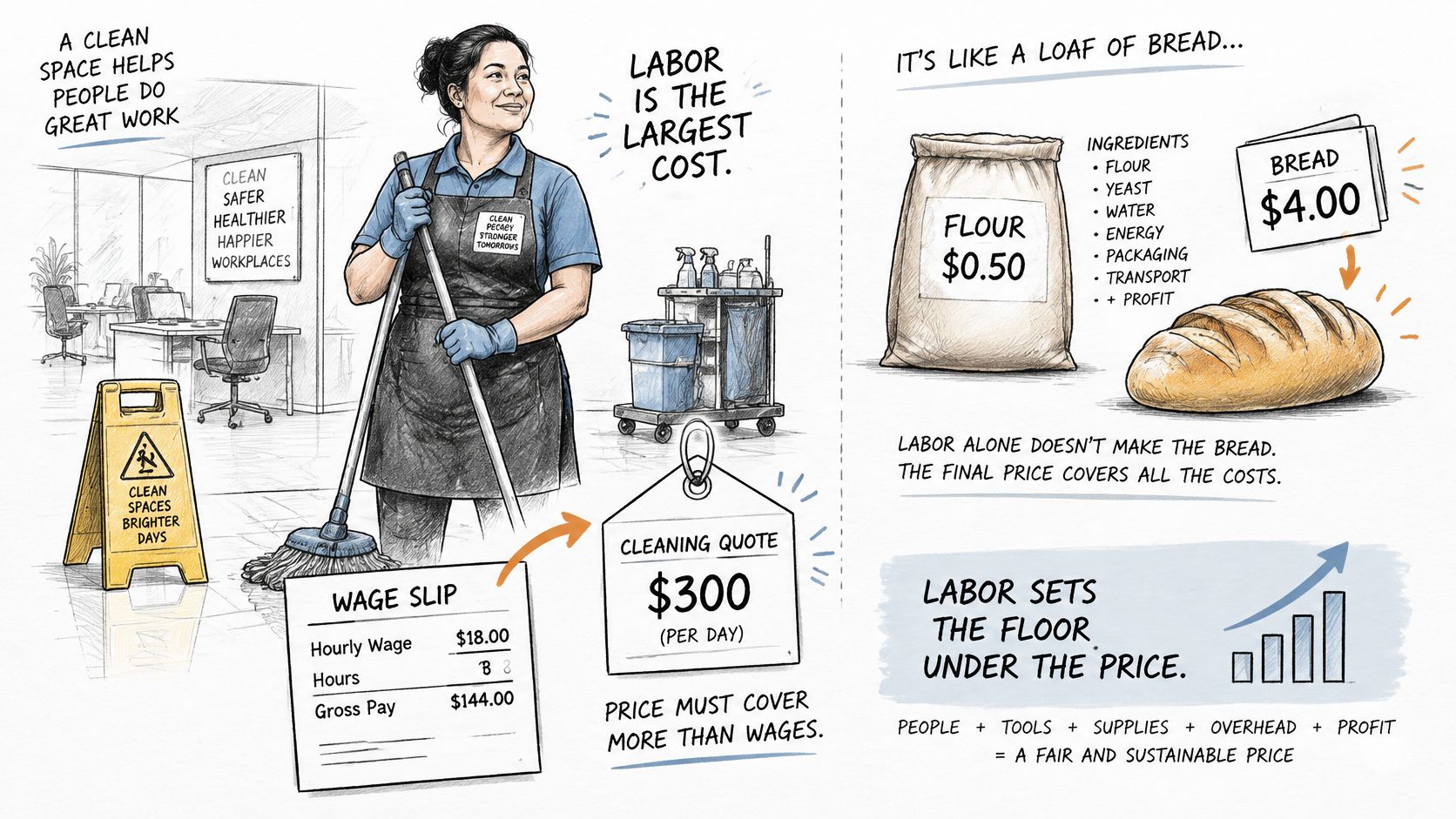
A 2026 industry-cost analysis estimates that labor represents 50%–65% of total operating costs in commercial cleaning. The wage on a paycheck is not the billable labor rate. Build from a loaded cost near $25 per hour, which accounts for payroll taxes, workers' compensation, and benefits added to median cleaner pay. Then account for the other operating costs and profit. Multiplying wages by hours alone leaves those expenses uncovered.
For a defensible labor floor, convert wages into a loaded hourly cost using a consistent method. The guide to calculating labor cost per hour lays out that calculation. Record labor hours alongside the building's size and service frequency. Those production inputs make benchmark ranges useful; without them, a published rate may not fit the actual route.
The same cost analysis reports that optimized routing can reduce driving time by 18%–25%, potentially returning one to two productive hours per crew per day. Less time spent driving means fewer paid hours the price has to cover. Frequency matters too: a five-night office can require more labor than a weekly warehouse of similar size.
List premiums separately so their costs do not disappear inside a per-square-foot rate:
These premiums do not add cleanable square footage, but they do add cost. Keep them visible in the price list, or they come directly out of margin. A price list works best as a set of production rules: labor hours establish the floor, while scope, frequency, routing, and site conditions shape the final rate.
These examples show how a rate band becomes a working estimate. Each calculation depends on its stated unit and scope; access demands or specialty tasks can move a site toward the top of its range.
| Scenario | Inputs | Estimated range | Calculation |
|---|---|---|---|
| 5,000 sq ft office, per visit | Standard office scope | $500–$1,000 | 5,000 × $0.10 to $0.20 |
| 10,000 sq ft general office, monthly | Recurring, before specialty work | $700–$1,800 | 10,000 × $0.07 to $0.18 |
| 10,000 sq ft medical office, monthly | Tighter infection control | $1,400–$3,200 | 10,000 × $0.14 to $0.32 |
| Labor floor, 20 hours per month | Median wage $17.71 per hour | About $354.20 | 20 × $17.71 before employer costs |
| One restroom, per visit | 15 minutes at a $25 loaded rate | About $6.25 labor | 0.25 hours × $25 |
The first three rows multiply square footage by a published rate band. The 5,000-square-foot office figure is per visit; the two 10,000-square-foot figures are monthly. At the low end, the medical office estimate is exactly double the general office estimate. Tighter infection control and the demands of medical cleaning are reflected in that higher rate, rather than treated as an afterthought. For a separate medical-site benchmark, see medical office cleaning rates.
The fourth row is a cost floor, not a customer quote. The Bureau of Labor Statistics reports a median wage of $17.71 per hour in May 2025, or $36,840 a year. At that wage, 20 labor-hours cost about $354.20 before employer costs and overhead. A monthly price close to that amount leaves little room for those costs, supplies, or margin.
Use task time to make smaller jobs just as clear. A restroom taking 15 minutes at a $25 loaded hourly rate carries about $6.25 of labor before supplies. Four restrooms therefore carry about $25 of labor for that visit, before chemicals and margin.
A benchmark is useful only when its unit matches the job. Record whether the figure is per visit or monthly, then compare it with the labor hours needed to deliver the stated scope. Size and frequency shape the estimate, while task-level time helps show whether the price covers the work. A price list is a set of production rules, not a single rate.
A benchmark tells you the neighborhood. Labor hours tell you whether you can afford the house.
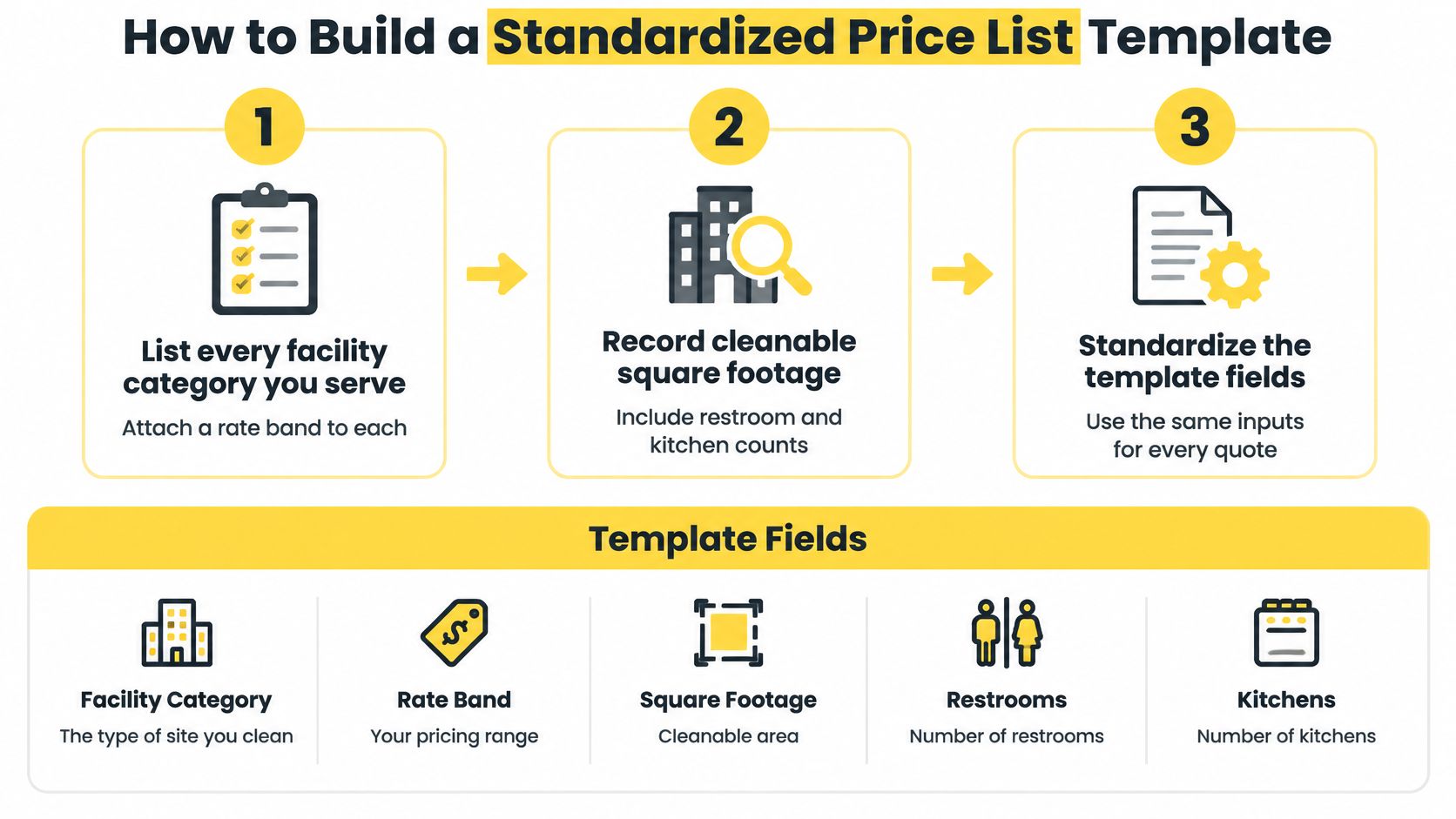
Build the card in this order so every estimator uses the same rules.
A spreadsheet the team can copy is enough to start. A tool such as Estimatty can hold the same pricing rules so estimates go out by SMS and email, with quotes issued once the details are confirmed. The fields below are the ones I would not drop.
| Field | Sample entry | Purpose |
|---|---|---|
| Line item | Restroom cleaning, per visit | Names the task being priced |
| Unit | Per restroom | Sets the pricing basis |
| Quantity | 4 | Counts units at the site |
| Rate | $6.25 | Loaded labor cost per unit from the labor build |
| Total | $25.00 | Quantity multiplied by rate |
| Notes | Heavy access, add premium | Flags premiums and benchmark checks |
Four restrooms at $6.25 is $25.00 of labor before supplies and margin. The notes cell is where the benchmark check lives. If the total sits outside the facility band, the note should say why.
Consumer Protection New Zealand defines an estimate as a rough cost indication that is not a fixed price, while a quote is generally a confirmed maximum price and an offer to do the work for a specified amount. Business Queensland treats estimates as normally nonbinding, often with a disclaimer that the price may change, and treats a quote as a calculated price that may become part of a legally binding contract.
Show the range first, as an estimate, while square footage or restroom counts are still unverified. Issue the quote after the scope is confirmed. A commercial cleaning bid template keeps that handoff from turning into a fresh spreadsheet every time the phone rings.
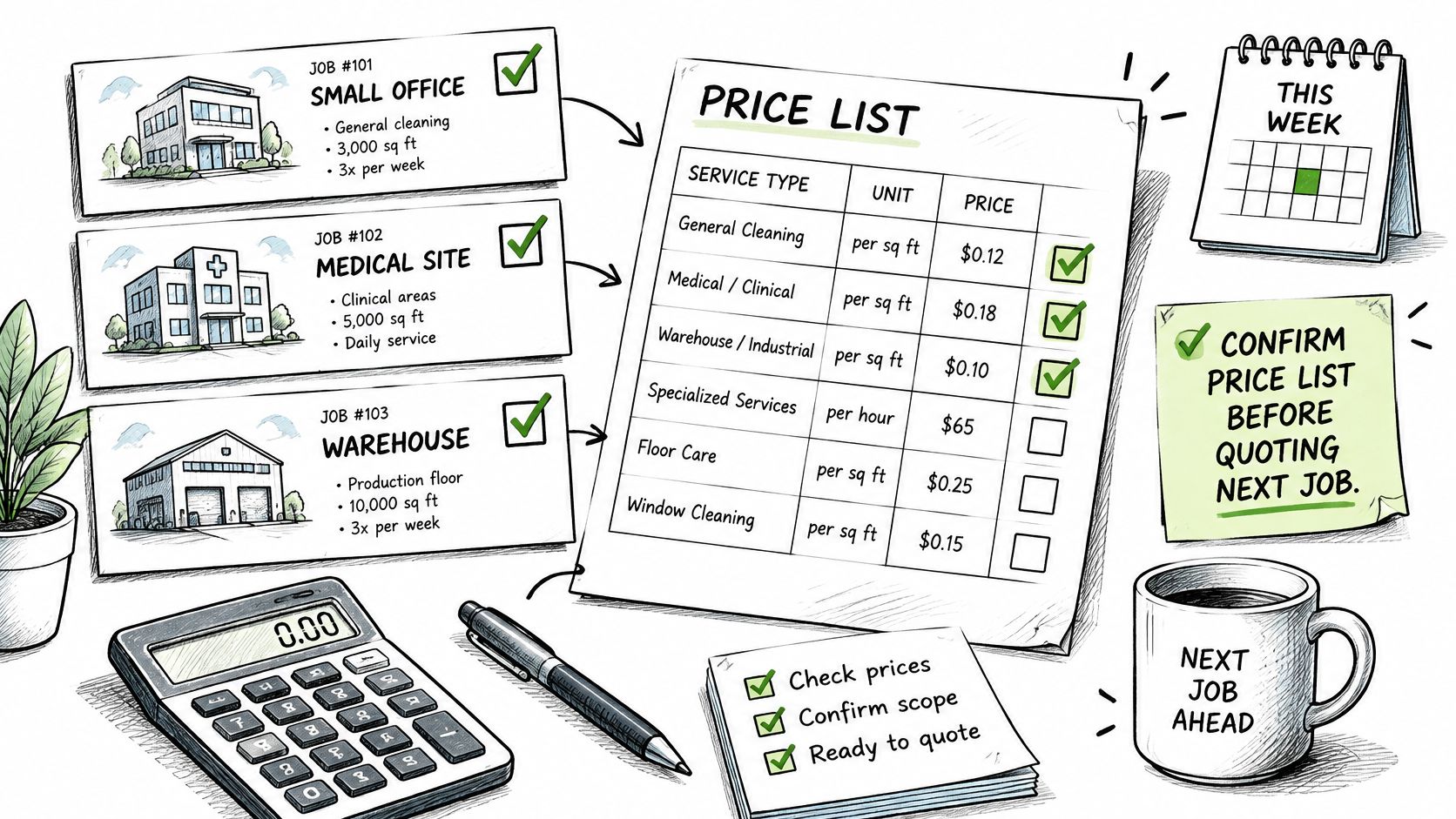
Pick three completed jobs of different types this week. A small office, a medical site, and a warehouse are enough. Run each through the price list and compare the result with the price you charged and the hours the crew worked.
Watch for three warning signs:
Adjust labor minutes first, then the premiums, and only then the base rate. Changing the base rate first hides a bad production assumption inside a nicer number. Once the list passes, publish the ranges as estimates and keep the quote step for confirmed scope. Further pricing guides sit on the Estimatty blog, including a commercial cleaning estimate calculator you can use as a second check.
Run those three past jobs through the grid before the next prospect calls. If the grid and the hours disagree, the grid is wrong, not the building.
Estimatty gives cleaning companies a pricing setup that turns square footage, service formulas, and add-on charges into consistent estimates instead of one-off guesses. If your commercial cleaning services price list already has rate bands, labor hours, and premium lines, that is the rule set an estimator should follow on every inquiry. Visit Estimatty to see how those rules can sit behind the estimates you send and the quotes you confirm.