October 30, 2026
How to Upsell Products on Cleaning Estimates
See how to upsell products on cleaning estimates with one timed add-on, a visible price, a short script, and numbers that show it paid.

Saturday, October 31, 2026
Copy this employee confidentiality agreement template for cleaning crews, with clauses for estimates, access codes, AI tools and lawful speech.
45% of 947 U.S. job seekers reported signing an NDA to secure their latest employment, according to a 2024 study reported by Yahoo News. Signing is common. Protecting the right information takes more than collecting a signature.
The cleaner holding your customer's key may also hold the alarm code, the gate note, the pet instructions, and the worksheet explaining how you built the estimate. That's the information your agreement should protect. A blanket ban on discussing anything connected to the company is the wrong tool.
For an owner or operations lead hiring house cleaners, small crews, or multi-site commercial teams, a useful employee confidentiality agreement template must answer ordinary route-day questions. Can someone screenshot tomorrow's access notes? May a supervisor send an estimate worksheet to a personal inbox? What happens to interior photos when a cleaner leaves?
A narrow agreement identifies customer and operational information, limits its use, and tells workers how to handle it. It doesn't claim that every skill learned on the job belongs to the company, and it doesn't try to stop lawful workplace discussion.
Practical rule: Protect the address, the access instructions, and the estimate logic. Don't confuse those protections with a right to control everything a worker says.
If your business operates in Georgia, Miles Hansford Law Firm's resource on protecting trade secrets in Georgia provides useful context for discussing local enforcement with counsel. Use that conversation to identify what you keep secret, not to expand the agreement until it covers ordinary cleaning knowledge.
Your packet should contain:
Don't treat the federal notice as optional boilerplate when trade-secret remedies matter. Put it in the drafting checklist before anyone signs.
Start with the clause map below. It's the document order to copy, annotate, and send for work-state legal review.
Employee confidentiality agreement template clauses
| Clause | What it covers | Cleaning example | Include |
|---|---|---|---|
| Parties and role | Legal company name, worker name, start date, employee or contractor status | Lead tech on a residential route | Required |
| Definition of confidential information | Named nonpublic categories, not a blanket label | Alarm code, gate note, estimate worksheet | Required |
| Exclusions | Public, prior knowledge, independent development, lawful third party, general skills | A cleaner's ordinary technique | Required |
| Permitted use | Need-to-know work for the company only | Sharing a code with the assigned partner | Required |
| Customer and site data | Addresses, access instructions, photos, payment details | Lockbox code for a vacant home | Required |
| Pricing and estimates | Nonpublic rates, add-ons, and how an estimate was built | Per-room pricing logic | Required |
| Whistleblower immunity notice | DTSA notice immediately after the definition, or a clear cross-reference to a policy containing it | Report to a government official | Required for DTSA remedies |
| Protected speech carve-out | Wages, conditions, lawful reports, no prior-approval gag | Talking about pay with coworkers | Required |
| AI and unapproved tools | No pasting protected data into unapproved consumer chatbots or personal drives | Estimate notes in a free chatbot | Required |
| Return or deletion | Keys, files, photos, messages at exit | Fob and phone photos | Required |
| Survival | Duties continue after the last shift, subject to local law | Ex-employee still holds a client list | Required |
| Remedies, governing law and signatures | Injunction and damages, state of work, dated signatures | California crew versus Texas crew | Required |
“Required” here means part of the recommended operational packet, not that every jurisdiction mandates every row.
Parties and role. Identify the actual contracting entity, not just the brand printed on the van. Add the worker's name, effective date, and whether the role is W-2 employment or a 1099 contractor engagement; the label doesn't resolve classification by itself.
Entity structure and worker confidentiality are separate decisions. If you're still selecting the business structure, The Lawyer Guide's resource on choosing an LLP for your business can help frame that discussion, but the agreement must name the entity you use.
Definition and exclusions. A starting definition for counsel to adapt is:
Confidential information includes the company's nonpublic customer and prospect data, cleaning-service estimates, pricing methods, operating procedures, software settings, credentials, vendor terms, financial information, business plans, and internal AI prompts or training materials, together with the customer and site information identified in the attached schedule.
Exclude information made public without breach, already lawfully known, independently developed without company information, or lawfully received from an authorized third party. Preserve general skills and experience that are acquired fairly.
Permitted use and care. Limit use to authorized company work and sharing to people who need the information for that assignment. Require secure handling and prompt reporting of accidental disclosure. Define who authorizes access so a crew lead isn't left guessing.
WIPO's trade-secret protection guidance recommends combining contractual duties with confidentiality markings, access restrictions, need-to-know permissions, training, and continuing obligations after termination, subject to applicable law. Put those measures into your policies and procedures manual, rather than promising controls nobody follows.
For return or deletion, name keys, fobs, printed route sheets, photographs, chats, downloaded files, and copies on personal devices. Preserve records the worker is legally entitled or required to retain.
For survival, distinguish information that remains confidential from material that has legitimately become public. Have counsel set appropriate duration language.
For remedies, permit the company to seek injunctions and damages available under applicable law. Don't invent an automatic penalty or imply a court must grant relief.
Leave a governing-law field for counsel to complete using the worker's state and applicable conflict-of-law rules. Provide employee and company signature lines, dated acknowledgments, and an optional witness line.
Place a plain-language annotation beside each legal block during review. Copy the table's order into the document, then insert the property schedule, rights carve-out, AI schedule, and complete federal notice before signing.
Residential versus commercial confidentiality schedule
| Topic | Residential schedule | Commercial schedule |
|---|---|---|
| Site identifiers | Home address and resident name | Building, suite, and tenant contact |
| Access | Lockbox, alarm, garage, key log | Badge, after-hours door, security desk |
| Sensitive notes | Pets, children, health or occupancy notes | Camera locations and restricted rooms |
| Pricing | House estimate inputs and add-ons | Contract rate, floor specs, multi-site pricing |
| Images | Interior photos stay in company systems | Before-and-after limited to the account file |
| Extra people | Family member riding along is not authorized | Fill-in subcontractor needs the same duties |
| When it attaches | Before the first home | Before the first night or site transfer |
Keep one master agreement and a short property schedule. Different buildings require different examples, not competing definitions of confidentiality.
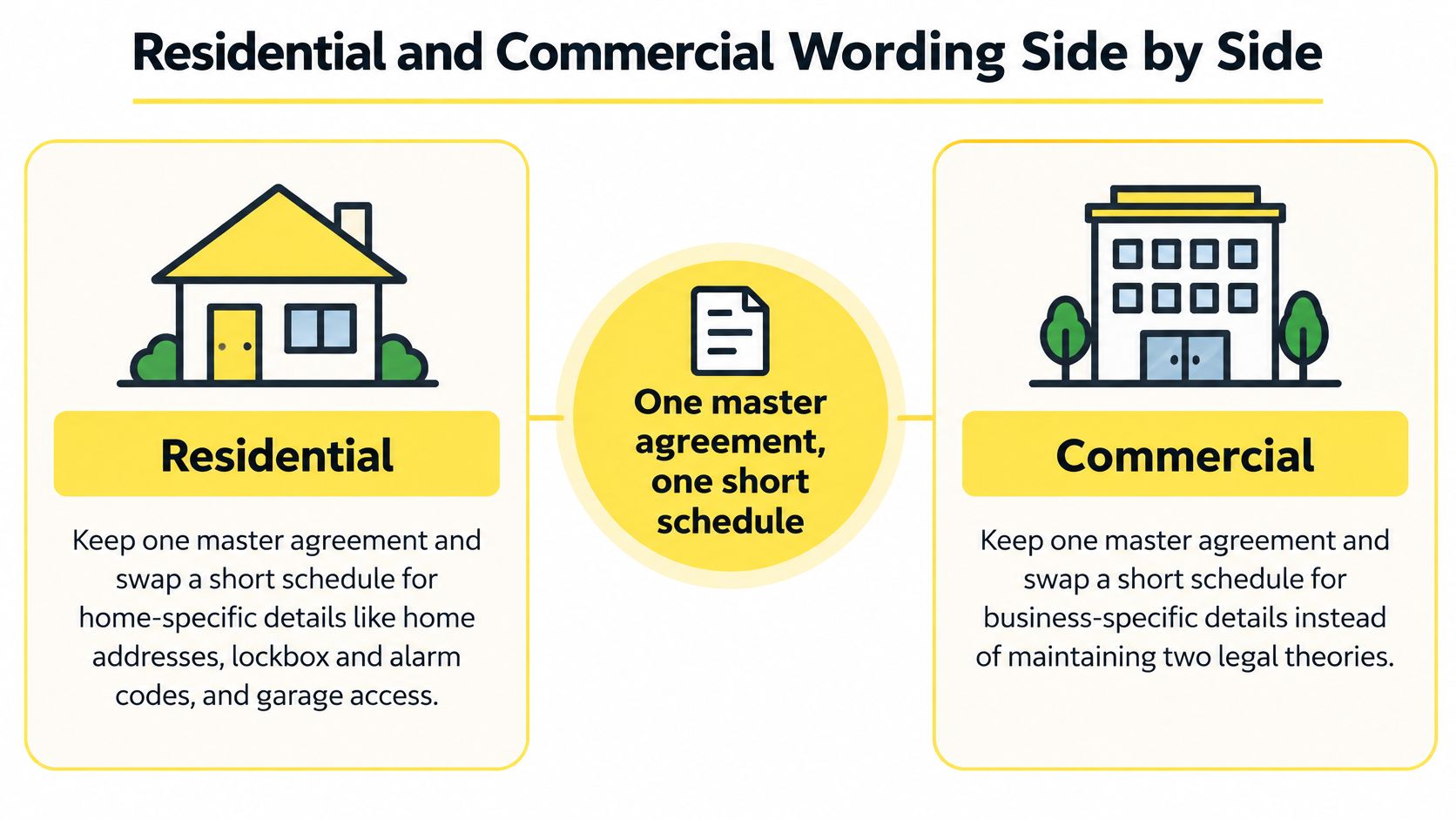
A residential schedule should identify home addresses, lockbox and alarm codes, garage openers, key logs, pet instructions, and necessary occupancy notes. Include interior images and the nonpublic inputs behind an estimate, such as square footage, surface condition, and selected add-ons.
Use a direct photo rule: Home images must remain in approved company systems and must not be posted or shared without documented authorization. An impressive room isn't permission to publish a customer's possessions, layout, or security equipment.
Limit the notes you collect, too. A cleaner may need to know that a pet must stay behind a closed door; they don't need unrelated details about the household.
A commercial schedule should name after-hours entrances, badge logs, tenant contacts, security-desk procedures, restricted rooms, and floor-care specifications. Identify nonpublic contract rates and multi-site estimate logic that a route manager could otherwise copy into another business.
Add a subcontractor requirement before a fill-in crew receives access. The crew's lack of direct contact with the client doesn't remove the need for written confidentiality duties and authorized-use limits.
Align the schedule with your cleaning contracts for small business, especially any customer restrictions on photographs, subcontractors, or building access. Don't promise the customer controls that your crew packet omits.
A worker serving both homes and offices should acknowledge the residential schedule and the relevant commercial addendum before the new account starts. For multi-location brands, maintain an authorized site list tied to the master definition, and update it when assignments change.
Protect the estimate inputs and resulting pricing logic, not just the final amount. Initial the schedule that matches tomorrow's work, and keep live access codes in the controlled operating system rather than embedding them in a widely stored personnel document.
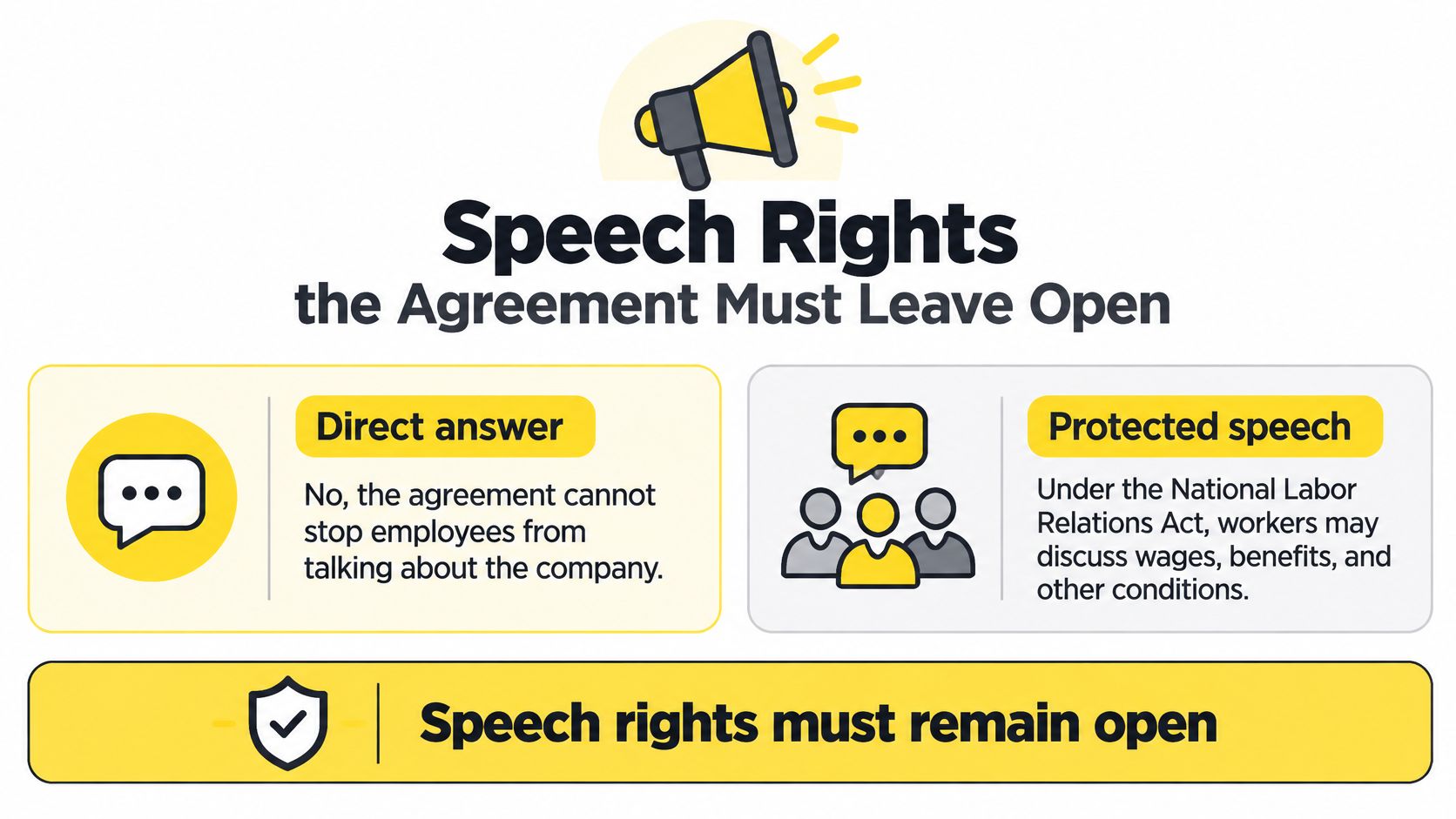
No, this agreement can't stop employees from talking about the company. It can restrict misuse of defined confidential information, but it must leave legally protected workplace discussion and reporting open.
Under the National Labor Relations Act, covered employees generally may discuss wages, benefits, and working conditions, including in nonunion workplaces, as explained by the Department of Labor's employee-rights guidance. Don't classify every conversation about operations as disclosure of a business secret.
| Situation | How to treat it |
|---|---|
| Cleaners compare hourly pay | Protected workplace discussion where applicable |
| A worker complains about a skipped break | Don't treat the complaint itself as a confidentiality breach |
| Someone sends a client list to a competitor for sales outreach | Unauthorized commercial disclosure |
| A supervisor sends tomorrow's nonpublic estimate sheet to another cleaning business | Potential misuse of defined business information |
Context matters. A document shared for competitive gain isn't the same as information submitted through a legally protected reporting channel.
Also separate protecting company information from declaring the agreement itself secret. Don't prohibit workers from showing the document to an attorney or using it to report suspected unlawful conduct.
Have counsel adapt this language:
Nothing in this agreement restricts legally protected discussions of wages, benefits, or working conditions; lawful reporting of suspected violations; or participation in investigations. Where protected by law, a worker may communicate with government agencies, regulators, law enforcement, courts, or attorneys without prior company approval and without notifying the company.
The SEC's whistleblower protections explain that Rule 21F-17(a) prohibits actions that impede direct communications with SEC staff about possible securities-law violations, including enforcing or threatening to enforce confidentiality agreements. Apply the same drafting discipline to other protected reports: don't surround the carve-out with threatening language that appears to cancel it.
California offers another warning. Its Civil Rights Department guidance explains restrictions associated with Business and Professions Code section 16600 and distinguishes legitimate confidentiality protection from unlawful restraints on work.
A clause claiming ownership of everything a cleaner learned could effectively prevent that person from cleaning elsewhere. Prohibit misuse of defined information, not future employment.
Have counsel review each work state before a multi-state rollout. Paste the rights carve-out beside the definition so workers see the boundary when they first read what's protected.
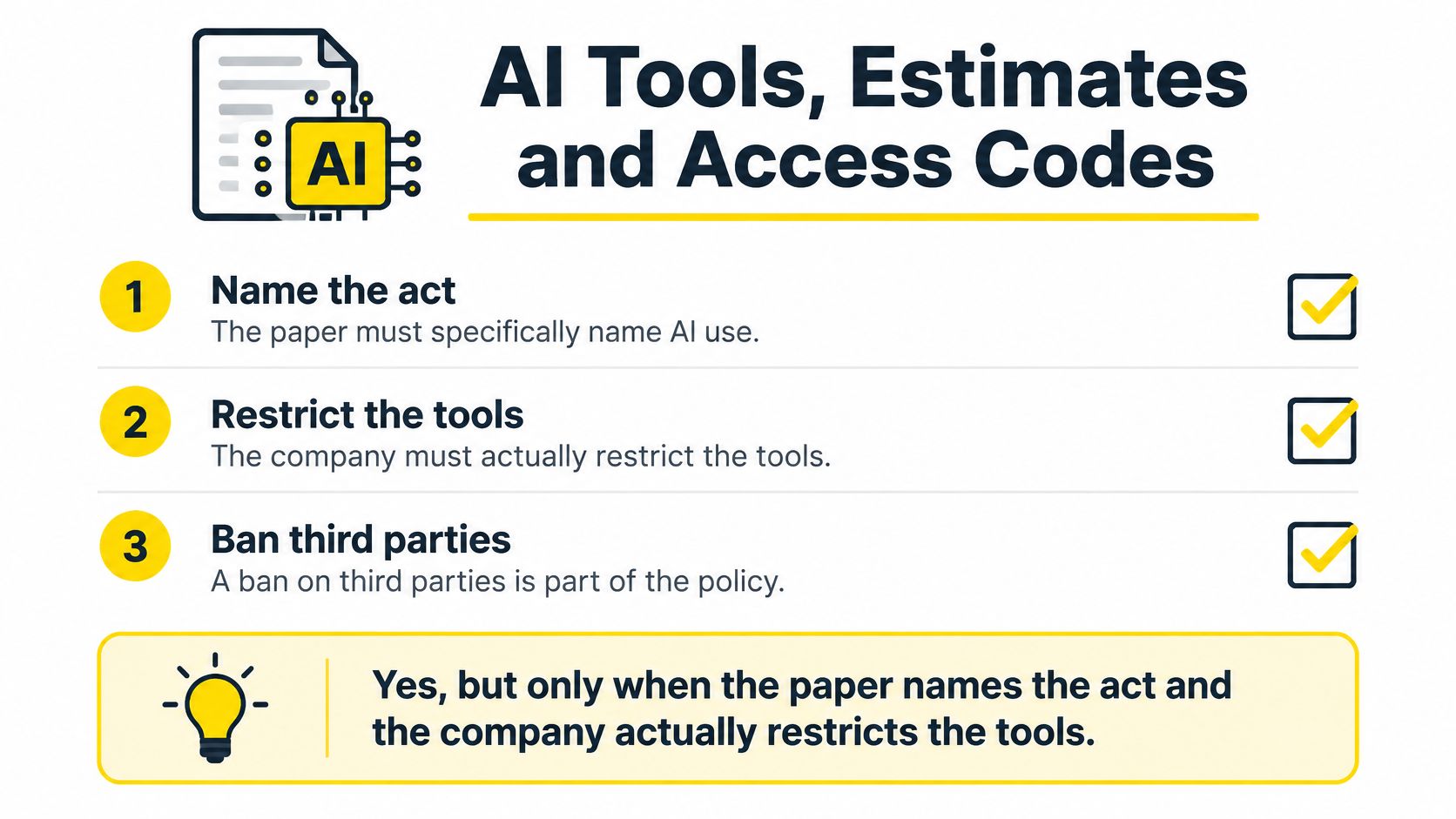
Does your confidentiality agreement cover AI use? Yes, if you expressly include it. But language alone isn't a protection program: name the disclosure and restrict the tools.
A worker may not interpret “third parties” as including a chatbot, transcription app, or personal cloud account. State that entering, uploading, syncing, or pasting protected information into an unapproved external service is an unauthorized disclosure or use.
Your AI schedule should prohibit sending these categories to unapproved tools:
Sheppard's guidance on employees feeding trade secrets into generative AI recommends addressing prompts explicitly, distinguishing approved enterprise tools from consumer platforms, reviewing retention and training terms, and supporting the rules with technical controls.
The approved path is an approved company system and authorized account, not whichever service a worker finds convenient. Prohibit forwarding estimate SMS threads or CRM exports to private inboxes; apply the same rule to phones used on routes.
Require same-day internal reporting when protected data enters the wrong tool. Give workers a named contact and tell them to preserve the relevant details rather than conceal the mistake.
Treat information moving through the website, phone, SMS, email, CRM, and Zapier-connected workflows as protected company information where it meets the agreement's definition. An AI estimating workflow for cleaning businesses needs explicit access rules at every handoff, not only at the original intake form.
Information sent to Estimatty for text messaging or storage remains the account holder's property. We encrypt information and transmit it using Secure Sockets Layer protocol. If you choose a third-party application that works with Estimatty, that application may receive access to data generated by your use of Estimatty.
Have a person review each connected vendor's access, retention, and training terms before approval. Ownership and encrypted transmission don't authorize employees to copy information elsewhere.
Pair the schedule with confidentiality markings, need-to-know access, audit records where available, and offboarding deletion. End with an initialed acknowledgment:
I will not enter customer addresses, access codes, payment data, or estimate logic into any tool the company has not approved.
A confidentiality agreement only protects customer information if the signed copy, access records, and exit steps are handled consistently. Assign one manager to own the process from candidate intake through the last shift.
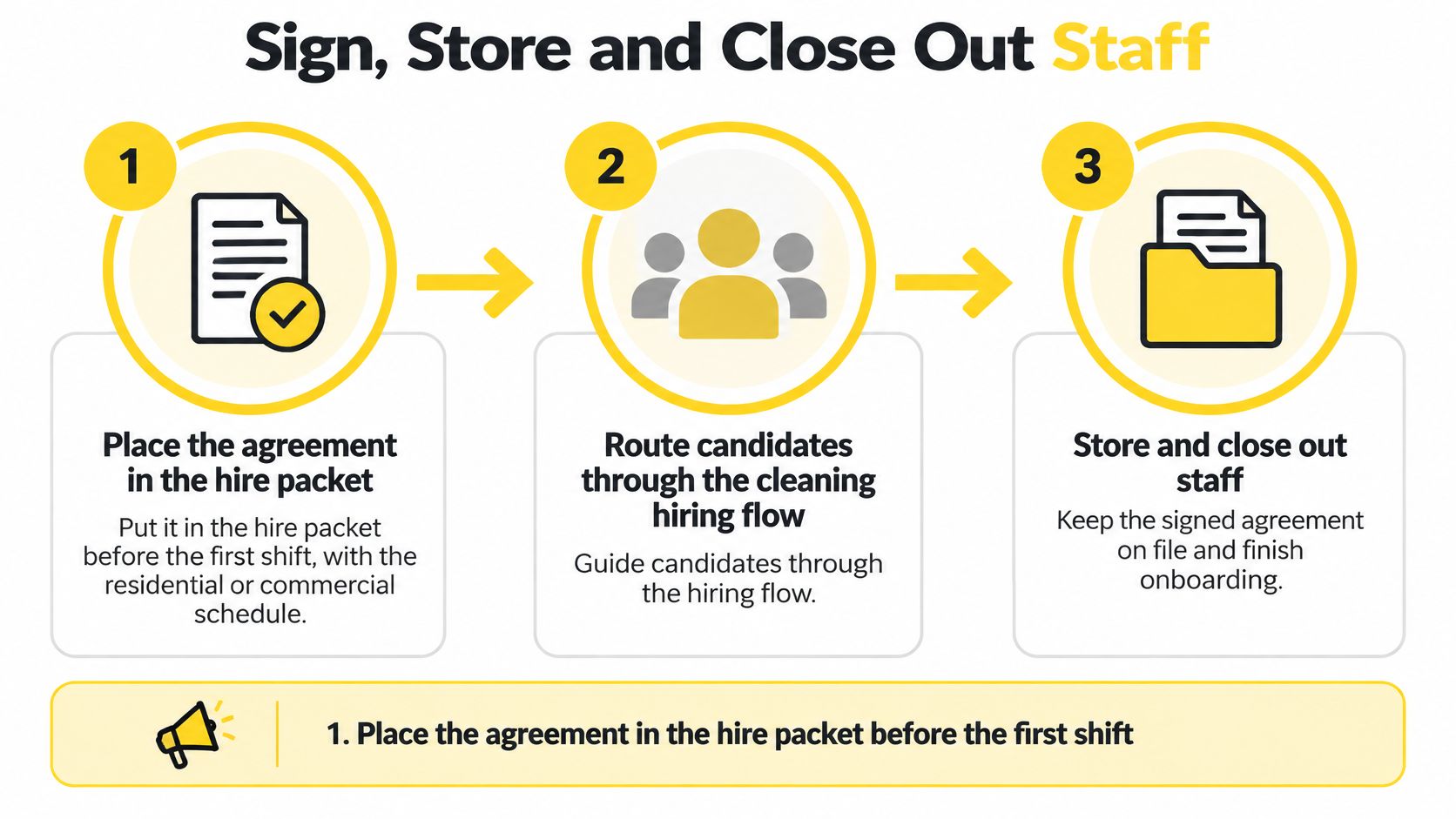
Put the agreement in the hire packet before the first shift. Include the applicable residential or commercial schedule and any policies incorporated by reference. Use your written hiring checklist and signing workflow to track completion.
Explain the boundaries in ordinary language. Ask the person to describe what counts as confidential, what they may still discuss, and what must not go into a personal chatbot. Use an example access note with invented details, never a live customer code.
Sign, countersign, and save. Use wet ink or an electronic-signature tool that provides a retrievable signing record. Have the owner or authorized manager countersign, give the worker a copy, and store the completed file in a controlled personnel record, not a text thread.
Issue access only after filing. Record who receives each key, fob, credential, or permission. Use individual credentials where available. For shared site codes, log who is authorized without putting the codes in an unrestricted hiring checklist.
Update the packet when the assignment changes. Review state transfers, residential-to-commercial moves, newly connected tools, and changes to incorporated policies or notices. Keep the version accepted and any new schedule on file instead of overwriting the earlier signed copy.
Close access at exit. Collect keys and fobs, disable alarm and CRM access, and remove shared-drive permissions. Require the return or authorized deletion of company photographs, messages, and estimate files on personal devices, subject to lawful retention and evidence-preservation requirements. Obtain written confirmation.
Retain records under an approved schedule. Keep the signed packet, amendments, access log, and exit confirmation for the period counsel sets under the agreement and applicable recordkeeping rules. Retention periods vary by worker and jurisdiction.
Use a cleaning employee hiring checklist to assign each document and access change to a named person. Have counsel review the agreement for every state where the crew works, including rules on electronic signatures, consideration, and post-employment duties.
The Estimatty setup requires no coding: enter pricing rules, customize preferences, and embed a single snippet into your website. Most cleaning company owners are up and running the same day they sign up, so prepare the staff-access packet before activating that workflow.
The estimator can standardize estimates. Your people and permissions control who can retrieve them. A misplaced PDF, an unexplained shared login, or access left active after departure can undermine careful handling.
Access gate: Do not release customer information or send a new hire onto the first shift until the signed packet is filed and the access assignment is logged.
A confidentiality agreement should tell staff how to report a suspected leak, while preserving their right to report suspected legal violations. Put the DTSA whistleblower-immunity notice immediately after the confidentiality definition, or clearly incorporate a policy that contains the complete notice. A generic promise to obey the law does not replace it.
As Goodwin's DTSA analysis explains, the Defend Trade Secrets Act became law on May 11, 2016 and created a federal civil claim for trade-secret misappropriation. The notice requirement applies to covered agreements entered into or updated after the DTSA's enactment on May 11, 2016.
The statute generally gives an employee, contractor, or consultant immunity from civil or criminal trade-secret liability for confidential disclosures to a government official or attorney made solely to report or investigate a suspected legal violation. It also covers disclosures in court filings made under seal.
Have counsel insert the complete applicable notice, including its treatment of retaliation litigation and sealed filings. Do not reduce it to an informal sentence that leaves out part of the protection.
The San Diego County Bar Association's DTSA discussion explains that exemplary damages for willful and malicious misappropriation may not exceed two times actual damages. Omitting the required notice can foreclose those damages and attorneys' fees. Neither remedy is automatic; statutory conditions still apply.
For operational incidents, give staff a clear reporting path:
The reporting process must not require permission before a legally protected government report. Keep operational incident procedures separate from the protected-reporting exception.
A company seeking trade-secret protection should be prepared to show that it took reasonable steps to protect secrecy. The California Lawyers Association's discussion of trade-secret protection describes secrecy measures and independent economic value as central to the trade-secret definition.
A signed agreement is one part of that record. Access limits and training records also help show how the company handled sensitive information. Use a controlled document workflow to preserve the signed version, incorporated policy, and acknowledgment history.
Have counsel confirm the complete notice is in place before relying on the template in a dispute. Don't wait until a customer list has left to find out it was missing.
Situation to clause cross reference
| Situation | Open this clause | Do not write |
|---|---|---|
| First day in homes | Residential schedule | A second full contract |
| First night in a building | Commercial schedule | A ban on working elsewhere |
| Coworker asks about pay | Speech carve-out | A gag on all company talk |
| Estimate pasted into a chatbot | AI and unapproved tools | Only the words third parties |
| Trade-secret remedy wanted | DTSA immunity notice | Notice buried in an unrelated handbook |
| Last shift | Return or deletion | Access left active until payroll |
| Worker changes state | Governing law | Silence on the work location |
| Subcontractor fill-in | Parties and permitted use | An oral promise only |
| Franchise or multi-site transfer | Site list on the master definition | A separate packet per site |
Use this lookup during hiring, transfers, and incidents. Find the situation, open the named clause, and record the action taken rather than redrafting the whole agreement under pressure.
A worker moving from Florida homes to a California route needs a work-state review, not merely a new mailing address. A franchise transfer calls for checking the legal employer, authorized site list, and access permissions before assuming the existing packet covers the destination.
An innocent chatbot paste still belongs under the AI schedule. Record what was entered, where it went, and what containment steps were taken; don't replace investigation with an accusation.
For a lost fob, the return-and-deletion process should trigger an immediate security assessment. Waiting for final payroll doesn't help secure the building.
Use the operations and hiring resources named earlier to keep estimating procedures and employee paperwork aligned. This is an operational drafting framework, not a substitute for counsel in the worker's state.
Attach the completed agreement, matching schedule, and incorporated policies to the hire packet before the first shift.
Yes, but have counsel check consideration before presenting it. Some jurisdictions may require something beyond continued employment for a new mid-employment obligation. A raise or bonus may be an option, but don't assume any particular payment makes the agreement enforceable.
Explain the new duties, supply the referenced policies, and preserve the signed version. Don't backdate the agreement to the original hire date.
It can, if drafted for the contractor relationship. Identify the contractor correctly in the parties block and specify the customer, site, and pricing information they may access.
A confidentiality agreement doesn't settle worker classification. Have counsel check the contractor terms separately, including requirements for any substitute personnel.
No. Draft it to prevent misuse of defined protected information, not to prohibit another cleaning job.
California's noncompete restrictions make that distinction especially important. A worker may take ordinary cleaning skills elsewhere; that doesn't authorize taking your restricted customer export or internal estimate worksheet.
For the period the survival language and applicable law permit. Match the obligation to the information, rather than imposing one unexplained perpetual term on everything.
Have counsel distinguish continuing trade-secret protection from ordinary confidential information. Don't use open-ended language where local law limits the obligation.
Don't assume this unsigned agreement binds them. Other statutory, contractual, or policy duties may apply, but that requires a separate legal analysis.
Preserve evidence of policies received and access granted. Disable credentials, document the return request, and consult counsel rather than retroactively treating a draft as an executed contract.
No. Reassess it when the work state, site type, legal employer, tools, or incorporated notice changes.
Keep version history and obtain updated acknowledgments when appropriate. Confirm these answers with counsel in the worker's state before relying on the packet for enforcement.
Estimatty offers an AI-powered web and voice sales estimator built for residential and commercial cleaning businesses, helping you apply consistent pricing and deliver estimates through your sales workflow. Visit Estimatty to see how it fits your operation, then pair that workflow with a signed confidentiality packet that protects customer details, access notes, and estimate logic.