October 29, 2026
Labor and Burden Rates for Cleaning Estimates
Labor and burden is more than the wage. Calculate cleaning burden rates, billable hours, and estimates that hold margin.

Friday, October 30, 2026
See how to upsell products on cleaning estimates with one timed add-on, a visible price, a short script, and numbers that show it paid.
You've probably watched it happen: a customer asks for a cleaning estimate, gets a vague list of extras, then books only the basic service, or doesn't book at all. The problem usually isn't that customers never want add-ons. It's that a generic menu asks them to do the work of figuring out which extra matters, what it costs, and whether they need it.
The better approach is simple: put one relevant add-on, with its incremental price, beside the service the customer already wants. A small free finish can earn permission for a paid upgrade later, but a premium menu read to everyone can cost you the booking.
A recurring two-bedroom home with a dog and a Sunday move-out shouldn't get the same list of extras. The recurring customer may care about pet hair or a refrigerator on a later visit. The move-out customer may need inside cabinets and an oven ready for a walkthrough. If both see the same menu, neither sees a recommendation suited to the job.
Use the information already collected during the estimate: home size, pets, surfaces, urgency, and whether the service is one-time or recurring. Choose one add-on that solves a specific problem. McKinsey's 2021 research found that personalized experiences most commonly produced a 10%–15% revenue lift, with company-level results ranging from 5% to 25%; those results support matching an offer to the customer, not promising that every extra will sell or generate the same lift (McKinsey's personalization research).
| Moment | Signal from the estimate | One offer | Price guide |
|---|---|---|---|
| During the estimate | Move-out or empty home | Inside cabinets and inside oven | Show each task as a separately priced add-on |
| During the estimate | Street-facing or dirty glass | Interior windows | $15–$30 per floor |
| After they pick the base service | Pets or heavy shedding | Pet-hair treatment or a small upholstery spot | $30–$60 |
| Day before the visit | Recurring home and spare crew time | Fridge or oven interior | About $20–$45, based on the appliance and scope |
| After a praised visit | Happy one-time customer | Switch to a recurring plan | About 10%–20% less per visit than one-time |
| Time-sensitive booking | Deadline inside a few days | Expedited appointment | A stated flat rush fee |
Treat those figures as editable starting guides, not universal prices. Set your actual incremental price from the time, supplies, travel, and labor the task requires. For a move-out, list oven and cabinet interiors separately so the customer can choose either, both, or neither. For windows, define whether the price covers one floor's interior glass, not exterior work.
A deadline inside a few days calls for a different offer: an expedited appointment with the rush fee stated before the customer commits. Don't promise a slot the schedule can't support. After the customer selects the base service, place the relevant add-on beside that choice, not in a separate list they have to remember.
The day before a recurring visit, send one message offering an appliance interior only if the crew has time to do it properly. After a customer praises a one-time clean, offer the recurring plan as a way to keep the same scope on a regular schedule. For a practical reference when setting your own service lines, compare your scope and add-ons with this cleaning service price list guide.
Choose two add-ons your crew can finish well this week. Price them, write the conditions that make each relevant, and leave the rest off the estimate until you can deliver them consistently.
Three options can help a customer choose, but only if they describe three real scopes of work. A higher price isn't a legitimate premium tier by itself. If the customer can't tell what the extra money pays for, the tier looks like pressure rather than value.
A choice experiment published in the Agricultural and Resource Economics Review found that price anchoring changed participants' willingness-to-pay estimates by 44% to 51%. Providing information specific to the anchor reduced those effects by 60% to 80% (the Agricultural and Resource Economics Review choice experiment). The useful lesson isn't to inflate the premium price. It's to show the tasks and prices clearly, so a customer can compare what's included.
A fake anchor is just an inflated estimate with better typography. Don't use it.
For a two-bedroom, two-bath home, a maintenance estimate might list surfaces, floors, bathrooms, and a kitchen wipe-down. The standard option can add one relevant task discussed with the customer. Premium can suit a move-out or first deep clean, but it needs a concrete task list, such as inside-oven cleaning and inside cabinets, with each add-on priced visibly.
| Package | What the estimate lists | Best for | How to price it |
|---|---|---|---|
| Basic | Surfaces, floors, baths, kitchen wipe-down | A maintenance visit | Lowest real price, no buried extras |
| Standard | Basic plus one chosen add-on | Most booked homes | Base price plus that add-on line |
| Premium | Standard plus two deep tasks | Move-out or first deep clean | Every task priced, no mystery fee |
| Recurring bundle | The same scope on a set cadence | Someone who liked a one-time clean | Per visit about 10%–20% under one-time |
| Move-out bundle | Empty-home tasks in one list | Landlords and moving households | Slightly under the à-la-carte sum, gap shown |
Build bundles from work you already perform. A move-out bundle can combine the empty-home tasks a customer needs, with a clearly stated price that comes in slightly below the sum of the individual lines. Show the difference; don't call it a discount without showing the arithmetic. A recurring bundle should keep the same scope on a set cadence, with a per-visit price about 10%–20% below the one-time rate.
Gift cards can sit beside your service packages for someone buying a clean for another person. They shouldn't replace the actual service lines or make it difficult for the recipient to see what the cleaning includes. If you use promo codes, show the discount and apply it before tax so the customer can follow the estimate math.
Write the options for a home your team cleans. If your crew doesn't include cabinet interiors in a premium visit, don't imply that it does. For more ways to set and explain your service rates, use this guide to business pricing strategies.
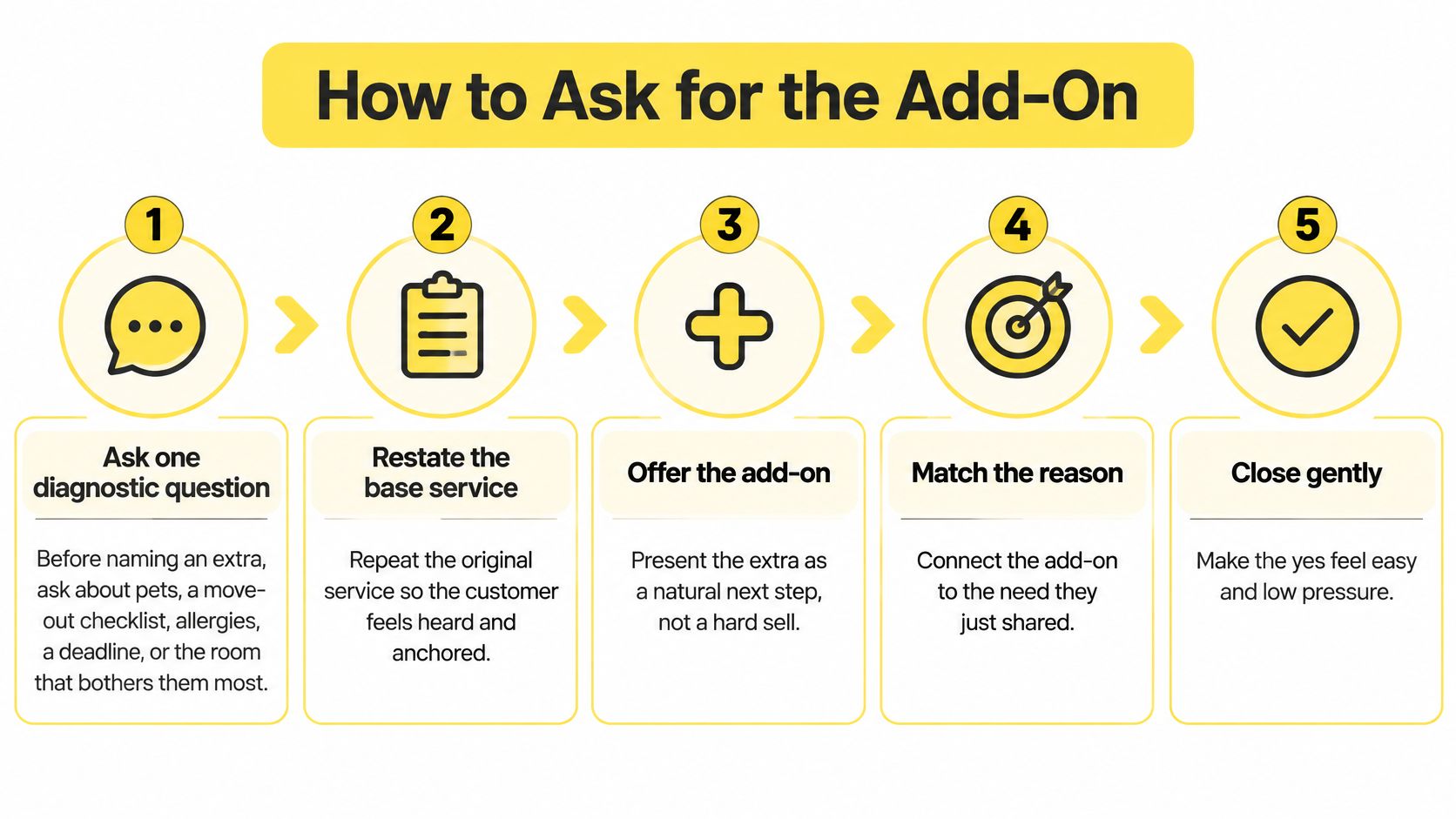
The customer shouldn't have to fend off a sales pitch to get a cleaning estimate. Ask one useful question, connect one extra to the answer, state the price before commitment, and stop talking. The offer should sound like a practical option, not a test of how much the customer will tolerate.
Akeneo's 2025 survey of 1,800 consumers across eight countries found that 66% of U.S. shoppers had abandoned purchases because pricing was hidden or inaccurate. In that survey, 57% said personalization would make them more loyal and 48% said they'd pay more for a personalized experience (Akeneo's 2025 B2C survey). The practical conclusion for a cleaning business is straightforward: relevance doesn't excuse unclear pricing. Show the base service, the add-on, its incremental price, and the outcome in plain language.
Ask one diagnostic question. Find out whether the customer has pets, a move-out checklist, allergies, a deadline, or a room that bothers them most. Don't ask a string of questions that feels like a qualification interview.
Restate the base service and price. Keep the original job visible in the conversation. That reassures the customer that the add-on is optional and doesn't change what they initially asked you to estimate.
Name one related add-on. Say what the crew will do, the result the customer can expect, and the incremental price before they commit.
Offer a clean choice. The customer can accept, choose a smaller version, or keep the base service. Once you've made the offer, stop talking. Silence gives them room to decide without turning a simple option into pressure.
Confirm the accepted line in writing. Send a text or email that names the extra and its price. Make sure the crew sees the change too, so the team arrives with the right scope rather than relying on a verbal note.
Here's how the five moves can sound in a move-out conversation:
“The base empty-home clean is $220. Inside the oven is $40 and inside the cabinets are $35, so the walkthrough photos show them empty. Want either, both, or just the base?”
And a day-before text to a recurring customer can stay just as clear:
“We can add fridge shelves this visit for $30. Reply yes and we will, or ignore this and we stick to the usual clean.”
Both scripts state the incremental price before the customer decides. They also make it easy to decline without an awkward exchange. If someone says no, confirm the original service and don't ask again in another form.
The same clarity helps when a customer raises a price objection. Keep the explanation tied to the work and the scope, and use a practical framework for handling price objections. Three add-on pitches in one breath, or a “premium” label with no task list, isn't a sales strategy. It's a reason to doubt the estimate.
Don't lead every customer with the most expensive tier. A customer who hasn't experienced the added finish has little reason to pay for it. A small, deliberate trial can show what the upgrade changes, then make a later offer concrete rather than theoretical.
A 2025 analysis of longitudinal transaction data from a major international car-rental company found that customers accepted and spent more on suggested upsells after receiving a free upgrade. The effect was stronger when employee engagement was higher (the 2025 analysis of car-rental upsells). That study concerns car rentals, not cleaning services, but the useful mechanism is clear: customers can judge an enhanced result more easily after they've seen it.
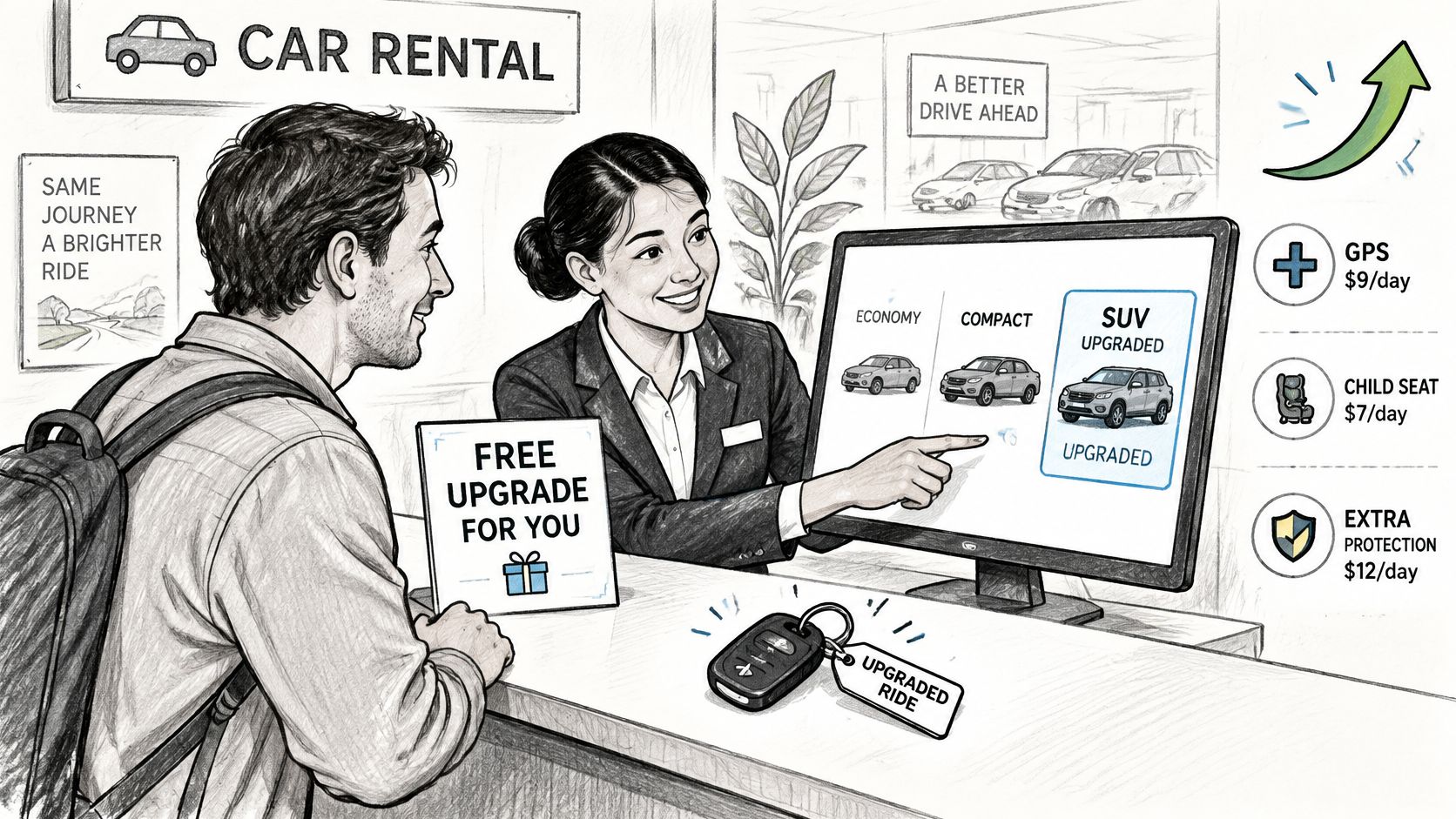
On a first visit, choose one extra finish the crew can complete without cutting into the promised work. It could be cleaning the inside of a microwave, disinfecting door handles, or giving the baseboards in one high-traffic room extra attention. Mark it as a one-time free inclusion, and tell the customer what you did. Don't let a complimentary task become an assumed part of every future clean.
After the visit, ask whether the customer was happy with that finish. If they were, name the paid version, explain what it adds beyond the sample, and state when the price starts. Keep the follow-up focused on that one task:
“We did the microwave interior on the house today. Adding it every visit is $15 starting with the next clean on the 12th.”
The customer can see what they received and what the recurring add-on would cover. Record which trial the crew completed and whether the customer liked it before sending the offer. That gives the team a reason for the follow-up, rather than a prompt to send the entire price book.
Skip the free finish if the schedule is already tight or the customer has asked for the lowest-cost clean. A rushed sample won't demonstrate value, and a free extra that delays the booked work can damage trust. When a customer values reliable completion, clear service standards matter too. For an example of how a cleaning company can explain its service commitment, see how to build trust with window cleaning guarantees.
The point is permission, not a giveaway. Use a free finish to demonstrate a specific outcome, then offer the paid version only if it was completed well and the customer has a reason to want it again.
A fuller customer relationship can matter as much as bringing in new customers. Forrester reported in a 2021 B2B benchmark that revenue from new logos accounted for nearly 23% of total revenue, leaving approximately 77% from retained business, upsell, and cross-sell (Forrester's customer-base benchmark). Treat that as a reason to measure add-ons, not as a forecast for a cleaning business.
Track four measures for 30 days. Count only estimates that showed an offer, and record the base price separately. That way, discounts or incomplete estimates won't make a weak offer look successful.
| Metric | Plain formula | Healthy read | Act when |
|---|---|---|---|
| Attach rate | Accepted add-ons divided by estimates that showed the offer | Rising while complaints stay flat | Many offers get few yeses |
| Average order value | Revenue per booked job | Up while the base price holds | It rises only because the base was discounted |
| Repeat booking rate | Customers who book again, especially recurring | Recurring share grows | Cancellations follow the extras |
| Time per add-on | Crew minutes compared with the fee | Fee covers labor and supplies | Jobs run long or the finish slips |
If offers rarely get accepted, check whether they match what the customer asked for. One relevant add-on beats a script delivered to every customer. If average order value rises only after discounting the base service, the add-on may not be adding value. Track its revenue and cost separately.
Cancellations after customers accept extras can point to a pressure-heavy pitch or a fee disclosed too late. Stop after a no, and show the add-on price on the estimate before the customer accepts. If jobs run long or the finish slips, compare crew time and supplies with the fee before offering that extra more widely.
Use a job costing program guide to examine whether an add-on pays for its labor and supplies. The practical test is simple: attach rate improves, complaints stay flat, repeat bookings hold, and the base service keeps its stated price. If routes slip as add-ons sell, limit the offers to work the crew can staff.
An add-on strategy fails if it exists only in a daytime conversation. The night or weekend lead still needs a clear base price, a relevant optional extra, and a way to accept it without waiting for someone to call back. Put your strongest offers in the same flow customers already use to choose a service, enter home size, and select bedrooms and bathrooms.
Keep the offer list short. Inside-oven cleaning, steam cleaning, AC-vent cleaning, and blinds can appear as options during the booking flow, not as surprise work when the crew arrives. A customer who wants an estimate for an appliance or specialist service can also use a practical guide to evaluate duct cleaning service costs, which helps make the task and scope part of the decision before booking.
Estimatty's online booking lets customers pick a service, enter home size, select bedrooms and bathrooms, and add options such as oven cleaning. Add-ons such as inside oven, steam cleaning, AC vents, and blinds can appear automatically during the booking flow. Smart Offers let the business create promo codes that are applied before tax, and the business can see which leads converted and which didn't. For a starting point on how to structure the online intake, use these estimate form templates.
Once the two offers are set, compare leads that booked with leads that stopped before booking. Keep the offer that improves attachment without slowing the crew or creating customer complaints. Don't keep an extra in the flow just because it looks polished; keep it because customers understand it and the team can deliver it.
Estimatty is an AI-powered web and voice sales estimator for cleaning businesses. Its agent answers prospects, captures details such as square footage, surfaces, and urgency, and sends estimates by SMS and email. When a prospect is ready to buy, a closer from Estimatty's team can take over the conversation and help turn the lead into a booked job. Eliana, founder of Sweet Home Cleaning, said her close rate jumped and revenue grew more than $2,500 a month within 90 days after Estimatty qualified leads and her team booked them.
The best upsell process isn't a long menu or a clever line. It's two well-priced offers in the estimate flow, shown when they fit the customer and hidden when they don't. Write those offers this week, confirm the crew can deliver them, and stop reading the rest of the menu.
Estimatty helps cleaning businesses answer web and phone inquiries, create consistent estimates, and present relevant add-ons around the clock. Put your two best offers into a booking flow that can capture leads at night and on weekends, then visit Estimatty to book a demo.