
September 29, 2026
Commercial and Residential Cleaning in 2026
Compare commercial and residential cleaning markets in 2026. Explore pricing, staffing, compliance, and how AI estimators streamline operations.

Friday, August 7, 2026
Learn how to start house cleaning services with a practical blueprint covering pricing, hiring, marketing, and the AI tools that turn leads into booked jobs.
The fastest way to get stuck in house cleaning isn't bad scrubbing, it's slow quoting. A lot of owners start with a few flyers, a borrowed vacuum, and a website that says “call for a free estimate,” then wonder why leads pile up at night while the calendar stays thin in the morning. The problem isn't that people don't want clean homes, it's that the business never builds a system that answers, prices, and books fast enough to catch them.
A house cleaning service can look easy to start and hard to grow for the same reason. Demand is real, but competition is crowded, so the owners who win are the ones who make their process tighter than everyone else's. That means choosing a niche, setting up lean, pricing with discipline, and capturing inquiries the moment they arrive, even after hours.
Maya thought she had a booking problem, but she really had a follow-up problem. She had the leads, a basic site, and a list of neighbors who'd asked for help, yet her inbox filled faster than her calendar because every inquiry needed a separate answer, a separate price, and a separate reminder to nudge the prospect again the next day.
That pattern kills a new service business. People launch with energy, but the business runs on guesswork, so the owner spends the best hours of the day cleaning and the worst hours trying to price jobs from memory.
House cleaning is a large, fragmented market. IBISWorld counts 356,516 residential cleaning services businesses in the U.S. in 2024, up 3.1% from 2023, and Jobber places the broader U.S. janitorial services market at about $112 billion with more than 1 million cleaning businesses as of 2026, which tells you two things at once, demand is real and competition is relentless. IBISWorld's residential cleaning services data shows why a new owner can't rely on being “available” alone.
The other trap is underpricing out of fear. Many businesses start with one-time jobs, hope referrals will save them, and then discover the workflow is too chaotic to support repeatable margins. That's where owners like Maya stall, not because they can't clean, but because they never build a system that turns interest into recurring work.
Practical rule: if every new lead requires a custom brain dump, your business is still a side hustle with invoices.
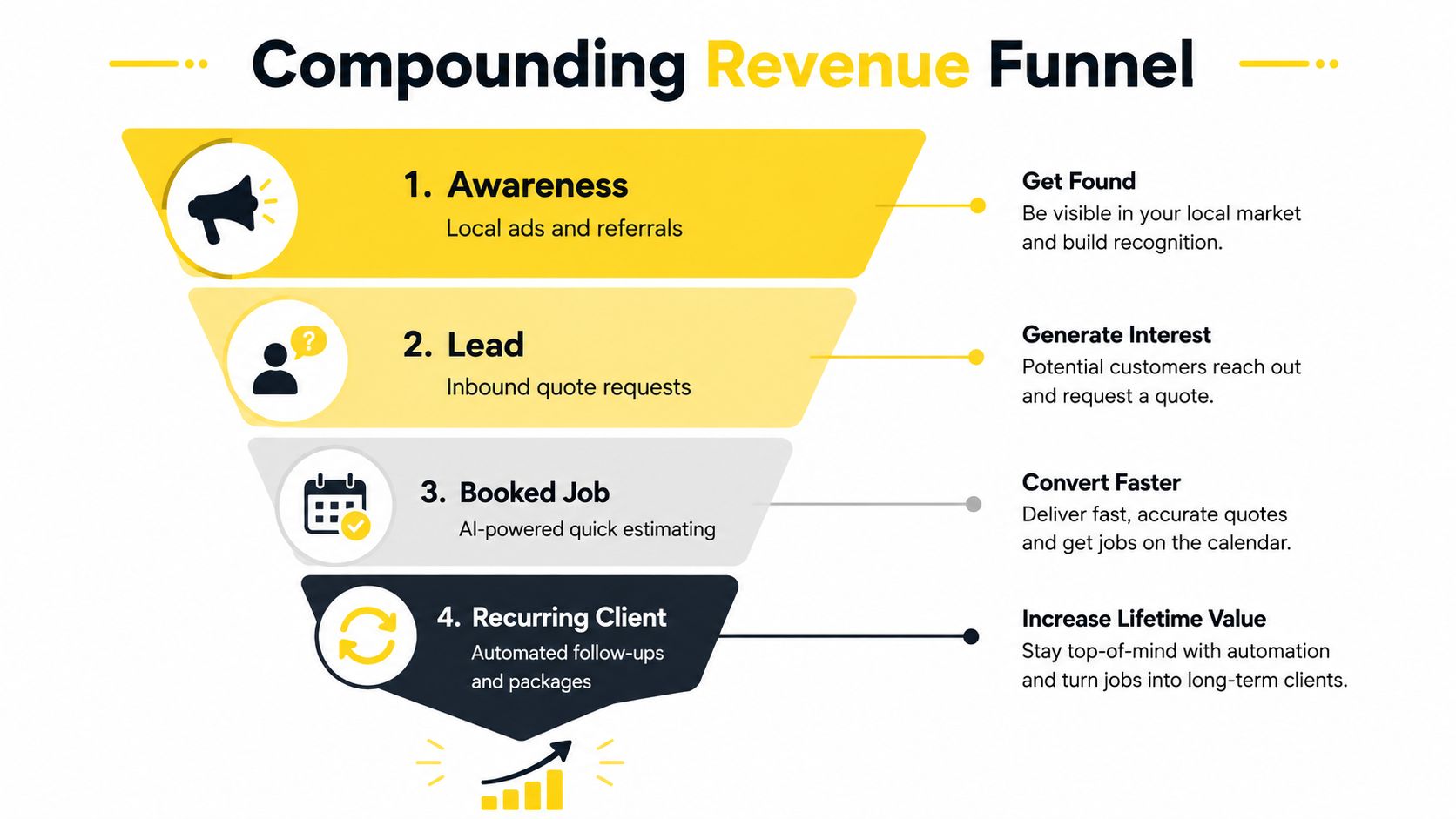
Scale starts when the owner stops selling labor one lead at a time and starts selling a process. Recurring clients, fast estimates, and a consistent follow-up cadence do more for growth than another bucket of supplies ever will. That's the difference between a calendar that fills and a business that dies between jobs.
The early decision, then, is simple. Launching the service is easy. Converting attention into recurring revenue is the actual game.
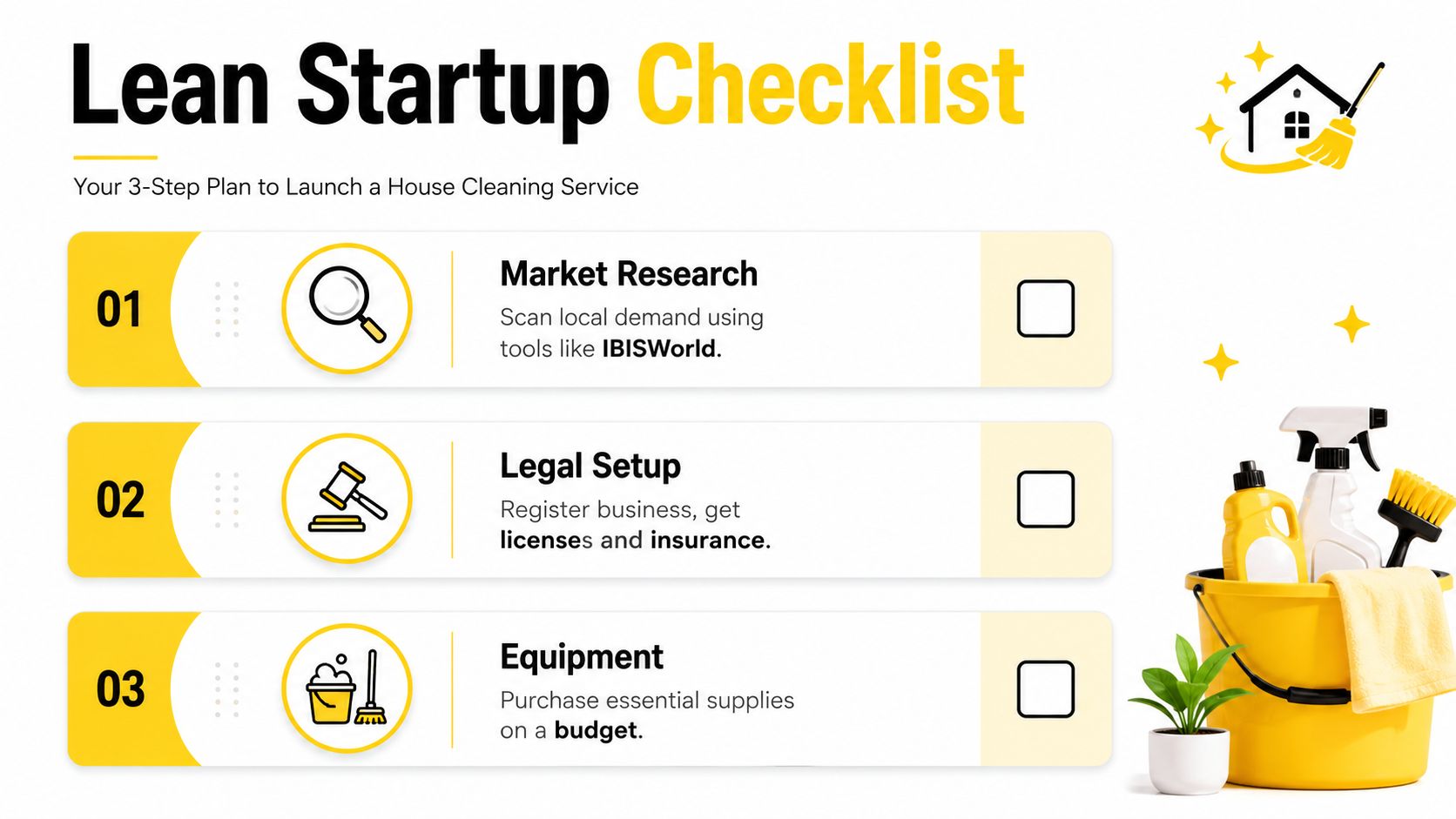
A lean launch starts with the market, not the mop. The fastest way to waste money is to buy gear before you know which homes you want, which jobs you will refuse, and which service you can quote quickly without second-guessing yourself. Standard recurring cleans, deep cleans, and move-out cleans each carry different expectations, different time windows, and different pricing pressure.
A solo operator does not need every tool under the sun. A small startup budget is enough to prove demand, and one guide pegs the equipment-and-supply spend for a lean start at roughly $150 to $500. Buy only what supports a paid job, not what looks polished in a shopping cart. How to start a house cleaning business with a lean setup
If you want a simple launch path, the order matters:
Local fees vary by jurisdiction, but some neutral startup guides say a local business license can cost about $50 to $300, while forming an LLC or corporation can run about $50 to $500 in filing fees depending on the state and city. This startup checklist from Deelo is a useful reminder that permit costs are not one-size-fits-all.
For registration help, startup registration help from Action Accountants is a solid practical resource if you want a plain-English walkthrough before you file. If you are operating in a city with extra home-services rules, check those early, because a permit surprise after you have sold jobs is a painful way to start.
For a cleaner state-by-state licensing overview, keep the process straight with Estimatty's cleaning business license guide. That kind of reference helps you avoid missing a local requirement while you are focused on booking the first client.
This is the part where many owners overspend. A borrowed vacuum and a short supply list are enough to validate your offer, and insurance should be treated as part of the launch decision, not as a luxury after revenue appears. If a city or county requires another permit, handle it before you promise arrival windows.
A one-page weekend plan is enough here, market scan, niche choice, entity setup, license check, and a bare-bones supply list. Anything beyond that can wait until the business has repeatable demand.
Pricing is where a lot of new owners sabotage the business. They look at three competitors, copy the cheapest number, and hope speed will fix the margin later. It usually does not, because the first jobs are slower, the travel time is messier, and the extra touches that never got counted still show up in labor.
One practical guide recommends choosing between hourly, flat-rate, or hybrid pricing, and it also ties profitable rates to tracking real job times before setting the number. That guidance matters because a quote built from actual labor gives you a cleaner baseline than one built from guesses or panic. The basic logic behind how to price cleaning services is straightforward, measure what the work takes, then price the work from that number.
A clean pricing structure usually looks like this:
| Model | Best For | Risk | Margin Lever |
|---|---|---|---|
| Hourly | Very irregular jobs or new crews | Customers may resist open-ended bills | Tight time tracking |
| Flat-Rate | Recurring homes with predictable scope | Underpricing if your speed is off | Accurate estimating |
| Hybrid | Jobs with add-ons or variable condition | Can get confusing if not documented | Clear base plus extras |
Most beginners do better with a pricing method they can explain in one sentence, then refine it as job times become predictable. Generic “compare competitors” advice leaves out the hard parts, square footage, frequency, travel, and add-ons. Those details are where margin gets protected or lost.
The right approach is mechanical. Estimate hours, set a target billable rate, and convert that into a flat number so the quote is not shaped by nerves. That also makes it easier to spot when a specific job is eating time you never intended to give away.
A cheap first quote is rarely cheap after you count touchpoints, callbacks, and unpaid adjustments.
Use a worksheet that breaks the job into base clean, frequency adjustment, travel, and add-ons for ovens, fridges, and inside windows. That gives you a repeatable way to price standard homes without changing the math every time a prospect asks for a number on the spot.
Quote on the phone when the job is standard and the scope is clear. Push for an on-site estimate when the home is large, cluttered, or obviously variable, because one rushed number can wipe out the profit on an otherwise good account. If you keep one rule in front of you, it should be this. The quote has to reflect the work, not the pressure to sound competitive.
A homeowner who sends a request at 9:47 p.m. on Sunday usually isn't checking back Monday at lunch. They're comparing whoever answered fastest, and the business that waits until office hours has already lost ground. That's why quoting speed matters more than another polished brochure.
A modern cleaning lead flow starts with an estimator on the site that asks the right questions up front. Square footage, surfaces, frequency, urgency, and add-ons all matter because they change the estimate, and the estimate changes whether the lead books or disappears. Estimatty's AI estimates software for cleaning businesses fits that use case because it standardizes the intake instead of forcing the owner to rewrite the same message ten times.
The point isn't just speed, it's consistency. When every prospect gets the same logic, pricing stops drifting based on mood, time of day, or how rushed the owner feels after a long clean.
The best setup is the simplest one that captures the lead, sends the estimate, and alerts the team in real time. Estimatty is one option for that workflow, it captures details like square footage and urgency, then sends estimates by SMS and email so the lead doesn't cool off while the owner is on another job. That matters because a lot of cleaning businesses still rely on voicemail, contact forms, or “we'll get back to you tomorrow,” and that delay costs bookings.
No-code setup is the practical advantage. A solo owner can usually configure pricing, voice, and FAQs in an afternoon without paying a developer, then plug the estimator into the site and start using it immediately. The win is not flashy automation, it's removing the dead time between interest and quote.
A good estimator doesn't just answer faster, it protects the pricing standard. It reduces callback-heavy estimates, keeps the quote language consistent, and makes it easier to tell which leads are worth a second look. That's the kind of structure that lets a cleaning business serve more inquiries without adding another salesperson.
If you've ever lost a job because you were busy scrubbing a tub while the prospect was still shopping, you already know the problem. The answer is not more hustle, it's a quoting system that works while you're busy or asleep.
The first time a solo owner says, “I can't keep doing every job myself,” the business changes. That is usually the point where the workload is too much for one person, and it is also the point where hiring starts to matter more than chasing another lead source.
A second cleaner should never be a panic hire. The better move is to build a small funnel, screen for reliability, and run a paid trial clean before anything becomes permanent. If your hiring flow is still spread across texts, voicemails, and sticky notes, an applicant tracking system gives you a cleaner way to sort applicants, follow up, and keep records in one place. Skill matters, but if somebody shows up late or misses details, the schedule falls apart no matter how nice their resume looks.
The strongest sign of a healthy hiring process is that it feels routine. You know where applicants come from, how they are screened, and what a good first week looks like.
For onboarding, a structured seven to 10 day training period is a practical benchmark, paired with a lead cleaner on live jobs. ZenMaid's startup guide recommends that kind of window, and it works because cleaning standards are easier to teach by repetition than by lecture.
A workable sequence looks like this:
Practical rule: if a new hire cannot follow the same sequence twice, they are not ready for unsupervised work.
The labor math matters too. Jobber places the average annual pay for a U.S. house cleaner at $35,034, while the average annual pay for a cleaning business owner is $127,973, which shows how owner earnings can widen once the business moves from labor only to systems and recurring accounts. Jobber's cleaning industry trends report makes the transition clear.
That gap is why scheduling stability matters. Cleaner retention usually improves when routes are predictable, standards are clear, and recognition is real, not performative. Hiring should make the business sturdier, not more chaotic.
A lot of new cleaning owners waste time trying every channel that looks busy. That produces activity, not booked work. The business grows faster when every local touchpoint points to one clear action, request the estimate, then move into recurring service if the fit is there.
Recurring service is already familiar to a large share of buyers, and that matters because the offer is easier to sell once people understand the rhythm. Weekly, bi-weekly, and monthly plans reduce the scramble for new work and give the route a steadier base. The point is not just more jobs, it is fewer gaps between jobs and less pressure to refill the calendar from scratch.
That changes how I market. One-off cleanings still help fill open slots, but recurring clients make scheduling more predictable and usually make it easier to hold price once the relationship is established.
A useful local stack usually starts with a Google Business Profile, then adds neighborhood Facebook groups, door hangers in target ZIP codes, and referral incentives. Each one should push to the same estimate flow, not a generic contact form that makes people wait. If the site can quote quickly, the channel matters less than how fast the lead gets a response.
That same logic applies offline. A referral card, flyer, or social post does more when it sends people to one page that captures the details, estimates automatically, and gives the owner a clean next step. For owners trying to keep search and site structure tight, SEO for a cleaning business is a practical reference for organizing local keywords and service areas without muddying the message.
The message should stay simple. Reliable estimates, recurring service, and clear follow-up sell better than a long list of promises that sound polished but do not help the customer decide.
If you are running a franchise-style growth plan, a marketing company for franchises can help standardize the local playbook across locations. For a small residential service, the same principle still applies, keep the booking path boring, fast, and easy to trust.
The first 30 days should be about control, not ambition. Pick one service lane, file the business, check the license requirements, buy the lean starter supplies, and put a pricing worksheet in place so the website can estimate from day one. If the estimate flow is live early, every lead you bring in teaches you something useful.
Build the basics in this order, entity, license check, supply list, pricing logic, estimator setup, and website contact path. Don't expand into too many service types too soon, because every extra option makes quoting slower and less consistent. A narrow offer is easier to price, easier to train, and easier to sell before reviews start coming in.
Focus on the first recurring accounts and the first hire. If you need a hiring workflow, pipehirehrm.com fits the early-stage team-building process, and the seven-to-10 day training period helps a second cleaner become productive without wrecking quality. At the same time, tighten your estimate intake so the same jobs produce the same margins. That is where a marketing company for franchises can help if you are trying to standardize the local playbook across locations, but the core issue stays the same, every new cleaner has to work inside a pricing system that holds.
Push route density, add-ons, and price discipline. Pricing changes need to happen before labor costs start eating each job, because underpriced recurring work is hard to fix after the schedule fills up. Keep the estimate flow fast and consistent, then use it to raise rates on weak jobs and protect the ones that already book cleanly.
Track what matters weekly, lead-to-estimate speed, estimate-to-book rate, recurring client share, and profit per clean.
That's the scorecard. If those numbers improve, the business is getting healthier. If they stall, more mops won't fix it.
If you want a cleaning business that books while you're still on another job, start with the estimate process, not the bucket. Estimatty gives residential cleaning owners a way to capture square footage, urgency, and service details, then return a consistent estimate fast enough to keep the lead warm. Visit Estimatty if you want to turn after-hours inquiries into booked jobs without adding more manual follow-up.