October 24, 2026
Area of Service for Cleaning Businesses: How to Map Yours
Learn how to define and map your area of service for a cleaning business using drive time, travel fees and job minimums that protect profit.

Thursday, June 11, 2026
Boost your residential cleaning business! Discover how to improve customer satisfaction with practical steps on feedback, quality control & automation.
A client calls at 8:12 a.m. because the crew missed a trash can liner. Another texts at 8:19 asking whether anyone is still coming because they never got a confirmation. By 8:27, your office manager is juggling reschedules, your field team is already behind, and a simple day turns into cleanup work that has nothing to do with cleaning.
That's how customer satisfaction breaks down in residential cleaning. It rarely starts with a dramatic failure. It starts with friction. A slow estimate. A vague arrival window. A missed note about pets, floors, or access. A follow-up that never happens. Owners often treat these as isolated issues, but they stack into churn, weak reviews, refund pressure, and fewer referrals.
If you want to know how to improve customer satisfaction, stop thinking about it as a soft skill. Treat it like an operating system. In residential cleaning, satisfaction is built before the first clean, protected during service, and confirmed after the team leaves.
The residential cleaning businesses that scale cleanly usually understand one thing early. Satisfaction is an economic metric. It affects repeat business, referral flow, pricing confidence, and how much energy your team wastes on recovery work.
Research cited by industry publications reports that for every 10-percentage-point increase in customer satisfaction, companies can see 2-3% higher revenue, while 89% of consumers are more likely to make another purchase after a positive customer service experience according to customer experience statistics summarized by Wavetec.
That matters even more in house cleaning because the service is recurring, personal, and performed inside the client's home. When a customer feels uncertain or disappointed, they don't just complain. They hesitate to rebook. They cancel recurring service. They stop referring neighbors. They leave a review that your next prospect reads before ever requesting an estimate.
Most owners only count the obvious cost. They see the reclean, the refund, or the discount. They don't count the operational drag:
Practical rule: If a problem creates extra phone calls, schedule changes, or manual explanation, it's already more expensive than it looks.
The strongest cleaning companies make customer satisfaction part of daily operations. They don't leave it to technician personality or hope that a good clean will cover weak communication. They build systems that make the experience feel organized and reliable.
That's why social proof matters too. When prospects see customer testimonials from cleaning companies using structured estimating and follow-up systems, they're not just looking for praise. They're looking for signs that the company feels easy to work with.
In residential cleaning, that ease is the product as much as the clean itself. A spotless bathroom is important. So is knowing someone will answer, confirm, show up prepared, and fix issues fast if something slips.
Most cleaning owners think satisfaction starts when the crew arrives. It starts much earlier. It starts when a homeowner fills out a form, leaves a voicemail, or tries to figure out whether your company even serves their area.
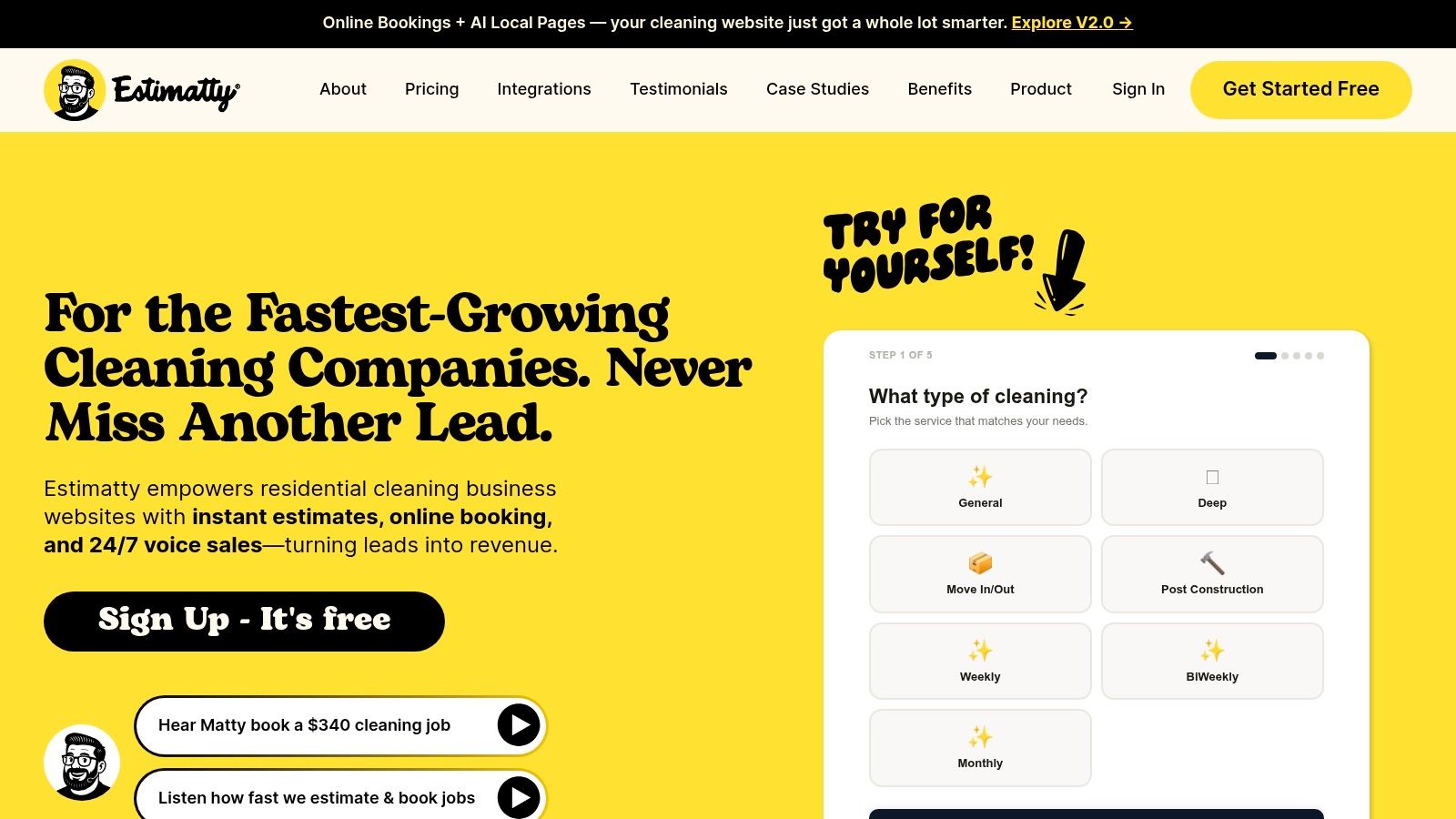
If your estimate process is slow, inconsistent, or vague, you create anxiety before the customer has paid you a dollar. That anxiety becomes the lens through which they judge everything else.
A frequently underserved angle in how to improve customer satisfaction is reducing uncertainty during the waiting period, not just improving service quality after contact. Recent CX guidance keeps emphasizing that customers want clarity on what happens next, as discussed in Drive Research's customer satisfaction guidance.
In residential cleaning, the old workflow usually looks like this:
| Friction point | What the customer feels | What the business creates |
|---|---|---|
| Voicemail or slow reply | “Did anyone get this?” | Lost trust before contact |
| Manual estimates from different staff | “Why did the price change?” | Inconsistent expectations |
| Weak confirmation process | “Am I actually booked?” | Avoidable inbound calls |
| No explanation of next steps | “What happens now?” | More hand-holding for office staff |
In these situations, owners lose satisfaction without noticing. The clean may still happen. But the customer arrives to the appointment already slightly on edge.
The best pre-service systems do a few simple things well:
One practical way to do that is with appointment confirmation email workflows for cleaning businesses. Good confirmations reduce preventable calls because they answer the exact questions customers ask when they're waiting.
A modern setup can also automate the estimate itself. Estimatty is one example. It gives residential cleaning companies a way to deliver instant estimates, capture job details, answer common questions, and send follow-up by text and email without relying on delayed callbacks or manual pricing.
That kind of automation doesn't replace service. It removes uncertainty.
Here's a quick look at what a more structured front-end experience can look like:
Customers will forgive waiting. They usually won't forgive not knowing whether anyone is handling their request.
In house cleaning, that distinction is everything. When the first impression feels organized, customers give you more trust, more patience, and a much stronger chance at a long-term relationship.
A great customer experience can still fall apart if the clean itself depends on memory, mood, or whatever habits a technician brought from their last company.
I've seen the same pattern over and over. An owner hires good people, gives a quick walkthrough, and assumes quality will stay consistent. It won't. Not across multiple homes, changing client preferences, vacation coverage, and new hires. Consistency comes from process.
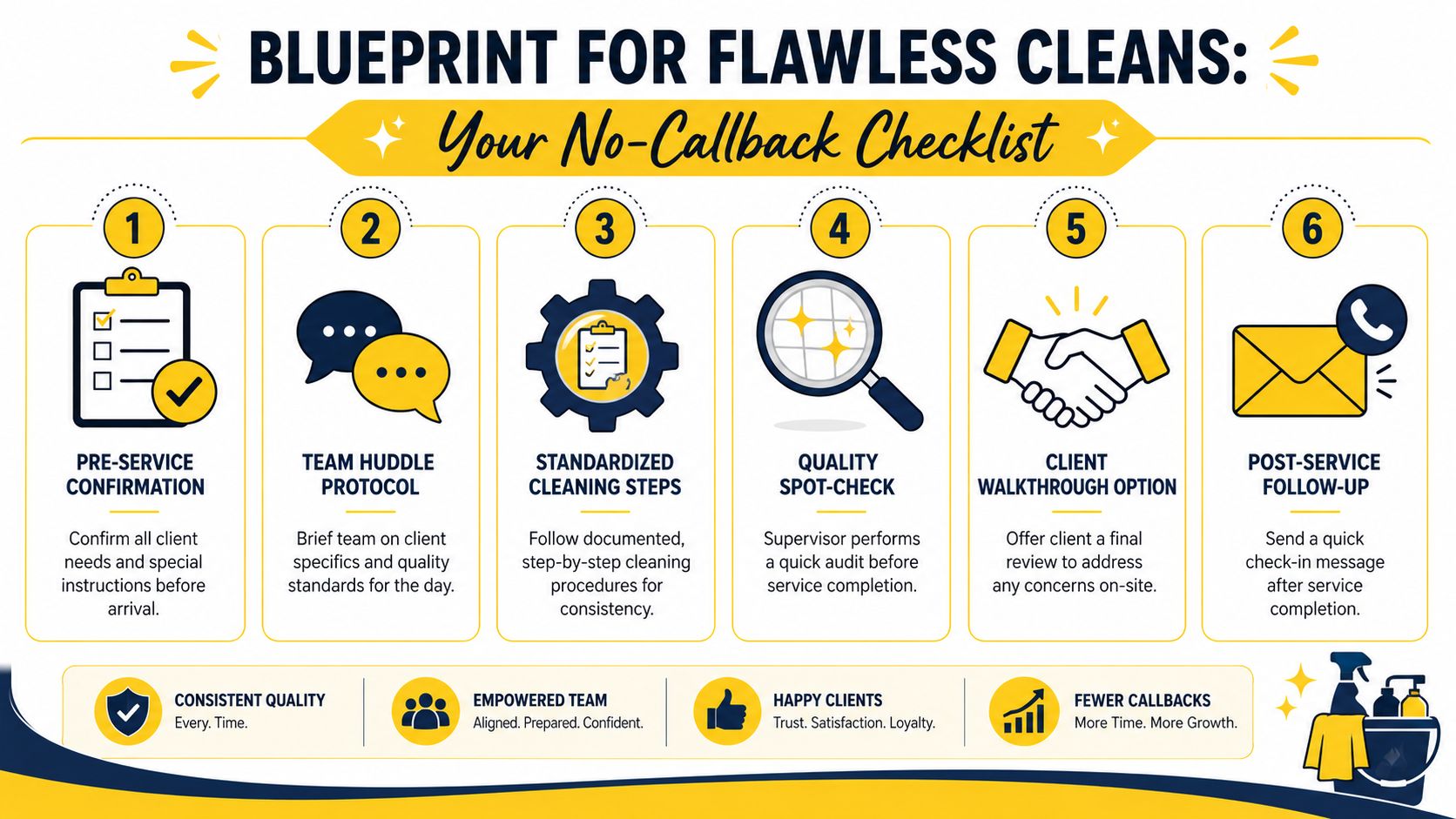
A reliable residential clean starts before the team enters the house. The crew already knows whether it's a recurring maintenance visit, a first-time deep clean, or a move-related service. They know pet instructions, access notes, fragile surfaces, and any room-specific priorities.
Then the work follows a repeatable structure:
That process sounds basic. It's also where most callback prevention lives.
Generic checklists don't fix much. “Clean bathroom” is not a system. A useful checklist breaks the job into visible tasks your team can execute and your supervisor can verify.
A room-level cleaning checklist should cover things like surfaces, mirrors, fixtures, floors, high-touch points, trash, and reset standards. It should also include client-specific exceptions. If the homeowner never wants a particular office touched, that note belongs in the process, not in someone's text thread.
For a practical framework, this cleaning schedule checklist guide is the kind of resource that helps owners turn broad standards into repeatable field execution.
Field note: If your team says “I thought someone else got that,” your process is too loose.
Strong cleaners help. Strong systems help more. When you onboard new technicians, train them on your exact standard, not just your brand promise. Show them the order of operations. Show them photo examples. Show them what “finished” means in each room.
If you're tightening staffing and training, resources like PipeHireHRM's blog for cleaning hiring and operations can support the recruiting side. But hiring alone won't stabilize customer satisfaction. The operating model has to protect the customer from variation.
Here's a simple comparison:
| Approach | Result |
|---|---|
| Talent-first with weak SOPs | Quality changes by crew |
| SOPs with no quality check | Mistakes repeat quietly |
| SOPs plus spot checks plus client notes | Fewer callbacks and fewer surprises |
A residential cleaning business becomes easier to manage the moment every clean stops being a custom performance and starts becoming a controlled process.
Most cleaning companies collect feedback in the weakest possible way. They wait for a complaint, skim a review, say “we need to do better,” and move on.
That isn't a feedback system. That's delayed damage control.
A high-signal method for improving customer satisfaction is to build a closed-loop feedback system. A common pitfall is stopping at feedback collection without closing the loop. Companies should not only listen, but also respond to problems raised by negative feedback and complaints, otherwise the same failure modes keep recurring, as outlined in Walker's closed-loop feedback guidance.
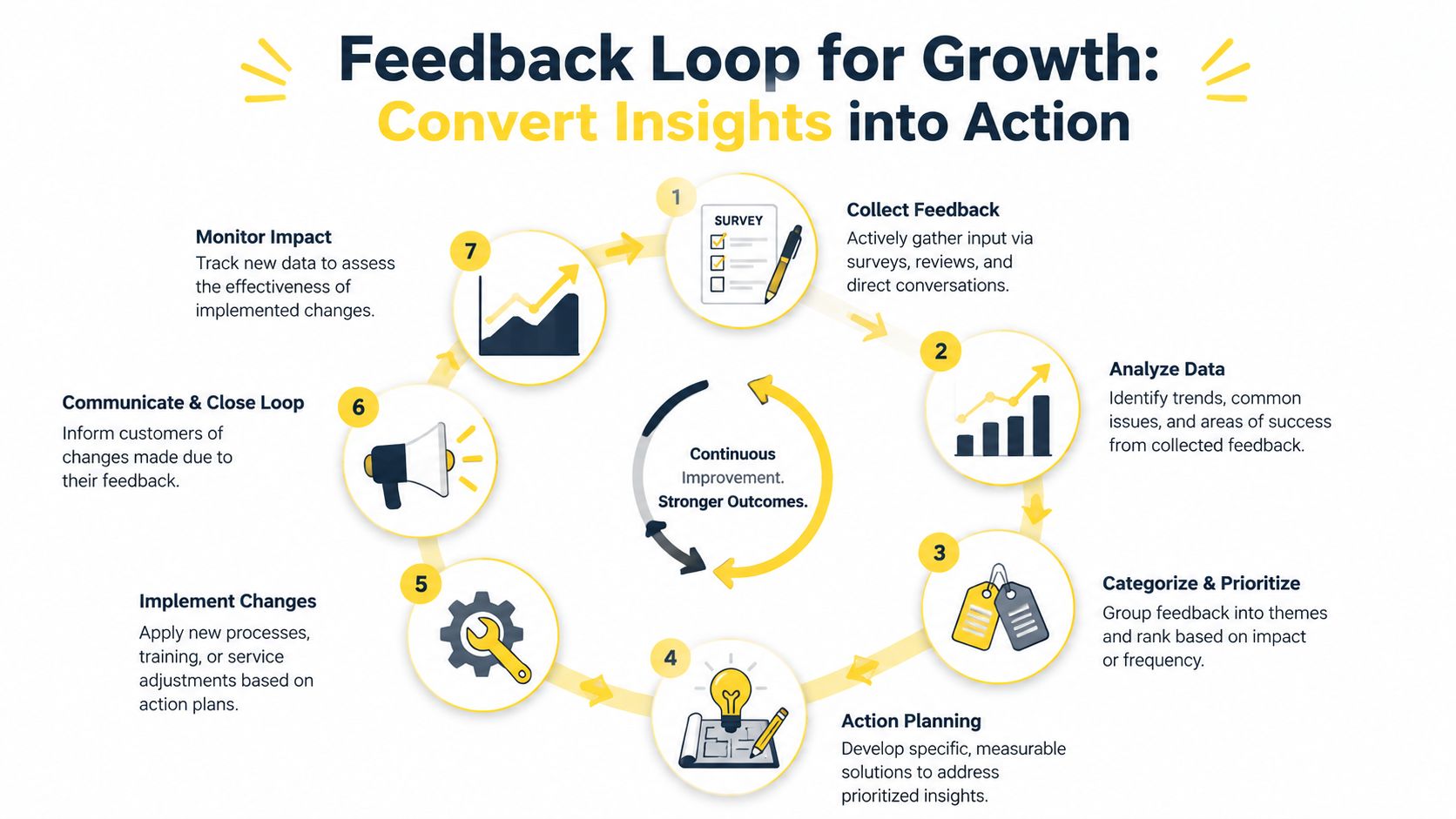
For residential cleaning, a workable loop looks like this:
That last step matters. Customers calm down when they can tell a real person understood the issue and changed something.
Many owners overcomplicate things. They build long forms nobody answers. Better practice is short, structured feedback tied to one interaction.
Zendesk recommends keeping customer satisfaction surveys to three questions at most and pairing them with rating-scale and open-ended questions, as explained in Zendesk's guide to measuring customer satisfaction.
For a house cleaning company, that can be as simple as:
| Survey question | What it tells you |
|---|---|
| How satisfied were you with today's clean? | Overall service quality |
| Was anything missed or unclear? | Specific defect or communication gap |
| Anything we should know for next time? | Future preference and retention insight |
The point isn't collecting more words. It's collecting feedback you can route into action.
Public reviews are part of this loop too. If your company wants a stronger review pipeline, this guide on how to get more customer reviews is useful because it focuses on practical review generation, not gimmicks.
But don't stop at volume. Read every review like an operations report. If multiple customers mention “easy booking,” preserve that process. If several mention “late arrival” or “had to explain things twice,” fix the handoff.
A lot of owners need better automation here. Customer service automation for cleaning businesses can help tie post-service follow-up, survey links, and response workflows together so feedback doesn't sit in an inbox waiting for someone to remember it.
Negative feedback is only expensive when the business learns nothing from it.
Cleaning owners often say they care about customer satisfaction, but when I ask how they measure it, I get vague answers. “We don't get many complaints.” “People seem happy.” “Our reviews are pretty good.”
That's not measurement. That's intuition.

The American Customer Satisfaction Index has reported an average satisfaction range of 73-77 over the last 12 years, which is why benchmarking matters. If you don't measure your current level, you can't tell whether you're ahead of the market or drifting below it, according to this review of customer satisfaction benchmarking.
For residential cleaning, I like to separate these two questions because they answer different management problems.
Use CSAT right after a clean. This is the immediate score tied to a specific visit.
A simple version is:
That question helps you monitor execution. If scores dip after first-time cleans, your onboarding or scope-setting may be off. If they dip on recurring appointments, your consistency or staffing may need work.
NPS is better for periodic check-ins with established clients.
A simple version is:
That question isn't about one bathroom or one missed dusting edge. It tells you whether the customer sees your company as reliable enough to put their name behind.
The score by itself won't run the business. You need to pair it with behavior.
Here's the KPI view I recommend:
| Metric | Use it for | Watch alongside |
|---|---|---|
| CSAT | Quality of a specific service visit | Recleans, callbacks, complaint type |
| NPS | Loyalty and referral intent | Referral volume, recurring retention |
| Response speed | Front-end confidence | Booking conversion, inbound follow-up load |
| Repeat-service retention | Long-term satisfaction | Cancellations and service changes |
Many businesses eventually recognize the connection. Satisfaction metrics become useful when they influence staffing, training, routing, and communication decisions.
A score without an action threshold is just decoration on a dashboard.
A lot of owners launch surveys and then make random changes because a few comments felt important. Don't do that. First establish your baseline. Then compare future data against it.
If your CSAT is stable but your retention is weak, the issue may not be cleaning quality. It may be pricing shock, scheduling friction, or weak reminder communication. If your NPS is healthy but reclean requests are rising, your loyal clients may like your company while your field quality slips.
That's how to improve customer satisfaction in a way that changes profit. Measure the experience, tie it to behavior, and use the data to decide where to tighten operations next.
Residential cleaning customers don't become loyal because you asked them to be loyal. They become loyal because every step feels easy, clear, and dependable.
That starts before the first service. A fast estimate, clear confirmation, and visible next step lower anxiety. Then the in-home process has to deliver the same level of discipline. Room-by-room standards, technician training, and quality checks prevent the kinds of misses that create callbacks. After that, feedback and measurement keep the system honest.
The key point is simple. Customer satisfaction is not an outcome you hope for. It's a result you design.
When owners get this right, they stop managing chaos and start managing a machine. The office gets fewer preventable calls. Crews walk into homes with better information. Customers know what to expect. Problems get caught earlier. Reviews improve because the experience deserves better reviews.
And when a client is happy enough to recommend you, a thoughtful thank-you referral message helps turn that goodwill into consistent referral behavior without sounding forced or awkward.
If you want the strongest first move, fix the front end first. Most cleaning companies leak trust before they ever have a chance to earn it in the home. Tighten that intake and estimate experience, and the rest of your satisfaction system gets easier to manage.
If you want a cleaner customer journey from the first inquiry forward, Estimatty helps residential cleaning companies automate estimates, capture job details, and respond instantly so prospects don't sit in limbo waiting for a callback. That gives your team a more consistent handoff, better customer expectations, and a stronger foundation for satisfaction before the first clean even starts.