
September 21, 2026
Inside and Out Cleaning: A Practical Pricing Guide
Learn what inside and out cleaning really includes, how pricing works, and which add-ons actually pay off for residential and commercial estimates.

Sunday, September 13, 2026
Learn how much to charge for washing windows with proven formulas, price tables and estimate scripts to price profitably and win more jobs.

Most residential window washing lands at $10–$15 per window or $4–$8 per pane, with whole-house jobs commonly priced at $150–$366. A typical visit often centers near $220, but the right number depends on access, glass type, service scope, and how much time the job consumes.
A homeowner may call while you're driving between jobs and ask for a fast price. You count the windows, make a quick guess, and offer a number low enough to win the work. Then you arrive to find screens packed with dirt, tracks that haven't been touched in years, and second-story glass above a sloped roof. The job looks simple from the phone, but the margin disappears before you finish loading the squeegees back into the van.
A low estimate can feel like a sales victory. It isn't if travel, setup, equipment, insurance, and access time consume the money you expected to keep. The problem usually isn't your closing ability. It's the absence of a pricing system that forces every job through the same practical checks.
The market gives you useful anchors, but it doesn't give you one universal rate. Residential window cleaning commonly clusters around $10–$15 per window or $4–$8 per pane, while whole-house work often falls between $150 and $366, according to Housecall Pro's window cleaning pricing guide. Commercial providers may use $0.50–$2.50 per square foot or $50–$100 per hour, depending on access and job size.
That range exists for a reason. A ground-floor pane in an empty room has a different cost profile from a divided-light window above a conservatory. Floor level, glass type, frequency, access equipment, and whether you're cleaning one side or both should shape the estimate before you send a number.
Use per-pane pricing when the glass has many individual sections and detail work drives labor. Use per-window pricing for straightforward residential jobs or simple storefronts. Use hourly pricing when the scope is uncertain, such as post-construction cleanup or difficult access. Use square-foot pricing for larger commercial glass where counting every pane creates unnecessary friction.
Estimates should make those decisions consistently. Estimatty's approach is useful here because it focuses on fast, standardized estimates rather than improvised quotes. A consistent estimate also gives customers a clearer explanation: the price reflects the work involved, not an arbitrary number pulled from memory.
Practical rule: Never send a price until you know the window count, service side, floor level, access condition, and add-ons.
This guide gives you the formulas, decision rules, sample tables, minimum-fee logic, and ready-to-send estimate language needed to protect profit without making the customer decode your entire operation. When demand grows beyond what you can personally fulfill, pipehirehrm.com can also be part of the staffing conversation, especially when reliable cleaning employees become the constraint.
A divided-light home, a short storefront route, and a post-construction cleanup should never receive the same pricing structure. Choose the anchor that matches the work creating your labor, then add a minimum fee or bundle when the job is too small to cover travel and setup.
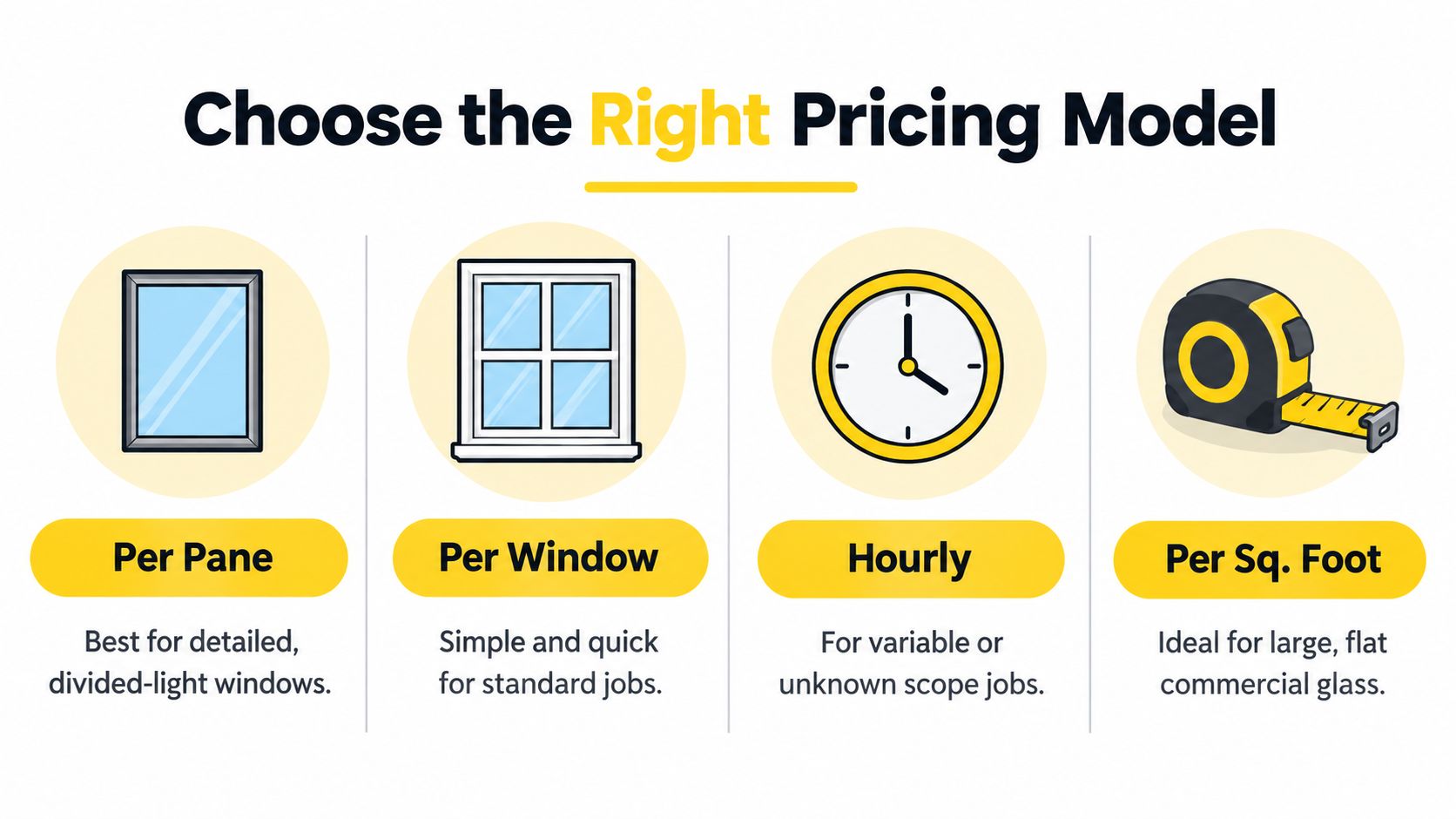
Per pane is the right choice for French panes, divided lights, and detailed interior work. Charge for each section you scrub and squeegee. This prevents a multi-pane window from being priced like one fast, standard opening.
Per window keeps estimates clear for ordinary homes and simple storefronts. Residential pricing is commonly reported around $10–$15 per window, but define whether that price includes one side, both sides, screens, and tracks. A “window” may contain several panes. For commercial storefronts, reported pricing is often around $3–$7 per pane, according to HomeGuide's window cleaning cost information.
Hourly pricing protects the margin when the scope cannot be counted reliably. Use it for post-construction dust, adhesive, paint specks, lift work, or obstructed access. State the hourly rate, the work included, and that the final total follows the verified scope. Add a project minimum so an uncertain job cannot consume a full visit for a small invoice.
Per square foot suits broad, flat commercial glass. Reported commercial benchmarks are around $0.50–$2.50 per square foot, with access, frequency, and job size affecting the final rate, as summarized by Grit Work's window cleaning pricing guidance.
| Job type | Best pricing anchor | Why it works |
|---|---|---|
| Divided-light residential windows | Per pane | Pays for each detail-heavy section |
| Standard home with predictable access | Per window or flat bundle | Keeps the quote simple |
| Simple storefront | Per window or per pane | Makes recurring visits easy to track |
| Post-construction or uncertain scope | Hourly with project minimum | Covers unknown labor |
| Large office or commercial facade | Per square foot | Matches how the glass is measured |
Use flat-rate bundles when the customer wants one easy number and the scope is predictable. Build the bundle from your unit price, then add screens, tracks, hard-water removal, interior work, or ladder access as separate line items. A recurring route can support a lower per-visit price because travel and setup become more efficient. A one-off deep clean should carry the stronger minimum.
For consistent quoting, follow this business pricing strategies guide. A practical estimate script is: “Your total is $X for inside and outside window cleaning, including Y windows. Screens and tracks are $Z, and any restoration work will be priced separately after inspection.” If an assistant handles inquiries, compare the cost of Expressify AI assistant with the staff time spent collecting job details. The tool only earns its place if it captures the information your pricing decision requires.
Market ranges tell you what customers may recognize. They don't tell you whether your business will make money on a particular property. Your price must start with the cost of delivering the job, then add a markup that pays for risk and profit.
Core formula: Labor + materials + overhead + travel + insurance, then apply a 20%–40% markup.
That markup range is specifically recommended in one commercial pricing guide after accounting for labor, equipment wear, insurance, travel, and overhead. The guidance appears in Grit Work's pricing resource, which also warns that small or distant jobs can leak revenue when owners ignore setup and operating costs.
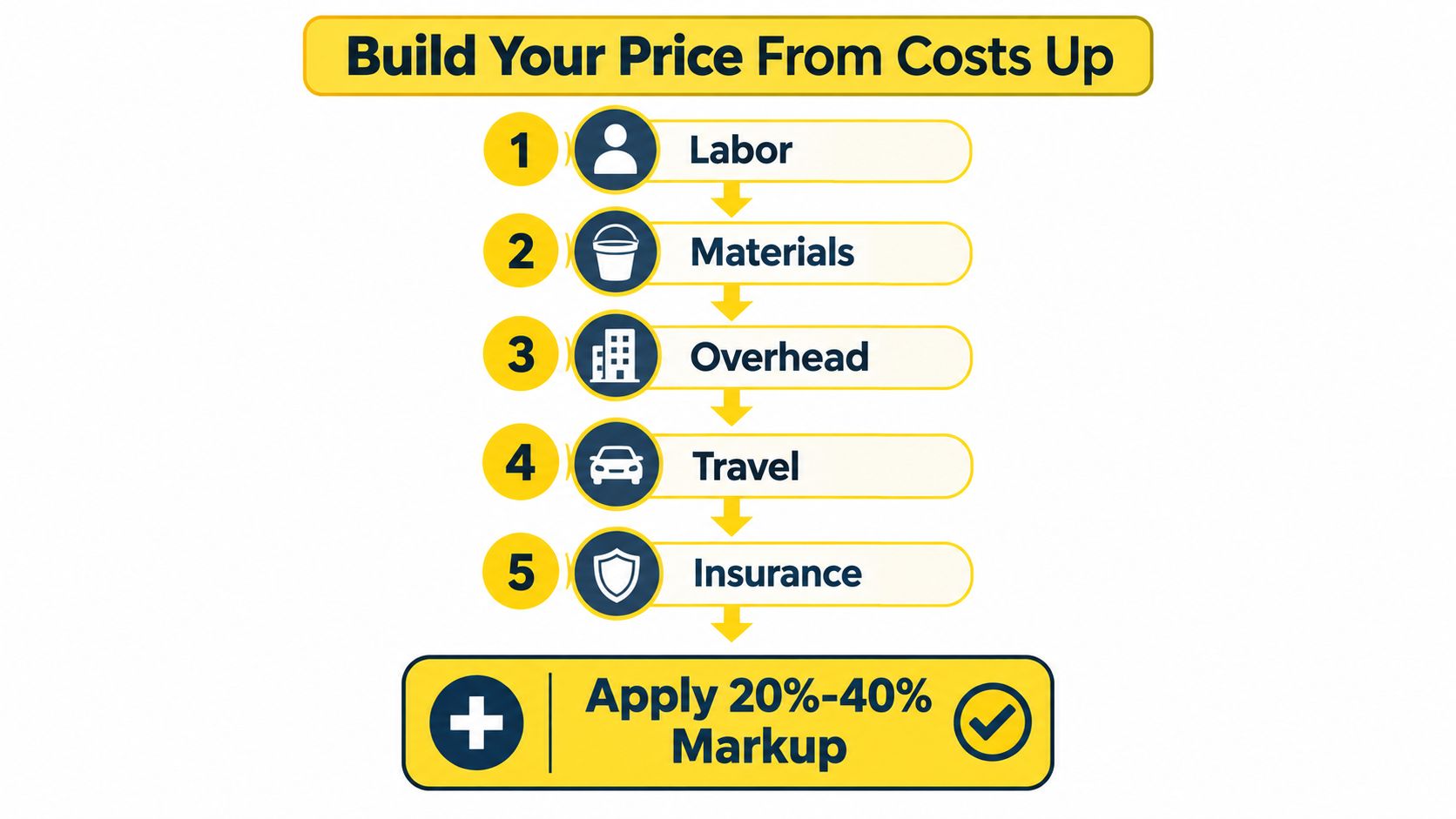
Start with labor. Include loading, arrival, setup, moving furniture, cleaning, inspection, pack-down, and communication if those tasks are required for delivery. Your labor cost per hour calculation guide can help you separate what you pay a technician from the selling rate you need to charge.
Then add the costs that disappear when you estimate from instinct:
Consider a 20-window home requiring interior and exterior cleaning. Don't begin with “20 multiplied by my usual window rate.” First estimate the total labor time, including access checks, interior protection, screen handling, setup, and final inspection. Add the technician labor cost, solution and towel use, equipment wear, drive time, overhead allocation, and insurance allocation. Only after that should you apply the appropriate markup.
Small jobs create the most temptation to discount. A customer may need only a handful of windows, but your van still travels, your equipment still gets prepared, and your calendar still gives up a service slot. Set a minimum fee that makes a short visit worthwhile, then apply add-ons above that floor.
Your estimate can stay simple even when your internal math is detailed:
“Your exterior window cleaning estimate is based on the number of windows, access, and travel required. The minimum service amount applies so we can cover setup and on-site labor.”
Don't show customers every internal cost unless they ask. They need a clear scope and total. You need a reliable calculation that keeps the job profitable after the excitement of booking wears off.
The video below can reinforce the practical costing process while you build your own worksheet.
A twenty-window home can be a quick ground-level job or a slow, high-risk service above landscaping and rooflines. Price the access, handling, and condition, not the window count alone. Your quote should show customers what changed while protecting the margin those extra demands consume.
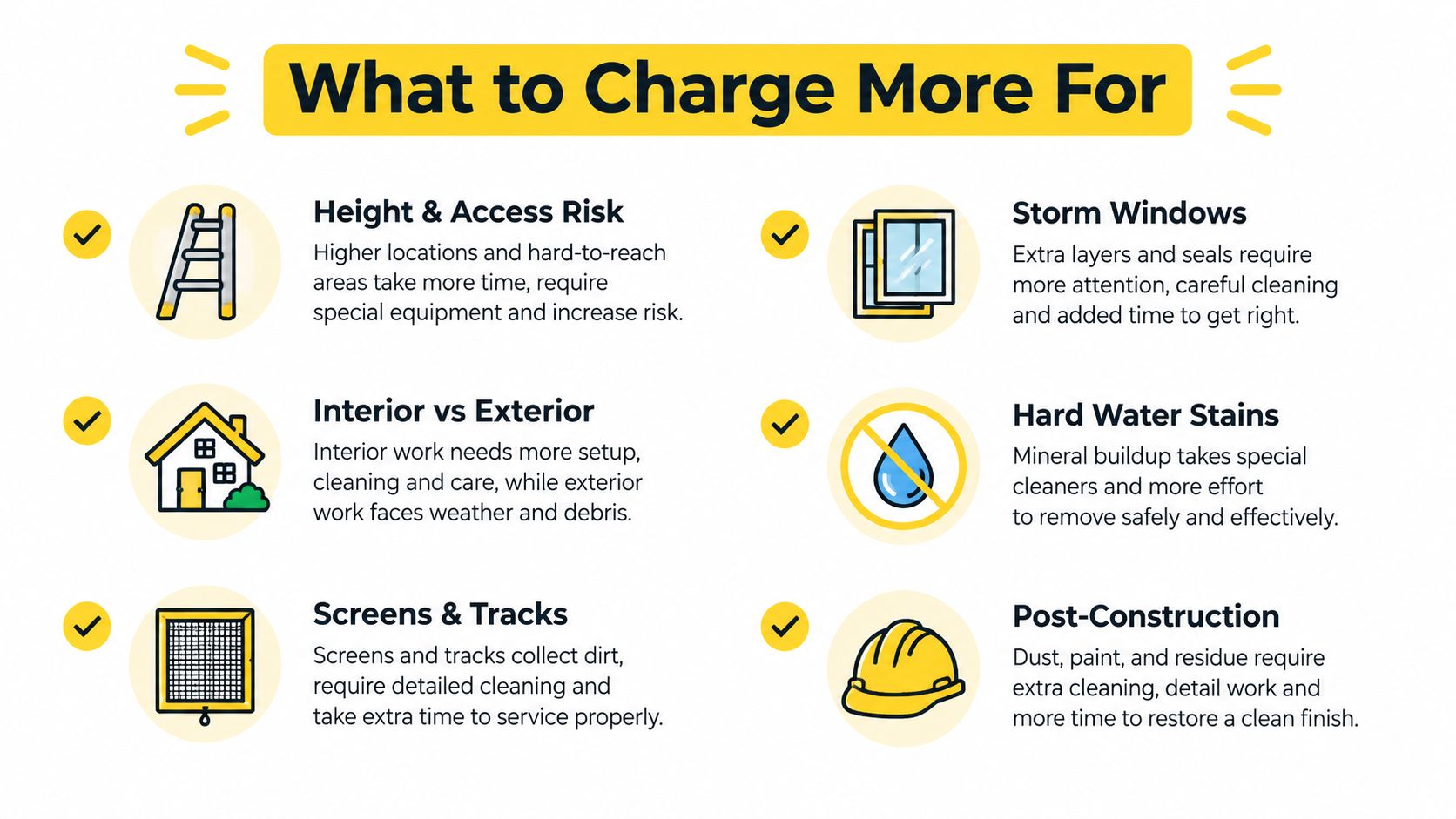
Second-story windows commonly add about $2–$4 per pane. Hard-to-access windows may add $10–$40 per window, according to HomeGuide's window cleaning price guidance. Windows above the second floor can average $10–$40 per window because they require extra equipment and safety measures.
Use a clear line such as “upper-level access” or “difficult-access service.” Customers accept a higher total more readily when the estimate connects the charge to setup, equipment, time, and safety controls. Apply the adjustment per pane when access affects individual panes. Use a flat access fee when the same setup affects the whole property.
Interior and exterior cleaning deserves a higher price than exterior-only service. Moving furniture, protecting floors, removing screens, wiping sills, and checking tracks all add handling time. Charge for that labor instead of giving interior work away.
Screens, tracks, storm windows, hard water stains, and post-construction debris should each have a separate line item. A separate charge keeps the scope visible and prevents specialized work from disappearing inside a vague window-cleaning total. Use the cleaning service price list as a reference when organizing consistent service categories and add-ons.
Before sending an estimate, check:
Photos can speed up quoting, but request the full window and its surrounding access. A close-up of clean-looking glass will not show a roofline, blocked path, or landscaping problem.
Recurring commercial work can support lower per-visit pricing when route density and repeated setup reduce travel and preparation. One-off deep cleans need a separate price because they may require heavier soil removal, extra detailing, and correction before maintenance becomes practical.
Commercial pricing anchors include $40–$100 per weekly storefront visit and $200–$800 per office-building visit, depending on scope, as reported by Grit Work. Use these figures as starting points, not automatic quotes. Height, access systems, glass area, scheduling limits, and frequency determine the final amount.
Send a simple estimate: “Your service includes exterior window cleaning, with upper-level access and screen cleaning listed separately.” Keep the customer-facing quote short, then use your internal per-pane, per-window, hourly, or flat-rate rules to make sure every add-on pays for its time.
Customers want one understandable total. They don't want to audit your internal worksheet. Your job is to keep the estimate easy to approve while keeping the line items detailed enough that you don't accidentally promise screens, tracks, or stain removal for free.
A flat-rate bundle works when the window count and access are predictable. Stay with per-pane, hourly, or project pricing when condition and access can change the labor substantially.
| Job Type | Pricing Anchor | Typical Range | When to Use |
|---|---|---|---|
| Whole-house residential service | Flat visit or per window | $150–$366 | Predictable home scope and access |
| Average residential visit | Flat visit | $150–$302, with an average near $220 | Standard-sized home with defined service |
| Commercial glass | Per square foot | $0.50–$2.50 per square foot | Larger glass areas and recurring work |
| Weekly storefront service | Per visit | $40–$100 per visit | Small, repeatable storefront routes |
| Office-building service | Per visit or contract | $200–$800 per visit | Larger commercial scope with defined frequency |
The residential range and average are supported by Angi's window cleaning cost guide. Use the table to choose a starting structure, then adjust for access, interior work, and add-ons.
A good bundle names the included work:
Avoid promising a discount unless your cost model supports it. Say, “Adding screens and tracks to the same visit keeps the estimate more efficient because the crew is already set up,” rather than claiming savings you can't measure.
Initial estimate
“Thanks for the details. Your estimate for exterior window cleaning is $[total]. It includes [scope], based on [window count], [floor level], and the access shown in your photos. Screens, tracks, storm windows, and stain removal are not included unless listed below. We can schedule [available time].”
Full-service option
“Your full-service estimate is $[total] for interior and exterior glass. The estimate includes [included items]. We can also add screens and tracks for $[add-on total], so the full visit is $[bundled total].”
Uncertain scope
“The property needs an on-site assessment because access and post-construction residue can change the labor. We'll use an hourly service structure with a minimum of $[minimum], review the scope before starting, and explain any additional work before proceeding.”
Objection response
“I understand you're comparing prices. Our estimate includes the stated access conditions and service scope, so you're not receiving a low starting number followed by unexpected add-ons. I can reduce the scope by removing interior glass or selected extras if you want a lower total.”
Send estimates by SMS and email while the inquiry is fresh. Use estimate form templates to standardize the details your team collects, then keep your estimate wording short enough for a customer to read on a phone. If upsells start exceeding your crew's capacity, get.pipehirehrm.com is a relevant resource for hiring support.
A profitable estimate must work at 9 a.m., after hours, and while you are on a ladder. Set the pricing anchor, calculate delivery cost, add access and service adjustments, apply the minimum fee, then send the scope and total in plain language.
Relying on memory creates slow replies and uneven quotes. A missed call gives competitors time to respond, while inconsistent pricing makes customers question why similar homes receive different totals.
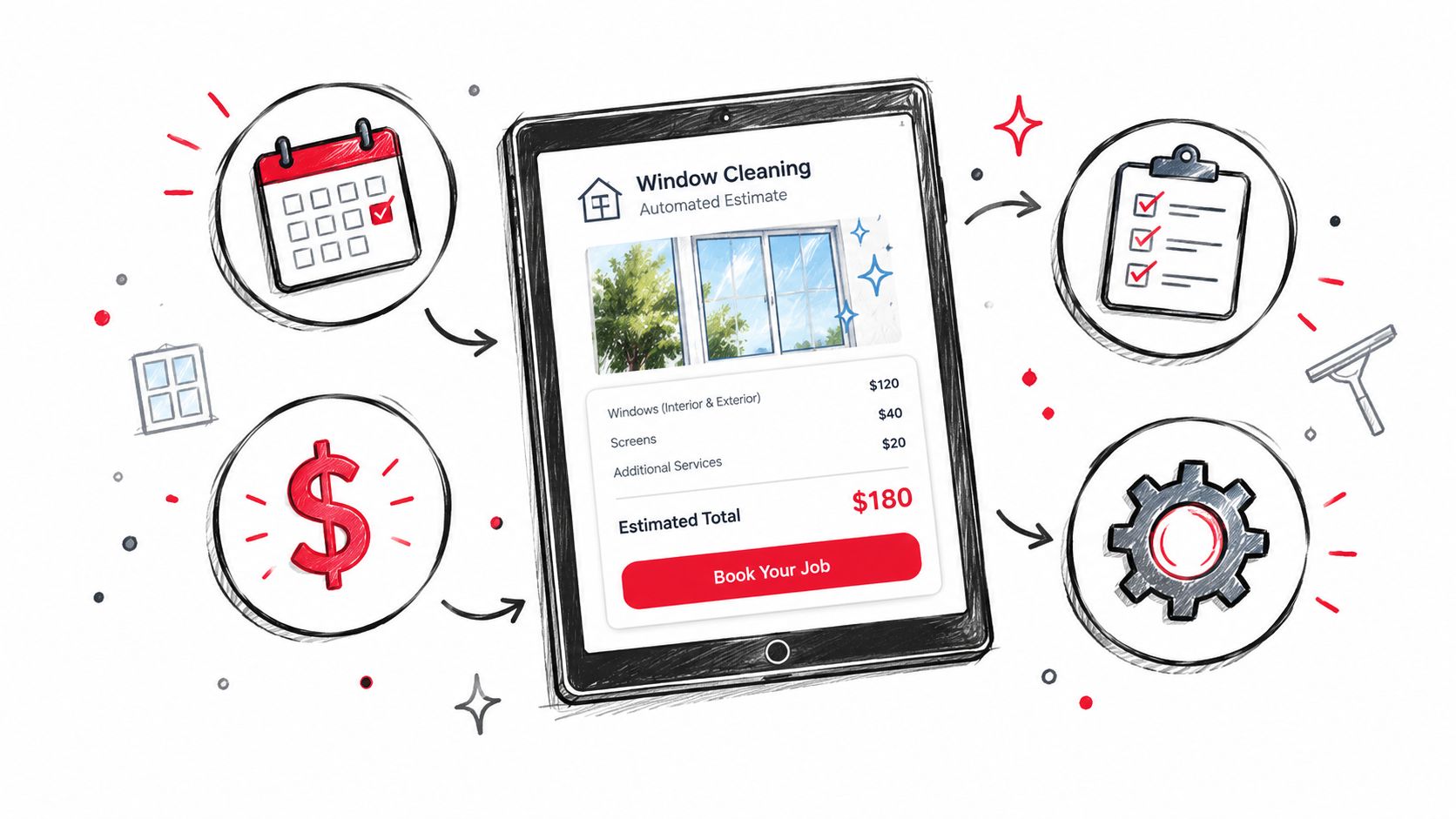
Estimatty offers cleaning businesses an AI-powered web and voice sales estimator. It can collect square footage, surfaces, and urgency, send estimates by SMS or email, notify your team, and connect with a CRM through Zapier. Review AI estimates software for cleaning businesses to see how that workflow fits your operation.
Keep the pricing decisions in your hands. Set the per-pane rate for clearly counted glass, the per-window anchor for standard homes, an hourly structure for uncertain access, a square-foot range for larger properties, the minimum fee, and each add-on rule. The system then applies those rules consistently, regardless of who handles the inquiry.
Audit estimate-to-booking conversion by lead source, service type, and salesperson. Also record which line items customers remove and which add-ons crews complete without billing. Review those results regularly. If conversion is strong but margins are weak, raise the minimum or adjust the affected add-on. If quotes rarely book, simplify the scope or correct the anchor.
Estimatty can turn your window washing rules into web and voice estimates, with customer details, add-ons, and SMS or email delivery in one workflow. Visit Estimatty to customize the pricing setup and add the estimator to your website.