October 24, 2026
Area of Service for Cleaning Businesses: How to Map Yours
Learn how to define and map your area of service for a cleaning business using drive time, travel fees and job minimums that protect profit.

Wednesday, June 10, 2026
Ready to start or scale your home service business? This comprehensive guide covers everything from pricing and marketing to operations and winning more leads.
Home services stopped being a side-hustle category a while ago. One industry roundup says bookings have risen 150% since the pandemic, 278,000 new home service businesses opened in the U.S. in 2023, and average annual household spending reached $13,667 (home services industry statistics). That should change how you think about a home service business.
This isn't small-ball anymore. It's crowded, fast, and operationally unforgiving. If you respond slowly, price inconsistently, or run jobs out of text messages and memory, someone else gets the work.
A lot of owners still treat growth like a hustle problem. It's not. It's a systems problem. The companies that scale build a machine that handles inbound leads, produces consistent estimates, schedules efficiently, staffs reliably, and tracks performance without guesswork.
The first mistake new owners make is underestimating the market. The second is underestimating the competition.
Homeowners are spending more, booking more, and giving more companies a chance to compete for their business. That creates real upside, but it also means your home service business has to operate like a business from day one. If you want proof that there's room to build something substantial, read this breakdown on whether a cleaning business is profitable.
A growing market attracts operators fast. That's exactly what happened. More demand brought in more businesses, which means buyers have options and owners have less margin for operational sloppiness.
You can no longer win just by being willing to work hard. Hard work matters, but systems decide who captures demand consistently.
Practical rule: In a busy market, the company with the cleaner process often beats the company with the better intentions.
That means your lead handling, estimation, staffing, and follow-up matter as much as your technical skill. A homeowner doesn't see your work quality first. They see your response speed, your professionalism, and whether booking feels easy.
If you're solo or running a small crew, this should encourage you. Large companies don't own speed, discipline, or customer experience by default. Small operators can move faster and tighten systems sooner.
Focus on a few things:
The market is big enough to build something durable. It's also active enough to punish owners who stay disorganized.
Your business model decides how stressful growth feels. Your niche decides whether that growth is stable or chaotic.
Too many people pick a service because it's easy to start. That's backward. You should pick a service mix that gives you repeat demand, operational simplicity, and room to upsell. Recent analysis on home service niches points toward services tied to structural shifts like aging housing stock or remote work, and it emphasizes the value of prioritizing repeat-work services over one-off jobs (home service niche trends).
If you're still deciding where to start, this guide on how to start a cleaning business is a useful reference point because cleaning is one of the clearest examples of recurring revenue done right.
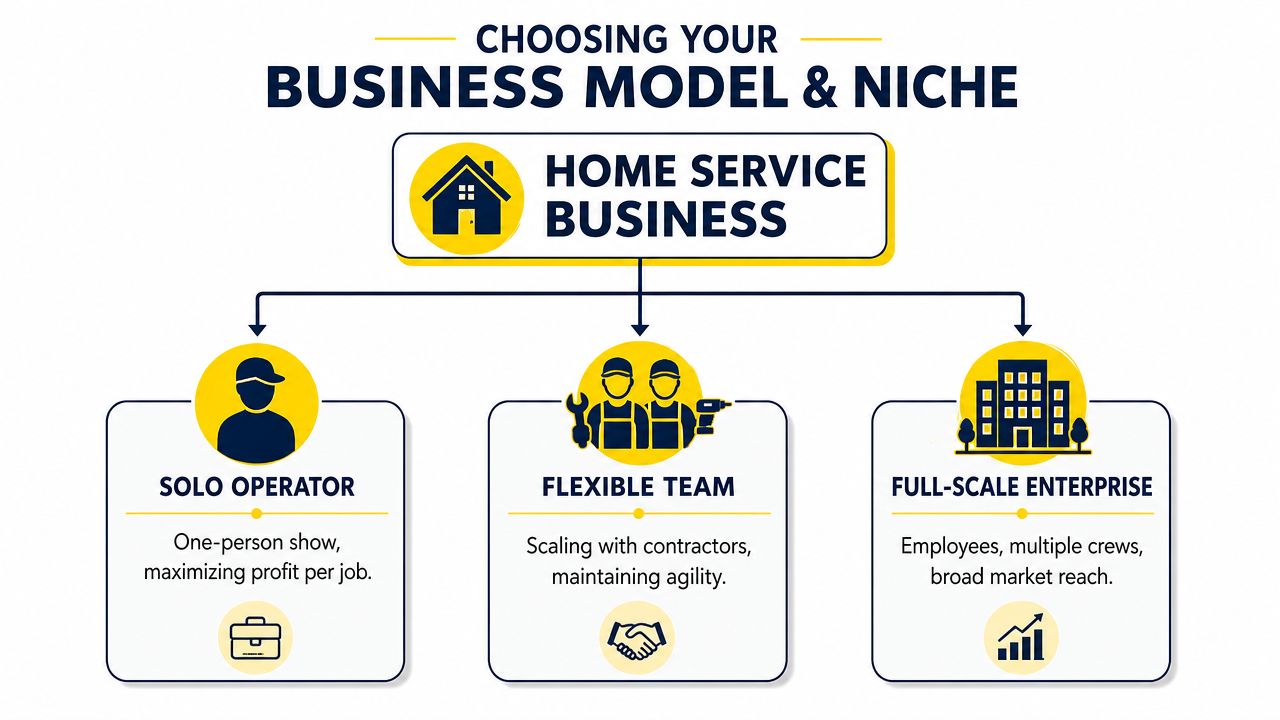
Here's the clean way to think about structure.
| Model | Best for | Main upside | Main risk |
|---|---|---|---|
| Solo operator | Skilled owner who wants control | High control over service and margin per job | Growth stalls when the owner's time fills up |
| Flexible team | Owners who want capacity without full payroll complexity | Agility and easier expansion into more jobs | Inconsistency if subs follow different standards |
| Employee-based company | Owners building a real company, not a self-employed role | Scalable service delivery and brand control | Hiring, training, and management get serious fast |
None of these is morally better. They just produce different businesses.
A solo operator can make strong money and keep life simple. A flexible subcontractor model can expand fast if quality control is tight. An employee-based company is the best path if you want long-term enterprise value, but only if you're ready to build systems instead of improvising every week.
Don't obsess over what's trendy. Obsess over what repeats.
A strong niche usually has these traits:
The best niche isn't the one that sounds exciting. It's the one you can price cleanly, deliver consistently, and sell again next month.
One-off jobs can still be profitable. They just shouldn't be your whole identity unless your margins and lead flow are exceptional. Most owners build a steadier company when they anchor the business on repeat services and use one-time projects as a feeder into ongoing work.
If you want a home service business that scales, avoid building around constant custom work unless you already have strong estimating discipline and operational control. Start with a niche that lets you create a repeatable offer, train people quickly, and forecast your schedule without guessing.
That's how you build a company. Otherwise, you built yourself a demanding job.
Most owners lose jobs before they even know they were in the running. The reason is simple. They answer late, they price slowly, or they send estimates that change depending on who picked up the phone.
That's a bad way to run a home service business. “Gut-feel” pricing creates three problems at once. It confuses the buyer, it erodes your margins, and it makes training impossible.
Guidance for home service operators points to slow speed to lead as a core failure point, especially when businesses struggle to handle first contact and after-hours inquiries (speed to lead in home services). If you don't fix that front-end gap, your marketing spend leaks out through response delays.
Owners usually start by pricing from instinct. That works for a short time because the owner is close to every job. Then volume increases, edge cases pile up, and pricing turns into a patchwork of exceptions.
Use a system instead. The exact system can vary, but the rule should not.
Common pricing structures include:
The point isn't which model sounds smartest. The point is consistency. If two different staff members produce two different estimates for the same work, your system is broken.
Every estimate should come from a defined pricing logic. For a cleaning business, that often means collecting job details like square footage, condition, surfaces, frequency, access, and urgency. For other home service categories, the inputs change, but the discipline stays the same.
A useful estimating playbook includes:
If your team can't explain how a price was produced, customers won't trust it and staff won't repeat it.
That's why “estimates” matter more than vague back-and-forth. An estimate should feel structured, not improvised.
When a prospect lands on your website or calls after hours, they want movement. They don't want a form that disappears into a black hole. They don't want voicemail. They definitely don't want “we'll get back to you tomorrow” if another company can respond now.
Automation demonstrates its worth. Tools that collect job details, produce a consistent estimate, and push that information to your team close the gap without forcing you to hire more office staff just to keep up.
One example is AI estimates software for cleaning businesses, which shows how automated estimating can gather job information, standardize pricing, and keep the conversation moving. Used correctly, that kind of workflow doesn't replace judgment. It removes delay and inconsistency from the first interaction.
A short demo helps if you're thinking through the front-end workflow:
If your estimates are slow or uneven, do these first:
Pricing is not admin work. It's sales, margin control, and operational discipline rolled into one. Treat it that way.
Sales gets attention. Operations decides whether the business keeps its reputation.
A home service business breaks when the handoff from sold job to delivered job is messy. The estimate says one thing, the schedule says another, the tech shows up late, nobody knows the special instructions, and the office spends the afternoon apologizing.
That's why your operating system matters. In a market estimated at $600 billion, businesses use cloud-based field-service CRMs to centralize scheduling, dispatching, customer management, and payments so teams aren't chasing information across multiple tools (field service CRM overview).
If your customer details live in one place, your schedule in another, payments somewhere else, and staff communication inside a group text, you don't have a system. You have a scavenger hunt.
Your core stack should do a few things well:
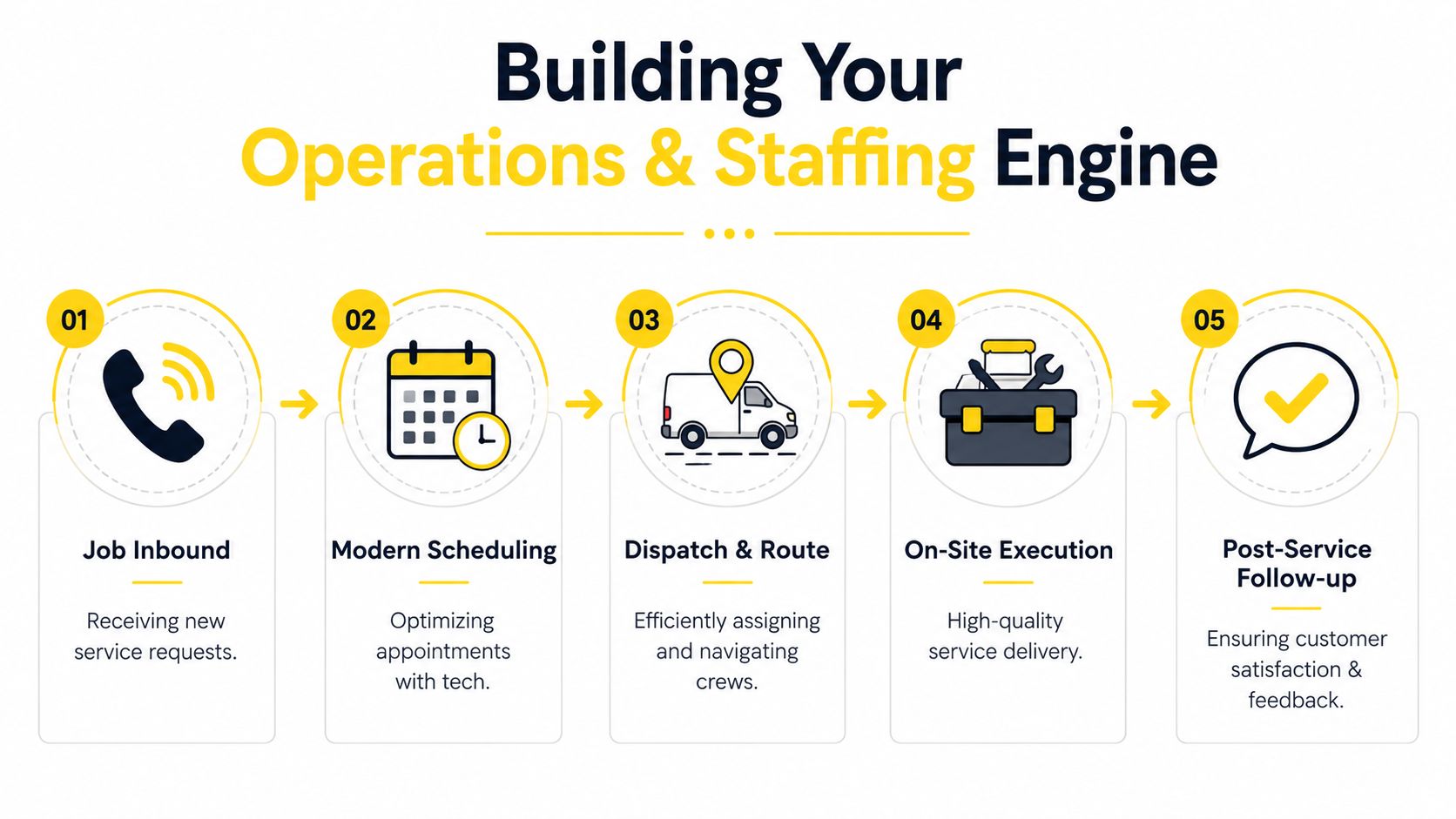
A booked job should trigger a repeatable chain of actions. No improvising.
A simple backend flow looks like this:
Clean operations feel boring on purpose. Boring is profitable.
Owners often chase complicated growth tactics while their dispatch flow is still fragile. Fix the handoff first. Better routing, better notes, and better follow-up reduce mistakes faster than most marketing tactics increase revenue.
A lot of owners say they want to scale. Then they hire casually, train inconsistently, and act surprised when service quality swings.
If you're in cleaning, recruiting should be treated like an operating function, not an emergency. Pipehire HRM is worth knowing because it focuses on cleaning employee hiring workflows, and the applicant tracking system guide gives a practical view of how structured hiring helps you stop losing candidates in the process.
Build your staffing engine around repeatable steps:
You don't want a team full of heroes. You want a team full of repeatable performers.
That means documenting the basics:
| Area | What should be documented |
|---|---|
| Service delivery | Scope, sequence, quality standards, customer communication |
| Vehicle and supply handling | Restocking, equipment care, issue reporting |
| Job exceptions | Lockouts, damage concerns, difficult access, change requests |
| End-of-job process | Photos if needed, notes, payment status, follow-up trigger |
When these rules are written down and reinforced, your business stops depending on memory. That's when growth gets calmer.
Most home service marketing fails for a simple reason. The company buys attention but doesn't convert it.
You can have a sharp website, a polished logo, paid ads, and a decent local presence. None of that matters if a visitor lands on your site and has no easy way to take the next step. Your website can't just explain what you do. It has to capture intent while it's fresh.

Every home service business needs a basic local marketing foundation. Skip the shiny stuff until these are in place.
If you want a local-market perspective on contractor visibility, this digital marketing guide for SWFL contractors is a solid example of how search, reputation, and conversion need to work together.
Most sites behave like brochures. That's a mistake.
A strong site should do at least one of these things immediately:
That's why instant engagement tools matter. Web chat, estimate workflows, and clear call paths help you turn passive traffic into active leads. A visitor who's ready now should never be forced into a dead-end contact form.
Traffic without conversion mechanics is expensive decoration.
The strongest marketing systems also connect with operations. If the lead comes in, the team should know what was requested, what kind of customer it is, and what follow-up should happen next. Otherwise marketing creates work, not revenue.
Some owners spread themselves too thin. They post everywhere, run weak ads, neglect reviews, and wonder why nothing compounds.
Pick a practical channel mix:
| Channel | Job |
|---|---|
| Google Business Profile | Capture local intent and trust |
| Website SEO | Rank for services and locations over time |
| Paid ads | Generate immediate demand when landing pages convert |
| Reviews and referrals | Lower-friction lead generation from social proof |
| Email or text follow-up | Re-activate old prospects and existing customers |
For cleaning companies, a focused paid campaign paired with a fast estimate path usually beats broad, unfocused promotion. This guide to ads for cleaning services is useful if you're dialing in that part of the funnel.
You should spend time reading both marketing and operations content because lead generation only works when fulfillment holds up. That's why blogs like Estimatty's and the content on get.pipehirehrm.com/blog are worth following. They tie lead flow, staffing, and execution together instead of pretending marketing lives in isolation.
Qualified leads are the goal, not just more leads. A smaller number of well-matched prospects with strong follow-up usually beats a pile of vague inquiries your team can't sort quickly.
If you don't know your numbers, you're not managing a company. You're reacting.
Home service KPI guidance emphasizes revenue per technician, customer retention, lifetime value, and labor efficiency, and it stresses that strong owners always know whether they're generating enough opportunities to keep schedules full and whether work is being completed efficiently (home service KPI guide).
You don't need a giant dashboard at first. You need a useful one.
Focus on these:
Those are the core operating metrics. Around them, you should also watch your booking conversion, estimate-to-job conversion, and lead source quality. Keep those in your management view, but don't let vanity metrics crowd out field economics.
Metrics matter because they point to specific problems.
| KPI | If it's weak | What to inspect first |
|---|---|---|
| Revenue per technician | Schedule may be thin or jobs underpriced | Lead flow, pricing rules, dispatch quality |
| Customer retention | Service may feel inconsistent | Quality control, communication, follow-up |
| Lifetime value | You may be overselling one-offs and underselling repeat service | Service mix, upsells, recurring offers |
| Labor efficiency | Teams may be wasting time between or on jobs | Routing, training, job scope accuracy |
A lot of owners stare at revenue and miss the story underneath. Revenue can rise while efficiency falls. That's how busy companies become stressed companies.
If reporting lives in a spreadsheet nobody updates or a software dashboard nobody trusts, it won't guide decisions. Keep your reporting simple enough that you'll review it every week.
A practical resource here is this guide to sales reporting tools, especially if you're trying to tighten how estimates, bookings, and sales outcomes get tracked across your team.
Numbers don't remove judgment. They give judgment something solid to work with.
The point isn't to become obsessed with analytics. It's to stop guessing where the bottleneck lies.
The path is different depending on where you are. A new owner needs traction. An established owner needs control.
Your first objective is not perfection. It's a clean operating foundation.
In your first stretch of building the business, make these moves in order:
If you do those five things well, you'll be ahead of a lot of operators who are still winging it.
Your job changes once the phone rings consistently. You stop trying to do everything yourself and start removing friction from the machine.
Audit these areas hard:
The biggest shift is mental. Stop asking, “How do I work harder?” Start asking, “What part of this business still depends on me unnecessarily?”
That question usually exposes the bottleneck.
A strong home service business isn't built on hustle alone. It's built on repeatable estimates, clean operations, deliberate staffing, and disciplined measurement. Get those right and growth gets simpler, not just bigger.
If you want to tighten the front end of your sales process, Estimatty is built for cleaning businesses that need instant web and voice-based estimates, consistent pricing, and faster lead capture without adding more office staff.