
September 29, 2026
Commercial and Residential Cleaning in 2026
Compare commercial and residential cleaning markets in 2026. Explore pricing, staffing, compliance, and how AI estimators streamline operations.

Saturday, August 8, 2026
Discover how to build a complete home cleaning system for your residential business. Learn core components, automation tips, KPIs, and strategies.

Monday starts ugly in a lot of cleaning businesses. The phone has three missed voicemails, one homeowner wants to know why her neighbor got a lower quote, and a cleaner just called out with no backup on the schedule. That is not a people problem first. It's a home cleaning system problem, because the business is running on scattered habits instead of one connected operating engine.
A real system ties together lead intake, estimating, scheduling, staffing, quality control, and follow-up. If one piece is weak, the whole operation feels it. The market itself is not small or informal, either. In the U.S., maids and housekeeping cleaners numbered about 836,830 workers in May 2023, with a median hourly wage of $15.17 and a median annual wage of $31,550 (BLS occupational data). Consumer demand is also real and recurring, with spending on housekeeping supplies and services reaching $9.2 billion in 2022 and broader household-services spending estimated at $42.6 billion in 2023 (BLS occupational data). If you're trying to grow a residential cleaning company, you're not managing chores, you're managing a high-volume service business.
A lot of owners call their setup a system when it is really just a patchwork. They use a spreadsheet for quotes, a text thread for scheduling, a notes app for customer preferences, and hope the cleaner remembers the rest. That works until it does not. Then the owner spends the morning putting out fires instead of selling, staffing, and tightening the operation.
A true home cleaning system is the full chain from first inquiry to repeat booking. It starts when a lead lands, moves through estimate delivery, turns into a scheduled job, gets completed consistently, and ends with the customer coming back without friction. That chain matters because cleaning is a real service category with steady demand, and the job itself has to be run like a business, not a collection of chores (BLS occupational data).
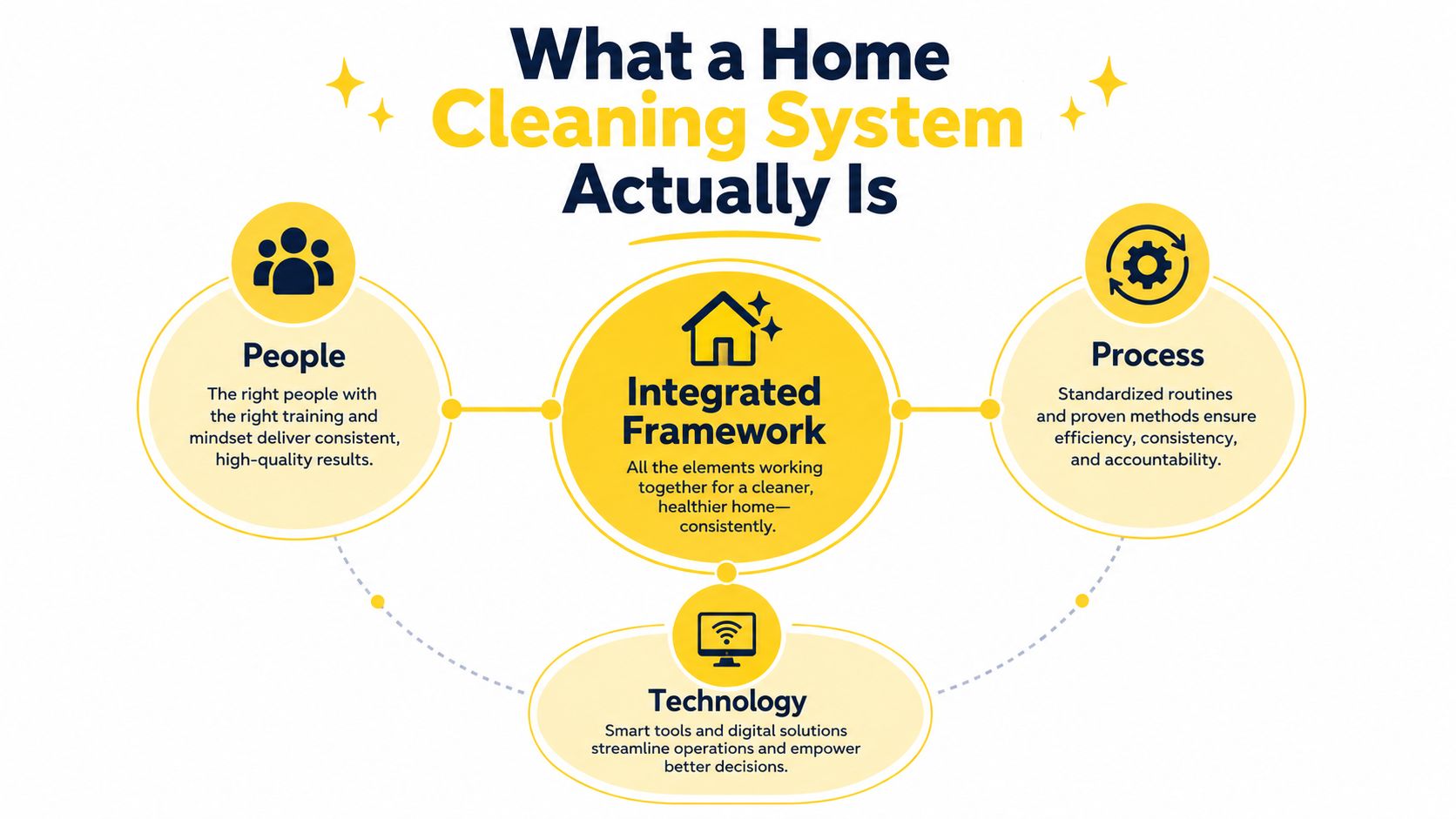
The system has six connected pillars. Customer intake captures the job correctly. Pricing and estimates turn the lead into a clear offer. Scheduling and dispatch place the work on the calendar without overloading the team. Quality control and verification protect reputation. Staffing and training make sure the work can be delivered. Technology integrations keep the operation from depending on one person's memory.
Practical rule: if you cannot explain how a lead becomes revenue in one sentence, you do not have a system yet. You have tools.
The operational logic is simple. Better intake creates a cleaner estimate. A cleaner estimate makes scheduling easier. Easier scheduling helps crews hit expectations and keeps customers from feeling shortchanged. That is why a useful resource like predictable lead machine for contractors only solves part of the problem, because leads do not turn into revenue until the rest of the workflow is built.
For a deeper operating lens, I would also point owners to our guide on home service business structure. A cleaning company scales when each handoff is deliberate, and Estimatty fits into that system as the conversion layer that helps move inquiries into booked jobs.
The strongest cleaning companies do not win by “doing a bit of everything” better. They win by tightening every handoff. If one component breaks, the entire operation stalls. That is why a business can have solid cleaners and still lose money, because the bottleneck usually sits in intake, pricing, scheduling, staffing, quality control, or follow-up.
Customer intake should collect only the information that affects scope and price. Square footage, cleaning type, surfaces, pets, urgency, and special requests are the inputs that stop wasted visits and bad quotes. Pricing then turns that input into a repeatable offer instead of a guess. The moment quoting becomes a gut-feel exercise, inconsistency takes over, and inconsistency kills trust.
This stage is also where the conversion layer matters. An AI estimator like Estimatty helps turn a messy inquiry into a quote the customer can understand, which is a big reason cleaner intake processes close more jobs.
Scheduling is capacity planning, plain and simple. If jobs are booked without realistic time blocks or skill matching, the schedule turns into callbacks, late arrivals, and exhausted crews. Quality control is the piece many owners ignore until a bad review lands, even though the industry keeps seeing the same miss points, baseboards, vents, blinds, and behind appliances. The customer notices those details faster than the team remembers them.
Staffing and training are where most systems either hold together or fall apart. The team needs a standard onboarding path, a checklist, and a clear definition of what “done” means. I would keep the policies and procedures manuals reference close, because consistency starts before the first visit and gets enforced long before a crew steps into a house.
A cleaning company feels high touch when owners personally touch every job, not because it relies on labor volume.
Technology should connect the system, not clutter it. One app for leads, another for schedules, another for invoices, and another for follow-up usually means the owner is still doing the integration manually. That is wasted time. A better setup moves information once, then lets the workflow carry it forward.
The cleaner the handoff, the less the business depends on memory. That is the point.
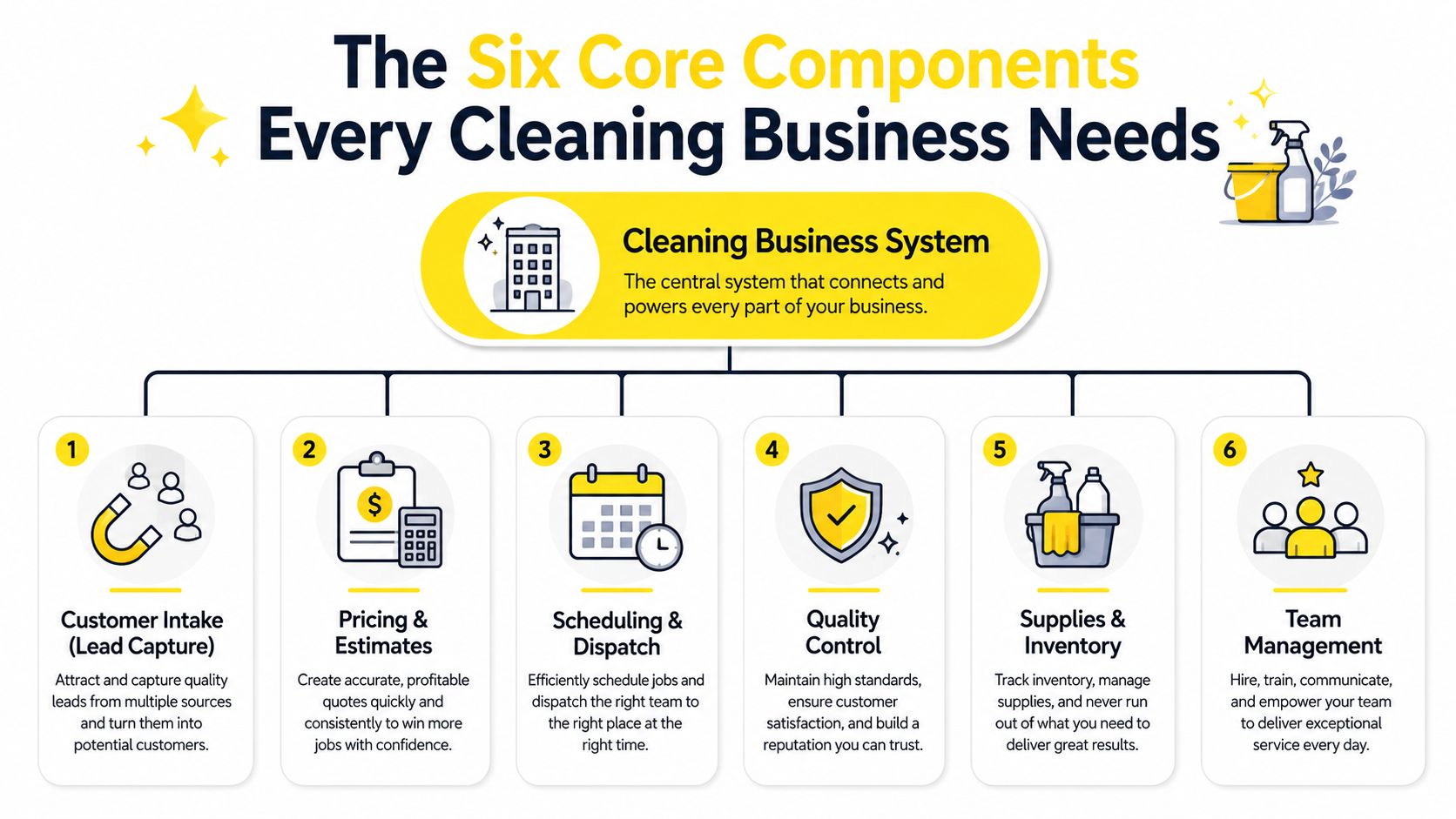
The six components only work when they are treated as one operating framework. Intake feeds pricing, pricing shapes scheduling, scheduling affects quality control, staffing determines delivery, and technology keeps the whole thing visible. If you skip any one of them, the rest have to compensate, and that is when growth gets expensive.
Start with the part that causes the most damage, not the part that looks newest. Owners usually rush into automation before the workflow is stable, then blame the software when the mess gets faster. Clean up the process first, then connect the tools. That order drives real improvement.
Standardize your pricing matrix before you touch anything else. If two prospects describe the same house and receive different quotes, you train the market to question your company. Build a single intake form, a single estimate template, and a single service-agreement format. Templates keep the customer experience consistent from the first interaction.
Set up one simple CRM pipeline that tracks inquiry, estimate sent, booked, completed, and follow-up. Do not overbuild it. The goal is visibility, not complexity. Owners who want a reference point for service-business structure can use a service-business scaling framework to build repeatable stages instead of random tasks.
Once the process is stable, connect the repetitive handoffs. Link your intake form, estimator, calendar, and follow-up messages. If your team uses Zapier, use it to move data between the tools you already trust. Growth also creates a staffing problem fast, so hiring needs structure at the same time. The cleaning employee hiring workflows resource is useful when the schedule outgrows informal recruiting.
Build a quality inspection checklist at the same time. A checklist serves as insurance against missed spots, not bureaucracy. Skip this step and you will automate complaints faster.
Measure what happens every week, then adjust. Look at estimate speed, booking rate, callback frequency, and team load. If one step consistently lags, fix that step before adding another layer of automation. Too many owners stack tools on top of ambiguity and wonder why nothing gets easier.
Rule of thumb: automate the path only after you've proven the path.
Keep the workflow simple enough that your team can follow it without constant owner intervention. That is what turns a home cleaning system into an operating engine instead of a pile of disconnected apps. Quoting, scheduling, quality control, and staffing should all feed the same machine, with the estimate stage doing its job before the job is ever booked.
Fast quoting is where a lot of cleaning revenue leaks out. A homeowner who has to wait for a callback starts shopping around, and the company that responds cleanly usually wins the job. That's why the estimate stage deserves more attention than almost any other part of the system. In cleaning, speed and consistency beat improvisation.
An AI estimator makes the first response immediate, which matters because the prospect is still engaged at that moment. It can ask for square footage, surfaces, urgency, service type, and add-ons, then return a standardized estimate by text or email without making the lead sit in voicemail limbo. That's exactly the kind of conversion layer most competitors ignore. I've seen owners overinvest in marketing and underinvest in the actual handoff that turns attention into booked work.
For a practical example of how this works in the category, look at AI estimates software for cleaning. Estimatty is one option in this space, and it's built to engage prospects by web and voice, capture job details, and send estimates through SMS and email. It also fits the no-code reality most small operators live in, where setup speed matters more than technical elegance.
Gut-feel pricing creates two problems at once. You undercharge on some jobs and lose others because the quote feels arbitrary. A standardized estimator reduces that inconsistency and makes the offer easier for the customer to understand. It also reduces the internal debate that happens when the owner, office manager, and lead cleaner all price the same home differently.
The best use of AI here is not to replace judgment. It's to remove delay and narrow the range of human error. If a lead needs a human touch, U.S.-based receptionists can still step in and close the loop. That blend of automation and human coverage is what makes the system feel responsive without becoming cold.
Most cleaning owners track activity instead of outcomes. They know how many calls came in, but not how many turned into booked jobs. They know the schedule was full, but not whether the team was profitable. If you want a real operating view, you need a small set of metrics that tell you where the system is leaking.
| KPI | What It Measures | Target Range |
|---|---|---|
| Lead-to-estimate conversion rate | How many inquiries become estimates | Track weekly, improve steadily |
| Estimate-to-booking rate | How often quotes turn into jobs | Track weekly, improve steadily |
| Average job value | The typical revenue per completed job | Track by service type |
| Customer acquisition cost | What you spend to win a new client | Keep visible and controlled |
| Rebooking rate | How often customers come back | Track by cohort and service type |
| Callback and complaint rate | Quality and consistency problems | Keep as low as possible |
| Labor cost as a percentage of revenue | Whether staffing is eating margin | Review weekly or monthly |
A dashboard does not need to be fancy. A spreadsheet is enough if it's updated every week and reviewed. If you use software that pushes real-time notifications, that helps, but the point is decision-making, not decoration. For accounting alignment, the internal guide on cleaning business accounting is the right place to tighten the financial side of these numbers.
A weak lead-to-estimate rate usually means intake is slow or incomplete. A weak estimate-to-booking rate usually means pricing, presentation, or response speed is off. A rising callback rate points straight at quality control. And if labor cost as a percentage of revenue keeps creeping up, the schedule is too loose or the jobs are being underpriced.
If the metric doesn't change your next decision, you're tracking vanity.
Keep the dashboard boring and visible. One owner, one review cadence, one set of actions. That discipline is what turns metrics into management.
The biggest mistake is blaming software for a broken operation. Owners buy tools, then keep quoting by hand, dispatching loosely, and training through scattered instructions. The process was never there, so the tool couldn't fail, it had nothing to automate.
Manual quoting is still the fastest way to slow growth. It drags response times, produces uneven pricing, and makes the company dependent on whoever answered the phone that day. Scheduling gets treated like calendar filling instead of capacity planning, so crews run late, routes stretch out, and the day turns into recovery work. Quality verification gets skipped because it feels slower than trusting the cleaner. That trade always costs more later.
Hiring breaks the system just as fast. Without a standardized onboarding path, every cleaner learns a different version of the job, and every manager corrects mistakes a different way. The hiring resource cited earlier can help structure that workflow, because staffing needs process just as much as field operations do. The fix is not vague talk about better people. It is a repeatable hiring path, a clear training sequence, and a standard for when someone is ready to work alone.
Stacking tech without integration is the last mistake, and it is a costly one. A CRM, an estimator, and an invoice app do not become a system just because they are all installed. They become three separate places where jobs stall, data gets copied twice, and details disappear between handoffs. Pick one workflow, connect it end to end, then move to the next.
A fully integrated cleaning operation gets built in layers. Start with faster response time, because slow estimates cost bookings. Standardize pricing next, then tighten scheduling so capacity matches the day, and make quality checks part of every visit. After that, connect staffing so growth does not turn into constant correction.
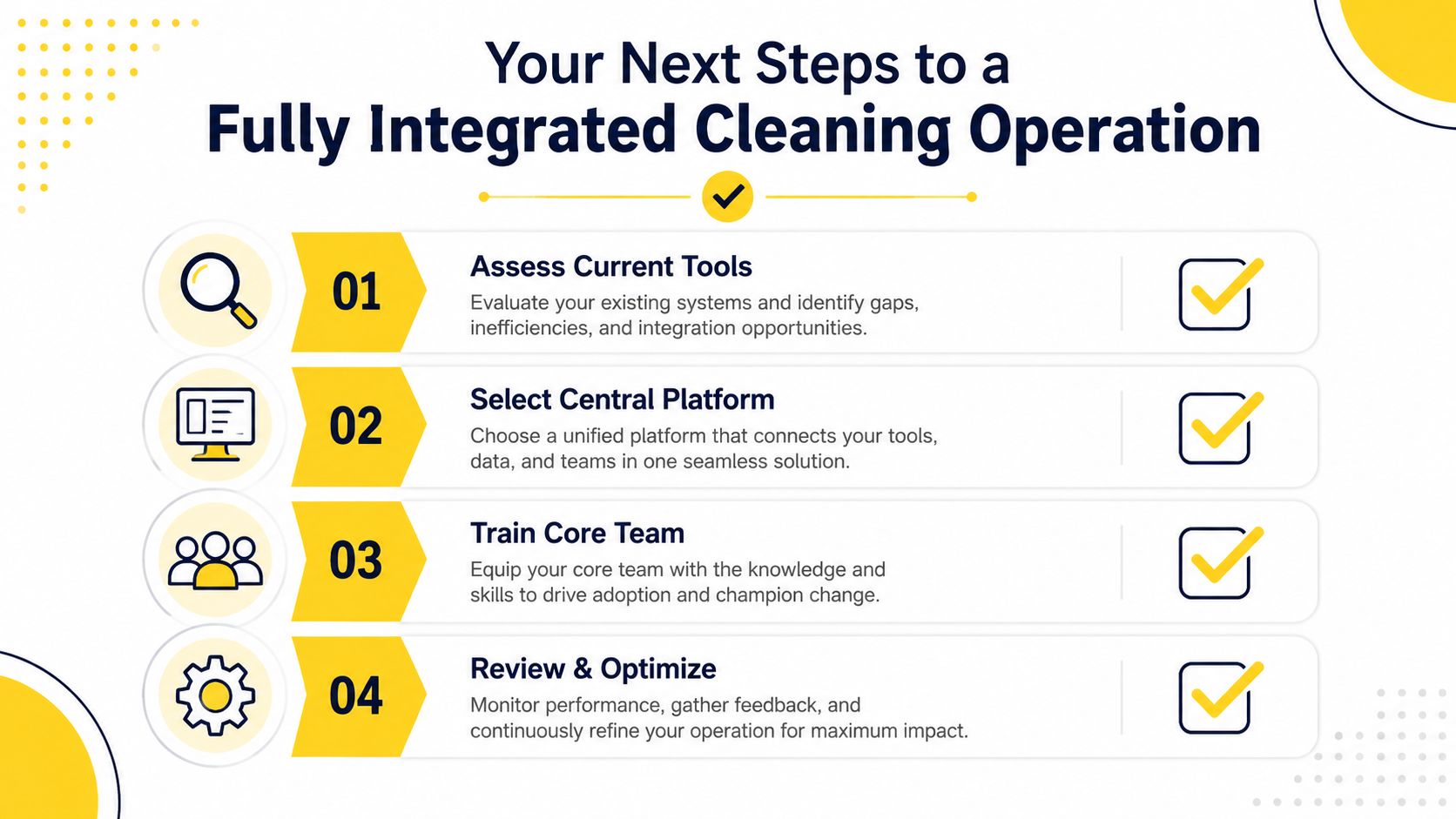
The work I'd start this week is straightforward. Track how long estimates take to leave your office, then tighten the pricing matrix so quotes are consistent across jobs. Set up at least three KPIs that your team can review, and write a verification checklist that gets used every visit. Then test an AI estimating workflow so the first response does not depend on office hours or manual follow-up.
Keep improving the system with the resources you already have. Use the operating ideas in Estimatty's blog for automation and process direction, and check pipehirehrm.com's blog when hiring starts to slow your expansion. The effect builds fast. Once one handoff works cleanly, the next one gets easier to control.
If you want your cleaning company to respond faster, quote more consistently, and stop losing jobs to slower competitors, take a hard look at Estimatty. It gives residential cleaning businesses an AI estimating layer that fits this exact operational problem, and you can see how it works at Estimatty.