September 8, 2026
How Much Should a House Cleaning Cost in 2026
How Much Should a House Cleaning Cost. Learn how much a house cleaning should cost in 2026, with real pricing ranges by home size, service type, and tips

Sunday, July 26, 2026
Find the best AI estimating software for your cleaning business. We review the top 10 tools' features, pricing, and use cases to help you automate estimates.

It's 10 PM, a new cleaning lead just landed on your site, and they want a price before they sleep on it. If your process depends on voicemail, a morning callback, or a handwritten estimate that gets typed up later, you've already lost ground to the company that answered first. The best AI estimating software for cleaning businesses does more than calculate a number, it keeps the conversation alive, captures job details fast, and turns late-night interest into a booked job.
That matters because cleaning buyers don't want a research project. They want a clear price, quick confirmation, and a simple next step. The tools below are the ones worth paying attention to if you want estimates that feel immediate, consistent, and tied to revenue instead of admin work.
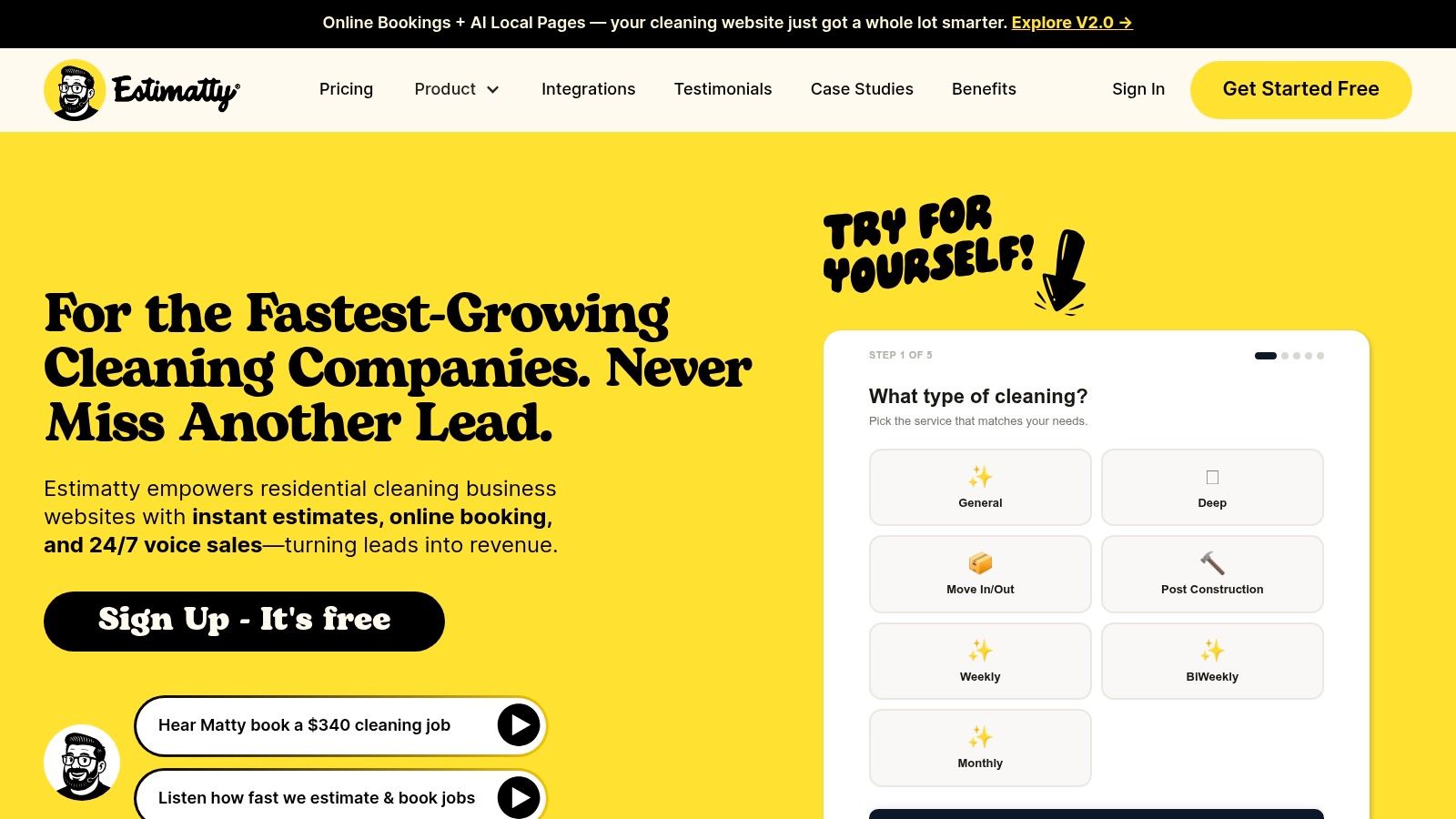
A cleaning lead calls after hours, texts from the driveway, or fills out a form while comparing vendors. Estimatty is built for those moments. It gives cleaning owners web and voice coverage instead of a static calculator, so the first response can go out before the lead moves on to someone else. The goal is straightforward, capture the job details, send an instant estimate by SMS or email, and keep the lead in motion.
Its real value comes from cleaning-specific logic. Estimatty is designed for recurring cleans, one-time cleans, move-ins, move-outs, and common add-ons like deep cleaning, windows, laundry, and inside appliances. That matters because cleaning pricing falls apart fast when the software cannot handle the actual mix of services. A tool that understands the service menu also helps reduce underquoting, which is one of the easiest ways to lose margin while still staying busy.
Estimatty treats the estimate as part of the sales process, not just an admin step. The no-code setup, drop-in widget, voice choice, FAQs, Zapier and CRM connections, and real-time notifications make it practical for small teams that do not want a long implementation project. The hybrid approach is useful too, because AI can handle the first response and U.S.-based receptionists can step in when a human handoff makes more sense.
Practical rule: If a cleaning lead can call you, text you, or submit a form after hours, your estimating tool should handle all three without making the customer wait.
The main trade-off is customization. If your pricing rules are highly local or unusually complex, you will need time to tune the setup so the automation matches your margins. Still, for cleaning companies that want a real AI sales assistant rather than a calculator, Estimatty is the most purpose-built option in this list. Visit Estimatty if you want a system that answers leads, builds estimates, and helps you book work while you are off the clock.
Pros
Cons
Website, https://www.estimatty.com

ResponsiBid fits cleaning companies that want estimates to do more than collect interest. It lives on your site, gives prospects a price range or package structure, and moves them toward a booking decision without forcing your team to chase every inquiry by hand. For service businesses that sell from a clear menu, that can mean fewer weak leads and more conversations with people who already understand the offer.
The tool is strongest when your pricing rules are already defined. Square footage, rooms, bathrooms, add-ons, and bundles can all be built into the flow, so a homeowner can get an estimate without waiting for a callback. That matters for cleaners who want the website to do some of the first-round selling.
The trade-off is that ResponsiBid is not a full CRM. Most owners still connect it to a scheduler or field-service platform, so it works best as a conversion layer rather than the center of the business. It also takes setup work to match your actual pricing logic, which means you need someone who knows the margins and can keep the rules honest.
If your pricing is clean, the software can sell cleanly too. If your pricing is inconsistent, the estimate flow will surface those gaps fast.
For cleaning companies that want straightforward estimating, follow-up sequences, and upsell paths without a heavy learning curve, ResponsiBid deserves a serious look. It will not run your whole back office, but it can make the front end of your sales process feel more organized and faster. It also pairs well with automating outbound calls with AI when you want to follow up on estimates that need a human push.
If you are already using an Estimatty integration for ResponsiBid in a broader workflow, the same idea applies. The estimate tool should help qualified leads move forward, not add another place for your team to babysit quotes.
Pros
Cons
Website, https://responsibid.com
Launch27 works best for cleaning companies that want the estimate to turn into a booking without a lot of manual follow-up. Customers can see live pricing, choose add-ons, set service frequency, and pay online in one flow. For residential maid services with standard packages, that usually means fewer back-and-forth messages and a shorter path from quote to confirmed job.
The strength is how it shapes the buying experience. Launch27 gives you an embeddable form, multi-location support, and pricing by zip code or region, so the offer can feel local and immediate instead of generic. It also connects with tools such as Google Calendar, Zapier, QuickBooks, and Twilio, which helps keep scheduling and communication in step with the rest of the operation.
Launch27 is a good match when your services are already packaged in a clear way. If you sell recurring house cleaning, standard deep cleans, or defined bundles, the platform can help you move faster and present a cleaner front end to the customer. It becomes harder to rely on when the job turns into a custom commercial scope or a negotiated janitorial bid.
That trade-off matters. Standardized offers tend to work well here because the pricing rules stay consistent and the booking flow can do more of the selling. More custom pricing needs more oversight, since inaccurate rules can create bad quotes or margin problems. For teams already using Estimatty, the Launch27 integration details are worth reviewing if you want the lead handoff to stay cleaner inside a broader workflow.
For teams looking to expand beyond estimating, consider automating outbound calls with AI to generate more leads.
Pros
Cons
Website, https://www.launch27.com

BookingKoala works well for cleaning companies that need a flexible booking system more than a strict estimating engine. It can handle bedroom and bathroom pricing, packages, hourly rates, add-ons, and scheduling in one flow, so a customer can move from quote to booking without bouncing between tools. For smaller operators that want to turn website traffic into scheduled work with less back-and-forth, that setup can save real time.
The broader appeal is that it covers more of the front office. It can host your site or live inside your current one, and it includes client and provider portals, GPS clock-in, and automated reminders. That makes it feel closer to an operational hub than a narrow quote tool. If you want one place to manage intake, scheduling, and basic client communication, BookingKoala gives you that option without forcing you to stitch together multiple systems.
That flexibility is also the trade-off. More pricing paths mean more setup decisions, and more setup decisions mean more chances to misconfigure the flow if your service menu keeps changing. Residential cleaning owners usually get the most value here because room counts, property types, and add-ons fit naturally into the platform's structure.
Commercial work is a different story. Custom janitorial estimates, walkthrough-based pricing, and account-specific scopes still need human review, so BookingKoala should support the process rather than replace it. For teams comparing a broader booking system with a dedicated AI sales assistant, the BookingKoala integration comparison with Estimatty helps clarify where each tool fits.
Pros
Cons
Website, https://www.bookingkoala.com

MaidCentral fits established cleaning brands that need estimates tied to real-time capacity. That distinction matters if you are already balancing multiple crews, several locations, or a packed calendar. A tool that only produces a number can create more work later. Capacity-aware estimating helps you avoid selling jobs your team cannot absorb.
The platform handles estimating through customizable iFrames, so you can shape forms around different service scopes and landing pages. It also connects estimates to real-time availability, which gives owners a practical guardrail as lead volume grows. You are not only quoting a price, you are offering a time slot your operation can support.
MaidCentral makes sense when scheduling discipline matters as much as closing the lead. Its reporting and price adjustment tools give managers a clearer view of what is happening across the business, not just inside one estimate request. That matters once a lightweight booking tool stops keeping up with the way a growing maid service works.
There is a real trade-off here. MaidCentral has no public pricing, so you will need a demo before you can judge fit and cost. Smaller operators may find it heavier than they need, especially if their process is still simple. A solo cleaner may see too much system and too much setup. A larger maid service is more likely to appreciate the control.
For cleaning companies comparing fit across systems, the MaidCentral integration details on Estimatty can help frame where it sits in a broader workflow.
Pros
Cons
Website, https://maidcentral.com

ZenMaid fits cleaning companies that want booking and estimate forms without a heavy setup. The platform is built for maid services, so the wording, workflow, and scheduling logic feel closer to how these businesses operate than a generic CRM. That matters when the owner is also the operator, because software that needs constant supervision slows the whole day down.
The estimating flow is rules-based rather than advanced AI, and that can work well if your services are standardized. Online forms can handle add-ons, frequency options, reminders, and notifications, which gives prospects enough structure to move ahead while keeping admin work under control. Its month-to-month setup also suits smaller businesses that want flexibility instead of getting locked into a long commitment.
ZenMaid stands out because it stays focused. For small to mid-size teams, that can be the better trade-off. If the goal is to quote quickly, book jobs, and keep the team organized, a clean setup often beats a flashy platform that takes weeks to learn.
The limit is depth. ZenMaid does not aim to deliver advanced AI takeoff features, and it has fewer enterprise-style controls than MaidCentral. That makes it a better fit for businesses that want practical workflow support rather than a full operations system.
If you are comparing how much automation you can add without rebuilding your process, the ZenMaid integration details on Estimatty give a useful reference point.
For service businesses that want to understand how ZenMaid fits into a broader quoting stack, the ZenMaid site shows the core workflow, while the ZenMaid interface gives a quick look at how the forms and scheduling pieces are presented.
Pros
Cons
Website, https://www.zenmaid.com

A cleaning company can outgrow simple quote forms fast. One day you only need a quick estimate, and the next you need that estimate to turn into booked work, scheduled jobs, invoices, and follow-up without extra admin. Jobber is built for that kind of handoff, which is why it shows up so often in service businesses that want one system to cover the full customer path.
The newer AI features, including AI Voice, AI Chat, and AI-assisted messaging, add another layer of automation on top of an already mature field-service platform. That matters if your team spends too much time on back-and-forth messages or missed calls, because the tool can help shorten the gap between inquiry and estimate without asking you to rebuild your whole process.
The strength is in the workflow after the quote. Estimates can include add-ons and approvals, then accepted work can move into jobs and invoices without much manual cleanup. That is the part many owners overlook. A polished estimate page is useful, but a platform earns its keep when the sold job turns into scheduled work and cash collected.
Jobber is not cleaning-specific, so you will still need to shape it around your service menu and pricing rules. That extra setup is the trade-off. If you want a system that can handle customer management, booking, and billing after the estimate is sent, it gives you a steadier operating base than a tool built only for quote capture.
For owners comparing where Jobber fits beside other cleaning software, the Housecall Pro vs Jobber vs ZenMaid comparison is a useful way to look at the differences in workflow, not just the feature list.
Jobber also gives you a practical middle ground on automation. The AI features can save time and make communication easier, but they are not the same thing as a specialized estimating engine that does the heavy selling for you. That is why I would call it a strong fit for cleaning businesses that want broad CRM coverage and active product development, while still keeping the estimating process anchored in a familiar service platform.
If you are comparing front-end lead capture with back-office control, the Estimatty and Jobber integration page shows how the connection is positioned.
Pros
Cons
Website, https://www.getjobber.com
Housecall Pro is a familiar name in field service software, and it gives cleaning companies a structured way to send estimates, offer multi-option proposals, and turn interest into scheduled work. If your business wants a recognizable platform with a broad feature set, it is easy to see why it keeps coming up in conversations. It also matters for owners comparing cleaning software against other home-service tools and trying to separate a flexible operations platform from a tool that only handles quote generation.
Value shows up after the estimate goes out. Estimates, online booking, payments, marketing widgets, reminders, and follow-ups can sit in one system, which cuts down the number of places a lead can slip away. For a small team, that operational control can matter more than a specialized feature set you may not use every day.
Housecall Pro is built for service businesses first, so the setup needs to match your cleaning workflow if you want the estimate process to feel natural. You will need to shape it around your pricing rules, service bundles, and follow-up sequence. A generic tool only works well when the structure behind it is deliberate.
That trade-off is the reason many owners keep it on the shortlist. If you want a system with broad coverage and a clear path from estimate to booked job, it is a credible option. For a direct comparison of how it stacks up against cleaner-focused platforms, the Housecall Pro vs. Jobber vs. ZenMaid guide is useful because it looks at workflow differences, not just feature labels.
Pros
Cons
Website, https://www.housecallpro.com
A cleaning company usually feels the pressure before the software does. Leads come in, the phone rings, and the estimate has to turn into a booked job before the customer moves on. Workiz is built for that kind of pace. It supports instant estimates, online booking, and automations, and its Reserve with Google connection gives it extra reach for prospects who want to book without jumping through extra steps. For local service businesses competing in crowded markets, that can matter more than a flashy feature list.
The estimate flow is designed to keep the job moving. Mobile estimates, online approvals, deposit support, and follow-up automations help shorten the gap between inquiry and commitment. If your current process still depends on manual reminders or a lot of back-and-forth messages, Workiz can bring more order to the handoff from first contact to booked work.
Workiz serves cleaning, junk removal, locksmithing, and similar service categories, and that breadth cuts both ways. It gives you a proven field-service platform, but it is not tuned specifically to the wording, pricing rules, or job structure that cleaning companies use every day. That means the setup takes more care than it would with a niche tool built only for cleaners.
For owners who want stronger lead handling and more Google-connected booking reach, Workiz still deserves a close look. The trade-off is cost visibility. Pricing is not always easy to evaluate publicly, and advanced automations can raise the total as you add more capability. I would treat it as a serious option if you want speed and reach first, then check whether the workflow fits your cleaning estimates before you commit.
Pros
Cons
Website, https://www.workiz.com
ServiceM8 suits small cleaning teams that want estimates, invoicing, and booking in one system without a heavy setup. It works well if you want customers to see pricing, accept the estimate, and move straight into scheduled work with little admin in between. For owner-operators and smaller crews, that kind of simplicity can save real time.
The platform includes online booking forms that show pricing and accept deposits, PDF estimates with e-signature, and follow-up automation. It also includes a Services add-on for packaged fixed-price offerings, which helps if you sell standard cleaning bundles instead of jobs that change from site to site. The mobile apps are strong enough to keep field teams connected after the job is booked.
ServiceM8 is not built just for cleaning, so the setup still needs to be shaped around your business. The trade-off is that the configuration burden is usually lighter than with larger enterprise systems, and the bundled plans are easier for smaller operators to work with. If your business model is straightforward and your goal is to move leads into scheduled work quickly, that practicality matters.
The limit shows up in more complex work. Packaged pricing works well until you start handling larger commercial scopes or unusual service requests, and then the system can feel more structured than flexible. ServiceM8 is a good fit if you want a clean process and can keep your offerings fairly standardized.
Pros
Cons
Website, https://www.servicem8.com/us
| Product | Core offering | Best for | Unique selling point | Pricing & setup |
|---|---|---|---|---|
| Estimatty (Recommended) | AI web + voice estimator and booking (instant estimates <1 min, SMS/email) | Residential & commercial cleaning businesses wanting 24/7 lead capture | Hybrid AI + U.S. receptionists, bilingual voice, no-code widget, industry-specific logic, proven conversion lift | Ultra-low hourly cost (site cites <$0.54/hr), free trial/no‑card, demo for detailed plans |
| ResponsiBid | Instant estimating widget with rule-based pricing, upsells & follow-ups | Cleaning, window, pressure washing, similar service niches | Robust rule-based pricing, bundles and CRM integrations | Paid plans; requires upfront configuration to match pricing rules |
| Launch27 | Live-pricing booking, add-ons and online payments | Maid/cleaning services that need a purpose-built booking flow | Transparent live pricing, multi-location & zip-based pricing | Paid tiers; setup to maintain pricing tables |
| BookingKoala | All-in-one booking, variable pricing, client/provider portals | Solo operators to multi-location cleaning teams wanting customization | Low entry price, can host site or embed widget | Low-entry cost; deeper features have a learning curve |
| MaidCentral | Enterprise estimating tied to real-time capacity and ops reporting | Established residential brands and multi-tech teams | Capacity-aware estimating to avoid overbooking; deep reporting | No public pricing; demo required |
| ZenMaid | Scheduling & CRM with embeddable booking/estimate forms | Small to mid-size maid services seeking simple workflows | Cleaning-focused language and month-to-month access | Calculator-based pricing by employee count; straightforward setup |
| Jobber (with Jobber AI) | Field-service CRM with estimates, booking and AI voice/chat | Trades and service pros needing end-to-end CRM | Mature platform + AI features and integrations (catalog ties) | Tiered pricing; costs increase with users/features |
| Housecall Pro | Estimates, multi-option proposals, online booking & payments | Small teams wanting a general-purpose FSM | Robust estimate flow and accessible entry pricing | Entry-level plans available; requires config for cleaning pricing |
| Workiz | Instant estimates, online booking, Reserve with Google and automations | Cleaning, junk removal, and on-demand services | Strong Google booking reach and practical estimate workflows | Pricing less transparent; add-ons can raise costs |
| ServiceM8 | Lightweight job management with online estimates, payments & mobile apps | Small cleaning teams wanting mobile-first, simple flow | Simple estimate-to-job acceptance and strong mobile apps | Bundled plans for small operators; setup required |
Choosing the best AI estimating software comes down to matching the tool to your real business, not the brochure version of your business. A solo cleaner needs something that captures leads while they're on the job. A multi-team operation needs stronger scheduling, capacity control, and enough structure to keep estimates aligned with actual availability.
That's why the best choice for one company can be the wrong choice for another. If you sell standard residential cleaning packages, a tool like Launch27, BookingKoala, or ZenMaid may be enough to move prospects from interest to booked work quickly. If you need a true sales assistant that handles web and phone leads around the clock, Estimatty is the one that's built for that job. If your operation already runs on a broader field-service platform, Jobber, Housecall Pro, Workiz, or ServiceM8 may fit better because the estimate has to plug into the rest of the workflow.
Treating software like a magic shortcut is a mistake. The tool only works if your pricing rules are clean, your service menu is clear, and your team knows how to handle the new faster sales process. That's also where hybrid AI plus human support becomes valuable, because the software can move fast on routine work while a person can step in when a lead is complicated, urgent, or high value.
The goal isn't to automate every decision. The goal is to stop losing good leads while your team is busy doing the work.
For cleaning companies, the biggest win usually comes from consistency. The right system standardizes how you price, how you respond, and how quickly you follow up. That makes your brand look more professional and helps the business grow without adding avoidable chaos.
Once the estimating side is working, the next bottleneck is people. If you need a specialized resource for cleaning hiring, pipehirehrm.com is worth keeping on hand. For ongoing strategy and practical industry guidance, check estimatty.com/blog and get.pipehirehrm.com/blog so you can keep improving both your sales process and your team.
If you want an estimating system that answers web leads, handles calls, and delivers cleaning-specific estimates without making prospects wait, Estimatty is built for that exact job. It helps cleaning businesses turn after-hours inquiries into booked work with a fast, consistent process that feels personal instead of robotic. Visit Estimatty to see how it can help you stop losing leads and start booking more cleanings around the clock.