September 21, 2026
Inside and Out Cleaning: A Practical Pricing Guide
Learn what inside and out cleaning really includes, how pricing works, and which add-ons actually pay off for residential and commercial estimates.

Sunday, June 21, 2026
Download our free small business tax deductions checklist PDF for 2026, tailored for cleaning services. Maximize your write-offs and simplify tax filing.
.png)
It's 9:30 p.m. You've finished jobs for the day, tax season is staring at you, and your records are scattered everywhere. Fuel receipts are stuffed in the console, supply orders are buried in email, payroll reports live in one app, and software charges hit whatever card was handy that week. That mess costs cleaning companies real money because deductions without clean records are hard to defend.
A good small business tax deductions checklist PDF solves the first problem fast. It gives you a practical list to print, mark up, and use to sort expenses into the categories that matter, supplies, equipment, uniforms, mileage, insurance, software, advertising, contractor payments, and office costs. For cleaning businesses, that matters more than a generic tax article because your spending is spread across jobs, vehicles, crews, and recurring restocks. If your books still need cleanup, get your cleaning business accounting system in order before you start guessing at deductions.
Here's my advice. Don't rely on one PDF and call it done. Use a broad deductions sheet to spot write-offs, a document-gathering checklist to pull records, and a planning worksheet to catch issues before you file. That three-part setup is stronger than any single download, and it's the right way to build a master checklist for residential and commercial cleaning companies.
That's the angle of this guide. I'm not handing you a random list of tax PDFs. I'm pulling the best ones together, showing what each does well, and turning them into a sharper checklist for cleaning business owners who need clear categories, industry-specific examples, and better recordkeeping. If you want another broad overview from outside the U.S. checklist ecosystem, Australia Wide Tax Solutions' guide is also worth scanning for category ideas.
If you want the fastest starting point, use Intuit QuickBooks' small business tax deductions cheat sheet. It's clean, direct, and easy to print. For a cleaning business owner who needs to get organized tonight, that matters more than fancy design.
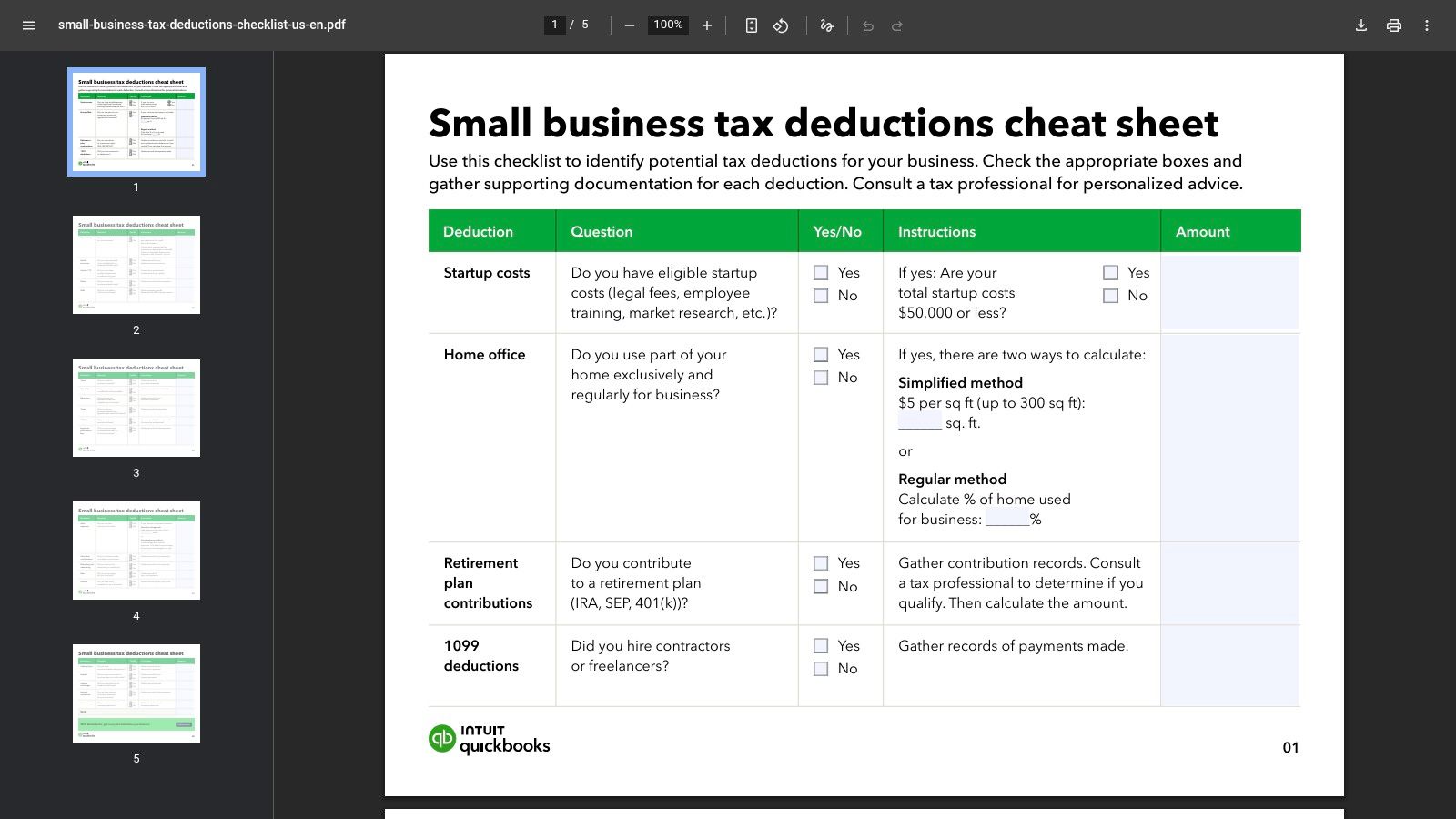
What I like is the format. It pushes you to review categories quickly instead of overthinking every line. If your books are messy, that's the right approach at first. Cleaning owners usually need momentum before precision.
This PDF is best for owners who already have transactions somewhere, bank feeds, card statements, bookkeeping software, or a spreadsheet, and need a fast filter for likely deductions. It's also one of the better tools for conversations with a preparer because it prompts action instead of theory.
Intuit also puts useful emphasis on backup records. Its checklist tells users to gather supporting documentation and prompts for things like mileage logs and purchase records. That's the part many generic lists skip, and it's exactly where audit trouble starts. If you're still cleaning up your chart of accounts, this pairs well with Estimatty's guide to cleaning business accounting.
Practical rule: Don't hand your tax pro a pile of expenses without proof. Hand them categorized expenses with the receipt trail already attached.
Best for: Owners who want a simple small business tax deductions checklist PDF they can use immediately.
Watch out for: It stays high level. You'll still need judgment on mixed-use expenses, especially vehicle, phone, and home office items.
Block Advisors' Small Business Tax Checklist is the one I'd hand to an owner who says, “I don't just need deductions. I need to know what documents to bring.” That's its strength. It organizes the prep work around what a real filing appointment usually requires.
For cleaning businesses with payroll, subcontractors, supplies, and recurring operating costs, this broader approach is useful. It forces you to gather records across income, payroll, and expenses instead of thinking about deductions in isolation.
This PDF is heavier than a cheat sheet. That's a good thing if your business has grown beyond a solo operation. If you've added office help, field crews, software subscriptions, insurance policies, and equipment purchases, you need a checklist that reflects the whole business.
I also like it for owners using multiple apps. If your numbers live in a booking platform, card processor, payroll system, and bank feed, this kind of list keeps you from forgetting one source. Estimatty's write-up on apps for small business is a good reminder of how quickly software sprawl can muddy year-end records.
Use this when:
The tradeoff is simple. It tells you what to gather more than why each deduction works. That's fine. In my experience, most cleaning owners don't need a tax lecture first. They need a document chase list.
QuickBooks' Small Business Tax Prep Checklist earns its spot for one reason. It matches how many cleaning companies already keep their books.
If your deposits, expense categories, payroll records, and contractor payments already run through QuickBooks, this PDF cuts down the last-minute scramble. You can pull reports, review missing items, and hand your preparer a cleaner file without rebuilding the year from memory.
That matters for residential and commercial cleaning businesses with recurring supply purchases, fuel, equipment, insurance, and labor costs. A generic deductions sheet tells you what might count. This one helps you gather what your tax preparer will ask for.
Use this checklist after the bookkeeping is mostly done. It is a prep document, not a rescue plan for messy books. If your reconciliations are behind, receipts are scattered, and owner spending is mixed into business accounts, fix that first.
For owners deciding whether their bookkeeping setup still fits the business, this comparison of QuickBooks and FreshBooks for service businesses is a useful gut check.
What I like here is the workflow. The PDF pushes you to collect reports, tax documents, payroll details, and support for common write-offs in one pass. For a cleaning business, that usually means you can build a master tax folder with your P&L, balance sheet, vehicle logs, equipment receipts, insurance statements, subcontractor records, and home office support if you qualify. That lines up well with the master checklist approach in this article, where the goal is not to download random PDFs. The goal is to combine the best parts into one cleaning-specific system you can reuse every tax season.
Clean books make this checklist useful. Messy books make it frustrating.
My take: Strong choice for cleaning owners already running disciplined books in QuickBooks. Weak choice if you still need to sort the basics.
Best for cleaning owners who: Want a tighter handoff to their CPA or tax preparer, especially if the business has regular payroll, contractors, and repeat operating expenses.
Homebase's small business tax deductions checklist for 2026 is the easiest recommendation for non-accountants who want current-year context and plain-English examples. That matters in cleaning, where many owners are strong operators but not finance people.
Homebase writes for main-street service businesses, and that shows. The examples feel closer to real business activity than abstract tax commentary. If you run residential cleans, janitorial contracts, or post-construction jobs, that tone is useful.
A lot of PDFs look like they were built for tax firms, not owners. Homebase does better at making categories understandable. That improves follow-through, especially if you're reviewing costs like uniforms, software, local advertising, vehicle use, and team-related expenses.
The downside is access. Depending on how they deliver the checklist, you may have to click through the article or provide your email. I don't love gates, but if the content is current and usable, it can still be worth it.
Good fit if you want:
This isn't the only PDF I'd use, but it's one of the better ones for owner education. If you're building a master small business tax deductions checklist PDF for your cleaning company, this is a smart supporting download.
Bench Accounting's Big List of Small Business Tax Deductions is built for owners who want a running reference, not just a one-time filing packet. That's a smart format for cleaning companies because deductible spending happens all year, not just in tax season.
If you buy chemicals, gloves, vac bags, microfiber cloths, replacement tools, software, and branded materials regularly, a year-round list keeps your team alert to what belongs in the books.
Print it. Keep it near whoever handles cards, receipts, and vendor bills. If that's you, keep it in the office. If an admin handles payables, make it part of your monthly close process.
This is especially useful when you're trying to understand overhead, because many deductions live in categories owners mentally ignore until tax time. Estimatty's guide on how to calculate overhead costs fits nicely here because overhead discipline and deduction discipline are tied together.
Bench's limitation is the email gate. You'll probably need to submit your information to receive the PDF. That's annoying, but not a deal-breaker if you want a saved copy in your inbox.
My recommendation: Use this as your ongoing reference sheet.
Don't use it as your only tax tool: You still need a document checklist and, ideally, a planning worksheet.
A crew finishes three jobs, fuel hits the company card, a vacuum motor gets replaced, and someone grabs extra disinfectant on the way to the next stop. That is normal for a cleaning business. It is also why Smart Service's small business tax deductions checklist earns a spot on this list.
This PDF fits service operators better than generic small business worksheets. If you run vans, dispatch cleaners, buy supplies constantly, and replace tools before they fully die, you need a checklist that reflects how the business spends money.

I like this one because it pushes owners to review the categories that get messy in cleaning companies. Vehicle costs. Equipment replacement. Small tools. Routing software. Advertising. Office expenses. Those are easy to miss when purchases happen in small amounts across the month.
For residential and commercial cleaners, this is the kind of PDF I would merge into a master deduction checklist. Keep the broad categories, then add your own cleaning-specific line items under each one, such as vacuums, mop heads, extractor repairs, PPE, laundry costs for reusable materials, and fuel tied to crew travel.
Home office expenses also deserve a hard look. If you run scheduling, invoicing, payroll, quoting, or dispatch from a dedicated space at home, review whether that setup qualifies under the home office rules. Do not guess. Document the business use clearly and keep the space separate from personal use.
Separate mixed-use expenses when you record them, not months later when memory is shot.
What Smart Service gets right:
My take: Use this as an operations-first checklist. It does a better job than most at matching how cleaning companies spend money.
Its limit: It organizes deductions well, but it does not replace tax judgment. Confirm eligibility before you claim anything questionable.
KBC CPAs' small business taxes checklist is short, sharp, and useful. This is the kind of one-pager I like for owner reviews before a CPA meeting because it cuts out the noise.
If you're a solo cleaner or a small team with straightforward operations, that brevity helps. You can review the likely categories fast, flag what applies, and move on to gathering support.
A lot of tax PDFs lose people because they try to be both a teaching tool and a filing organizer. This one keeps it tighter. It works well when you've already got the basics in place and want to sanity-check whether you missed common categories like insurance, utilities, mileage, or home office costs.
The downside is obvious. It doesn't go deep. You won't get nuanced guidance on partial business use or more technical asset treatment. But for a quick review document, it does the job.
Use it if:
This isn't my top overall pick, but I'd absolutely keep it in the stack. Sometimes the best checklist is the one you'll finish.
ITA Business Advisors' business tax checklist is broader than a deductions-only sheet, and that's exactly why some owners will benefit from it. It behaves more like a pre-appointment organizer from a CPA office.
For cleaning businesses with payroll, contractor payments, equipment, and multiple revenue streams, that wider lens is useful. It helps you think about filing readiness, not just expense categories.
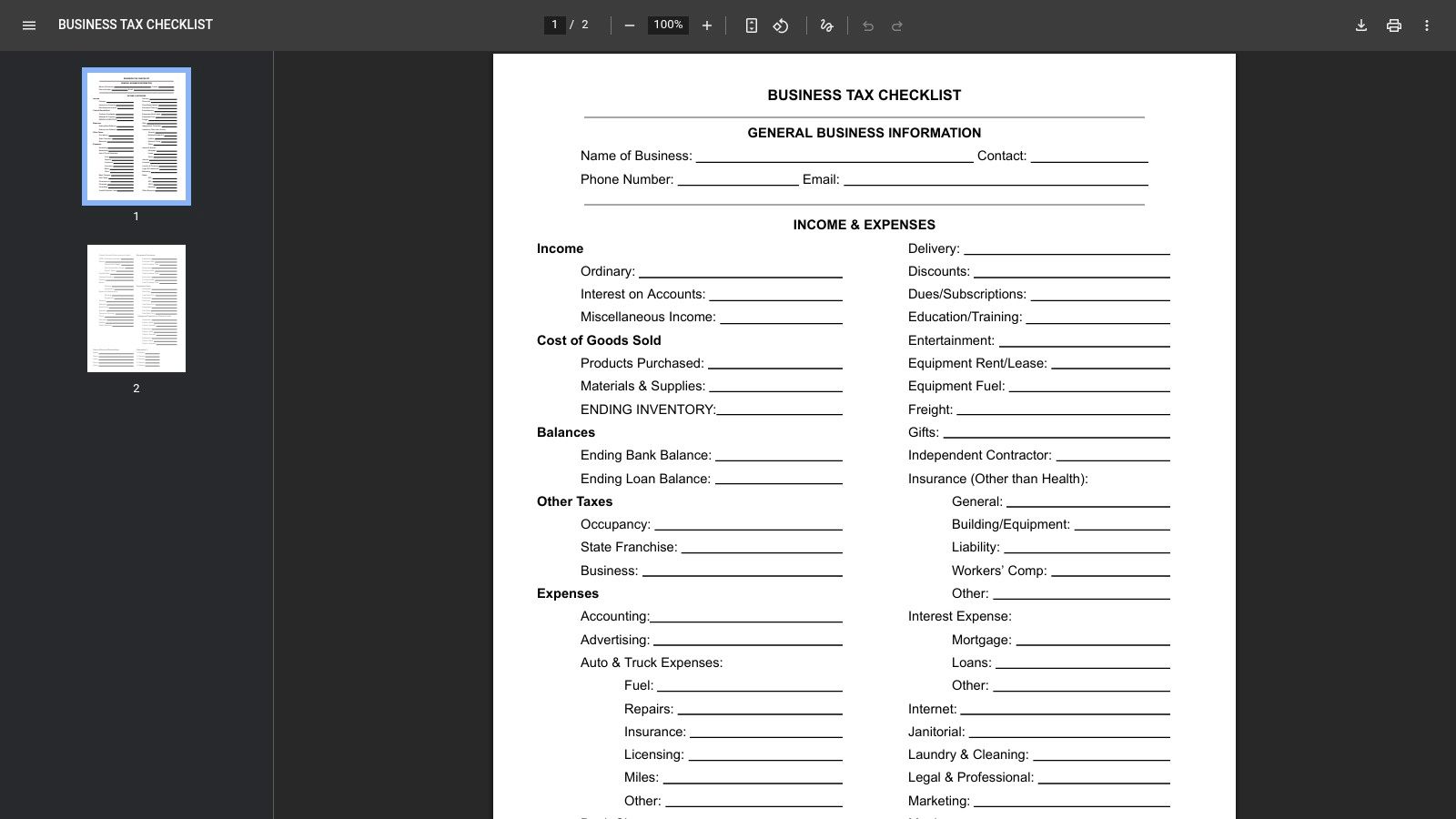
Use ITA's PDF if your business has reached the point where tax prep means more than “I need to deduct supplies and gas.” Once you're dealing with workers, business insurance, recurring software, and larger purchases, your tax file needs structure.
I also like this style of checklist for owners who changed systems midyear. If you moved from spreadsheets into software, switched payroll providers, or added admin support, a broader organizer helps catch missing records.
What it does well:
Its weakness is focus. If you only want a pure small business tax deductions checklist PDF, this one may feel wider than necessary. Still, for a maturing cleaning company, that's often the right trade.
A cleaning company buys a new floor machine in December, renews software in January, hires two cleaners, and then realizes at tax time that none of those decisions were documented with tax treatment in mind. That is the mess Beckley & Associates' small business tax planning checklist helps prevent.
Most small business tax deductions checklist PDFs focus on what you already spent. This one is more useful for owners who need to decide what to do before year-end closes. That makes it a strong source to pull into a master checklist for residential and commercial cleaning businesses, especially if you are weighing equipment purchases, vehicle use, insurance costs, or larger recurring subscriptions.
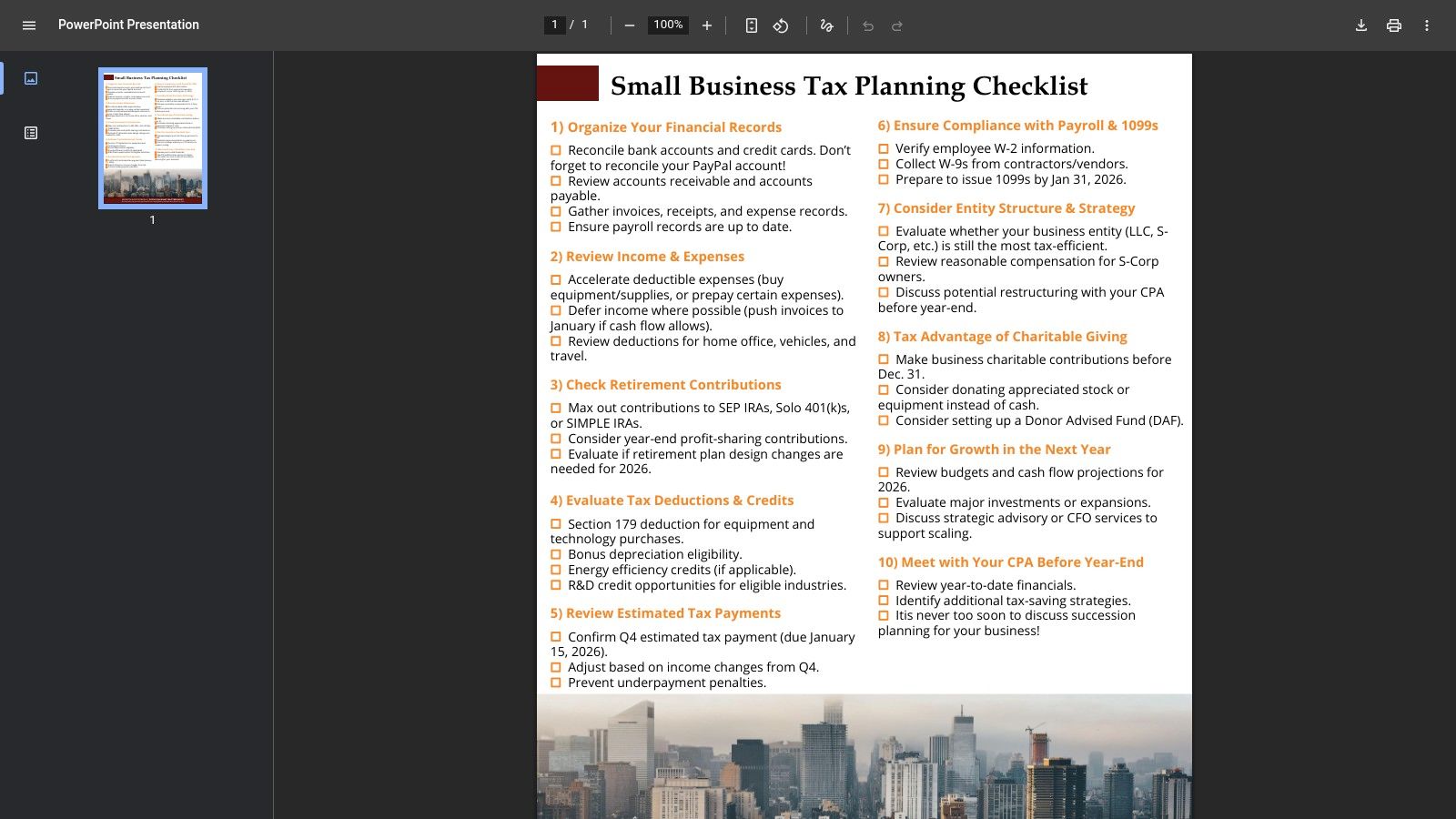
Beckley's value is timing. A deduction category means very little if you buy, finance, place in service, or document the expense the wrong way.
For cleaning businesses, I would use this PDF to review three areas before year-end:
Earlier IRS guidance discussed in this article makes the point clearly. Depreciation rules and Section 179 treatment can change the tax result on major purchases, so classification and recordkeeping need to be done right the first time.
Here is my advice. Do not use a planning checklist as a generic download you save and ignore. Use it to make decisions while you still have time to act. If you are building a master downloadable checklist for your cleaning business, this is the PDF that includes the timing side the other deduction lists miss.
Best use: Add this to your master checklist if your cleaning company is buying equipment, replacing vehicles, changing insurance, or making year-end spending decisions.
Not ideal for: Owners who only want a simple document-gathering sheet for an accountant.
You sit down to hand your tax file to your accountant and realize the core problem is not missing deductions. It is that your records no longer match how the business operates. That is why Bench Accounting's U.S. small business tax checklist earns a spot here.
This version is the better Bench download for cleaning business owners who changed business structure, added an owner, started payroll, or moved from side hustle to real company. Those changes create filing and recordkeeping issues that generic deduction PDFs gloss over. If you are building a master checklist for a residential or commercial cleaning business, you need one document that covers deductions and one that forces you to sort entity-specific paperwork correctly. This is the second one.
Bench focuses on what you need to hand over, not just what you hope to deduct. That matters. Cleaning company owners regularly mix personal and business vehicle use, buy supplies at retail stores without clean receipt trails, reimburse helpers inconsistently, and forget to separate contractor payments from payroll records. A checklist that forces document collection by tax situation fixes that faster than another generic expense list.
I would use this one after you build your core deduction tracker. Then match each category to proof. Mileage logs. insurance invoices. payroll reports. contractor records. year-end bank and credit card statements. If you are also reviewing coverage and admin records, keep this guide to liability insurance for a cleaning company in the same folder so your insurance documents are easy to pull during tax prep.
Meals deserve special attention. As noted earlier in this article, meal deductions have specific limits and timing rules. Do not dump every lunch receipt into one bucket and hope for the best. Label who attended, the business purpose, and whether the expense was ordinary business discussion, employee food, or something personal that does not belong on the return.
Bottom line: Use this PDF when your cleaning business has outgrown a simple deduction cheat sheet and needs a cleaner tax file. The email gate is irritating. The structure is still worth it because it helps you hand over organized records instead of a pile of guesses.
| Resource | Format & Access | Coverage & Depth | Best for (Target audience) | Unique selling point | Access / Cost |
|---|---|---|---|---|---|
| Intuit QuickBooks, Small business tax deductions cheat sheet (PDF) | Direct PDF, printer‑friendly | High‑level deduction categories, checklist style | Schedule C filers & incorporated small businesses | Concise checkbox cheat sheet from Intuit | Free, immediate download |
| Block Advisors (H&R Block), Small Business Tax Checklist (PDF) | Direct PDF + interactive web checklist | Comprehensive doc‑gathering: income, COGS, payroll, expenses | Owners prepping for CPA appointments or DIY filing | Broad "bring‑to‑your‑CPA" checklist backed by H&R Block | Free, direct PDF |
| QuickBooks, Small Business Tax Prep Checklist (PDF) | Direct PDF; pairs with QuickBooks exports | Step‑by‑step: income, expenses, payroll, home office | QuickBooks users and year‑end preparers | Practical layout that aligns with bookkeeping exports | Free, immediate download |
| Homebase, Small Business Tax Deductions Checklist for 2026 (PDF) | PDF via article link (may prompt for email) | Up‑to‑date 2026 guidance; examples across 20+ categories | Main‑street & service businesses, non‑accountants | Current‑year rules and clear examples | Free, may require email |
| Bench Accounting, The Big List of Small Business Tax Deductions (PDF) | Printable PDF, email gate | Long, organized list for ongoing tracking | Non‑accountants keeping year‑round records | Comprehensive "big list" for tracking deductible types | Free, email required |
| Smart Service, Small Business Tax Deductions Checklist (PDF) | Direct PDF download, printable | Service‑business focus: vehicles, equipment, supplies | Field‑service operators and fleet managers | Fill‑in‑the‑blanks format for easy notes | Free, direct download |
| KBC CPAs, Small Business Taxes Checklist (PDF) | One‑page PDF, printer‑friendly | Brief, high‑level deductible categories | Clients preparing for CPA meetings | CPA‑authored concise intake tool | Free, immediate download |
| ITA Group, Business Tax Checklist (PDF) | Printable multi‑section PDF | Thorough CPA‑style organizer: income, payroll, deductions | Businesses prepping for tax appointments | Multi‑section CPA organizer for appointment prep | Free, direct PDF |
| Beckley & Associates, Small Business Tax Planning Checklist (PDF) | Printable PDF, planning‑oriented | Year‑end planning: Section 179, bonus depreciation, timing | Owners focused on tax timing and strategy | Actionable planning items for timing purchases/elections | Free, immediate download |
| Bench Accounting, U.S. Small Business Tax Checklist (PDF via email) | Entity‑specific PDFs (sole prop, S corp, etc.), email gate | Tailored prep and document lists by entity type | Entity‑specific tax prep for CPA hand‑offs or DIY | Entity‑specific checklists to increase accuracy | Free, email required |
The best small business tax deductions checklist PDF for a cleaning company isn't one PDF. It's a working stack.
If you want my direct recommendation, start with Intuit QuickBooks for a fast deduction scan, use Block Advisors or ITA Business Advisors for document gathering, and add Beckley & Associates if you're making year-end purchase or timing decisions. If you want a cleaning-friendly operational angle, Smart Service deserves a spot because it aligns better with vehicles, equipment, and field work than many generic guides.
Here's the mistake I see most often. Owners spend too much time asking, “What can I deduct?” and not enough time asking, “Can I prove it?” That second question is where tax prep gets real. A deduction without backup is a hope, not a record. For cleaning businesses, that means keeping receipts for supplies, separating personal and business use on phones and vehicles, saving software invoices, documenting home office use when it's legitimate, and tracking labor-related expenses in a way your preparer can follow.
This is especially important if your business has grown fast. Once you have crews, recurring commercial accounts, office software, insurance policies, and more equipment in rotation, your expenses spread across more systems. Card statements, payroll software, booking apps, bank feeds, and emailed invoices all need to reconcile into one clean file. That's why the strongest checklist isn't always the longest one. It's the one that gets completed, reviewed, and backed by records.
For residential and commercial cleaning businesses, I'd build a master checklist around these categories:
That's the practical way to use these downloads. Don't collect PDFs and feel productive. Pick the two or three that match your business stage, print them, assign someone to gather every record, and finish the file before tax season gets chaotic.
If you run a residential or commercial cleaning business, Estimatty helps you tighten the front end of your operation while you clean up the back end. It gives your company a faster, more consistent way to send estimates, capture lead details, and book more work without relying on slow callbacks or manual follow-up.