September 21, 2026
Inside and Out Cleaning: A Practical Pricing Guide
Learn what inside and out cleaning really includes, how pricing works, and which add-ons actually pay off for residential and commercial estimates.

Friday, September 11, 2026
Learn how to start a window washing business step by step — from licensing and equipment to pricing, estimates and scaling recurring routes.

You've bought the squeegees, created a business name, and told a few neighbors you're available. Then the phone rings. One homeowner wants a one-time clean across town, a storefront asks for a same-day estimate, and a commercial prospect wants proof of insurance before discussing access. Your first week can disappear into driving, manual pricing, and paperwork without producing a dependable route.
Learning how to start a window washing business profitably means thinking beyond inexpensive equipment. The durable model combines a focused service area, access-specific safety procedures, fast estimates, and recurring contracts. The operator who builds a dense route and responds consistently can outperform a busier competitor who accepts every isolated job.
The U.S. window washing industry had 35,344 businesses operating nationwide in 2024, although the count declined 2.6% from 2023, according to IBISWorld's window washing industry analysis. That combination tells you two things. The market is large enough for many small operators, but it's fragmented and competitive enough that location, reliability, routing, and retention matter more than owning a bucket and squeegee.
The same analysis places U.S. industry revenue at about $2.9 billion in 2024 and projects roughly $3.2 billion by 2029. It describes modest average annual growth of 2.3% from 2019 to 2024 and a projected 1.7% from 2024 to 2029. This isn't a technology-style growth market where broad expansion does the work for you. Profit usually comes from disciplined operations, efficient travel, repeat service, and sensible labor planning.
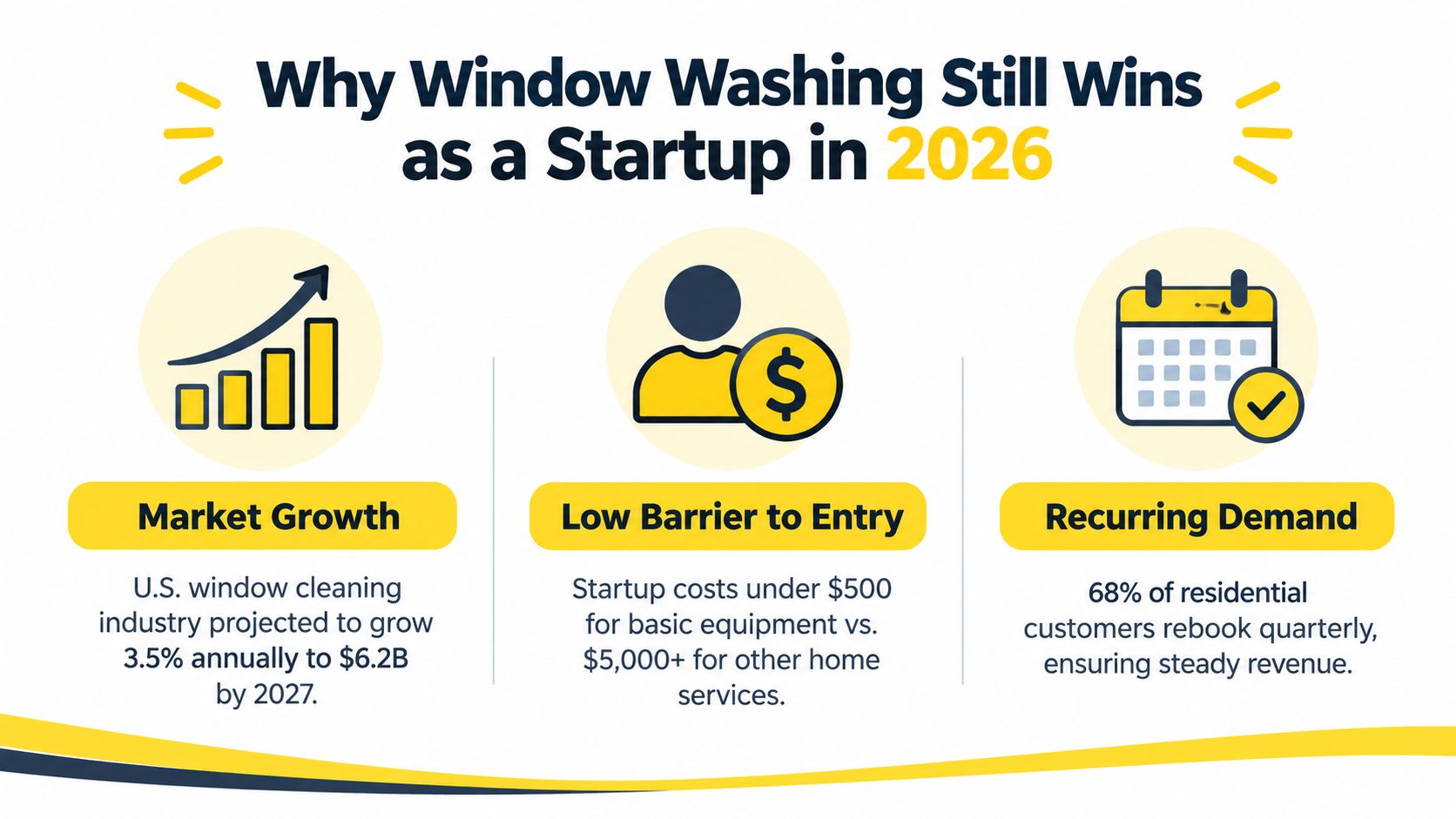
A new washer often accepts any job that appears. That feels productive, but scattered appointments create unpaid windshield time, unpredictable days, and difficult follow-up. A route owner makes a different decision. They target adjacent neighborhoods, repeat storefronts, property managers, or facilities that need scheduled maintenance.
Residential customers can offer quick access to the decision-maker and straightforward sales. Commercial clients may take longer to approve, but a contract can create predictable visits and open doors to bundled facility services. Neither segment is automatically superior. The right choice depends on access complexity, local competition, service frequency, and your ability to meet documentation requirements.
Global market coverage also supports the long-term durability of the category. Fortune Business Insights reports a global window cleaning services market valuation of USD 151.18 billion in 2025, projected at USD 162.35 billion in 2026 and continuing through 2034. Treat those global figures as context, not as a promise about your town. Your immediate opportunity is local and operational.
Before choosing a service area, review this practical licensing and pricing guide, then compare your assumptions with whether a cleaning business is profitable. The winning launch is usually lean, local, and built around repeat work rather than maximum service breadth.
Don't buy advanced equipment until you know which customers you can reach, serve safely, and retain. A practical niche hypothesis should fit on one page: target customer, service area, access method, recurring need, likely add-ons, and the reason a prospect would choose you over nearby providers.
Start with observation, not assumptions. Search Google Maps for window cleaners, read recent customer reviews, note which companies appear repeatedly in the same neighborhoods, and record complaints about missed appointments, poor communication, streaks, damaged screens, or unclear pricing. Drive commercial corridors during business hours and look for storefront clusters, medical offices, restaurants, property management signs, and small office buildings.
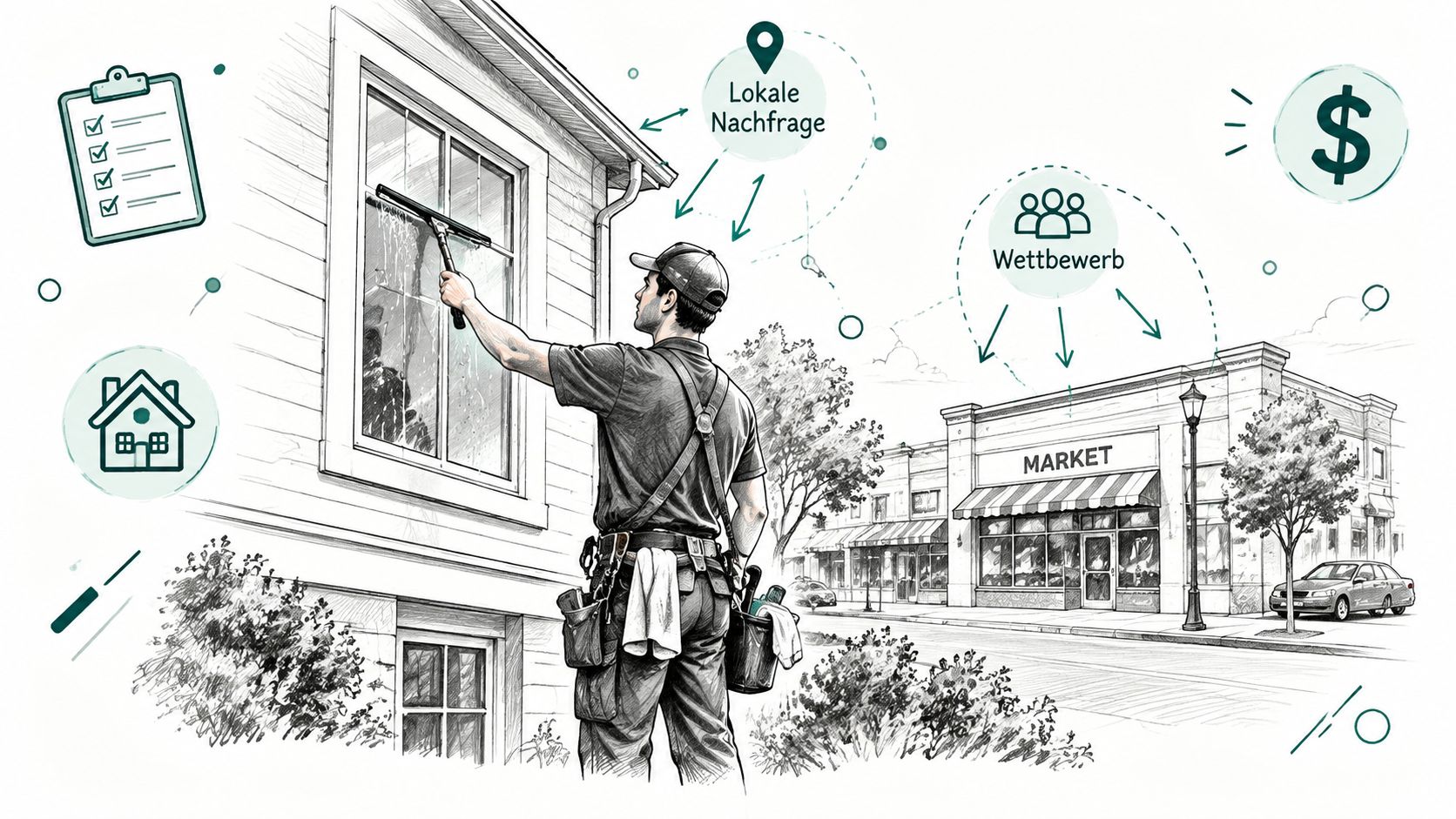
Score each potential segment against four practical questions:
Residential work often books faster because the homeowner controls the decision. It can also become geographically inefficient if every appointment is isolated. Storefront work can produce compact routes, but owners may expect early-morning or after-hours service. Low-rise commercial accounts can support recurring contracts, yet they may require more documentation, insurance, and formal onboarding.
Create two or three narrowly defined service packages. For example, one could cover residential exterior glass and screens, another could target recurring storefront maintenance, and a third could serve low-rise offices with interior and exterior cleaning. Keep the access scope explicit so you don't promise work your equipment or training doesn't support.
Then contact prospects with a short, specific offer. Ask when they last had the windows cleaned, what access challenges exist, whether they prefer a recurring schedule, and what other exterior tasks create inconvenience. Issue estimates from the same structure each time and track which prospects respond, which objections repeat, and which service areas produce clustered demand.
Use local marketing techniques for cleaning businesses to support the initial outreach, but don't mistake visibility for validation. A niche is validated when prospects accept the service conditions, the travel makes sense, and the work can become a repeatable route.
The safest way to define your business is by access method first, not by customer type. Ground-level residential cleaning, ladder-based exterior work, pure water pole cleaning, and suspended access each create different equipment, training, inspection, and compliance obligations.
Many U.S. markets allow residential and low-rise operators to work with a general business license, but local rules can still require permits for water use or wastewater runoff. Scotland requires window cleaners to be licensed to operate lawfully, and some jurisdictions require contractor licensing for higher-risk work. One municipal example requires a license when window cleaning occurs more than 24 feet above grade, or on an adjoining flat roof or another flat surface, while grade-level and ladder-supported cleaning are exempt. Review requirements for a contractor's license before advertising a service that exceeds your local threshold.
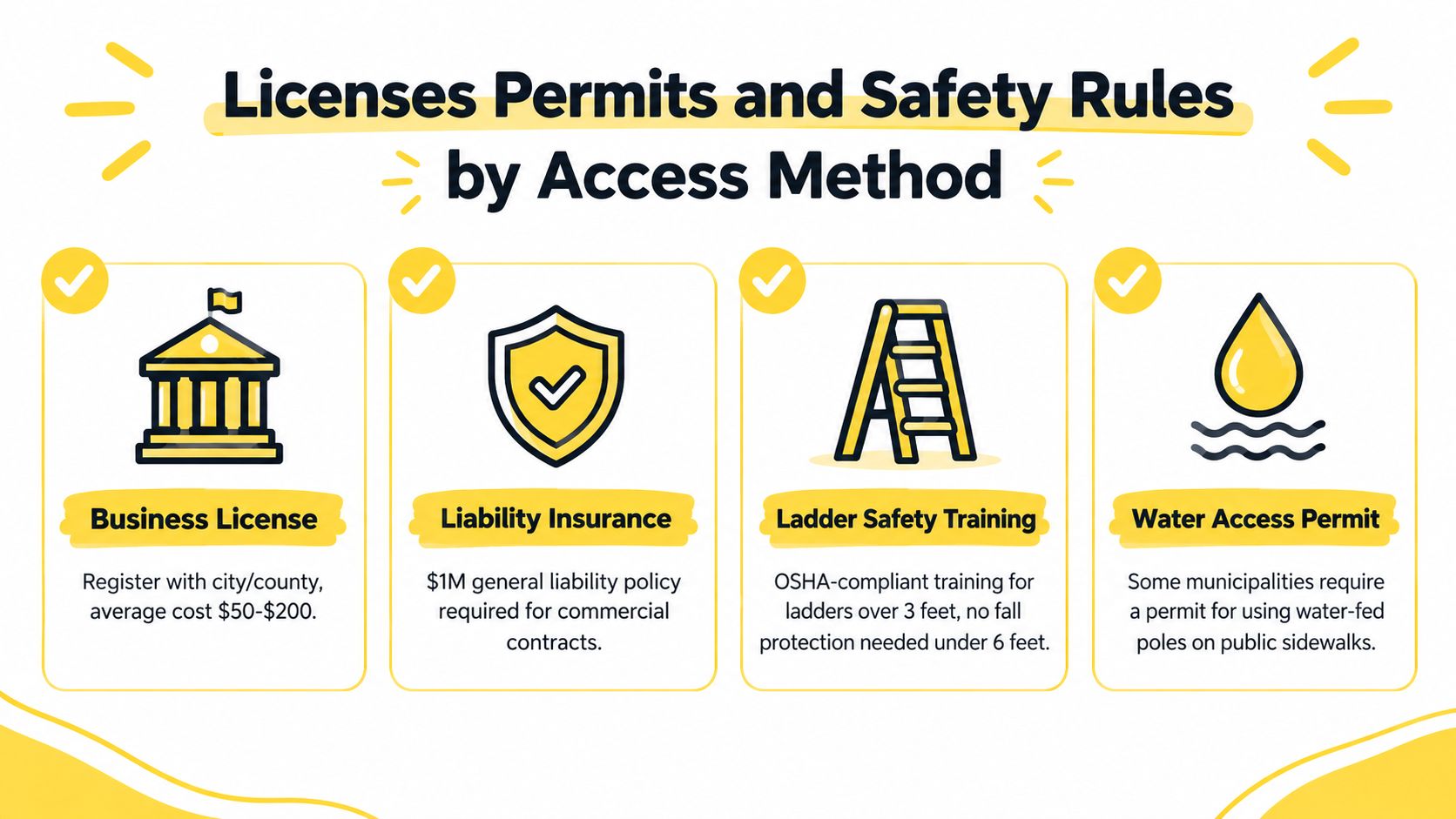
Ground-level work is the simplest place to begin. You still need a business registration appropriate to your location, liability protection, safe chemical handling, slip prevention, and a documented process for protecting customer property.
Ladder work adds setup discipline. Inspect ladders before use, establish stable footing, keep the work area controlled, and train anyone who uses them. Never let a low price pressure you into taking an unsafe setup.
Pure water pole work can reduce ladder dependence for suitable buildings, but it doesn't eliminate risk. Consider water flow, hose placement, pedestrian exposure, overhead hazards, surface compatibility, and runoff rules. A water-fed pole is an access tool, not a substitute for planning.
Suspended access and rope access demand a much higher compliance threshold. The relevant building access standards require pre-use certification of permanently installed access platforms, anchorages, belt anchors, fall protection systems, and wind-sway protection systems under the selected building's rated load and full operating range. If a commercial prospect expects this type of work, verify certificates and qualifications before accepting the job.
Major jurisdictions require employers to provide compliant safety devices and maintain them in safe condition at all times. Keep inspection records, training documentation, equipment manuals, certificates, incident procedures, and proof of insurance in one accessible file. The ANSI access standard excerpts for building owners and managers provide useful context for why building access equipment cannot be treated like ordinary cleaning gear.
A local check should cover:
The expensive mistake is buying equipment before defining the service scope. Decide what you'll safely sell, then purchase and train for that category.
A lean launch needs reliable basics, not a warehouse. The practical core includes a squeegee, extension pole, bucket, microfiber cloths, neutral glass detergent, ladders, and wet-floor signs. Add task-specific PPE based on the surface and access method, and maintain every tool as part of the operating routine.
Keep detergent dilution within the manufacturer's instructions. Replace worn squeegee rubber, inspect ladder feet and locks, check pole sections, and remove damaged equipment from service. Equipment that works intermittently slows the route, creates quality failures, and makes a cheap job expensive.
A workable pricing model starts with the job's real drivers:
| Estimate component | What to record |
|---|---|
| Property scope | Window count, panes, screens, tracks, and interior access |
| Access method | Ground, ladder, pure water pole, or specialized access |
| Condition | Normal soil, construction residue, hard water, or difficult detailing |
| Route value | Whether the appointment fits an existing neighborhood or commercial run |
| Recurring schedule | One-time service, seasonal maintenance, or scheduled contract |
Use estimates, not casual “quotes,” when building the customer experience for Estimatty. An estimate should show the address, scope, access assumptions, included services, add-ons, total price, and validity period. If the customer changes the scope, issue a revised estimate rather than improvising at the property.
This guide to quoting window cleaning can help structure formulas and service variables. For larger commercial opportunities, the Orbit AI cleaning proposal guide is useful when you need to present scope, schedule, responsibilities, and terms in a more formal format.
Manual estimating creates a predictable leak. You finish a job, return a call late, ask the same questions again, and send a price after the prospect has contacted several competitors. A consistent web and voice workflow can capture address, window count, surface details, urgency, and access information, then send an estimate by SMS and email while notifying the team. Estimatty is one option that provides this type of AI-powered estimating and booking workflow, with no-code configuration and connections to Zapier or a CRM.
Practical rule: The estimate must be easy to understand, fast to receive, and specific enough that the customer knows exactly what happens next.
Don't discount by reflex. Use a clear introductory offer only when it supports a recurring conversion or fills an otherwise inefficient route. A low initial price that attracts distant, one-time work can damage capacity rather than build the business.
Marketing should produce a route, not just a pile of inquiries. Start with a service area small enough to serve consistently, then make the offer visible wherever that customer already looks. Residential operators can combine a complete Google Business Profile, neighborhood flyers, before-and-after photos, and referral requests. Commercial operators should visit storefront clusters, contact property managers, and present a maintenance schedule instead of only offering a one-time clean.
The offer needs a reason to recur. Present monthly, seasonal, or otherwise scheduled maintenance where the building's condition supports it. Bundle compatible exterior services only when your team can perform them safely and profitably. Screen cleaning, track detailing, hard water treatment, or gutter-related work may create useful add-ons, but an oversized menu makes the first decision harder.
A strong booking flow asks for the details needed to price the work, delivers an estimate promptly, and gives the prospect a simple way to approve a date. It should also trigger follow-up when the prospect doesn't book immediately. The sequence can be practical:
A 24/7/365 system can handle web inquiries and calls outside working hours, send real-time notifications, connect to a CRM or Zapier, and route complex conversations to a human receptionist when needed. Online booking software for cleaning businesses offers additional context on organizing that kind of workflow.
Risk-sensitive commercial clients want more than clean glass. They want evidence that your company understands access, protects pedestrians and property, maintains equipment, and documents training. A compliance-forward proposal can distinguish you from operators who compete only on a low number.
Commercial buyers often choose the vendor who makes risk easier to manage, not the vendor who promises the cheapest visit.
Track which marketing source produces recurring work, not merely calls. A flyer that brings one residential job may be less valuable than a property manager introduction that creates a compact maintenance route. Keep the channel that produces profitable density.
Hiring too early can turn a promising route into a payroll problem. Hire when accepted recurring work consistently exceeds the hours one operator can safely deliver, or when a second person will improve route density and service capacity. Don't add labor because the business feels busy. Add it when the schedule, cash flow, and training process can support the decision.
Recruit cleaners through local networks, trade referrals, and platforms such as pipehirehrm.com and get.pipehirehrm.com/blog. If you're considering remote recruiting support or international hiring processes, Virtustant's guide to hiring in Argentina provides a separate resource for evaluating that route.
A new cleaner should learn more than squeegee technique. Train them to inspect the property, protect floors and furniture, identify fragile surfaces, set warning signs, use access equipment correctly, communicate changes, and complete a final quality check. Use a written checklist with photographs or short demonstrations so standards don't depend on memory.
Route density should guide hiring and scheduling. Put the same technician in a neighborhood or commercial cluster long enough to learn access details, parking conditions, customer preferences, and recurring issues. That knowledge reduces setup time and improves consistency.
Before adding another route, standardize:
Cleaning-sector coverage cites failure rates as high as 18% in the first year and about 50% by five years, making cash flow discipline, fast lead conversion, and compliance execution central survival issues. CleanLink's coverage of how small cleaning businesses can avoid failure also reinforces why technical cleaning ability alone isn't enough.
Your launch sequence is straightforward. Select a narrow access category, validate a dense local niche, register and insure the operation, buy only the equipment that scope requires, issue consistent estimates quickly, and sell recurring service before adding staff. This month, build the one-page offer, contact local prospects, schedule the first route, and record every objection so the next estimate gets sharper.
Estimatty helps window washing businesses capture web and voice inquiries, collect property and access details, send consistent estimates by SMS and email, and support booking around the clock. Set up your pricing workflow for the services you perform, then visit Estimatty to start turning more inquiries into organized recurring routes.