September 8, 2026
How Much Should a House Cleaning Cost in 2026
How Much Should a House Cleaning Cost. Learn how much a house cleaning should cost in 2026, with real pricing ranges by home size, service type, and tips

Tuesday, July 28, 2026
Learn how to quote commercial cleaning jobs with practical formulas, pricing models, and follow-up tips that help your cleaning business win more contracts.
You're on the phone with a prospect who sounds serious. They want a number fast, they want it “roughly by tomorrow,” and they promise they're comparing a few companies. You know the drill. If you throw out a guess, you might win the account and lose money for months. If you take too long, somebody else sends a cleaner estimate first and gets the contract.
That's why how to quote commercial cleaning is not a math trick. It's a sales system, a pricing system, and a contract system all at once. The owners who stay profitable don't just calculate labor, they normalize scope, choose the right pricing model, convert visits into recurring revenue, and follow up until the deal is signed.
The first bad quote usually starts with a simple mistake. The prospect asks for a price, the owner gives a quick number, and the conversation disappears into silence. A week later, the job either goes to the cheapest bidder or comes back with a scope complaint that should have been obvious on day one.
That's expensive in more ways than one. You waste time on walkthroughs, callbacks, and revisions, and you often underprice the job because you skipped overhead, supplies, or payroll extras. Practical industry guidance says a commercial-cleaning workflow should start with estimated visit time, then add supplies, overhead, and profit, and some pricing guides say payroll-related extras can add 25–40% on top of wages, which is why quoting only direct labor usually underprices the work.[^1]
Practical rule: if your estimate doesn't cover labor, supplies, and overhead, it isn't a quote, it's a donation.
Quoting also is the sales conversation. The buyer isn't only asking, “What's the price?” They're asking, “Can you understand my building, give me a number I can defend, and make this easy to approve?” That means the estimate has to do three jobs at once, price the service, reduce uncertainty, and move the prospect toward a signed contract.
| Common Pricing Model | How It Works | Best For |
|---|---|---|
| Square footage | Price off cleanable area and service frequency | Offices, medical spaces, recurring janitorial |
| Hourly | Price by labor hours and task time | One-time, unclear, or variable scopes |
| Flat rate | One recurring number for agreed scope | Ongoing contracts with predictable service |
| Per room | Price based on countable spaces | Small, segmented facilities |
If you want the internal mechanics nailed down, pair your pricing process with a solid job costing program so you're not building bids from memory and gut feel. A good estimate is repeatable. A sloppy one is just a lucky guess that hasn't failed yet.
The wrong pricing model creates friction before the client even sees the number. Square footage is the cleanest default for most recurring commercial work because it scales with building size and gives you a stable baseline. Industry guidance says square-foot pricing is the most common method, and it also recommends converting a facility to cleanable square footage, subtracting non-cleaning areas, and pricing by frequency.[^2]

Square footage wins for offices and medical facilities because these jobs usually live or die on repeatability. Hourly pricing makes more sense when the scope is messy, like post-construction or a move-out where the time requirement is unpredictable. Flat rate works when the client wants a simple recurring number and you've already normalized the scope enough to trust the number. Per room works best in boutique gyms, salons, and small retail where the layout is fixed and easy to count.
A quick compare-and-decide table helps you avoid forcing the wrong model onto the wrong account.
| Model | Use It When | Watch Out For |
|---|---|---|
| Square footage | The building has stable recurring scope | Don't use gross square footage without adjusting for non-cleanable space |
| Hourly | The task list changes visit to visit | Don't leave the client guessing what the final bill will be |
| Flat rate | The service is standardized and recurring | Don't lock in a number before you understand frequency |
| Per room | The space is segmented and countable | Don't use it for wide-open, irregular buildings |
A lot of owners get distracted by “which model is easiest.” That's the wrong question. The better question is which model protects your margin without confusing the buyer. For most commercial jobs, I'd default to square footage adjusted for cleanable area, then use hourly only when the scope is completely unknown.
If you're building this into a pricing tool, a commercial cleaning pricing calculator keeps the same logic in one place instead of making you rebuild it from scratch every time. And if you're also thinking about how pricing shows up in local search pages, realistic 2026 local SEO costs can help you budget the marketing side without mixing it into your service pricing.
If you quote blind, you're gambling. The best owners ask the same handful of questions every time because those details move the number more than anything else. Building type, cleanable square footage, frequency, restroom count, floor types, headcount, and specialty requests all matter because they change labor time and cleaning complexity.
Start with the site, not the price. A quick phone script or walk-through should answer who uses the building, how many people are there, what kind of surfaces you're cleaning, how often service happens, and whether there are any nonstandard areas like server closets, mechanical rooms, or stairwells. Industry guidance says to measure the facility, convert it to cleanable square footage, exclude non-cleaning areas, and then price by frequency.[^2]
Good estimates come from cleanable area, not bragging rights about total building size.
Here's the part many owners skip. A 10,000-square-foot building might only have 7,500 cleanable square feet once you remove non-cleaning areas. If you price on gross square footage, your estimate gets fat in all the wrong places and you end up paying to clean empty space.
Use a one-screen intake form in your CRM so the same data gets captured every time. If you already use professional deep cleaning checklist language in your notes, keep it tied to the bid so scope and pricing stay connected. Before you send anything, take before-and-after photos and write a short scope note. That protects you when the client says, “I thought that was included.”
Now the math that matters. A real estimate is a stack, not a single number. You start with the time it takes to service the site, then layer in labor, supplies, overhead, and profit, and only after that do you convert it into the recurring billing cadence the client wants.

Take an 8,000 cleanable square foot office that needs service five nights a week, with two restrooms and VCT floors. Start by estimating visit time based on the scope, then turn that into labor cost. If two staff cover the site for four hours at $22 per hour, that's $880 per week in labor before anything else. If your supplier and equipment load adds $150 per week for supplies and $75 per week for equipment overhead, your base operating cost is already climbing before margin enters the picture.
A practical commercial-cleaning workflow says to add overhead at about 10–20% of labor-plus-supply costs, and some pricing guides say payroll-related extras can add 25–40% on top of wages.[^1] Another bidding guide says overhead and profit can total 30–35% on top of labor cost.[^5] That's why the cleanest owners build the stack intentionally instead of trying to “land on a fair number” after the fact.
If you quote labor alone, you're not pricing the job, you're pricing the easiest part of the job.
The recurring number matters because clients don't buy visits, they buy service cadence. One widely shared pricing explanation says to calculate cost per visit, multiply by weekly frequency, then convert to monthly using 4.33 weeks per month.[^3] Another commercial-cleaning bidding guide shows a monthly recurring charge can also be derived by multiplying daily hours by service days, then by 52 weeks, and dividing by 12 months.[^5]
Use either path, but be consistent. Here's a spreadsheet-style formula you can copy:
For a bid like this, the monthly number should be derived from the cadence the client wants, not from a random monthly guess. If the building wants five nights a week, you price for five nights a week. If they want less frequent service, the economics change with the service pattern, and the estimate should change too.
If you want to sanity-check the labor math itself, use how to calculate labor cost per hour as a separate pass before you finalize the bid. Clean cost stacks win because they're defensible. Weak ones bleed margin one visit at a time.
Base cleaning is only the starting point. The profit margin often lives in add-ons, because they let you charge for specialized labor instead of absorbing it into the main contract. Carpet hot-water extraction, floor stripping and waxing, window cleaning, restroom deep cleans, and disinfection services all deserve their own line because each one changes labor intensity and equipment use.
Don't hide specialty work inside a flat monthly number and hope it balances out. Separate line items keep the account clear and protect your margin when the client adds scope later. This is also where you prevent the common trap of giving away high-skill work at basic janitorial rates.
A few contract terms matter just as much as the price:
Tax and certificate-of-insurance questions belong here too. The client should know what is included, what gets billed separately, and what your coverage looks like before service starts. Commercial buyers ask for paperwork because they want predictability, not surprises.
If you layer two add-ons onto the office example, the monthly recurring charge should rise in a way the client can understand. That's not nickel-and-diming. That's how you pay for better equipment, more stable staffing, and fewer turnover headaches. If you don't charge for specialty work, you'll end up subsidizing it with your own labor.
A great price sent late loses to an average price sent fast. Commercial clients are busy, and they usually compare multiple vendors at once. Send the estimate by email and SMS, and make sure they can open it on their phone within minutes, not “sometime this afternoon.”
Use a simple cadence. Text or call at 24 hours, send a value-add email at 72 hours, then do one final check-in at day seven. Your job is to keep the conversation active without sounding desperate.
A few scripts work well in real life:
When the buyer says your number is higher than the competition, don't apologize for being profitable. Explain the scope, the frequency, and what's included. If they say they need to think about it, ask one direct question about what's still unclear. You're trying to find the objection, not wait for it to vanish.
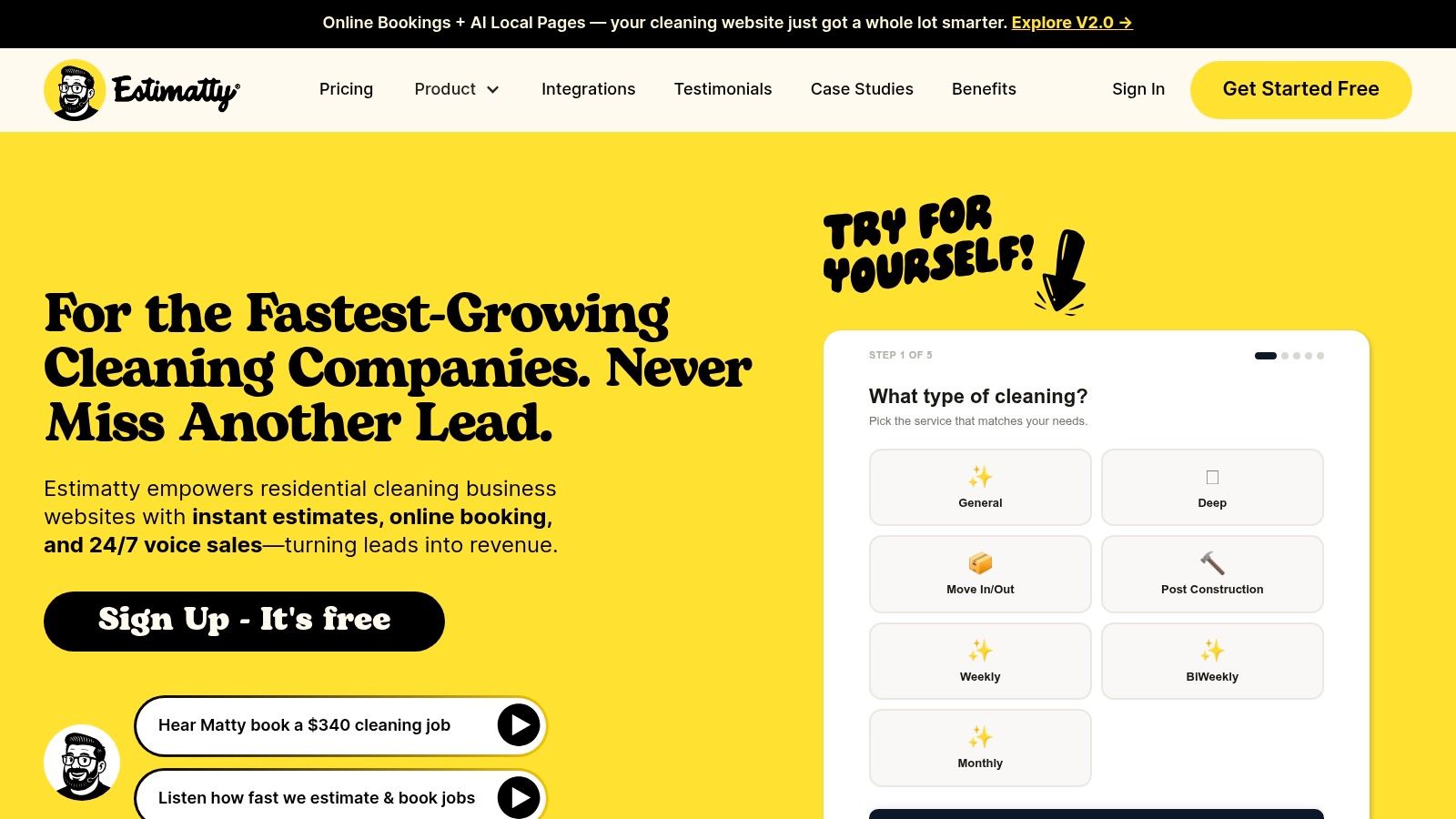
If you want a cleaner breakdown of what belongs in the document versus the relationship piece, how to set profitable prices is a useful companion for the pricing side, while proposal vs quote helps keep your sales language clean. An automated estimator like Estimatty can also capture the lead, gather the details, and send instant estimates so you don't lose the sale while you're still in another job. And if the contract needs more crews, pipehirehrm.com is worth a look for hiring support.
The quote is not the finish line. It's the start of the sales conversation that gets the contract signed.
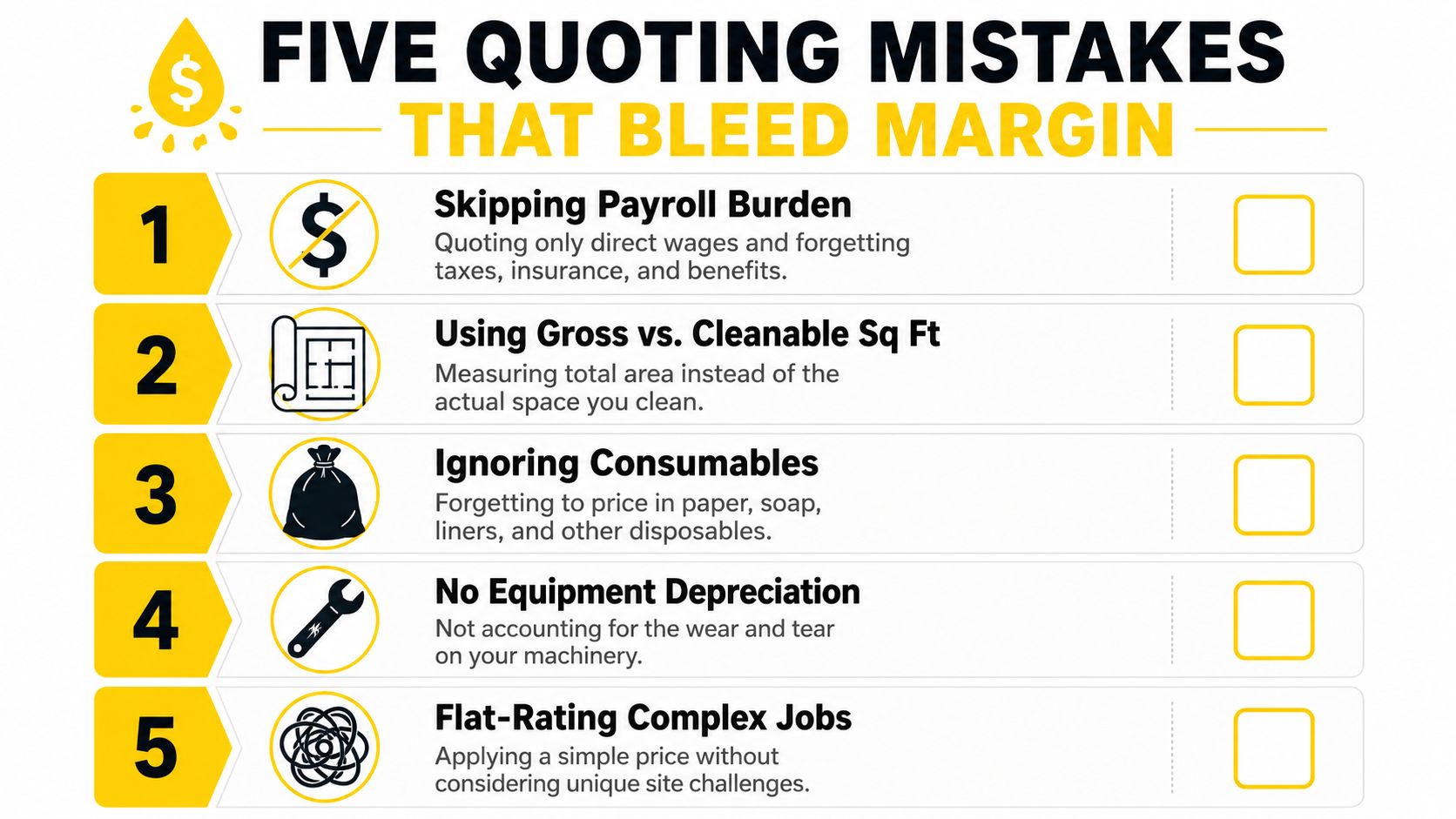
If you remember nothing else, avoid these five traps. Skipping payroll burden means your estimate looks competitive until labor eats it alive, so the fix is to price the fully loaded rate, not just wages. Using gross instead of cleanable square footage inflates scope, so the rule is to subtract non-cleaning areas before you price. Ignoring frequency when converting to monthly recurring breaks your cash flow math, so always convert visits into the billing cadence the client wants.
The last two are just as dangerous. Sending the estimate late gives the buyer time to move on, so send it fast. Forgetting to set a follow-up reminder leaves money sitting in your inbox, so every estimate needs a scheduled next touch before you hit send.
Print this checklist and tape it to your monitor:
The cleaning businesses that scale are not the ones with the lowest price. They're the ones with the most disciplined estimate.
If you want instant, consistent estimates instead of guessing on every job, visit Estimatty and see how it captures the prospect's details, applies your pricing logic, and sends a clean estimate without delay. It's built for cleaning businesses that want tighter quoting, faster follow-up, and fewer revenue leaks on commercial jobs.